
Key facts
- Self-hosted WordPress maintenance consumes 10–20 hours monthly that could drive strategic growth per TCO analysis
- Plugin conflicts are almost inevitable because plugins lack central coordination per WP Engine
- White Screen of Death locks admins out entirely and requires manual staging-site troubleshooting per WordPress.org
- WordPress enterprise TCO over three years ranges $75,000–$180,000 with maintenance alone $30,000–$90,000 per Flowout analysis
- Developer opportunity cost hits $36,000 annually for just 15 maintenance hours monthly per enterprise TCO findings
- Self-hosting costs $3,250–$55,000 monthly plus $2,000–$22,000 setup per WP Engine comparison
- Managed platforms bundle security, backups, staging, and 24/7 support into one predictable fee per managed hosting positioning
WANT RESULTS LIKE THIS?
Imagine a system doing all of this for your local business — every day, without you.
We build local businesses a custom website with a team of AI behind it: every lead captured and followed up, new content published monthly,customers finding you on Google — live in 7 days.
- 85+ pages at launch
- Every lead followed up, automatically
- Your whole business on one screen
The Ongoing Maintenance Burden
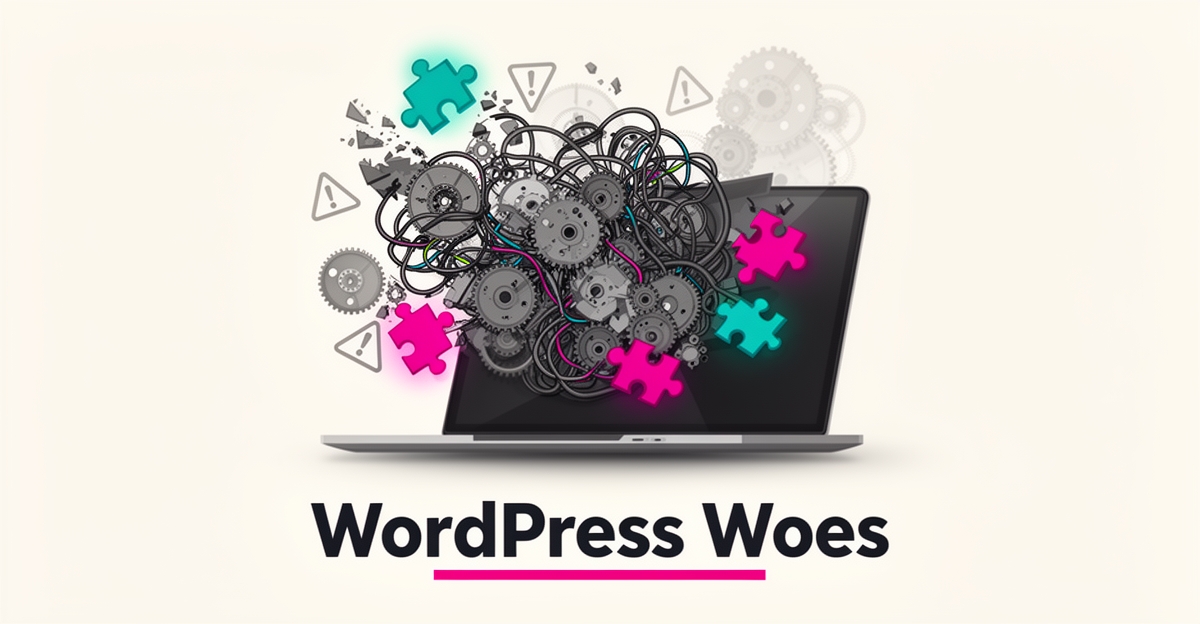
The hidden cost of a self-hosted WordPress site isn't the software — it's the endless technical chores that follow. Core updates, plugin updates, theme compatibility testing, security patching, performance monitoring, backup verification, and conflict troubleshooting all land on the owner's plate. Research shows this ongoing maintenance burden consumes 10–20 hours per month that could be spent on strategic business initiatives instead of keeping the lights on according to TCO analysis.
- Core and plugin updates that break functionality without warning
- Theme compatibility testing after every WordPress release
- Security patching and vulnerability monitoring
- Performance tuning and backup verification
- Conflict troubleshooting when plugins clash
Plugin conflicts are almost inevitable because plugins are authored by different developers with no central coordination as WP Engine notes. A botched update can disrupt lead flow, crash the server, or trigger the White Screen of Death — a blank white screen that locks you out of the admin panel entirely per WordPress.org documentation. Troubleshooting requires backups, staging sites, error logs, and manual plugin deactivation — all manual work that pulls you away from running your business.
The financial impact compounds quietly. Enterprise-grade WordPress TCO over three years ranges from $75,000 to $180,000, with ongoing maintenance alone accounting for $30,000–$90,000 of that total per Flowout's analysis. Developer opportunity costs add another $36,000 annually for just 15 hours a month at market rates. Self-hosting estimates run $3,250–$55,000 monthly plus $2,000–$22,000 in one-time setup according to WP Engine's cost comparison.
Managed platforms eliminate this burden by handling updates, security, performance, and conflict resolution as part of a predictable fee. AI Business Sites takes this further — the platform manages the entire technical stack while an AI back office runs content, leads, CRM, and automations behind the scenes. The owner gets a working system without the maintenance tax.
Plugin and Theme Conflicts: Inevitable Sources of Downtime
WordPress breaks where different authors meet. Because plugins and themes are built by separate developers, it’s almost impossible to guarantee that the code behind one won’t conflict with another plugin, theme, or WordPress version. That decentralized development makes visual or functional errors on a live website almost inevitable sooner or later.
A conflict can start small and escalate fast. Some sites show visual or functional errors while admin access remains, others suffer a complete crash such as the White Screen of Death that locks users out of the admin panel. The White Screen of Death is a common issue in WordPress where the site displays a blank white screen, making it inaccessible. Root causes include exhausted memory limit, PHP errors, database issues, plugin or theme conflicts or compatibility issues.
When a conflict hits, the owner is the one who troubleshoots. Best practice is to work from a clone, not live. A WordPress development or staging site is a clone of your live site. It’s the best practice for safe web management. The manual safety net is also manual work: create a full site backup before making changes, most hosting providers back up their entire server; backup can also be done via FTP client transfer to computer and compress to zip. Diagnosis then relies on tools like the Health Check and Troubleshooting plugin is a valuable tool created by the WordPress.org community to diagnose and fix common issues, plus error logs and step-by-step plugin deactivation.
That chore load is part of a larger ownership burden. WordPress Enterprise TCO 3-Year is $75,000 - $180,000, with ongoing maintenance $30,000 - $90,000 over three years. Ongoing maintenance represents perhaps the most significant TCO differentiator. WordPress sites require continuous attention, core updates, plugin updates, theme compatibility testing, security patching, performance monitoring, backup verification, and conflict troubleshooting. Self-hosting means juggling plugins, vendors, infrastructure, and security. When things break, you're alone.
For a business owner, the cost shows up as downtime and diverted time. Botched plugin updates break your lead flow, and malicious traffic crashes your server and screws up your marketing analytics. Security vulnerabilities compromise your online reputation and put your customer data at risk. Each incident forces a choice between paying a developer or pausing the business to fix it yourself.
A managed approach changes who owns those chores. A managed, integrated approach — where one team oversees all aspects of WordPress site health — reduces coordination overhead, improves problem diagnosis, and provides clearer paths to resolution by eliminating vendor finger-pointing. Managed platforms bundle security, backups, performance, staging, and 24/7 support into one predictable fee, eliminating the DevOps burden.
That is the contrast AI Business Sites is built around. Instead of the owner managing updates, compatibility testing and conflict recovery, the platform handles hosting and maintenance as part of the monthly service, so the business owner can run the business while the system runs the rest. Updates, security patching and conflict prevention are handled by the team, not added to the owner’s to-do list.
- Conflicts are almost inevitable due to decentralized plugin and theme authors
- White Screen of Death can lock out admin access entirely
- Safe fixes require backups, staging clones and manual plugin deactivation
- Ongoing maintenance and emergency fixes drive a significant portion of total cost of ownership
Choosing a done-for-you system means updates, conflicts and security chores are handled for you instead of becoming the owner’s weekly fire drill.
Local business: doing this the old way?
One system replaces the whole pile.
All of it — the website, the follow-up, the content, the leads — built and run for you for $1,497 + $497/mo. Month-to-month, and you own everything.
See what your build includesSecurity and Update Chores as Ongoing Risk Factors
WordPress security isn’t a one-time setup; it’s a continuous chore list that never ends. Vulnerabilities are constantly being discovered, and while platforms work hard to keep the core secure, outdated plugins on your site will leave it vulnerable to attackers.
Once a plugin is out of date, the risk compounds. Expert guidance on WordPress maintenance notes that it might feel tedious to keep up with plugin updates, especially if you’re managing multiple sites, but those updates are published for a reason — security. Because plugins are authored by different developers, it’s almost impossible to guarantee code won’t conflict with another plugin, theme, or WordPress version.
The fallout shows up in ways owners feel directly. SiteCare analysis of WordPress pain points describes botched plugin updates breaking lead flow, malicious traffic crashing your server and screwing up your marketing analytics, and security vulnerabilities compromising your online reputation and putting your customer data at risk. Amateur coders create more problems than they solve, adding hidden technical debt that surfaces during an update.
Patching is not optional because the cost of skipping it is measurable. Enterprise TCO research puts WordPress Enterprise TCO 3-Year at $75,000 - $180,000, with ongoing maintenance alone representing $30,000 - $90,000 over three years. That maintenance includes core updates, plugin updates, theme compatibility testing, security patching, performance monitoring, backup verification, and conflict troubleshooting.
Self-hosting amplifies the burden. WP Engine cost comparisons estimate self-hosting total cost per month for mid-to-large companies at $3,250–$55,000 plus $2,000–$22,000 one-time setup/migration. When things break, you’re alone juggling plugins, vendors, infrastructure, and security.
A managed approach shifts those chores off the owner. Managed hosting positioning shows platforms bundling security, backups, performance, staging, and 24/7 support into one predictable fee, eliminating the DevOps burden. That’s the context in which AI Business Sites operates — updates, conflicts, and security patching are handled by the team instead of the business owner.
The ongoing risk factors owners face on self-hosted WordPress include:
- Constant vulnerability discovery that makes outdated plugins a security liability
- Malicious traffic that can crash servers and corrupt analytics
- Plugin and theme conflicts that can trigger White Screen of Death and lock out admin access
- Amateur coding that creates more problems than it solves
With security patching treated as an operational job, not an occasional task, a managed platform removes the update treadmill. At AI Business Sites, hosting and maintenance are included in the monthly managed service, so core updates, plugin updates, and security monitoring happen without interrupting the business.
The Total Cost of Ownership Trap
The Total Cost of Ownership Trap
Many businesses underestimate what it truly costs to run a WordPress site beyond the initial setup. While the core software is free, enterprise-grade WordPress implementations accumulate significant ongoing expenses that quickly eclipse the apparent savings. Over a three-year period, the total cost of ownership for WordPress enterprise sites ranges from $75,000 to $180,000, driven by recurring needs that remain the owner’s responsibility according to detailed TCO analysis.
This burden breaks down into several predictable yet often overlooked categories. Hosting alone can cost between $15,000 and $60,000 over three years, while essential plugins and licenses add another $6,000 to $15,000. Security services—including malware scanning, firewalls, and intrusion detection—typically require $6,000 to $15,000 over the same period to maintain baseline protection as outlined in enterprise cost benchmarks. Ongoing maintenance represents the largest ongoing expense, consuming $30,000 to $90,000 over three years for core updates, plugin compatibility testing, performance monitoring, and backup verification. Emergency fixes for unexpected crashes or security incidents further add $3,000 to $9,000 to the total.
Beyond these direct costs lies a substantial hidden burden: developer opportunity cost. Maintaining a WordPress site consumes approximately 10–20 hours per month of skilled developer time that could otherwise be dedicated to product development, conversion optimization, or strategic business initiatives. At an average rate of $200 per hour, this translates to $36,000 annually in lost productivity—time spent troubleshooting plugin conflicts, applying security patches, or resolving White Screen of Death incidents instead of advancing core business goals per enterprise TCO findings. These chores—updates, security monitoring, conflict resolution, and performance tuning—are precisely what managed platforms like AI Business Sites handle internally, bundling hosting, maintenance, security, and ongoing improvements into a predictable monthly fee. This eliminates the DevOps burden and frees technical resources to focus on growth rather than maintenance.
Frequently Asked Questions
What are the most common technical problems with WordPress that cause downtime?
How much time does maintaining a WordPress site actually take each month?
What is the total cost of owning a WordPress site over three years, and what drives those costs?
Why are plugin updates so risky on WordPress, and what happens if they fail?
How does a managed platform like AI Business Sites reduce the burden of WordPress maintenance?
What security risks come with self-hosted WordPress, and how are they typically managed?
Stop Paying the WordPress Maintenance Tax
WordPress isn’t the problem — the ongoing ownership is. Core and plugin updates, theme compatibility testing, security patching, performance monitoring, backup verification and conflict troubleshooting become a permanent part-time job for the owner, with maintenance alone consuming 10–20 hours per month and driving enterprise TCO to $75,000 to $180,000 over three years according to TCO analysis. Plugin conflicts are almost inevitable, and a single botched update can trigger the White Screen of Death, break lead flow, or expose customer data. The real cost is the time and focus pulled away from running your business. A done-for-you approach shifts those chores off your plate so updates, security and conflict prevention happen without interrupting operations. If you’re tired of choosing between fixing your site and growing your business, talk through what a managed system could look like for you. Book a free strategy call at aibusinesssites.com/book-a-call for a no-obligation conversation about your goals.
FOR local businesss — BUILT AND RUN BY US
Your website. Your content. Your leads. Your data.
$500 starts your build. Seven days later it's live — chat, booking, follow-up, and your Google presence all set up. Then we run it, every month. You do the work you actually get paid for.