
Key facts
- 68% of people struggle to distinguish credible sources from misinformation online per a 2023 study
- 94% of organizations reported being hit by phishing in 2024 according to phishing statistics
- Over 50% of cyber attacks target small and medium-sized businesses cybersecurity data shows
- Poor contrast is the most under-diagnosed design mistake, creating readability barriers that frustrate users design studies confirm
- Visitors expect pages to load in about two seconds, and delays beyond this threshold significantly reduce conversion potential usability research indicates
- Fixing usability problems led to a 24% increase in conversions for one site relaunch case studies demonstrate
- AI can produce a believable phishing login page in under 10 queries phishing statistics reveal
WANT RESULTS LIKE THIS?
Imagine a system doing all of this for your local business — every day, without you.
We build local businesses a custom website with a team of AI behind it: every lead captured and followed up, new content published monthly,customers finding you on Google — live in 7 days.
- 85+ pages at launch
- Every lead followed up, automatically
- Your whole business on one screen
Why Red Flags Destroy Trust and Revenue
Why Red Flags Destroy Trust and Revenue
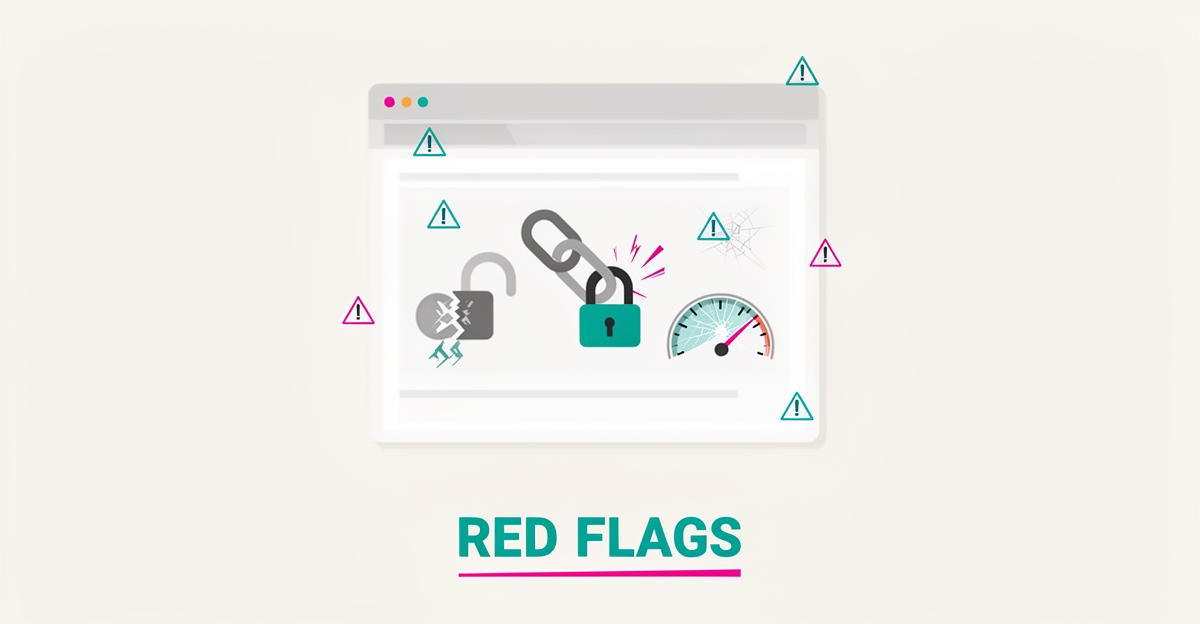
A single unaddressed red flag can erode visitor trust and drive potential customers straight to a competitor. Research shows website credibility, security, and usability issues cluster into three distinct risk areas, each with measurable business consequences.
Credibility and design signals form the first cluster. Visitors make trust judgments in a fraction of a second, and issues like missing author information, broken links, poor contrast, or lack of HTTPS immediately signal unreliability. According to credibility research, 68% of people struggle to distinguish credible sources from misinformation online, making these signals critical for retention. Poor contrast, identified as the most under-diagnosed design flaw, creates readability barriers that frustrate users and increase bounce rates, especially on mobile devices where over half of all web traffic originates design studies confirm.
The second cluster centers on security and phishing exposure, which directly threaten both visitor safety and business reputation. Phishing remains pervasive, with 94% of organizations reporting attacks in 2024 phishing statistics reveal. Generative AI now enables attackers to produce convincing phishing pages in under 10 queries, increasing the risk of brand impersonation and data theft. For small businesses, the average data breach cost ranges from $120,000 to $1.24 million, and over 50% of cyber attacks target SMBs cybersecurity data shows, turning security lapses into existential threats.
The third cluster involves usability and performance friction. Slow load times, confusing navigation, and non-responsive layouts force visitors to work harder than necessary, prompting abandonment before engagement. Users expect pages to load in about two seconds, and delays beyond this threshold significantly reduce conversion potential. When design flaws compound—such as combining poor contrast with slow performance and unclear calls to action—the combined friction can silently erode revenue streams. Conversely, addressing these issues delivers measurable gains; one site relaunch focused on usability improvements resulted in a 24% increase in conversions case studies demonstrate.
AI Business Sites mitigates these risks through managed AI design, content generation, and continuous analytics. The platform automatically enforces HTTPS, monitors for broken links, ensures proper contrast ratios, and validates content credibility with citation requirements. By aligning technical hygiene with user experience best practices, it reduces the silent erosion of trust that costs businesses leads and revenue every day.
Credibility and Security Signals That Users Scan For
Users scanning a website for trustworthiness instinctively look for signals that separate credible sources from noise. Missing HTTPS, absent author or contact details, broken links, vague claims, sensational headlines, and spammy ads all trigger immediate skepticism. These red flags matter because 68% of people struggle to distinguish credible sources from misinformation online, leaving them vulnerable to poorly designed or deceptive sites. For small and medium-sized businesses—already targeted in over 50% of cyber attacks—this gap in user judgment amplifies risk, as attackers exploit trust deficits to deliver phishing or malware.
Automated hygiene directly counters these vulnerabilities. Managed AI design ensures every page launches with HTTPS, validates author attribution, and continuously audits for broken links or missing contact information. The content engine grounds every claim in verifiable sources, preventing vague or unsupported statements from slipping through. By integrating citation-backed workflows and real-time analytics, AI Business Sites maintains the technical and editorial standards users scan for—reducing friction, reinforcing credibility, and helping SMBs avoid the silent erosion of trust that drives visitors away before they engage.
Local business: doing this the old way?
One system replaces the whole pile.
All of it — the website, the follow-up, the content, the leads — built and run for you for $1,497 + $497/mo. Month-to-month, and you own everything.
See what your build includesDesign and Performance Friction That Kills Conversion
Design and Performance Friction That Kills Conversion
More than half of web traffic now comes from mobile devices, and visitors expect pages to load in about two seconds. When sites fail these basic performance tests, users leave silently before engaging with content. Poor contrast is the most under-diagnosed design mistake—text that fails WCAG 4.5:1 standards is invisible to some visitors and exhausting for the rest, yet most teams never test for it. Cluttered layouts and confusing navigation force visitors to work harder than necessary, directly increasing bounce rates.
Managed AI design and analytics continuously monitor for these UX red flags, automatically flagging contrast violations, slow load times, and mobile rendering issues. This proactive approach prevents the friction that drives visitors away. As demonstrated by the Gridwise site relaunch, fixing these usability problems led to a 24% increase in conversions, proving that design quality shows up in measurable business results. By maintaining technical hygiene and providing real-time visibility into user behavior, AI-powered platforms help businesses catch silent churn before it impacts revenue.
How Managed AI Design, Content and Analytics Prevent Red Flags
How Managed AI Design, Content and Analytics Prevent Red Flags
Credibility and security red flags erode trust before a visitor reads a single sentence. Over 68% of people struggle to distinguish credible sources from misinformation online, making automated safeguards essential industry research. AI Business Sites prevents these issues by embedding continuous monitoring and governance into every layer of the site—no manual oversight required.
Technical hygiene is maintained through automated HTTPS validation and broken link scanning, both running in the background with instant alerts to our team. Missing contact or author pages trigger human-in-the-loop review before publication, directly addressing the No HTTPS Secure Connection, Lack of Contact Information, and No Author Information red flags credibility guidelines. Every AI-generated content piece undergoes claim verification, source citation, and schema validation—countering the rise of AI-enabled deception where believable phishing pages can be generated in under 10 queries phishing statistics.
Performance and accessibility are continuously audited against real-user expectations. With more than half of web traffic mobile and visitors expecting sub-two-second load times, our analytics engine monitors render speed, contrast compliance (WCAG 4.5:1), and mobile responsiveness design research. Supply-chain risks are mitigated via automated script inventory and domain change monitoring, flagging newly registered third-party domains or SSL mismatches before they compromise trust cybersecurity data. This managed approach eliminates DIY overhead while ensuring every customer-facing element meets credibility, security, and usability standards.
Frequently Asked Questions
What are the most common website red flags that scare visitors away?
How can I tell if a website is secure or a phishing scam?
Why does website speed and mobile design matter for credibility?
What is poor contrast and why is it such a big problem?
How much can fixing website red flags actually improve my business?
Can AI help prevent these website red flags automatically?
Turn Red Flags into Revenue Signals
Your website’s credibility, security, and usability aren’t just technical details—they’re silent salespeople working 24/7. When broken links, poor contrast, or missing trust signals erode visitor confidence, you’re not just losing clicks; you’re leaking revenue before a conversation even starts. The good news? These red flags are predictable, preventable, and fixable with the right foundation. AI Business Sites continuously monitors and maintains your site’s technical hygiene, content integrity, and performance—so you can focus on running your business while your website works to build trust, capture leads, and convert visitors. Ready to see what a truly managed online presence looks like? Book a free strategy call to explore how we can help you eliminate silent churn and start converting with confidence.
FOR local businesss — BUILT AND RUN BY US
Your website. Your content. Your leads. Your data.
$500 starts your build. Seven days later it's live — chat, booking, follow-up, and your Google presence all set up. Then we run it, every month. You do the work you actually get paid for.