
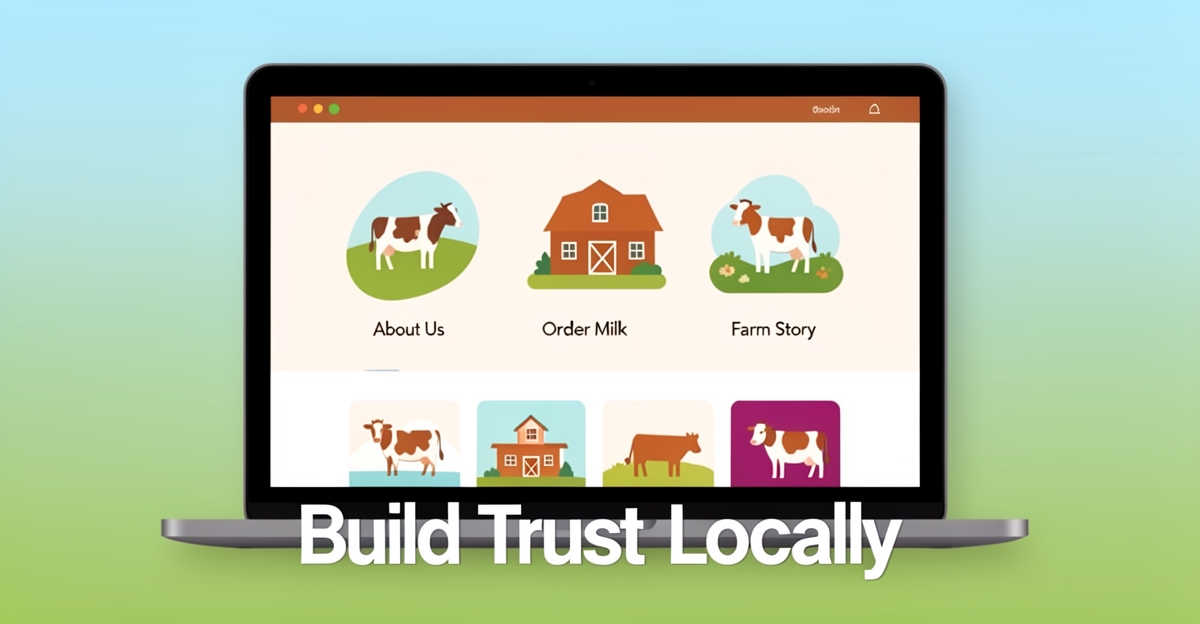
Key facts
- 88% of visitors never return after a poor user experience on a farm website according to Barn2Door.
- Farms using authentic farm visuals saw a 78% sales increase within six months per HomeGrown Hosting clients.
- Young dairy farmers under 30 are adopting IT tools at a ~67% rate reports Dairy Herd News.
- Farm websites need at least 300 words per page and 800–900 for cornerstone pages for optimal SEO Mike Badger advises.
- Google Business Profile optimization during launch can deliver dozens of new orders before competitors even load their sites AI Business Sites configures this upfront.
- Mobile-first farm websites with clickable contact info in headers can turn a 3-second visit into a confirmed order research from Pastured Poultry Talk shows.
- HomeGrown Hosting clients processed 400+ orders totaling $43,000+ in online sales within 12 months after simplifying their transaction flow per their metrics.
WANT RESULTS LIKE THIS?
Imagine a system doing all of this for your local business — every day, without you.
We build local businesses a custom website with a team of AI behind it: every lead captured and followed up, new content published monthly,customers finding you on Google — live in 7 days.
- 85+ pages at launch
- Every lead followed up, automatically
- Your whole business on one screen
Why Most Farm Websites Fail Rural Communities
Most farm websites fail rural dairy communities before a visitor even clicks away. Generic templates and flashy designs designed for urban markets alienate nearby customers who value honesty, simplicity, and direct connection. Research shows 88% of visitors never return after a poor user experience, and dairy farmers themselves describe dreading complex websites they can’t navigate between milking sessions.
The stakes go beyond frustration. A mismatched website erodes trust, misses sales, and misrepresents the farm’s identity. Instead of clean local imagery or farmer stories, generic templates push corporate branding that feels foreign on a rural landscape. Instead of straightforward pricing or seasonal availability, visitors encounter dense blocks of text and confusing navigation. Instead of instant answers or easy ordering, they face dead ends and unanswered questions. The result is lost trust, lost customers, and a website that doesn’t reflect the real heart of the farm.
What rural dairy customers need is authenticity, function, and local focus—not bells and whistles. A website should mirror the farm’s daily rhythms: local visuals, clear messaging, and simple pathways to buy milk, cheese, or subscribe to deliveries. It should answer questions before they’re asked—when to expect deliveries, how much it costs, what’s available this season. And it should do this on mobile, where most rural customers first discover a farm.
At AI Business Sites, every page is designed around the farm’s real life instead of a template. Clean local visuals, straightforward messaging, and built-in tools like farmer bios and transparent pricing reflect the farm’s identity. Mobile-first design keeps visits fast and effortless. And automated systems handle the busywork—answering FAQs instantly, capturing leads after hours, sending order confirmations—so the farmer can focus on the herd, not the website. The goal isn’t a flashy showcase; it’s a site that works as hard as the farm itself.
Design That Reflects Real Farm Life
A rural dairy farmer’s website should feel like walking into their neighbor’s barn—not a sleek city boutique. The best farm websites use clean local visuals and simple design to build instant familiarity. Research shows that 88% of visitors leave after a poor user experience source, proving that cluttered layouts or slow load times drive potential customers away. Instead, prioritize ≤5 colors, 2–3 fonts, and crisp, high-quality images of the farm itself—no stock photos of generic "happy cows" unless they’re yours.
Trust comes from seeing the real people behind the milk. Farmer bios with short stories—"We’ve milked the same herd since 1982"—or seasonal photos of hay baling in late summer can make a website feel like part of the community. HomeGrown Hosting’s research found that farms with authentic visuals saw a 78% increase in sales within six months source. Transparency matters too: display pricing upfront, note seasonal availability ("Limited supply in winter"), and include a short video tour of the milking parlor. These elements don’t just look good—they reduce hesitation for rural shoppers who value honesty over polish.
Keep navigation tight. A single page per product—like dedicated sections for whole milk, cheese CSA boxes, or butter—makes it easy for visitors to find what they need without scrolling. As Mike Badger of Pastured Poultry Talk notes, context is everything for local SEO: "The only way Google knows you sell food in your community is by providing real words and content" source. For AI Business Sites, this means building pages that answer specific questions ("Where to buy raw milk near me?") while keeping the design rooted in the farm’s identity. The result? A website that feels less like a digital storefront and more like a familiar part of the countryside.
- Clean local visuals (farm photos, seasonal imagery) and ≤5 colors build trust
- Farmer bios and transparent pricing reduce hesitation for rural shoppers
- One page per product improves SEO and simplifies navigation
Simplify Buying for Repeat Customers
Most dairy customers order from their phones while standing in a barn aisle or loading a truck — if your site forces them to pinch, zoom, or hunt for a phone number, they'll call someone else. Mobile-first layouts with clickable contact info in the header and footer turn a three-second interaction into a confirmed order instead of a missed opportunity. Research shows 88% of visitors won't return after a poor mobile experience source, making this the single highest-impact design decision for rural farms.
- Bulk ordering for milk subscriptions and cheese CSA boxes with one-click reorder
- Seasonal availability indicators that update automatically (e.g., "Limited winter supply — reserve now")
- Instant auto-response emails that confirm orders with a farmer's name and expected delivery date
- Saved customer preferences so repeat buyers skip the form entirely
HomeGrown Hosting's farm clients saw 78% sales growth, 400+ orders, and $43K+ in online sales within 12 months after simplifying their transaction flow source. The common thread? Every extra click they removed translated directly into revenue. An AI Business Sites website builds this functionality in from launch — mobile-optimized product pages, subscription options, and automated confirmations that feel personal, not robotic. When a customer places a 6 a.m. order for next week's cheese share, they get a thoughtful reply signed by the farmer before their coffee's cold.
Local business: doing this the old way?
One system replaces the whole pile.
All of it — the website, the follow-up, the content, the leads — built and run for you for $1,497 + $497/mo. Month-to-month, and you own everything.
See what your build includesGet Found Where Customers Actually Search
If your website isn’t showing up where customers actually search, you’re invisible to the people who matter most—even if you’ve got the best dairy in the county.
Local SEO isn’t a nice-to-have for rural dairy farms—it’s the difference between a full milk tank and an empty one. A farm-focused SEO study found that the only way search engines know you sell fresh milk in your community is when your website explicitly says so, repeatedly and clearly. That means weaving “Dairy Farm in [Your County]” into your page titles, headers, and body copy—not just once, but across every product and service page. Without that geographic anchor, Google won’t rank you for local searches like “buy raw milk near me,” and nearby families will drive straight past your farm to the big-box grocery, unaware you exist.
But showing up in search results isn’t enough. You have to own the first page—and that starts with your Google Business Profile (GBP) and Bing setup at launch, not as an afterthought. A well-optimized GBP doesn’t just list your hours; it turns every review into a signal that says “this farm is real, responsive, and trusted.” AI Business Sites configures GBP and Bing profiles during the website launch, so your farm appears instantly on Maps and in local packs, not weeks later when you finally remember to log in. That 30-day head start can mean dozens of new orders before your neighbor’s website even loads.
Content isn’t just for customers—it’s for search engines. A farm SEO guide recommends at least 300 words for standard pages and 800–900 for cornerstone pages like “Our Grass-Fed Milk Program.” Those longer pages don’t just rank better; they give families the details they need to trust you enough to drive to your farmstand. With AI Business Sites’ automated location and service pages, each new page links automatically to your most relevant content, building the internal structure Google rewards—no manual link building required.
- Create a Google Business Profile and Bing listing during launch—not later
- Embed “[Your County]” in every page title, header, and description
- Publish at least 300 words per standard page and 800–900 for cornerstone pages
- Use AI-generated, location-specific pages to cover every product and season
- Respond to every review within 24 hours to boost local ranking signals
The best website in the world won’t matter if no one finds it. But when your site speaks the language of local search—geography, freshness, and trust—your farm becomes the obvious choice before the first gallon is poured.
Automation That Keeps the Human Connection
The midnight text from a customer asking about milk pickup times used to mean a groggy trip to the barn office. Now, an AI assistant handles it — instantly, accurately, and in the farm's own voice — while the family stays focused on the herd. That balance of automation and authenticity is what rural dairy communities need: technology that works quietly in the background, preserving the human connection that builds trust.
Young dairy farmers are driving this shift. In Europe, roughly 67% of producers under 30 are already using IT tools to run smarter, not just harder source. They're not chasing novelty — they want autonomy, ease of use, and practical benefits that free up time for the work that matters. An AI assistant that remembers returning customers, drafts emails with the farmer's signature, and routes only the decisions that need a human eye fits that criteria exactly.
The platform's built-in CRM, newsletter engine, and content system run on the same principle. Leads from web forms, voice calls, or chat all land in one place with instant, personalized responses. Follow-ups happen automatically — tagged, timed, and tracked — while the farm family sees a clean pipeline, not a cluttered inbox. Monthly blog posts, service pages, and location pages publish themselves, grounded in the farm's actual services and service areas, with internal linking that strengthens local SEO without manual effort.
- AI assistant answers FAQs 24/7 using the farm's own knowledge base
- Voice agent captures after-hours leads and books appointments by phone
- Instant auto-response emails include the farmer's signature and personal touch
- Human-in-the-loop approval keeps every customer message authentic
- CRM, newsletter, and content engine run automatically in the background
The result is a website that runs the business with you — handling the busywork so the farm family can stay where they belong: in the barn, with the herd, and connected to the community they feed.
Frequently Asked Questions
Why do most farm websites fail rural dairy communities?
What are the key elements rural dairy customers need from a farm website?
How important is mobile optimization for rural dairy farm websites?
What impact does authentic visuals have on sales for rural dairy farms?
Why is local SEO crucial for rural dairy farms, and how can it be achieved?
How can automation enhance the user experience for rural dairy farm websites without losing human connection?
Key Takeaways
{ "title": "Harvesting Trust Online: The Rural Dairy Farmer’s Digital Blueprint", "content": "A website for a rural dairy farm community isn’t just a digital presence—it’s a gateway to trust, sales, and sustainability. As we’ve explored, the key to success lies in reflecting the farm’s authentic ide
FOR local businesss — BUILT AND RUN BY US
Your website. Your content. Your leads. Your data.
$500 starts your build. Seven days later it's live — chat, booking, follow-up, and your Google presence all set up. Then we run it, every month. You do the work you actually get paid for.