
Key facts
- Home emergency insurance market grows at a 5.9–9.5% CAGR according to WiseGuyReports.
- Dealership trust declined from 62% to 54% amid price transparency concerns per Cox Automotive.
- EV owners visit service centers 2.6 times/year, spending $443/visit as reported by Cox Automotive.
- Job Order Contracting reduced bid spreads from 30% to 4% in a NJDOT case study.
- Disaster repair spending now constitutes 6% of home improvement expenditures as noted by JCHS Harvard.
WANT RESULTS LIKE THIS?
Imagine a system doing all of this for your local business — every day, without you.
We build local businesses a custom website with a team of AI behind it: every lead captured and followed up, new content published monthly,customers finding you on Google — live in 7 days.
- 85+ pages at launch
- Every lead followed up, automatically
- Your whole business on one screen
The Emergency Repair Conundrum: Why One-Time Fixes Hurt Your Bottom Line
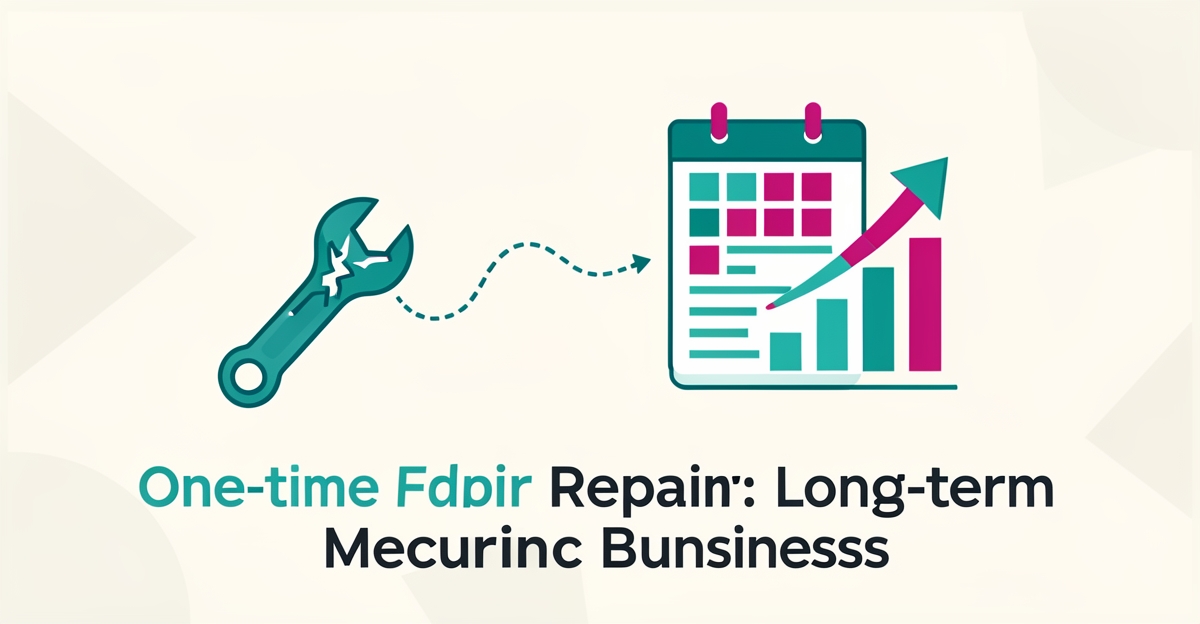
Most shop owners know the feeling: a customer limps in with an overheated engine or a dead battery, you get them back on the road, and they vanish until the next crisis. That cycle feels like revenue, but it's actually a leaky bucket. Across the broader emergency services market, consumers are voting with their wallets for predictability — the home emergency insurance sector is projected to grow at a 5.9–9.5% CAGR as households swap pay-per-incident models for subscription-based coverage (market research, industry analysis).
The automotive data tells the same story. Dealership service share has slipped from 35% to 30% while general repair shops capture 28% of visits, largely because trust at dealerships fell from 62% to 54% even as visit costs jumped 45% since 2021 (Cox Automotive study). Customers aren't leaving because you're expensive — they're leaving because the one-off repair model gives them no reason to stay.
EV owners amplify the problem. They visit shops 2.6 times per year versus 2.3 for ICE vehicles, spend roughly $443 per visit on newer models, and report 54% frustration rates compared to 39% for gas-car owners (same study). More visits, higher bills, lower satisfaction — that's a retention crisis waiting for a solution.
The shops breaking this cycle treat every emergency repair as the first touchpoint in a longer relationship. They document the repair with photos and diagnostic codes, explain what failed and why, then follow up automatically with a maintenance plan priced around the customer's actual vehicle and driving patterns. AI Business Sites builds websites that handle this follow-up automatically — capturing the lead, sending the repair summary, and triggering a personalized contract offer without the shop owner lifting a finger.
- One-time repairs create revenue spikes but zero predictability
- Customers increasingly prefer subscription models across every emergency service category
- EV owners visit more often, spend more, and report higher frustration — a clear signal they want a better model
- Trust erodes when the only contact is a crisis and a bill
The next section breaks down five proven strategies to convert that emergency visit into a recurring maintenance contract.
From Transactional to Recurring: Evidence-Backed Strategies for Conversion
From Transactional to Recurring: Evidence-Backed Strategies for Conversion
When an urgent roadside repair is complete, the transaction doesn’t have to end there. By leveraging strategic, data-driven approaches, repair shops can turn one-time customers into long-term contract holders. Here’s how:
1. Automate Follow-Up with Subscription Offers Research shows subscription models are dominating emergency services, growing at a 5.9–9.5% CAGR, driven by consumer preference for cost predictability source. Immediately after repair, deploy automated email/SMS sequences offering tiered maintenance subscriptions. For example, AI-powered platforms like those integrated with AI Business Sites can personalize offers based on vehicle specifics, increasing the likelihood of conversion.
Key Stat: 45% of customers cite cost concerns, making transparent, predictable pricing crucial source.
2. Introduce Task-Based Transparent Pricing Inspired by Job Order Contracting’s success in infrastructure maintenance, where task-based structures reduced competitive bidding spreads from 30% to 4% source, create a "Maintenance Task Catalog" with fixed prices for each service. Customers can build custom contracts, enhancing trust through transparency.
3. Capitalize on EV Service Frequency EV owners visit service centers more frequently (2.6×/year vs. 2.3× for ICE vehicles) with higher costs ($443 vs. ~$250) and a 54% frustration rate source. Offer EV-specific subscriptions covering high-frequency needs, positioned as "predictable EV care."
4. Document for Trust Combine emergency responses with comprehensive, insurance-ready digital reports. This approach, effective in disaster restoration source, builds trust and serves as the basis for personalized maintenance proposals.
5. Predictive Analytics for Timely Offers Analyze vehicle data to predict maintenance needs, triggering automated outreach 30–60 days in advance. This proactive strategy mirrors the growing demand for disaster mitigation services, where spending grew to 6% of home improvement expenditures source.
Actionable Takeaways:
- Automate follow-up with personalized subscription offers.
- Adopt transparent, task-based pricing for trust and competitiveness.
- Leverage EV service frequency for targeted contract entry points.
- Use comprehensive documentation to build customer trust.
- Employ predictive analytics for proactive maintenance offers.
By integrating these strategies, repair shops can effectively transition from transactional repairs to recurring revenue streams, leveraging the power of data, transparency, and proactive customer engagement — a seamless experience enhanced by platforms like AI Business Sites, which automate follow-ups and personalize customer interactions.
Local business: doing this the old way?
One system replaces the whole pile.
All of it — the website, the follow-up, the content, the leads — built and run for you for $1,497 + $497/mo. Month-to-month, and you own everything.
See what your build includesPutting it into Practice: Implementation Tips for Your Shop
Putting it into Practice: Implementation Tips for Your Shop
Converting urgent repairs into long-term contracts requires strategic execution. Here’s how to integrate these strategies into your business, leveraging the capabilities of AI Business Sites' platform:
1. Automate Post-Repair Follow-Ups with AI Personalization Within minutes of completing an emergency repair, AI Business Sites' platform can trigger personalized follow-up sequences. For example, if a customer's vehicle required urgent brake repairs, the AI can send a tailored email offering a maintenance contract highlighting priority brake service, citing the 45% of customers who cite cost concerns as a reason for choosing subscription models source. This approach mirrors the 9.5% CAGR growth in subscription-based home emergency services source, where predictability is key.
Key Action:
- Implement: Set up automated email/SMS sequences through AI Business Sites.
- Personalize: Use customer and vehicle data to tailor subscription offers.
- Example Statistic: Subscriptions in home emergency services grew by 9.5% CAGR source, indicating strong consumer preference for predictable costs.
2. Introduce Transparent, Task-Based Pricing with AI-Generated Catalogs Inspired by Job Order Contracting’s success, create a transparent maintenance task catalog. AI Business Sites can help generate and update this catalog digitally. Dealership trust issues (down to 54% from 62%) highlight the need for transparency source. By mirroring the 30% to 4% bid spread improvement seen in JOC models source, shops can build trust.
Key Action:
- Publish: A clear, fixed-price task menu for maintenance services.
- Utilize AI: For dynamic catalog updates and customer selection interfaces.
- Example Statistic: JOC reduced bid spreads from 30% to 4% source, demonstrating improved competitive bidding with transparency.
3. Leverage EV Service Frequency for Contract Entry Points Given EV owners’ 2.6 annual service visits (vs. 2.3 for ICE) and higher costs ($443 vs. ~$250) source, design EV-specific subscriptions. AI Business Sites can help target these customers effectively. 71% of dealers have already adapted by adding high-voltage technicians source, indicating a readiness to support EV-centric strategies.
Key Action:
- Design: EV-focused maintenance plans addressing high-frequency needs.
- Target: Utilize platform analytics to identify and outreach to EV owners.
- Example Statistic: EV owners spend $443 per visit, over $190 more than ICE owners source, highlighting a clear need for tailored, cost-effective solutions.
4. Build Trust with Comprehensive Digital Reports and AI-Generated Proposals After each emergency repair, provide detailed digital reports (including photos, diagnostics, and recommendations) using AI Business Sites’ document generation capabilities. This builds trust, similar to how disaster restoration services leverage comprehensive records source. Aging home infrastructure and the desire for convenience in emergency services source also support the value of detailed, accessible documentation.
Key Action:
- Generate: Detailed post-repair reports with AI assistance.
- Propose: Personalized maintenance contracts based on the report’s findings.
- Example Statistic: Disaster restoration with detailed records protects repeat demand source, illustrating the power of transparency in building customer loyalty.
5. Predictive Analytics for Timed Maintenance Offers Use AI Business Sites’ analytics to predict service needs based on vehicle data and trigger proactive, automated outreach. This mirrors the growing use of advanced analytics in home emergency services source to optimize offerings. With 23 billion-dollar disasters annually in the 2020s source, proactive maintenance is increasingly valued.
Key Action:
- Analyze: Vehicle data for predictive maintenance scheduling.
- Automate: Outreach with tailored offers before anticipated service needs.
- Example Statistic: Advanced analytics optimize service offerings in home emergency markets source, showing how data-driven approaches improve customer retention.
By seamlessly integrating these strategies with AI Business Sites’ platform, your shop can effectively turn one-time emergency repairs into long-term, revenue-generating contracts.
Frequently Asked Questions
Why should I try to turn emergency repairs into maintenance contracts instead of just fixing the car and moving on?
Do customers actually want maintenance subscriptions, or will they see it as an upsell?
How do I know which customers are most likely to sign up for a maintenance contract after an emergency repair?
What's the simplest way to start offering maintenance contracts without overcomplicating my shop's workflow?
How can I build trust with customers who only see me during emergencies?
Is there a pricing model that makes maintenance contracts easier to sell?
Key Takeaways
{ "title": "From Reactive Repairs to Predictable Profits: The Shift to Smart Maintenance Contracts", "content": "In today’s service-driven automotive landscape, the traditional one-time repair model is no longer sufficient. As consumers increasingly opt for subscription-based services, repair shops
FOR local businesss — BUILT AND RUN BY US
Your website. Your content. Your leads. Your data.
$500 starts your build. Seven days later it's live — chat, booking, follow-up, and your Google presence all set up. Then we run it, every month. You do the work you actually get paid for.