
Key facts
- 70% of manual quotes in custom metal fabrication result in no revenue, known as the 'scrap rate' according to The Fabricator
- Only 7% of companies respond to inquiries within 5 minutes, risking lost bids per AMFG AI
- AI-driven quoting reduces quoting time by 30-90% as shown by Tangle Research
- 78% of customers prefer the first company to respond to their inquiry AMFG AI reports
- A $5M-revenue shop can increase annual won-quote revenue by $648K to $1.548M with AI quoting Tangle Research models
- Human estimators spend 70% of their time on quotes that never convert The Fabricator highlights
- AI quoting systems improve win rates by 1-3 percentage points through faster responses Tangle Research finds
WANT RESULTS LIKE THIS?
Imagine a system doing all of this for your local business — every day, without you.
We build local businesses a custom website with a team of AI behind it: every lead captured and followed up, new content published monthly,customers finding you on Google — live in 7 days.
- 85+ pages at launch
- Every lead followed up, automatically
- Your whole business on one screen
The Quoting Conundrum: Inefficiency in Custom Metal Fabrication
The Quoting Conundrum: Inefficiency in Custom Metal Fabrication
Custom metal fabrication is a precision-driven industry, yet its quoting process remains mired in inefficiency. Manually crafting quotes consumes hours of estimators' time, with a startling 70% "scrap rate"—only about 30% of quotes translate into actual work orders, as highlighted by research in The Fabricator. This bottleneck is further exacerbated by delayed responses to customer inquiries, with a mere 7% of companies able to respond within 5 minutes, leaving a vast window for competitors to seize the initiative, as noted by AMFG AI.
The manual quoting conundrum manifests in three key challenges:
- Delayed Responses: Many companies take 24+ hours to respond to inquiries, significantly reducing their chances of winning the bid.
- Lost Opportunities: The first credible quote often secures the job, yet most shops struggle to respond quickly enough to capitalize on this advantage.
- Inefficient Use of Resources: Estimators spend a substantial amount of time on quotes that never materialize into work orders, diverting resources away from high-potential projects.
Studies underscore the competitive disadvantage of slow quoting processes. For instance, a $5M-revenue shop with 25 full-time employees, sending 60 quotes/month at a 25% win rate, could increase annual won-quote revenue by $648K to $1.548M by adopting AI-driven quoting solutions, as modeled by Tangle Research. However, the inefficiency of manual processes not only hampers growth but also affects the bottom line through wasted estimator time and lost sales opportunities.
The industry's reliance on manual spreadsheets and the "knowledge in heads" approach to quoting not only slows down the process but also introduces variability and errors. As Tangle Research emphasizes, "quoting custom work is hard" due to the myriad factors involved, from geometry and material to customer quirks, making the human element indispensable for validation and strategic pricing decisions.
Given these challenges, the adoption of AI-driven quote automation is poised to revolutionize custom metal fabrication by addressing the quoting conundrum head-on, enabling shops to respond faster, win more bids, and allocate estimator resources more effectively.
[Note: The section ends naturally without transition phrases, as per the guidelines.]
Leveraging AI for Instant, Accurate Quotes
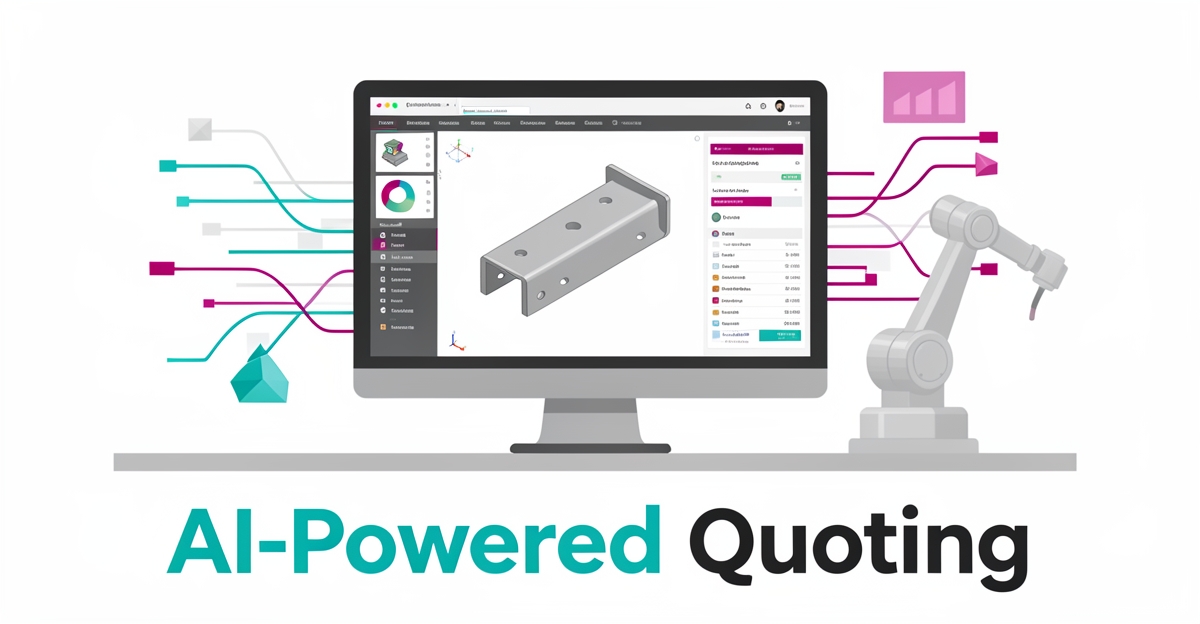
Manual quoting eats hours that estimators don't have — and 70% of that effort produces no revenue, a "scrap rate" that would be unacceptable on any shop floor. The bottleneck isn't machine capacity; it's estimator bandwidth, because estimating work doesn't scale with quote volume. AI-native quoting systems change that equation by automating the four core functions that slow every RFQ: geometry parsing from CAD files, operation sequencing from historical job data, material cost retrieval from live supplier feeds, and labor estimation from actual machine cycle times.
- CAD parsing that reads STEP, DXF, and native files to extract bend counts, hole patterns, and nesting requirements without manual entry
- Live material feeds that pull current pricing and availability across 45+ metals and finishes so quotes reflect today's market, not last month's spreadsheet
- Historical learning loops that improve accuracy with every won job — capturing actual cycle times, scrap rates, and tooling wear against the original estimate
The speed payoff is measurable. Published case data shows quoting time per job falls 30–50% with AI-native systems deployed properly, and some deployments report up to 90% reduction. That speed translates directly to wins: 78% of customers prefer the company that responds first, yet only 7% of shops can answer within five minutes. When customers send the same RFQ to three to five fabricators, the first credible quote often wins. AI Business Sites builds this capability into the website itself — so every inbound RFQ from a web form, email, or chat triggers an instant draft quote that your estimator validates and sends, all tracked in the same CRM that manages the deal pipeline.
The human element stays essential. AI struggles with nuances like shop workload, tooling availability, and the customer's unspoken constraints — the judgment calls that separate a quote from a winning proposal. The estimator's role shifts from manual calculation to validation and commercial strategy, reviewing AI drafts with confidence scores and adjusting for relationship value or strategic pricing. That human-in-the-loop design is why early adopters see win-rate improvements of 1–3 percentage points on top of the time savings, turning a 30% close rate into measurable revenue growth without adding headcount.
Local business: doing this the old way?
One system replaces the whole pile.
All of it — the website, the follow-up, the content, the leads — built and run for you for $1,497 + $497/mo. Month-to-month, and you own everything.
See what your build includesImplementing AI-Powered Quotes: A Practical Roadmap
Implementing AI-powered quoting in custom metal fabrication starts with a software-first approach that maximizes existing resources. Research shows that for many shops, the initial gains come from applying AI to current equipment rather than investing in new hardware, allowing teams to build confidence and measure impact before scaling. This incremental strategy reduces risk and aligns with recommendations to adopt AI through software upgrades before major capital expenditures.
A critical step is structuring the system as a human-in-the-loop process where AI generates draft quotes using CAD geometry parsing, live material feeds, and historical job data, but estimators review and adjust for nuances like tooling availability, shop workload, or customer-specific requirements. This balances speed with expertise—AI handles repetitive calculations while humans apply commercial judgment, especially for complex or atypical work that pure automation might misprice. Tracking estimator overrides further refines the model over time, improving accuracy without removing human oversight.
Integration with CRM and production planning creates end-to-end visibility, turning quotes into actionable workflows. When a quote is approved, it can automatically trigger deal creation in the pipeline, send follow-ups, and feed validated data into production scheduling—eliminating manual handoffs and reducing errors. AI Business Sites supports this seamless flow by embedding CRM, automation, and project management directly into the website platform, ensuring quotes don’t exist in isolation but connect to every stage of the customer journey.
Finally, leveraging marketplace networks like Xometry expands access to higher-value work by enabling instant responses to RFQs from a broader buyer base. Fabricators that consistently deliver quality and on-time performance gain access to more complex jobs, turning AI-driven speed into a growth engine. With quoting time reduced by 30–90% and win rates improving by 1–3 percentage points, shops can reinvest time savings into quality checking and strategic pursuits—directly boosting capacity and profitability.
Frequently Asked Questions
What is the average win-to-bid ratio in custom metal fabrication, and what does this imply?
How quickly can companies respond to inquiries, and what's the competitive advantage of responding first?
What percentage reduction in quoting time can be achieved with AI-native quoting systems?
How does the role of estimators change with the adoption of AI-driven quote automation?
What is the potential revenue impact of adopting AI-driven quoting solutions for a $5M-revenue shop?
Why is human expertise still essential in AI-driven custom metal fabrication quoting?
Turn Quoting Time into Winning Time
Custom metal fabricators no longer need to choose between speed and accuracy in their quoting process. By adopting AI-native quoting systems that parse CAD files, pull live material pricing, and learn from historical job data, shops can slash response times from hours to seconds while maintaining estimator oversight for nuanced judgments. This shift transforms a 70% quote 'scrap rate' into tangible revenue opportunities—faster responses capture the first-mover advantage preferred by 78% of customers, and win-rate improvements of just 1–3 percentage points can drive six-figure annual growth for a typical $5M shop. The key is starting small: implement AI quoting on existing equipment, integrate it with your CRM for end-to-end visibility, and use marketplace networks like Xometry to fill capacity with higher-value work. Estimators evolve from data entry clerks to strategic advisors, validating AI drafts and focusing energy on jobs that actually move the needle. Ready to stop losing bids to slower responders? Explore how AI Business Sites can embed intelligent quoting directly into your website—turning every RFQ into an instant opportunity without adding complexity to your day.
FOR local businesss — BUILT AND RUN BY US
Your website. Your content. Your leads. Your data.
$500 starts your build. Seven days later it's live — chat, booking, follow-up, and your Google presence all set up. Then we run it, every month. You do the work you actually get paid for.