
Key facts
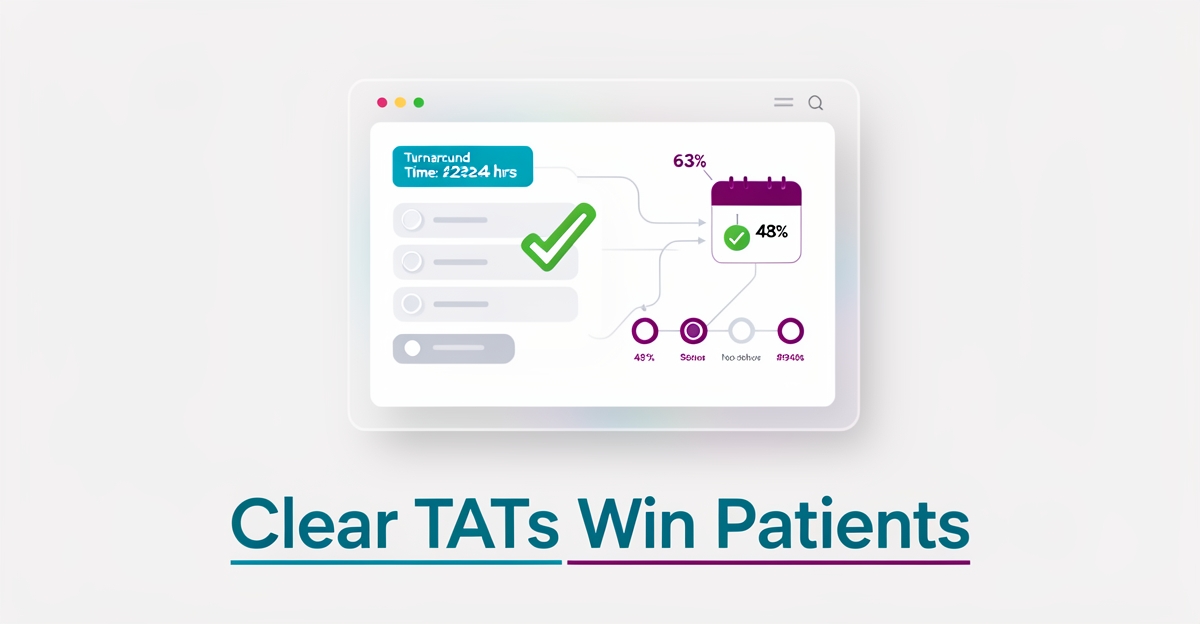
- 63% of patients delayed care due to inconvenient appointment availability Kyruus Health
- 48% of patients would switch providers for better online scheduling access Kyruus Health
- Lab result delays extend emergency department stays by 61% Roche Diagnostics
- Nearly 80% of clinical labs receive complaints about slow turnaround times Sapio Sciences
- 70% of medical decisions rely on lab results Roche Diagnostics
- Non-analytical workflow inefficiencies cause up to 96% of delayed diagnoses Biosero
- 60-70% of lab errors occur during the pre-analytical phase Biosero
WANT RESULTS LIKE THIS?
Imagine a system doing all of this for your local business — every day, without you.
We build local businesses a custom website with a team of AI behind it: every lead captured and followed up, new content published monthly,customers finding you on Google — live in 7 days.
- 85+ pages at launch
- Every lead followed up, automatically
- Your whole business on one screen
Why Patients Leave When Turnaround Times Are Missing
Why Patients Leave When Turnaround Times Are Missing
Imagine waiting anxiously for lab results, only to be left in the dark about when to expect them. This uncertainty isn’t just frustrating—it’s a deal-breaker for many patients. A staggering 63% of patients who delayed care cited inconvenient appointment availability as a key barrier, while 48% would switch providers for the simplicity of better online scheduling (Kyruus Health Patient Access Insights 2024 Benchmark Report). The absence of clear lab turnaround times (TATs) on websites directly contributes to this patient exodus.
The Ripple Effect of Unclear Timelines
- Delayed Treatment, Extended Stays: Laboratory result delays extend emergency department stays by 61% and postpone treatment by 43% (Roche Diagnostics LabLeaders), impacting patient outcomes and satisfaction.
- Patient Frustration and Avoidance: Nearly 80% of clinical labs face complaints about slow TATs (Sapio Sciences), reflecting the significant frustration patients experience when expectations aren’t met.
- Switching Providers for Transparency: The demand for clear online scheduling and transparency is so high that 48% of patients would choose a different provider for this convenience (Kyruus Health), highlighting the direct link between website clarity and patient retention.
Key Takeaways for Laboratories:
- Display TATs Clearly by Test Type: Reduce uncertainty with transparent turnaround times for each test category.
- Integrate Real-Time Updates (If Feasible): Provide current TAT estimates based on workload for enhanced patient planning.
- Optimize for Local SEO with Service Details: Ensure your website structure promotes clear, findable information for patients and search engines alike.
AI Business Sites addresses this critical need by automatically structuring lab websites to highlight turnaround times and test categories, fostering trust and reducing no-shows through clear expectations. By prioritizing transparency, laboratories can not only improve patient satisfaction but also streamline their operations, ultimately retaining more patients in the process.
The Clinical and Operational Impact of Unclear TAT
Turnaround times aren’t just numbers on a lab report—they’re the invisible thread connecting patient trust, operational efficiency, and even safety. When labs fail to clearly communicate how long a test will take, the consequences ripple through the entire healthcare journey. Research shows that 70% of medical decisions depend on lab results, yet nearly 80% of clinical labs receive complaints about unclear or slow turnaround times. These gaps don’t just frustrate clinicians—they delay care. Emergency department stays extend by 61%, and treatment initiation is delayed by 43% when results aren’t returned in time, creating bottlenecks that affect everything from bed availability to patient outcomes.
The frustration isn’t limited to the lab. Patients who can’t find straightforward answers about test timelines and service types are 48% more likely to switch providers for better online scheduling access. This isn’t just about convenience—it’s about trust. When a patient lands on a lab’s website and sees vague language like “results in 2–5 days” without clarity on what that timeline covers, uncertainty takes hold. Whether it’s a routine blood panel or a STAT culture, missing details fuel hesitation. In fact, 63% of people who skipped or delayed care in the past year cited inability to find a convenient appointment as a barrier, a frustration that’s amplified when TAT isn’t clearly defined upfront.
Behind these delays aren’t just analytical errors—up to 96% of delayed diagnoses stem from non-analytical workflow gaps. Ambiguous transitions between roles, invisible idle time, and fragmented systems turn expected turnaround times into moving targets. When labs communicate these timelines clearly online, they don’t just inform—they reduce friction at every stage:
- Combine test types with clear TAT ranges—group blood work, pathology, and genetic tests with expected timelines so patients know what to expect from the first click.
- Display priority levels (routine, urgent, STAT) alongside pricing and insurance acceptance to remove decision fatigue.
- Use real-time estimates where possible—labs with automated systems can surface current workload data, turning transparency into a competitive edge.
- Optimize page structure for local SEO—highlight turnaround times in schema markup and internal links so Google surfaces accurate service details first.
Labs that structure their websites to answer these questions upfront aren’t just improving UX—they’re building trust. When patients see clear timelines, they book with confidence. When clinicians trust consistent delivery, they rely on results. And for labs, that clarity reduces complaints, retains patients, and smooths operations. It’s not just about avoiding delays—it’s about owning the narrative of reliability. Platforms like AI Business Sites automate this structure, turning turnaround times from a pain point into a patient attraction tool.
What Patients Actually Need to See on Your Lab Website
Patients researching lab services don't browse casually — they compare. Over half of consumers consult three or more online sources before booking care, making your website one of several tabs open at once. When turnaround times and test categories are missing or vague, patients don't call to ask. They move to the next result.
Healthcare access research shows that 63% of people who delayed care couldn't find convenient appointment availability, and 48% would switch providers for better online scheduling access. For labs, "convenient" doesn't just mean open slots — it means knowing whether a routine metabolic panel takes 24 hours or a STAT troponin comes back in 60 minutes. Without that clarity, patients assume the worst.
The information structure patients actually seek is straightforward but rarely delivered:
- Test categories grouped by clinical purpose (blood work, pathology, genetic panels) with typical turnaround ranges
- Priority levels clearly defined — routine, urgent, STAT — with expected windows for each
- Insurance acceptance mapped to specific test types, not just a generic "we accept most plans" statement
- Preparation requirements and fasting instructions per test category
- Real-time or current-week capacity indicators where feasible
This level of detail does more than inform — it sets expectations that reduce no-shows and follow-up calls. When Roche Diagnostics notes that nearly 80% of clinical labs receive complaints about slow turnaround times, the gap isn't just speed — it's communication. Labs that publish structured timelines build trust before the patient walks in.
AI Business Sites builds this structure into every lab website from launch, organizing service pages around actual test categories with turnaround ranges, priority tiers, and insurance details — not as an add-on, but as the default way the site presents your services. The result is a website that answers the questions patients are already asking across multiple tabs, so they book instead of bounce.
Local business: doing this the old way?
One system replaces the whole pile.
All of it — the website, the follow-up, the content, the leads — built and run for you for $1,497 + $497/mo. Month-to-month, and you own everything.
See what your build includesHow Structured Website Content Reduces No-Shows and Builds Trust
How Structured Website Content Reduces No-Shows and Builds Trust
Unclear laboratory turnaround times (TAT) and missing service details on websites are silent killers of patient trust and business efficiency. Research reveals that 63% of individuals who skipped or delayed care cited inconvenient appointment availability as a barrier, while 48% would switch providers for better online scheduling access (Kyruus Health). By clearly displaying TAT and test types on your website, you set patient expectations, reduce uncertainty-driven no-shows, and enhance local search visibility.
The Power of Transparency
- Turnaround Time Clarity: Present expected TAT for different test categories (e.g., routine, urgent, STAT) directly on your website. This proactive approach addresses patient frustrations and sets realistic expectations, mirroring how AI Business Sites structures lab pages for transparency.
- Test Type Categorization: Dedicate website sections to explaining various test categories (e.g., blood work, pathology) with associated TAT ranges. This centralized information hub caters to the 52% of consumers who consult multiple online resources during their care search (Kyruus Health).
- Insurance Transparency: Clearly display accepted insurance plans alongside service details to alleviate financial uncertainty, another significant patient concern.
The Impact on Trust and Visibility
- Reduced No-Shows: By managing patient expectations through clear TAT and service information, laboratories can significantly reduce no-shows, a common issue exacerbated by poor communication.
- Improved Local SEO: Structuring your website with schema-optimized service pages (as AI Business Sites does for its clients) enhances local search visibility, making your lab more discoverable to those seeking transparent healthcare providers.
Actionable Takeaways
- Display TAT by Test Type: Organize expected turnaround times by test category on your website.
- Create Dedicated Test Pages: Offer clear explanations of each test type and its associated TAT.
- Integrate Insurance Details: List accepted insurance plans alongside service information for financial transparency.
By embracing these strategies, laboratories can foster a trust-driven relationship with patients, reduce operational inefficiencies, and ultimately, minimize the real cost of unclear turnaround times. AI Business Sites facilitates this transformation by building websites that not only provide transparent service details but also optimize for local search, ensuring your lab stands out in a crowded healthcare landscape.
From Friction to Flow: Making Your Website a Patient Retention Tool
From Friction to Flow: Making Your Website a Patient Retention Tool
Unclear lab turnaround times on your website can be a significant friction point for patients, leading to dissatisfaction, care avoidance, and ultimately, lost business. Research shows that 63% of individuals who skipped or delayed care cited inconvenient appointment availability as a barrier, while 48% would switch providers for better online scheduling access (Kyruus Health). By transforming your website into a transparent, patient-centric tool, you can turn this friction into flow, enhancing both patient retention and acquisition.
Audit Your Current Site Gaps
Begin by assessing your website for the following:
- Visibility of Turnaround Times (TATs): Are TATs clearly displayed for each test category?
- Test Type Categorization: Are different tests (e.g., blood work, pathology) explained with associated TATs?
- Real-Time Updates: Is there a system for providing current TAT estimates based on workload?
Implement Structured TAT Displays by Test Category
- Clear TAT Presentation: Organize expected TATs by test type (routine, urgent, STAT) on dedicated pages.
- Dedicated Test Type Pages: Explain each category (e.g., genetic testing, blood work) with typical TAT ranges.
- Integrate Real-Time Updates (if feasible): Reflect current workload-based TATs to set dynamic expectations.
Integrate Real-Time Updates Where Possible
Leveraging real-time updates can significantly reduce patient uncertainty. For instance, a laboratory with variable workload-dependent TATs can implement a system that adjusts expected wait times on the website based on current demand, ensuring patients have the most accurate information at all times.
Optimize for Local SEO with Clear Service Details
- Structure Content Around Services: Use schema markup and internal linking to highlight actual services and areas, enhancing local search visibility.
- Include Insurance Acceptance: Display accepted insurance plans alongside test types to address financial uncertainties.
Actionable Steps for Immediate Implementation
- Conduct a Website Audit: Identify and address gaps in TAT visibility and test categorization.
- Implement Structured TAT Displays: Use dedicated pages for clear TAT and test type information.
- Integrate Real-Time Updates (if possible): Enhance patient expectations with dynamic TAT information.
By following these steps and leveraging platforms like AI Business Sites, which automatically structure pages to highlight turnaround times and test categories, laboratories can build trust, reduce no-shows, and improve operational efficiency. Remember, transparency in service details is not just a patient satisfaction metric but a competitive advantage in patient acquisition and retention.
For example, a lab using AI Business Sites can ensure its website not only provides clear, categorized TATs but also optimizes for local SEO, making it more visible to patients searching online. This integrated approach addresses both the patient's need for transparency and the lab's goal of reducing operational inefficiencies caused by unclear expectations.
Frequently Asked Questions
Why do patients leave when lab turnaround times aren't on the website?
How much do unclear lab turnaround times actually delay patient care?
What lab information do patients actually look for before booking?
Do labs really get that many complaints about turnaround times?
What's the main cause of lab result delays — is it the testing itself?
How does showing turnaround times on our website help our lab's bottom line?
Turn Transparency Into Trust: Your Website’s Next Move
When patients can’t find clear turnaround times or test details online, they don’t call—they click away. This article has shown how missing TAT information fuels frustration, drives no-shows, and pushes nearly half of patients to seek providers with better online transparency. The solution isn’t more guesswork—it’s structured clarity: displaying turnaround times by test type, organizing services with priority levels, and optimizing your site for local search so patients find exactly what they need. AI Business Sites builds this foundation into every lab website from launch, turning service pages into trust-building tools that reduce uncertainty and support smoother operations. Take the first step today by auditing your current site for TAT visibility and test categorization—then let your website do the work of answering patient questions before they even ask.
FOR local businesss — BUILT AND RUN BY US
Your website. Your content. Your leads. Your data.
$500 starts your build. Seven days later it's live — chat, booking, follow-up, and your Google presence all set up. Then we run it, every month. You do the work you actually get paid for.