
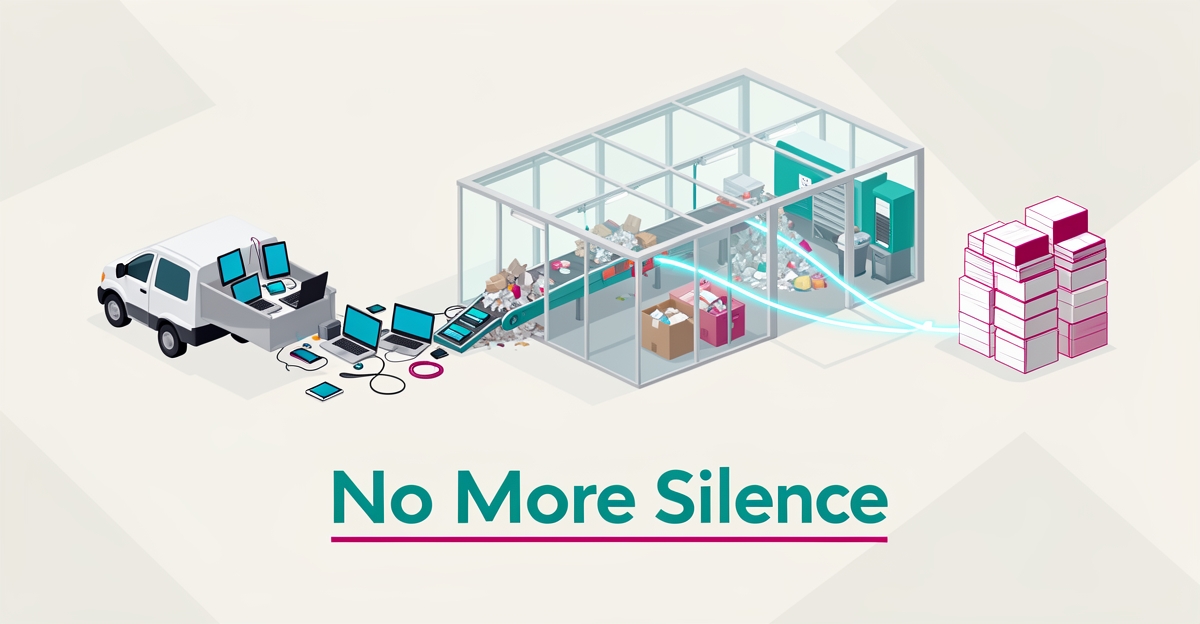
Key facts
- The world generated 57.4 million metric tonnes of e-waste in 2021–22, and that figure is on track to nearly double to 74.7 million tonnes by 2030 according to market research.
- Global e-waste recycling rates remain alarmingly low — just 1% in India, 0% in Brazil, 6% in Russia, and only 15–16% in the U.S. and China per industry data.
- Europe leads per-capita e-waste generation at 16.2 kg per person annually, followed by Oceania at 16.1 kg and the Americas at 13.3 kg based on regional analysis.
- Germany, the UK, and France achieve recycling rates of 52%, 57%, and 56% respectively — far outpacing the U.S. at 15% and China at 16% per country-level data.
- The global electronic recycling market was valued at USD 37.55 billion in 2023 and is projected to reach USD 86.71 billion by 2030, growing at a 12.7% CAGR according to market projections.
- Transparency in explaining the recycling process — from pickup to material recovery — is explicitly identified as critical for building customer trust per market research findings.
- CISA guidance states that simple deletion isn't enough; permanent data removal requires disk wiping, secure erase, or physical destruction per federal cybersecurity guidance.
WANT RESULTS LIKE THIS?
Imagine a system doing all of this for your local business — every day, without you.
We build local businesses a custom website with a team of AI behind it: every lead captured and followed up, new content published monthly,customers finding you on Google — live in 7 days.
- 85+ pages at launch
- Every lead followed up, automatically
- Your whole business on one screen
The Trust Gap That's Costing You Customers
Most recycling businesses hand a customer a receipt at pickup and never explain what happens next. That silence creates a vacuum — and customers fill it with doubt.
The numbers make the stakes clear. The world generated 57.4 million metric tonnes of e-waste in 2021–22, and that figure is on track to nearly double to 74.7 million tonnes by 2030. Yet recycling rates in major economies remain alarmingly low — just 1% in India, 0% in Brazil, 6% in Russia, and only 15–16% in the U.S. and China. The gap between volume and recovery isn't just an environmental problem; it's a trust problem.
Research from multiple sources confirms the same pattern: businesses that don't clearly communicate what happens after pickup — from shredding and data destruction to material and energy recovery — lose customers to competitors who do. Transparency in explaining the recycling process is explicitly identified as critical for building customer trust, while a lack of transparency creates a trust gap that drives customer loss. Federal guidance reinforces this: openness about post-pickup processes builds trust and encourages proper disposal behaviors.
The trust gap shows up in three places where silence costs you:
- Data security concerns — customers don't know if their devices are wiped, shredded, or simply resold
- Environmental skepticism — without proof of responsible recovery, they assume landfill or export
- ESG pressure — business clients need documented chain-of-custody for their own compliance reporting
Proper e-waste disposal is now tied directly to ESG goals and business reputation, making transparency a competitive requirement, not a nice-to-have. AI Business Sites helps recycling companies close this gap by automating personalized, real-time explanations of post-pickup processes on their websites — turning a trust liability into a conversion asset.
Why Transparency Wins: Data Security Meets Environmental Responsibility
Two concerns dominate every conversation about old electronics: what happens to the data, and what happens to the planet. Customers don't just want reassurance — they want proof. CISA guidance makes clear that simple deletion isn't enough; permanent data removal requires disk wiping, secure erase, or physical destruction. At the same time, ESG compliance demands environmentally responsible recycling, not landfill diversion. Businesses that address both transparently convert hesitant prospects; those that don't lose them to competitors who do.
The stakes are measurable. Europe generates 16.2 kg of e-waste per person annually, while the Americas produce 13.3 kg — the highest per-capita rates globally, according to market research. These regions face the sharpest regulatory scrutiny and the most informed customers. The EPA's National Recycling Strategy targets a 50% recycling rate by 2030, turning transparency from a nice-to-have into a compliance imperative. Companies in high-generation regions can't afford vague promises about "responsible recycling."
Research confirms that recycling businesses lose customers by not clearly communicating what happens after pickup. The trust gap closes when you show, not tell:
- Certificates of data destruction for every device
- Chain-of-custody documentation from pickup to final disposition
- Downstream vendor audits proving material recovery, not export
- Real-time tracking portals customers can access themselves
This level of transparency used to require dedicated compliance teams. AI Business Sites builds websites that automate these explanations in real time — generating personalized process breakdowns, certificates, and tracking links for each pickup. The website becomes the trust layer, not just the marketing layer. When a prospect asks "what actually happens to my old servers?", the answer is already live, specific to their device types, and verifiable. That's how you turn a trust gap into a conversion advantage.
What Transparent Post-Pickup Communication Actually Looks Like
The difference between a customer who books a pickup and one who ghosts your site often comes down to what they see after they click "schedule." Research shows that many recycling businesses lose customers by not clearly communicating what happens to old electronics after collection. Transparency isn't a nice-to-have — it's the trust signal that closes the deal.
Germany, the UK, and France achieve recycling rates of 52%, 57%, and 56% respectively, far outpacing the U.S. at 15% and China at 16%. These European nations share a common thread: transparent systems that show citizens exactly where their devices go. When people understand the journey, they participate. When they don't, devices sit in drawers — or worse, landfills.
- Collection logistics — real-time tracking from doorstep to facility, not a generic "we'll pick it up"
- Data destruction methods — device-specific explanations of wiping, degaussing, or physical shredding, with certification standards named
- Material recovery processes — what percentage of a laptop, phone, or server returns to the supply chain as copper, gold, or rare earth elements
- Energy recovery outcomes — what happens to non-recyclable components, quantified in emissions avoided or energy generated
Generic "we recycle responsibly" copy doesn't cut it. A smartphone follows a different path than a rack server, and customers know it. Proper disposal requires both data sanitization and environmentally responsible recycling to prevent data breaches and environmental harm — and your website must prove you do both, for every device type you accept.
Clear explanations of the recycling process from shredding to energy recovery can close this trust gap, but only if they're current. Processes evolve — new sorting tech, updated certifications, changing downstream partners. Static content becomes misinformation within months. The businesses winning trust today treat their post-pickup page like a live dashboard, not a brochure.
Local business: doing this the old way?
One system replaces the whole pile.
All of it — the website, the follow-up, the content, the leads — built and run for you for $1,497 + $497/mo. Month-to-month, and you own everything.
See what your build includesAutomating Transparency Without Adding Workload
Most recycling businesses know they need to explain what happens after pickup — but writing and maintaining those explanations for every device type is a full-time job nobody has. The trust gap research is clear: companies that don't transparently communicate post-pickup processes lose customers, while the global e-waste market grows toward $86.71 billion by 2030.
AI Business Sites handles this automatically. The platform generates device-specific process pages that explain exactly what happens to laptops, phones, servers, and monitors — from shredding and data destruction to material recovery and energy recovery — without you writing a single word. Each page is grounded in your actual facility capabilities and certifications, not generic industry boilerplate.
- Auto-links related content so visitors flow from "what happens to hard drives" to "our R2 certification" to "schedule a pickup" without manual cross-linking
- Updates explanations when your recycling methods advance — new sorting tech, new recovery rates, new compliance standards — keeping every page current automatically
- Replaces the need for separate content agencies, SEO tools, and manual website updates while you stay in control via human-in-the-loop review
The AI assistant researches, writes, and publishes this content monthly, building the topical clusters Google rewards. You review and approve before anything goes live — full control, zero busywork. As federal guidance emphasizes, transparency about shredding, data destruction, and material recovery builds the trust that drives proper disposal behavior. Your website now delivers that transparency at scale, automatically.
From Trust Gap to Conversion: Measuring the Impact
From Trust Gap to Conversion: Measuring the Impact
A profound trust gap exists in the electronics recycling industry, where businesses often fail to clearly communicate what happens to old electronics after pickup, leading to lost customers. Research from Maximize Market Research and Compucycle underscores that transparency in post-pickup processes—from shredding to energy recovery—is pivotal in building customer trust and driving conversion rates. CISA further emphasizes the importance of transparency in ensuring data security and environmental responsibility, advising that proper disposal requires both data sanitization (through methods like disk wiping or physical destruction) and environmentally responsible recycling.
- The global electronic recycling market, valued at USD 37.55 billion in 2023, is projected to reach USD 86.71 billion by 2030 (Maximize Market Research), indicating a growing demand for responsible e-waste management.
- Despite this growth, e-waste recycling rates remain alarmingly low globally, with countries like Brazil and India recycling 0% and 1% of their e-waste, respectively (Maximize Market Research).
- Transparency in explaining the recycling process is identified as a critical factor in building customer trust, with many businesses losing customers due to a lack of clear communication (Compucycle, Maximizemarketresearch).
Businesses can close this trust gap by providing clear, detailed explanations of their post-pickup processes on their websites. Reworld highlights that proper e-waste disposal is crucial for meeting Environmental, Social, and Governance (ESG) goals, directly impacting business reputation and customer trust. Key transparency stages to include are:
- Detailed Process Overview: From pickup to material recovery, including data destruction methods.
- Data Security Measures: Explaining disk wiping, secure erase, or physical destruction to alleviate security concerns.
- Environmental Impact: Highlighting recycling and energy recovery processes to demonstrate sustainability.
Websites that incorporate these transparency measures see a reduction in customer hesitation and an increase in conversion rates. AI Business Sites, by automating personalized explanations of post-pickup processes in real time, empowers recycling businesses to build trust seamlessly. For example, a website explaining how devices are securely shredded and materials are recycled can reassure customers about both data protection and environmental responsibility.
- Audit Your Current Site: Evaluate the transparency of your post-pickup process explanations.
- Systematically Build Transparency: Incorporate the identified stages, leveraging technological capabilities for engaging content (e.g., videos of recycling facilities).
- Align with ESG and Regulatory Frameworks: Frame transparency efforts within the context of meeting ESG goals and regulatory standards (like the U.S. EPA’s National Recycling Strategy).
By doing so, electronics recycling businesses can transform their websites from passive platforms into active trust-building assets, directly influencing customer acquisition and conversion rates.
Example of Transparency in Action: A recycling business in Europe, where per capita e-waste generation is highest, could detail on its website how it ensures 16.2 kg/person of e-waste is properly recycled, including specific data destruction and material recovery steps, thereby addressing regional concerns and building trust.
Bold Highlights:
- Transparency in recycling processes increases customer trust and conversions.
- Websites are the primary trust-building asset for e-waste recycling businesses.
- AI-driven platforms like AI Business Sites can automate transparency, reducing customer hesitation.
Frequently Asked Questions
Why don't customers trust recycling companies when they pick up old electronics?
What specific proof do customers want to see about what happens to their old devices after pickup?
How does transparency in the recycling process actually affect customer behavior and business outcomes?
Is it enough to say we 'recycle responsibly' on our website, or do customers need more detail?
What are the real risks if a recycling business doesn’t explain what happens after pickup?
How can a small recycling business provide transparent post-pickup explanations without hiring a content team?
Key Takeaways
{ "title": "The Trust Equation: What Happens After Pickup Determines What Happens Before It", "content": "The data is unambiguous: 57.4 million metric tonnes of e-waste generated globally in 2021–22, projected to nearly double by 2030, yet recycling rates stall at 15% in the U.S. and 16% in Chin
FOR local businesss — BUILT AND RUN BY US
Your website. Your content. Your leads. Your data.
$500 starts your build. Seven days later it's live — chat, booking, follow-up, and your Google presence all set up. Then we run it, every month. You do the work you actually get paid for.