
Key facts
- Halifax's GDP grew 2.3% in 2025, the second-highest rate among benchmark cities according to Halifax Partnership's economic report
- Nova Scotia's digital economy accounts for over 11% of provincial GDP and employs roughly 37,000 people per Digital Nova Scotia's landmark study
- Halifax manufacturing sales increased 1.9% in 2025, driven by a 2.4% jump in durable goods per Halifax Partnership data
- Halifax created an estimated 1,235 foreign direct investment jobs in 2025 as reported by Halifax Partnership
- Nova Scotia's technology sector unemployment rate in the tech industry is 1.7%, indicating effectively full employment per Digital Nova Scotia
- Halifax's Business Confidence Index increased 5.2 points year-over-year in 2026, the largest single-year increase since 2016 according to Halifax Partnership
- Halifax has 550 exporting firms, an all-time high since 2000 per Halifax Partnership data
WANT RESULTS LIKE THIS?
Imagine a system doing all of this for your local business — every day, without you.
We build local businesses a custom website with a team of AI behind it: every lead captured and followed up, new content published monthly,customers finding you on Google — live in 7 days.
- 85+ pages at launch
- Every lead followed up, automatically
- Your whole business on one screen
Why Local Service Area Visibility is Costing You Clients
Most calibration businesses don't realize how much revenue slips away when potential clients can't instantly confirm you serve their area. A manufacturing manager in Burnside needs a pressure gauge calibrated today — if your website doesn't make it obvious you cover Dartmouth, they'll call someone who does. This invisible barrier costs more than a few missed calls; it erodes the local trust that drives repeat contracts in a relationship-driven industry.
Halifax's economy grew 2.3% in 2025 — the second-highest rate among benchmark cities — with manufacturing sales climbing 1.9% and durable goods jumping 2.4% according to Halifax Partnership's economic report. Meanwhile, the region added 1,235 estimated foreign direct investment jobs and $398.7M in capital expenditure. Every new facility, every expanded production line, every quality compliance requirement creates calibration demand. But the businesses driving this growth — 550 exporting firms at an all-time high — are also the ones rating regulatory environment at a net-negative -21.6 and labor costs at -22.2. They're cost-sensitive, compliance-focused, and they need local partners who understand both.
- Unclear service zones force prospects to guess — and they guess wrong
- Competitors with visible maps capture the "near me" searches you're invisible in
- Seasonal industries like fishing and tourism need year-round calibration support during off-peaks
- Nova Scotia's 11% digital economy share means buyers research online before they ever call
The province's digital economy now accounts for over 11% of GDP and employs roughly 37,000 people across 1,500 tech firms — with Halifax ranked #2 among emerging tech markets in North America. These companies need traceable calibration for test equipment, sensors, and measurement systems. They also research vendors online first. Digital Nova Scotia's landmark study warns that stalled digital growth could cost the province over $450 million in GDP and 2,600 jobs — making reliable local calibration infrastructure more critical than ever.
Market research on Nova Scotia confirms the province's economic duality: Halifax's tech and manufacturing surge contrasts with rural reliance on fisheries, agriculture, and tourism. A calibration provider serving both needs distinct messaging for each zone — not a generic "we serve Nova Scotia" footer. Local providers like Land & Sea Instruments in Dartmouth already anchor their model around facility-based and in-situ service capabilities. The businesses winning this market aren't just technically competent — they're visibly, unmistakably local where it counts.
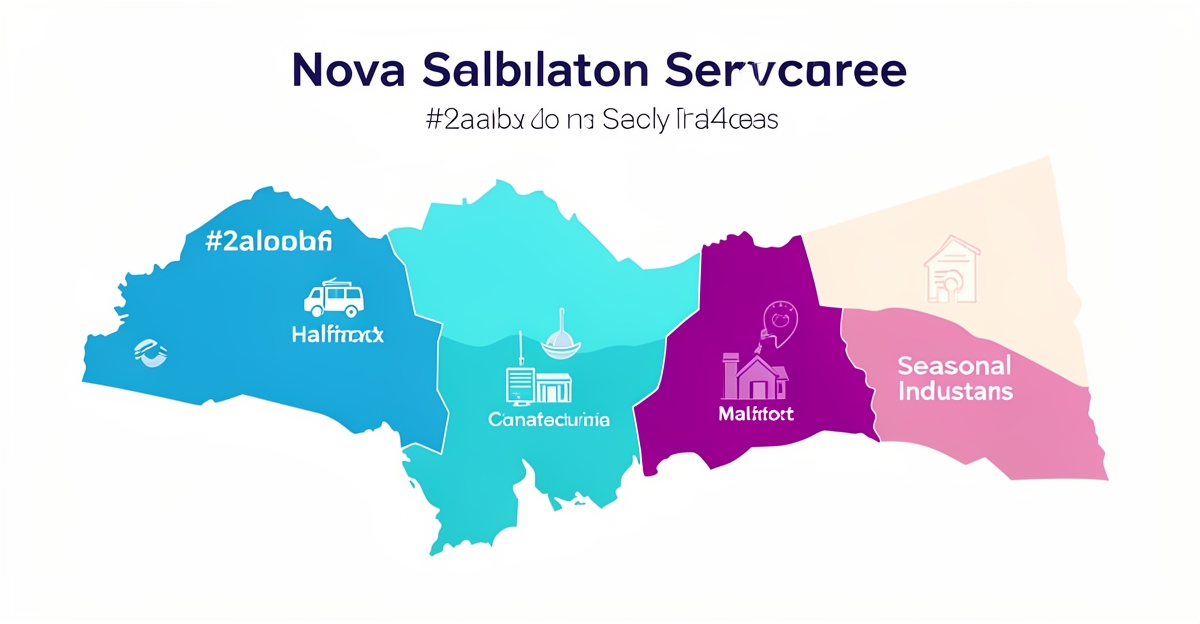
Map Your Exact Service Zones to Match Nova Scotia’s Economic Hotspots
Map Your Exact Service Zones to Match Nova Scotia’s Economic Hotspots
Calibration service businesses in Nova Scotia can significantly boost local client acquisition by strategically aligning their service area maps with the province's economic hubs. Halifax, with its 2.3% GDP growth in 2025 and 1.9% increase in manufacturing sales, emerges as a prime target for calibration services catering to tech and manufacturing sectors (Halifax Partnership, 2025).
By mapping precise service zones around Halifax, businesses can leverage the city's economic resilience and growing industries. For instance, emphasizing quick response times and compliance expertise in service area communications can address the net-negative ratings for the cost of labour and regulatory environment identified as key concerns for Halifax businesses (Halifax Partnership, 2026).
- Halifax (Tech, Manufacturing, Digital Services): Highlight calibration for equipment used in emerging tech, renewable energy, and durable goods manufacturing, leveraging the city's 1,235 estimated FDI jobs created in 2025 (Halifax Partnership, 2025).
- Rural Nova Scotia (Fisheries, Agriculture, Tourism): Focus on seasonal industry needs, positioning calibration services as year-round support for off-season maintenance, a strategy supported by the seasonal fluctuations in tourism and fishing highlighted in market research (SIS International).
-
Dartmouth and Sydney/Cape Breton: While direct data is scarce, calibrating services to mirror the industrial base of these areas (e.g., Dartmouth's manufacturing facilities like Land & Sea Instruments) can fill a visibility gap, with Nova Scotia's digital economy offering a broader context for growth opportunities (Digital Nova Scotia).
-
Leverage Local Presence: Emphasize cost savings of local calibration services to counteract Nova Scotia's Atlantic coast logistics challenges (SIS International).
- Sector-Specific Messaging: Use website service area pages to speak directly to the needs of Halifax's tech/manufacturing sectors versus rural industries, reflecting the province's economic duality (SIS International).
- Visibility for Hidden Gems: Highlight service areas like Dartmouth, despite limited data, by focusing on known industrial activities and the broader digital economy growth indicated by Digital Nova Scotia.
By precisely mapping and communicating service zones in tandem with Nova Scotia's economic landscape, calibration businesses can enhance local trust and attract a higher volume of nearby clients, ultimately driving more targeted lead generation through clear online visibility strategies.
Halifax's economic indicators and Nova Scotia's digital economy report provide foundational insights for this strategic alignment, guiding businesses to stand out in targeted service areas.
Local business: doing this the old way?
One system replaces the whole pile.
All of it — the website, the follow-up, the content, the leads — built and run for you for $1,497 + $497/mo. Month-to-month, and you own everything.
See what your build includesTurn Service Area Pages Into Lead-Generating Machines
A well-structured service area page does more than list towns — it answers the searcher's real question: "Can you actually get to me?" Research shows that Halifax's manufacturing sector grew 1.9% in 2025, driven by durable goods, while the city's GDP rose 2.3% — the second-highest among benchmark cities. That growth means more equipment, more compliance needs, and more local businesses searching for calibration partners who show up.
Start with a clear, interactive map that highlights every community you serve — not just Halifax, but Dartmouth, Bedford, Sackville, and the surrounding corridors. Layer in schema markup for LocalBusiness and ServiceArea so search engines understand your geographic scope without guessing. Pair the map with neighborhood-specific content blocks: typical industries in each zone, common calibration requirements, and realistic response-time estimates. A manufacturer in Burnside needs different messaging than a lab in downtown Halifax.
- Embed a live service-area map with clickable zones linking to hyper-local content
- Add LocalBusiness and ServiceArea schema to every location page
- Include industry-specific calibration examples per neighborhood
- Show real response-time commitments, not vague promises
- Link each zone to relevant case studies or client logos from that area
Internal linking turns these pages into a topical cluster. Connect each service-area page to your core calibration service pages, your Google Business Profile, and any blog posts addressing region-specific regulations. AI Business Sites builds this structure automatically — every new location page gets linked to the most relevant existing content, and older pages gain links to newer ones over time. The result is a site architecture that compounds search visibility without manual effort. When a prospect in Sydney searches "pressure gauge calibration Cape Breton," they land on a page that proves you serve their region, understand their industry, and can respond fast — because the page was built to convert, not just exist.
Automate Your Local Trust Signals to Stay Ahead
Keeping your service area map and local reputation signals accurate across Google, Bing, and your website used to mean hours of manual updates every month. AI-powered automation now handles that busywork in the background — refreshing service zones, monitoring review sentiment, and syncing changes across platforms without you lifting a finger.
Nova Scotia's digital economy has grown to over 11% of provincial GDP, employing roughly 37,000 people across 1,500 technology firms, according to Digital Nova Scotia. With Halifax ranked #2 among emerging tech markets in North America, local search competition is only intensifying. Businesses that automate their trust signals — live service area maps, real-time review feeds, and consistent NAP data — stay visible while competitors rely on stale listings.
The Halifax Partnership's 2025 economic report shows manufacturing sales rebounded 1.9% year-over-year, driven by a 2.4% jump in durable goods — a direct signal of rising calibration demand across the region. This growth means more prospects searching for nearby providers, and automated systems ensure your service boundaries reflect reality the moment you expand to Dartmouth, Sydney, or any new zone.
- Service area maps update automatically when you add or adjust coverage zones
- Google Business Profile reviews sync to your site in real time
- Competitor review monitoring alerts you to sentiment shifts in your market
- Local schema markup stays current without developer involvement
AI Business Sites builds this automation into every website we launch — your service area pages, review widgets, and local business schema update themselves while you focus on calibration work. The platform also tracks competitor reviews weekly so you spot gaps before they affect your rankings.
Frequently Asked Questions
Which areas in Nova Scotia should I focus my calibration service on to get the most local clients?
How can I show local clients I serve their area without sounding vague?
What’s the best way to prove I’m local and trustworthy to nearby businesses?
I’m a small calibration business. Do I really need a detailed service-area page?
How does showing my service area clearly impact my online visibility?
What’s the easiest way to keep my service area updated across my website and Google?
I serve both urban and rural areas. Should I use the same messaging everywhere?
Key Takeaways
```json { "title": "Map Your Way to More Calibration Contracts: A Local Visibility Roadmap for Nova Scotia Businesses", "content": "For calibration service companies in Nova Scotia, the cost of invisible service zones isn't just missed opportunities—it's eroded trust and lost contracts in a prov
FOR local businesss — BUILT AND RUN BY US
Your website. Your content. Your leads. Your data.
$500 starts your build. Seven days later it's live — chat, booking, follow-up, and your Google presence all set up. Then we run it, every month. You do the work you actually get paid for.