
Key facts
- AI-generated ceramic designs could boost sales by 39% but reduce non-AI artist participation by 23% Stanford GSB study
- After AI introduction, image volume in markets surged by 78% while active producers jumped 88% Stanford GSB study
- AI excels at design ideation but cannot assess ceramic material constraints like shrinkage or glaze adhesion Solecasa insights
- Firms like Not Quite Past train AI on Delftware to produce hyper-specific, brand-coherent designs BBC interview
- Human designers retain a creative edge over AI in emotional and artistic appeal evaluations University of Kansas study
- AI-generated outputs may trigger legal claims from creators of training data, warns Stanford GSB Stanford GSB study
- Pottery studios using AI must require human oversight to ensure manufacturability and brand integrity Solecasa insights
WANT RESULTS LIKE THIS?
Imagine a system doing all of this for your local business — every day, without you.
We build local businesses a custom website with a team of AI behind it: every lead captured and followed up, new content published monthly,customers finding you on Google — live in 7 days.
- 85+ pages at launch
- Every lead followed up, automatically
- Your whole business on one screen
The Ceramic Conundrum: AI's Double-Edged Sword for Studios
The Ceramic Conundrum: AI's Double-Edged Sword for Studios
In the pursuit of innovation, pottery studios are faced with a dilemma: should they leverage AI for custom ceramic designs, potentially sacrificing creativity and brand integrity for efficiency? The answer lies in a delicate balance between harnessing AI's capabilities and maintaining the essence of human craftsmanship.
The Efficiency vs. Authenticity Tradeoff
AI can generate unique, personalized ceramic designs in seconds, catering to client input with unprecedented speed. However, a Stanford GSB study reveals that AI-generated creative outputs act as substitutes for human-made work, leading to a 23% decline in non-AI artist participation after AI introduction industry research. This substitution effect poses a significant risk to studios relying on human craftsmanship as their unique selling point.
Production Feasibility: The AI Blind Spot
While AI excels in early-stage ideation, it lacks the understanding of ceramic material behavior, such as shrinkage, structural stability, and decoration techniques. Solecasa, a ceramic manufacturer, emphasizes that AI-generated concepts require professional evaluation for manufacturability, highlighting the necessity of human oversight production insights. For instance, AI might design a visually appealing piece with thin walls or complex shapes that are impractical for firing or use.
Legal Risks in the Shadows
The use of AI-trained datasets, potentially including copyrighted designs, exposes studios to legal risks. Stanford GSB researchers warn that creators of training data may claim compensation, suggesting studios should train AI on their own archival designs or public-domain historical styles to mitigate risks legal considerations.
Navigating the Conundrum: Key Strategies
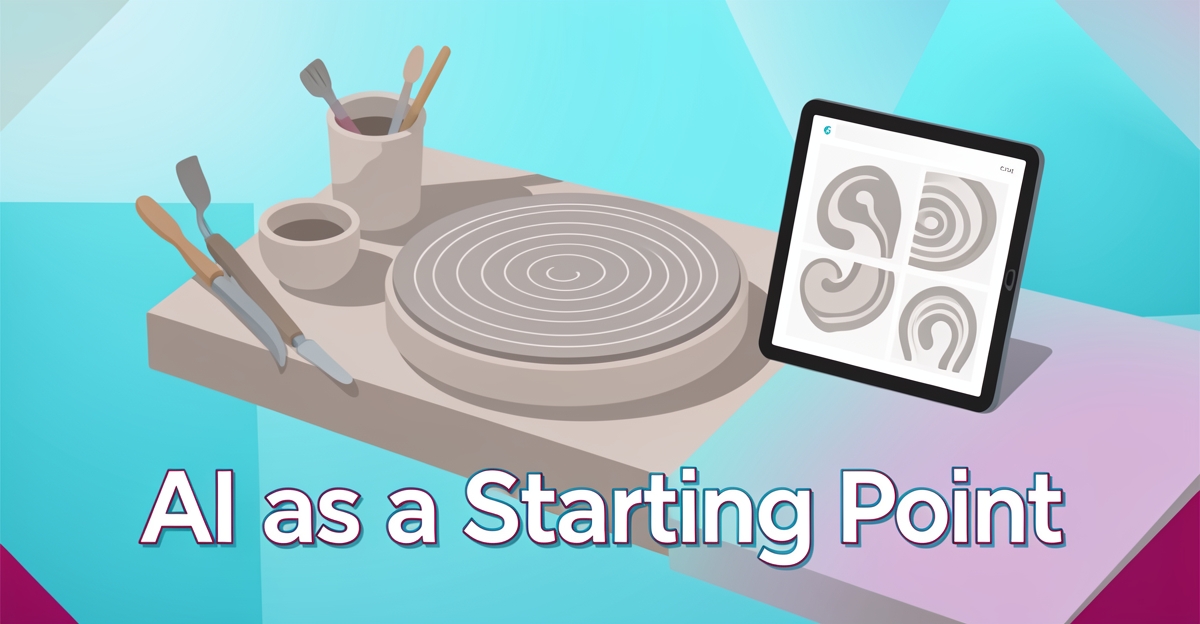
- Transparent Collaboration: Offer AI-generated designs as a starting point, with clear human refinement and approval processes.
- Educate Clients: Clearly communicate the AI-assisted nature of designs to preserve brand integrity and justify premium pricing.
- Mitigate Legal Risks: Train AI on owned or public-domain datasets to avoid copyright issues.
By acknowledging AI's role as a collaborative tool rather than a replacement for human expertise, pottery studios can harness its efficiency while safeguarding creativity and legal safety. As Keith Brymer Jones, ceramicist and judge of The Great Pottery Throw Down, notes, AI is best used to enhance creativity, not replace it expert insight.
Actionable Takeaways for Studios:
- Use AI for rapid ideation, but ensure human oversight for production feasibility.
- Train AI on your brand's historical styles to maintain artistic coherence.
- Clearly disclose AI's role in the design process to clients.
Balancing Act Achieved
For pottery studios, the path forward involves a strategic blend of technological innovation and traditional craftsmanship. By doing so, they can capitalize on AI's efficiency without compromising the unique value proposition that sets them apart in a market increasingly dominated by technology. AI Business Sites, with its integrated AI systems for lead capture and content creation, understands the importance of balancing innovation with the human touch, especially in creative industries.
The future of ceramic design lies not in choosing between AI and human expertise, but in harmoniously combining both.
Evidence-Based Solution: Collaborative AI for Ceramic Designs
Evidence-Based Solution: Collaborative AI for Ceramic Designs
In the pursuit of innovation, pottery studios can leverage AI as a collaborative tool to enhance creativity while mitigating risks. Grounded in research, a balanced approach emerges where AI accelerates design ideation, and human expertise ensures brand integrity and production feasibility.
AI as a Design Accelerator, Not a Replacement Stanford GSB research highlights that AI-generated creative outputs act as substitutes for human-made work in consumer markets, leading to a 39% increase in total sales but a 23% decline in non-AI artist participation source. To navigate this, studios can train AI on brand-specific historical styles (e.g., Delftware) to generate initial designs, which are then refined by human designers. Not Quite Past, a UK firm, successfully employs this method, training AI on Delftware tiles to produce hyper-specific, brand-coherent designs source.
Human-in-the-Loop for Quality Control Given AI's inability to fully understand ceramic material behavior and production constraints, manual review of all AI-generated designs is crucial before client presentation. Solecasa, a ceramic manufacturer, emphasizes that AI-generated concepts require professional evaluation for manufacturability, highlighting the need for human oversight to avoid unproducible designs source.
Key Implementation Strategies:
- Train AI on Archival or Public-Domain Designs to mitigate legal risks associated with copyrighted training data, as warned by Samuel Goldberg of Stanford GSB source.
- Clearly Communicate AI Assistance to clients, offering tiered pricing that reflects the value of human refinement and hand-finishing, a strategy supported by the University of Kansas' findings on the importance of human creative input source.
- Differentiate Through Human Craftsmanship, emphasizing unique glazes, hand-finishing, and the tactile quality of human-made pieces to justify premium pricing, as consumers value transparency and authenticity source.
Naturally Integrated Business Context AI Business Sites, with its expertise in integrating AI into small business operations, can support pottery studios by developing custom websites that not only showcase AI-assisted ceramic designs but also manage client interactions, lead follow-ups, and content generation seamlessly. This holistic approach aligns with the company's mission to build websites that "run themselves day to day," reducing the administrative burden on studio owners.
By embracing AI as a collaborative tool rather than a replacement for human expertise, pottery studios can navigate the creative and legal landscape effectively, offering unique, client-centric ceramic designs that balance innovation with tradition.
Local business: doing this the old way?
One system replaces the whole pile.
All of it — the website, the follow-up, the content, the leads — built and run for you for $1,497 + $497/mo. Month-to-month, and you own everything.
See what your build includesPutting it into Practice: 5 Actionable Strategies for Studios
AI isn’t here to replace your kiln or your hands on the wheel—but it can fire up your workflow when used strategically. The best studios aren’t choosing between AI and artistry; they’re blending the two to serve clients faster while keeping human craftsmanship at the heart of every piece. Here’s how to put it into practice without risking your reputation or your bottom line.
Start by training AI on your own archive, not the open web. A study from Stanford found that when AI-generated images flood the market, total sales rise by 39%—but purchases of non-AI work drop by 23% as consumers default to algorithmic options https://www.gsb.stanford.edu/insights/when-ai-generated-art-enters-market-consumers-win-artists-lose. To avoid becoming part of that trend, studios like Not Quite Past feed AI only their own historical designs—Delftware patterns, signature glazes, and studio motifs—so every AI suggestion stays unmistakably yours https://www.bbc.com/news/articles/cv2gp9j8zzyo. Your website’s AI assistant can then turn client ideas into on-brand concepts in seconds, but the final say always stays with your team.
Next, build in a human gatekeeper. AI excels at early-stage ideation, but it doesn’t know that a 3mm rim will crack in firing or that a particular slip won’t adhere to a textured surface https://www.solecasa.com/turning-ai-generated-tableware-designs/. Make it standard procedure to have a senior potter review every AI output before it reaches a client. This step isn’t just about quality—it’s about protecting your brand’s integrity and your studio’s reputation for durability. Pair it with a simple checklist: Is this manufacturable? Does it reflect our aesthetic? Would clients pay a premium for the hand-finished version? If the answer to any is “no,” send it back for revision or shelve it entirely.
Transparency builds trust—and trust justifies premium pricing. When clients know their design started with AI but was refined by human hands, they’re more likely to value the final, handcrafted result. Market research shows that consumers respond to authenticity; the same Stanford study found that while AI-generated images dominated in volume, human-created work still held emotional and artistic appeal in curated collections https://www.gsb.stanford.edu/insights/when-ai-generated-art-enters-market-consumers-win-artists-lose. Use your website and client communications to clarify the process: “AI helps us brainstorm faster—you get more options, we bring the expertise.” That framing transforms AI from a competitor into a collaborator, letting you charge more for the human touch that follows.
Finally, differentiate with what AI can’t do. Consumers may love AI’s speed, but they’ll pay for the tactile warmth of a brushstroke imperfect, the resonance of a glaze fired just so, the story behind a piece made entirely by hand. Pair AI-generated concept boards with limited-edition runs of hand-thrown, wood-fired, or individually glazed pieces. Offer clients a tiered menu: AI concept + machine-made blank + hand-finished detailing, or full hand-built, one-of-a-kind. This strategy mirrors findings from the University of Kansas, where human evaluators consistently rated designs higher when creative intent aligned with human values—something AI can’t replicate https://news.ku.edu/news/article/experiment-shows-human-designers-retain-creative-edge-over-ai.
- Train AI on your own archival designs to preserve brand identity and avoid legal gray zones.
- Require human review of every AI output to ensure manufacturability and aesthetic cohesion.
- Be transparent with clients about AI’s role to build trust and justify premium pricing.
- Offer tiered services—AI concepts paired with hand-finished or hand-built options—to keep human craftsmanship central.
The studios winning with AI aren’t the ones chasing speed alone—they’re the ones using it to amplify their artistry, not erase it. Your website can be the engine behind that balance, automatically capturing client ideas, generating concepts, and nurturing leads—all while your team focuses on the work only hands can do.
Frequently Asked Questions
Will using AI to generate ceramic designs replace my studio's human artists?
Can AI-generated ceramic designs actually be manufactured, or do they just look good on screen?
Is it legally risky to use AI image generators trained on the open web for my studio's custom designs?
How can I use AI for custom ceramics without losing my studio's unique artistic identity?
Will clients pay premium prices for ceramics if they know AI helped create the design?
What's the most practical way to start using AI for custom ceramic designs in my studio?
Key Takeaways
{ "title": "Harmonizing Art and Efficiency: The Path Forward for Pottery Studios", "content": "As pottery studios navigate the double-edged sword of AI-generated custom ceramics, the path to success lies in strategic balance. By leveraging AI for rapid ideation while maintaining human oversight
FOR local businesss — BUILT AND RUN BY US
Your website. Your content. Your leads. Your data.
$500 starts your build. Seven days later it's live — chat, booking, follow-up, and your Google presence all set up. Then we run it, every month. You do the work you actually get paid for.