
Key facts
- High-skill users of project management software reduce overhead costs by 5% or more in 83% of cases according to Dodge Construction Network and Procore research
- High-skill users increase profit margins by a median of four percentage points, with 77% reporting gains per the Construction.com study
- 76% of high-skill users cut project delays by five or more days according to the same research
- Low-skill users see benefits in only 31–66% of cases versus over 80% for high-skill users proving expertise drives ROI
- A synchronization taking 10 minutes manually happens in seconds with cross-company automation per Exalate workflow automation data
- Doubling workflow volume no longer requires doubling staff with automated cross-company processes according to Exalate
- Integrating design tools with project management platforms eliminates duplicate data entry and syncs revisions instantly per Worksection engineering software analysis
WANT RESULTS LIKE THIS?
Imagine a system doing all of this for your local business — every day, without you.
We build local businesses a custom website with a team of AI behind it: every lead captured and followed up, new content published monthly,customers finding you on Google — live in 7 days.
- 85+ pages at launch
- Every lead followed up, automatically
- Your whole business on one screen
The Hidden Cost of Manual Admin in Growing Firms
As civil engineering firms grow, administrative overhead quietly erodes project margins and pulls engineers off-site — the very work that drives revenue. The problem compounds with scale: every new project adds layers of RFIs, submittals, change orders, and compliance documentation that demand manual routing, tracking, and follow-up.
Research from Dodge Construction Network and Procore reveals a stark divide in outcomes. High-skill users of project management software report overhead cost reductions of 5% or more in 83% of cases, while light users see similar benefits in only 31–66% of cases. Profit margins tell the same story: 77% of high-skill users report margin increases, with a median gain of four percentage points. The difference isn't the software — it's the expertise applied to it.
- Scheduled reports and automated notification sequences eliminate manual status updates for stakeholders
- Integration between design tools, project management platforms, and accounting systems removes duplicate data entry
- Cross-company workflows connect owners, architects, subcontractors, and regulators in real time
Automation isn't a technology upgrade — it's a margin-protection strategy. Firms that pair workflow automation with user training keep engineers in the field where they generate value. Industry research confirms that 76% of high-skill users reduce project delays by five days or more, directly translating to healthier project economics. At AI Business Sites, we see the same pattern: websites that automate scheduled reports and notification sequences free teams from manual data entry so they can focus on delivery.
Why User Expertise — Not Just Software — Determines ROI
Automation tools alone don’t deliver results. The real driver of ROI in civil engineering firms isn’t the software itself—it’s the expertise of the people using it. High-skill users of project management software report measurable benefits across more than 80% of categories, from cost control to schedule performance, while low-skill users see gains in only 31–66% of cases. This stark gap proves that technology is only as effective as the team operating it.
For engineering firms scaling operations, this means automation must be paired with deliberate investment in user training and workflow standardization. Simply deploying scheduled reports or automated notifications won’t move the needle if engineers and project managers lack the skills to configure, interpret, and act on the data. High-skill users, by contrast, unlock compounding returns: 83% reduce overhead costs by 5% or more, 77% increase profit margins (median +4 points), and 76% cut project delays by five or more days. These outcomes aren’t accidental—they stem from deep familiarity with the platform’s capabilities and disciplined use of its automation features.
The multiplier effect of expertise is clear. Firms that treat training as a core component—not an afterthought—see higher adoption rates, fewer errors, and faster realization of efficiency gains. Standardizing workflows post-training ensures consistency across teams, turning individual proficiency into organizational advantage. As one industry expert noted, investing in technology without investing in people leaves potential untapped. For civil engineering firms aiming to keep engineers in the field and off administrative tasks, the path to scalable ROI runs through skill development, not just software deployment.
AI Business Sites supports this approach by embedding automation into the website platform itself—handling routine tasks like client notifications and report generation so engineering teams can focus on higher-value work. But the platform’s true value emerges only when users understand how to leverage it: setting up triggers that match real-world processes, interpreting automated insights, and refining workflows over time. Without that expertise, even the most advanced automation sits idle. With it, firms transform admin overhead into a strategic advantage.
Automate the Workflows That Cross Company Lines
Automate the Workflows That Cross Company Lines
Scaling civil engineering firms often hits a roadblock: administrative bottlenecks that pull engineers away from the field. A critical solution lies in automating workflows that transcend company boundaries, streamlining interactions between owners, architects, subcontractors, and regulators.
The High-Impact Lever: Cross-Company Automation
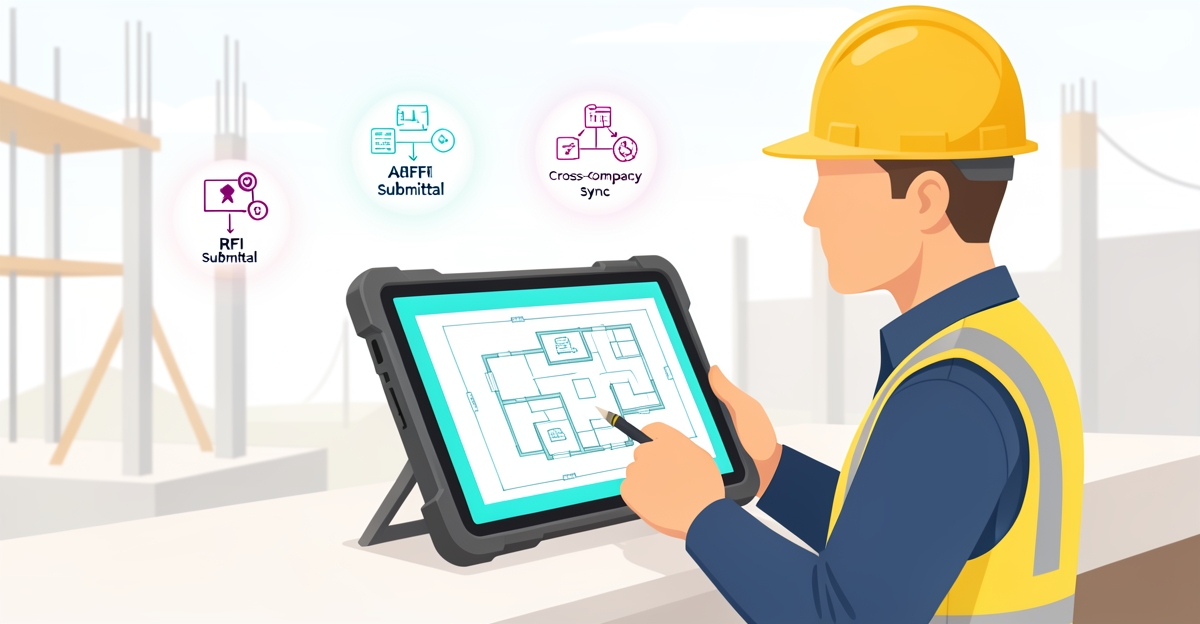
Automating workflows like RFIs, submittals, change orders, and compliance documentation can significantly reduce delays and enhance collaboration. For instance, a synchronization that would take an engineer 10 minutes manually can happen in seconds with automation source. Moreover, doubling the volume of such tasks no longer requires doubling the staff, as automated workflows handle the increase without proportional hiring source.
Key Statistics Highlighting the Need:
- 77% of high-skill users of project management software report increased profit margins (median +4 points) source.
- 76% of high-skill users achieve project delay reductions of at least 5 days source.
- Cross-company automation is identified as the highest-impact opportunity for efficiency gains, particularly in coordinating RFIs, submittals, and change orders across stakeholders source.
Actionable Strategies for Implementation:
- Map External Workflows: Identify top workflows involving external parties (e.g., RFI responses to owners, submittal approvals from architects) and automate them using integration platforms like Exalate.
- Define Sync Rules: Ensure each party controls their data flow while benefiting from real-time updates (e.g., a submittal approved in Autodesk Construction Cloud auto-syncs to the owner’s system).
- Start Small, Scale Fast: Begin with high-volume workflows (e.g., RFI routing) and expand based on ROI, avoiding the complexity of automating everything at once.
The Bottom Line
By focusing on cross-company automation and investing in user expertise, civil engineering firms can reduce overhead, improve margins, and most importantly, keep engineers in the field where they add the most value. As highlighted by Kris Lengieza, VP at Procore, "The data shows that investing in technology alone isn’t enough; it must be paired with an investment in people" source. AI Business Sites' approach to integrating automated workflows into custom website solutions for small businesses, including those in civil engineering, exemplifies how technology can streamline operations without adding complexity.
Further Reading on Automation in Civil Engineering:
Local business: doing this the old way?
One system replaces the whole pile.
All of it — the website, the follow-up, the content, the leads — built and run for you for $1,497 + $497/mo. Month-to-month, and you own everything.
See what your build includesIntegrate Design, PM, and Accounting to Eliminate Double Entry
Integrate Design, PM, and Accounting to Eliminate Double Entry
Scaling civil engineering firms often struggle with administrative overhead, which can erode project margins and distract engineers from fieldwork. A strategic solution is integrating design, project management (PM), and accounting systems to automate repetitive workflows, reducing errors and manual handoffs.
Automated Design Revisions and Project Timelines
By connecting design tools like AutoCAD and Revit with PM platforms such as Procore or Autodesk Construction Cloud, design revisions can auto-sync with project timelines. For instance, changes to a building's structural design in Revit can immediately update the project schedule in Procore, ensuring all stakeholders have the latest information without manual intervention. According to Worksection, integrations between design and PM tools enable seamless updates, reflecting changes in project timelines instantly source.
Streamlining Approved Change Orders to Accounting
Approved change orders can automatically flow from PM software into accounting systems like Unanet or Deltek, eliminating double entry. This integration ensures financial transparency and accuracy, with changes to project scope or costs reflected immediately in financial records. Construction.com highlights that high-skill users of integrated PM software see 77% increases in profit margins (median +4 points) due to reduced errors and improved efficiency source.
Mobile Field Reports for Real-Time Updates
Field reports submitted through mobile devices can auto-update in the PM tool, reducing delays and ensuring real-time project visibility. Exalate emphasizes the importance of cross-company automation, where such integrations can significantly reduce manual effort and improve collaboration across stakeholders source.
- Eliminate Double Entry: Auto-sync design changes, approvals, and field reports across systems.
- Reduce Errors: Minimize miscommunication with real-time updates.
- Increase Efficiency: Free engineers for fieldwork by automating administrative tasks.
By implementing these integrations, civil engineering firms can significantly reduce administrative burdens, enhance collaboration, and keep engineers focused on what matters most—the fieldwork. As Kris Lengieza, VP at Procore, notes, investing in both technology and user expertise is crucial for realizing the full potential of automation source.
AI Business Sites understands the importance of streamlined operations in scaling businesses, offering solutions that integrate seamlessly with existing workflows to reduce overhead and enhance productivity.
Start with Three Workflows, Measure, Then Scale
The fastest way to reclaim engineering hours isn't a new hire — it's a systematic look at where admin work actually lives. Firms that automate repetitive workflows while investing in user expertise see 83% reductions in overhead costs and 77% increases in profit margins, while light users capture benefits in only 31–66% of cases according to Dodge Construction Network and Procore research.
Start by mapping the three to five workflows consuming the most field and office time — typically RFI routing, submittal tracking, change order processing, compliance documentation, and field report submission. For each, define a clear trigger and automated action: an RFI submitted auto-assigns to the discipline lead, logs in the project management tool, and notifies stakeholders; a submittal due date approaching triggers a reminder to the reviewer and updates status automatically. Baseline the hours spent on each workflow today, then measure reductions after automation goes live.
- RFI submitted → auto-assign, log, notify
- Submittal due → reminder sent, status updated
- Change order approved → accounting synced, team alerted
- Compliance deadline → template generated, audit trail created
- Field report filed → mobile entry synced to PM dashboard
The research is clear: automation alone doesn't deliver results. High-skill users of project management software report benefits across more than 80% of measured categories, while low-skill users see gains in barely half. That means the first investment should be power-user training — identify project managers and field leads who can master the platform, then document their workflows as the standard for the firm. AI Business Sites sees this pattern repeatedly: firms that treat training as the multiplier, not the afterthought, move from pilot to scale in weeks instead of months.
Once baseline metrics prove ROI on the core workflows, expand incrementally. Connect design tools (AutoCAD, Revit) so drawing revisions flow instantly into project timelines. Link the PM platform with accounting (Unanet, Deltek) so approved change orders post without manual entry. Then layer in cross-company syncs — owners, architects, subcontractors, regulators — each controlling their own data while status updates flow in real time. A synchronization that takes ten minutes manually happens in seconds, and doubling workflow volume no longer means doubling administrative headcount.
The Field Is Where the Value Lives
Civil engineering firms don't scale by adding more admin staff — they scale by keeping engineers on-site where every hour drives revenue. The research is consistent: high-skill users of project management software see overhead drop by 5% or more in 83% of cases, margins rise a median of four points, and project delays shrink by five days or more. Light users capture a fraction of those gains. The difference isn't the tool; it's the expertise applied to it. Start by automating the three workflows eating the most field time — RFI routing, submittal tracking, change order approvals — then measure the hours reclaimed. Pair that with deliberate power-user training so automation becomes a firm-wide capability, not a pilot project. From there, connect design, PM, and accounting so data flows once and informs everywhere. Finally, extend those workflows across company lines so owners, architects, and regulators stay in sync without manual handoffs. At AI Business Sites, we see the same pattern: websites that automate scheduled reports and notification sequences free teams from manual data entry so they can focus on delivery. The firms that win the next decade won't be the ones with the most software — they'll be the ones whose people know how to make it work. Industry research confirms that 76% of high-skill users reduce project delays by five days or more, directly translating to healthier project economics.
FOR local businesss — BUILT AND RUN BY US
Your website. Your content. Your leads. Your data.
$500 starts your build. Seven days later it's live — chat, booking, follow-up, and your Google presence all set up. Then we run it, every month. You do the work you actually get paid for.