
Key facts
- Rework costs from non-compliance can exceed 10% of project budgets according to industry estimates
- NFPA updates its standards annually per regulatory tracking sources
- ASHRAE standards sometimes see multiple addenda in a single year based on update cycle data
- ICC releases new editions of model codes every 3 years per code update schedules
- Nomic's AI platform supports 380+ building codes and standards as stated in tool capabilities
- PermitFlow raised $54M reflecting growing investment in AI compliance tools per funding announcements
- FORTIFIED home certification adds only 3–10% in cost over minimum code construction per Insurance Institute estimates
WANT RESULTS LIKE THIS?
Imagine a system doing all of this for your local business — every day, without you.
We build local businesses a custom website with a team of AI behind it: every lead captured and followed up, new content published monthly,customers finding you on Google — live in 7 days.
- 85+ pages at launch
- Every lead followed up, automatically
- Your whole business on one screen
The Hidden Dangers of Sole Architect Reliance
The Hidden Dangers of Sole Architect Reliance
Relying exclusively on architects for building code compliance creates significant blind spots in an increasingly fragmented regulatory landscape. While architects bring essential design expertise, they often cannot keep pace with the independent update cycles of model codes, standards, and local amendments that govern construction today.
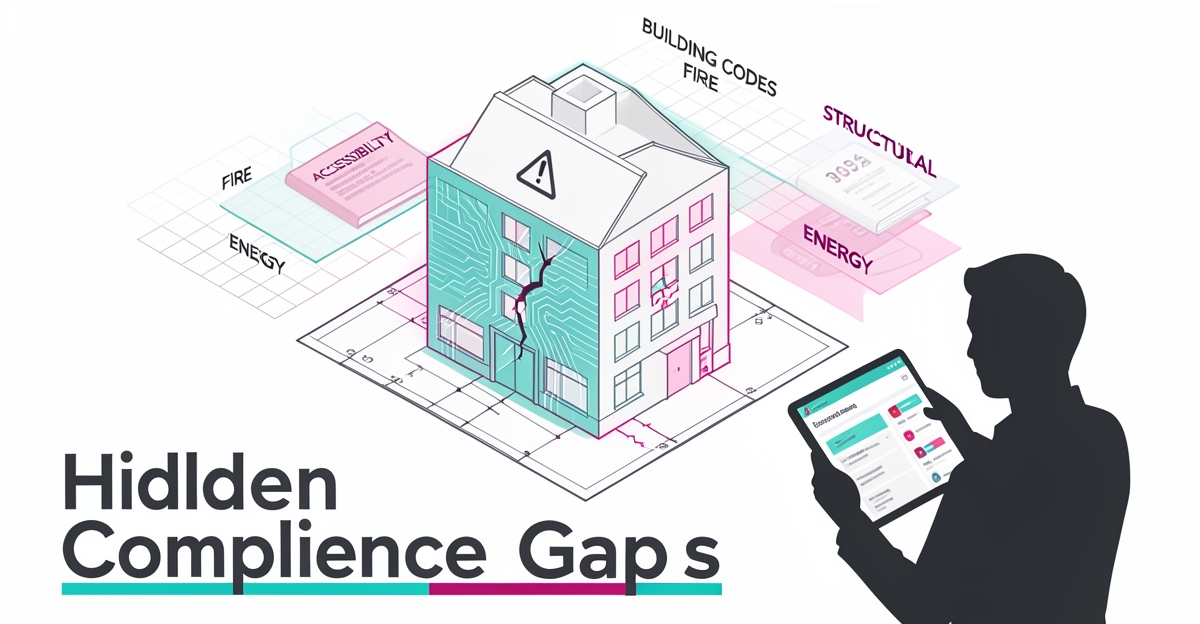
The U.S. building code ecosystem operates as a decentralized network where the International Building Code (IBC) updates every three years, NFPA standards refresh annually, and ASHRAE standards evolve with multiple addenda possible within a single year. This creates a constant stream of changes that are rarely announced publicly by local jurisdictions, meaning critical updates to fire codes, accessibility rules, or energy efficiency requirements can surface only through plan review comments or inspection feedback. As a result, firms depending solely on architectural oversight face heightened risks of permitting delays, redesigns, failed inspections, and construction rework that industry estimates show can exceed 10% of project budgets.
These risks are amplified in complex projects such as multi-use facilities, where simultaneous compliance with OSHA, ADA, IBC, local zoning, and environmental standards like LEED creates layered and sometimes conflicting requirements. Emergency egress, in particular, emerges as a critical pain point requiring nuanced interpretation of occupancy loads and accessibility needs that go beyond standard architectural training. Without dedicated code expertise, teams miss early warnings embedded in AHJ bulletins or plan review templates, leading to costly change orders and potential legal liabilities from non-compliance.
- Tracking dozens of moving pieces of independent code updates across jurisdictions
- Missing localized amendments not publicly announced
- Overlooking high-liability areas like NEC or NFPA 101
- Failing to anticipate jurisdictional variations in fire or energy codes
- Reacting to compliance issues only after plan review failures
AI Business Sites recognizes that mitigating these risks requires more than general design insight—it demands specialized, current knowledge of jurisdictional nuances and update frequencies that only dedicated code compliance focus can provide. By grounding compliance strategy in real-time regulatory awareness, businesses avoid the reactive cycles that turn code oversights into budget overruns and safety concerns.
The Solution: Multi-Disciplinary Compliance with AI
The solution to unreliable code compliance isn’t found in a single discipline—it’s built on a foundation of specialized expertise and smart technology. Forward-thinking firms are moving beyond the outdated model of architects carrying the full compliance burden alone. Instead, they’re creating multi-disciplinary teams where architects collaborate with dedicated code consultants who track the 30+ code families, jurisdictional amendments, and real-time AHJ bulletins that most design teams simply don’t have the bandwidth to monitor. This layered approach doesn’t just reduce gaps—it actively closes them before they become costly mistakes.
At its core, this solution relies on three pillars: specialized human expertise, domain-specific digital tools, and AI-powered automation. Dedicated code consultants bring deep knowledge of high-risk areas like electrical systems (NEC), fire safety (NFPA 101), and energy efficiency (IECC)—domains where even experienced architects often need specialized support. When paired with AI tools that can parse 380+ building codes and standards, cross-reference local amendments, and flag potential conflicts in seconds, the result is a compliance process that’s both faster and more reliable. The industry data backs this up: firms using AI-powered compliance platforms report catching issues earlier, reducing rework costs, and delivering projects with greater confidence in compliance.
The value of this approach is measurable. By integrating code consultants into the workflow, firms avoid the $1.2M+ in rework costs estimated at just 10% of average project budgets. More critically, they reduce exposure to legal liabilities, failed inspections, and schedule overruns that can derail even well-designed projects. When you couple this human expertise with AI tools that automate drawing checks, track jurisdictional variations, and provide real-time code updates, you’re not just mitigating risk—you’re building a repeatable system that scales across projects and jurisdictions.
This isn’t about replacing architects. It’s about giving them the right support to focus on what they do best—designing safe, functional spaces—while specialists handle the complex compliance landscape that no single professional can master alone. For firms serious about delivering compliant projects on time and on budget, the path forward is clear:
- Dedicated code consultants who specialize in the 30+ code families and jurisdictional nuances most architects aren’t trained to track
- AI-powered compliance tools that automate natural language queries, detect cross-code conflicts, and flag AHJ-specific requirements in real time
- Multi-disciplinary collaboration where architects, engineers, and consultants work in parallel—not sequentially—to catch issues before they reach construction
- Proactive design frameworks that exceed minimum code requirements, particularly in high-risk areas like emergency egress and climate resilience
For firms ready to modernize their compliance process, AI Business Sites helps bridge the gap between design intent and regulatory reality. By embedding these capabilities into a website that operates as a business operations platform, teams can ensure every project—from permitting to inspection—benefits from both expert oversight and intelligent automation. The result isn’t just safer buildings. It’s a competitive advantage built on precision, speed, and reliability.
Local business: doing this the old way?
One system replaces the whole pile.
All of it — the website, the follow-up, the content, the leads — built and run for you for $1,497 + $497/mo. Month-to-month, and you own everything.
See what your build includesImplementing Effective Compliance Strategies
The fragmented nature of U.S. building codes — where model codes, NFPA standards, and local amendments update on independent cycles — makes it nearly impossible for any single professional to track every moving piece. Architects bring essential design expertise, but the research shows that specialized knowledge in high-liability areas like electrical systems (NEC), fire safety (NFPA 101), and energy efficiency (IECC) often falls outside standard architectural training. This gap creates measurable risk: rework costs from non-compliance can exceed 10% of project budgets, while permitting delays and failed inspections cascade into schedule impacts and costly change orders.
A multi-disciplinary approach has emerged as the practical standard for complex projects. Dedicated code consultants provide up-to-date jurisdictional knowledge, early identification of compliance issues, and third-party validation that developers, insurers, and municipalities increasingly require for financing and permitting. For multi-use facilities, this collaboration becomes even more critical — these projects must simultaneously satisfy OSHA, ADA, IBC, local zoning laws, and potentially environmental standards like LEED certification, each with distinct requirements that may conflict or overlap. Safety consultants are explicitly recommended as distinct partners alongside architects and contractors to navigate this layered complexity.
AI-powered compliance tools now function as force multipliers for this team-based model. Platforms like Nomic's support 380+ building codes and standards, enabling natural language queries, automated drawing checks, cross-code coordination, and jurisdictional awareness that reduce manual review errors. Firms adopting these tools catch issues earlier, reduce rework costs, and deliver projects with higher confidence in compliance. The investment signal is clear: PermitFlow's $54M raise reflects growing recognition that manual workflows are unsustainable as codes grow more complex and timelines compress.
For small architectural firms and building code consultants looking to implement this approach, the practical steps are straightforward:
- Integrate a dedicated code consultant into the project team from schematic design, not just permit set review
- Adopt AI compliance tools that augment — not replace — professional judgment, focusing on jurisdictional awareness and cross-code conflict detection
- Build proactive design strategies that exceed minimum code requirements, particularly for resilience against climate-related threats
- Establish third-party validation protocols that satisfy developer, insurer, and municipal requirements
AI Business Sites helps specialized consulting firms build websites that showcase this multi-disciplinary expertise while the platform handles the busywork — generating content that explains complex code nuances, capturing leads from developers seeking third-party validation, and following up automatically so no opportunity slips through. The result is a digital presence that positions specialized code compliance as the risk mitigation investment it is, not an optional add-on.
Frequently Asked Questions
Why can't my architect handle all the code compliance for my project?
What are the real risks of relying only on an architect for code compliance?
How do code consultants differ from architects in handling compliance?
Can AI tools replace the need for a code consultant?
Why do developers and insurers require third-party code validation?
Is meeting minimum code requirements enough for long-term building resilience?
The Compliance Advantage You Can Build On
The evidence is clear: relying solely on architects for code compliance leaves gaps that translate directly into permitting delays, failed inspections, and rework costs exceeding 10% of project budgets. The fragmented regulatory landscape — where IBC updates every three years, NFPA standards shift annually, and local amendments appear without public notice — demands specialized, current knowledge that no single discipline can maintain alone. Forward-thinking firms are closing this gap by embedding dedicated code consultants into project teams from schematic design and equipping them with AI tools that parse 380+ codes and standards to flag conflicts and jurisdictional nuances in real time. This multi-disciplinary approach doesn't just reduce risk; it creates a repeatable system that scales across projects and satisfies the third-party validation developers, insurers, and municipalities increasingly require. For firms ready to move from reactive compliance to proactive strategy, the next step is straightforward: integrate a code consultant early, adopt AI tools that augment professional judgment, and build design frameworks that exceed minimums in high-risk areas like emergency egress and climate resilience. AI Business Sites helps specialized consulting firms showcase this expertise through websites that generate leads, explain complex code nuances, and follow up automatically — so your digital presence works as hard as your compliance strategy.
FOR local businesss — BUILT AND RUN BY US
Your website. Your content. Your leads. Your data.
$500 starts your build. Seven days later it's live — chat, booking, follow-up, and your Google presence all set up. Then we run it, every month. You do the work you actually get paid for.