
Key facts
- Small business websites typically take 6 to 12 weeks from kickoff to launch.
- Roughly half of every website project delay comes from the client side — waiting on content, images, and approvals, per industry analysis.
- Businesses that deliver content on schedule launch their websites two to four weeks faster than those that don't.
- AI has compressed average website publish times from eight days to four, according to Wix's State of Websites report.
- 91% of users rewrite AI-generated copy themselves and 69% swap in their own images, a recent industry report found.
- Hiring a designer takes 7–14 weeks while a DIY approach can drag on for 10–20 weeks, according to timeline research.
- The seven-day build delivers 85+ pages at launch — 25–30 hand-crafted core pages plus 60 AI-generated SEO pages — with client approval before anything goes live.
WANT RESULTS LIKE THIS?
Imagine a system doing all of this for your local business — every day, without you.
We build local businesses a custom website with a team of AI behind it: every lead captured and followed up, new content published monthly,customers finding you on Google — live in 7 days.
- 85+ pages at launch
- Every lead followed up, automatically
- Your whole business on one screen
Why Most Website Projects Take Months (And Why That's a Problem)
If you've ever hired an agency to build a website, you already know the drill: a promising kickoff call, an optimistic timeline, and then weeks of silence. Small business sites routinely take 6 to 12 weeks from kickoff to launch, and hiring a designer can stretch the wait to 7–14 weeks — while a DIY approach can drag on for 10–20.
Here's the part most agencies won't tell you: the bottleneck usually isn't the design work. It's you. Industry analysis finds that roughly half of every project delay comes from the client side — waiting on content, images, and approvals. Businesses that deliver everything on schedule launch two to four weeks faster than those that don't.
That puts the owner in an impossible spot. You're running jobs, answering calls, and quoting work — and now a web project needs you to write service descriptions, source photos, and review copy by Friday. Miss the deadline and the whole timeline slips, because the agency can't build pages around content that doesn't exist yet.
The delays also carry a real cost while the clock runs:
- Every week without a live site is a week of missed calls and missed leads — most callers who hit a dead end simply move to the next business
- Competitors keep publishing content and collecting reviews while your project sits in a review queue
- Momentum fades — owners who start excited about a new website often stall out mid-project and never launch at all
Speed alone isn't the answer, though. Agencies warn that highly compressed timelines increase the risk of oversights, and a project promising custom design, a two-week turnaround, and a bargain price is almost always cutting a corner somewhere.
This is the gap a seven-day launch is designed to close. AI has already compressed average website publish times from eight days to four, according to Wix's State of Websites report — but a fast template with no substance isn't a business asset. The model AI Business Sites follows takes a different route: a short kickoff questionnaire, a done-for-you build of 85+ pages in seven days, and your approval before anything goes live. Fast, but nothing skipped — because the research is clear that owners still want the final say on how their brand looks and sounds.
The Seven-Day Launch Timeline, Day by Day
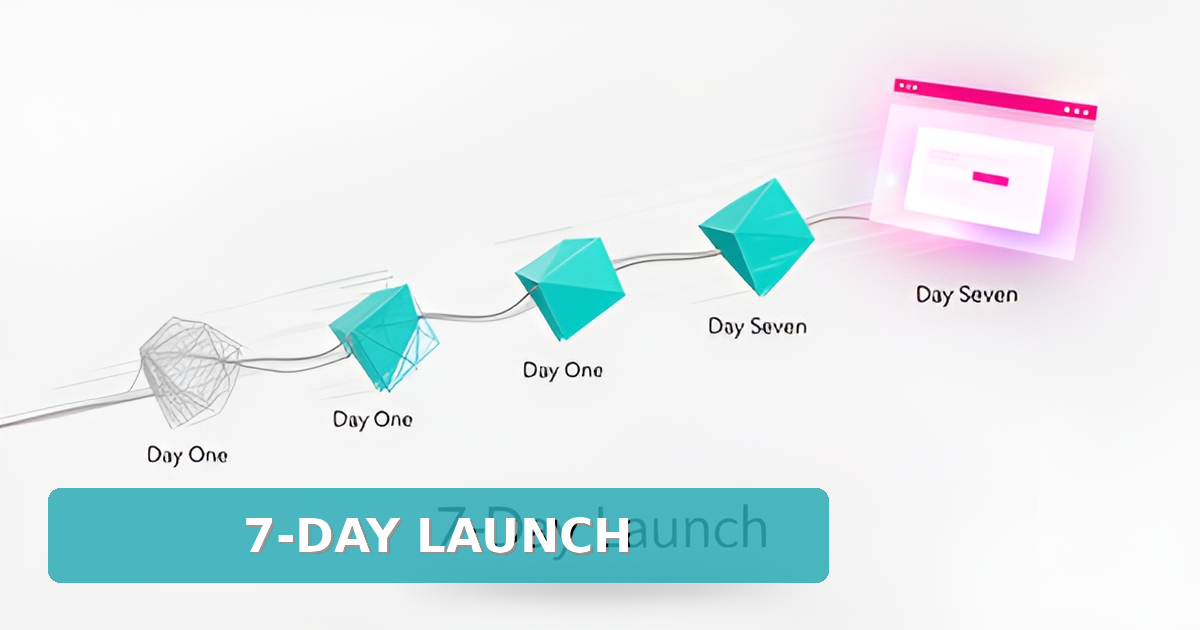
Most professional website builds take weeks of back-and-forth before anything goes live. Industry timelines for a small business site typically run 6–12 weeks from kickoff to launch, according to web design timeline research — which makes a seven-day launch worth explaining in detail.
The process AI Business Sites follows breaks into five clear steps, and the client's workload stays light the entire way.
Step 1: Kickoff. It starts with a $500 deposit that confirms the build slot, plus a short questionnaire about the business, its services, and its customers. That's the only homework. This matters because research shows roughly half of all website delays come from client-side decisions, content, and approvals — businesses that deliver content on schedule launch two to four weeks faster, per Real Web Marketing's analysis. A short questionnaire up front removes that bottleneck entirely.
Step 2: The seven-day build. Over the next week, the AI pipeline designs, writes, and builds the full site — 85+ pages at launch, made up of 25–30 hand-crafted core pages (homepage, about, contact, FAQ, booking, and individual service pages with schema markup) plus 60 AI-generated SEO pages covering service areas and comparisons. The same week covers the Google setup: Business Profile, Search Console, and sitemaps, along with the knowledgebase, FAQ bot, CRM, and automations.
Step 3: Client approval. Nothing goes live until the owner has seen the build. This step matters — a recent industry report found that 91% of users rewrite AI copy themselves and 69% swap in their own images, because people want final say on how their brand looks and sounds. Building that review into the timeline answers the common criticism that compressed builds invite oversights.
Step 4: Launch. The site goes live with lead capture working from day one — forms, chat, and bookings all feeding the CRM instantly — and billing begins.
Step 5: Training and handover. The final step is a full walkthrough of the dashboard and AI assistant, so the owner knows how to run everything — or can simply let the system run itself.
The payment flow mirrors this structure. The $500 deposit comes off the $1,497 setup total, and the remaining $997 isn't due until launch — the client sees the finished work before paying the balance. There's no long stretch of paying for a site that exists only in a project plan.
Local business: doing this the old way?
One system replaces the whole pile.
All of it — the website, the follow-up, the content, the leads — built and run for you for $1,497 + $497/mo. Month-to-month, and you own everything.
See what your build includesFast But Not Rushed: How the 7-Day Build Avoids the Speed-vs-Quality Trap
It's a fair question: if a typical professional website takes three to four weeks, what corners get cut to go live in seven days? Industry observers warn that highly compressed timelines can increase the risk of oversights or technical debt, and that a fast, cheap build almost always sacrifices something. The seven-day process avoids that trap not by working faster at the expense of care, but by removing the things that actually slow builds down — and by putting a human checkpoint in front of launch.
The first safeguard is the client-approval gate. Nothing goes live until the owner has reviewed the finished build. That matters because research on AI-assisted sites shows 91% of users rewrite AI copy themselves and 69% swap in their own images — people want the final say on how their brand looks and sounds. The seven-day model builds that expectation into the process rather than leaving it to chance. At AI Business Sites, the client approves the build before it goes live, and the remaining balance isn't due until after they've seen the work.
The second safeguard is a pre-launch verification checklist. Launch isn't just publishing — it's the moment a site becomes secure, crawlable, trackable, and able to turn visitors into enquiries. Two of the most common launch failures are leaving search-engine indexing disabled and shipping silently broken contact forms, so the checklist covers the unglamorous essentials:
- Search indexing switched on so Google can actually find the site
- Every form tested to confirm leads are captured and delivered
- Google Business Profile configured with the map listing
- Search Console and sitemaps set up so performance is measurable from day one
The third safeguard targets the biggest bottleneck of all: the client. In traditional builds, roughly half of every delay comes from client decisions, content, and approvals — and businesses that deliver content on schedule launch two to four weeks faster. As one web designer puts it, what takes longest is gathering all the information and images needed to build the site. The seven-day process sidesteps this with a minimal-homework kickoff: a deposit plus a short questionnaire about the business, services, and customers, and nothing beyond that. The build team researches and writes everything else.
Speed and quality aren't opposites when the slow parts — waiting on content, chasing approvals, configuring search basics — are handled by design instead of by luck. The seven days are spent building, not waiting.
After Launch: What Happens on Day 8 and Every Day After
Day seven feels like the finish line. It isn't. Launch is a milestone — the moment your site goes live, lead capture starts working, and the real work of growing begins. As one launch checklist for small businesses puts it, a website isn't finished when it looks nice; it's finished when it can be found, tracked, and turning visitors into enquiries. That's what days 8 and beyond are for.
Here's what happens after your site goes live with AI Business Sites. First, you get a full walkthrough of your dashboard and AI assistant — but you're not being handed software to learn. Everything runs through conversation: you can type or talk, ask "which invoices are unpaid?" or "draft a quote for yesterday's call," and skip the menus entirely. The dashboard is there for review, not homework.
Then the content engine takes over. Every month, the system publishes 14+ new SEO content pieces — blog posts, service pages, location pages, and comparison guides — plus daily industry news for your niche. Every piece is keyword-targeted, researched, and linked into your existing pages so Google sees a growing, connected site rather than a static brochure. Each new page also publishes with its own AI-generated featured image, sized and wired for Google Discover.
Behind the scenes, an included SEO team runs a weekly loop — measuring your Google and Bing rankings, tracking whether AI tools like ChatGPT and Perplexity recommend you, refreshing pages that decay, and sending you a growth report with what moved and what's next. Meanwhile, the platform handles the unglamorous essentials:
- Hosting, maintenance, and 24/7 system monitoring
- Instant follow-up on every lead, from every source
- Automated review requests after jobs and payments
- Weekly reports landing in your inbox with plain-language summaries
This matters because most sites stall after launch. Industry research on small business web timelines shows the hard part isn't the build — it's everything that comes after: content that never gets written, follow-up that never happens, pages that quietly decay. A recent report found AI has cut average publish times in half, from eight days to four — but publishing fast means little if nothing grows afterward.
The philosophy is simple: launch is day one of a working system, not the end of a project. Your job is running the business. The system runs the rest — answering, writing, following up, and improving every single day.
If that sounds like the model your business has been missing, book a free strategy call. Thirty minutes, no obligation, no sales pitch — just a real conversation about your website, your goals, and whether this approach fits.
Frequently Asked Questions
How long does a typical small business website actually take to build?
What do I have to do as the client during the seven-day build?
Doesn't a seven-day launch mean corners are getting cut somewhere?
Do I get to review the site before it goes live?
What actually gets built in seven days?
What happens after launch — does the site just sit there?
Seven Days, One Questionnaire, and a Website That Starts Working on Day One
The seven-day timeline works because it removes the things that actually slow websites down: waiting on content, chasing approvals, and hoping the basics get configured. A short kickoff questionnaire replaces weeks of homework. A client-approval gate means nothing goes live until you've seen it — answering the fair concern that compressed builds invite oversights, especially when 91% of owners rewrite AI copy themselves before publishing. And launch is treated as a verification milestone, not just a publish button — indexing on, forms tested, Google presence live. Most importantly, day seven isn't the finish line. The real value is what happens after: 14+ SEO content pieces every month, instant lead follow-up, weekly growth reports, and a system that keeps improving while you run your business. If your current website project has been sitting in a review queue — or never started — the fastest next step is a conversation. Book a free strategy call with AI Business Sites: thirty minutes, no obligation, no sales pitch. Just a straight answer on whether a seven-day launch fits your business.
FOR local businesss — BUILT AND RUN BY US
Your website. Your content. Your leads. Your data.
$500 starts your build. Seven days later it's live — chat, booking, follow-up, and your Google presence all set up. Then we run it, every month. You do the work you actually get paid for.