
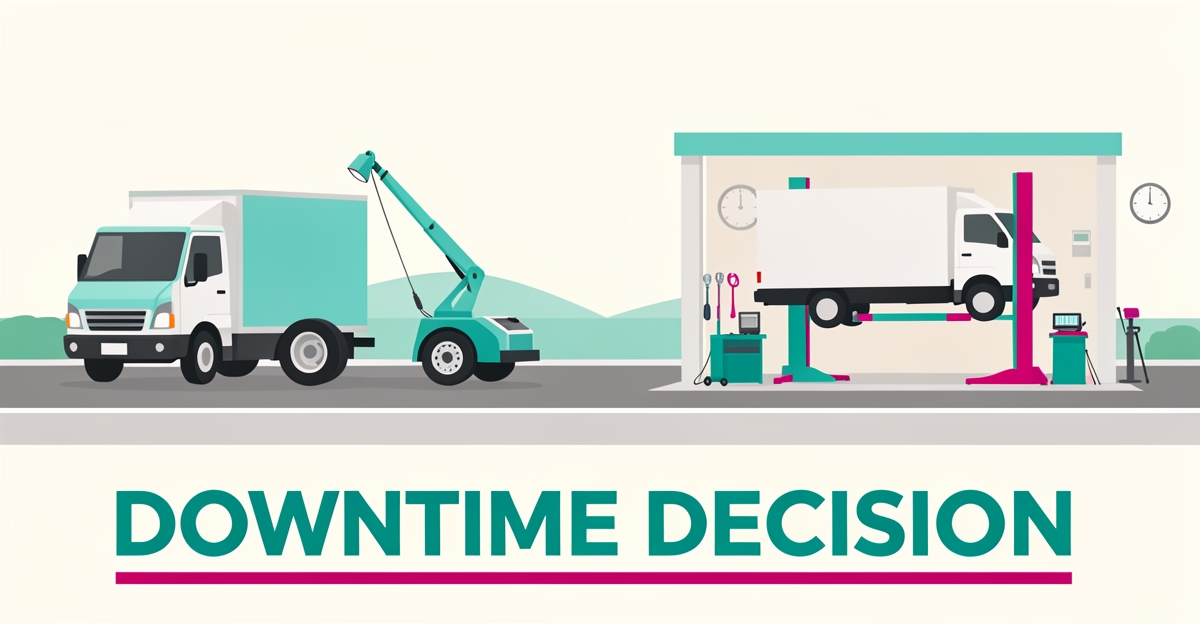
Key facts
- Unscheduled fleet downtime costs $448–$760 per asset daily according to industry research from Geotab.
- Mobile tire units reach disabled equipment within two hours in major metros per Heavy Duty Tires field data.
- Assets aged 4–6 years incur maintenance costs 2.75× higher than newer units per ATRI data cited by Geotab.
- Usage-based maintenance cuts unplanned breakdowns by up to 70% and total ownership cost by 15–25% per Fleet Owner findings.
- Motive customers report up to 62% less equipment downtime after implementing preventive workflows per platform data.
- No publicly documented system manages both mobile dispatch and shop bay availability in one calendar per current market research.
- Motive's platform analyzes 200+ telematics signals to predict maintenance needs before breakdowns occur per vendor specifications.
WANT RESULTS LIKE THIS?
Imagine a system doing all of this for your local business — every day, without you.
We build local businesses a custom website with a team of AI behind it: every lead captured and followed up, new content published monthly,customers finding you on Google — live in 7 days.
- 85+ pages at launch
- Every lead followed up, automatically
- Your whole business on one screen
The Uptime Conundrum: Challenges in Fleet Tire Maintenance
Fleet managers know that tire maintenance isn't just about rubber and pressure—it's a constant battle against costly downtime. Every hour a vehicle sits idle due to a preventable tire issue translates directly into lost revenue, delayed deliveries, and frustrated customers. For regional fleets operating across dispersed job sites or long-haul routes, traditional maintenance approaches often amplify these losses rather than mitigate them. The core problem isn't just the repair itself—it's the time and logistics required to get the equipment to the service point, especially when breakdowns occur far from a shop. Industry research confirms that unscheduled downtime costs between $448 and $760 per asset per day, turning what might seem like a minor tire issue into a significant financial drain when factoring in towing, labor delays, and missed opportunities. This reality pushes fleets toward reactive cycles where maintenance becomes an emergency response rather than a planned operation, eroding both efficiency and predictability.
The inefficiencies of conventional tire maintenance extend beyond immediate repair delays. Calendar-based scheduling, still common in many fleets, fails to account for actual vehicle usage, leading to either unnecessary service visits or missed wear indicators that culminate in breakdowns. As telematics data shows, assets aged 4–6 years incur maintenance costs 2.75 times higher than those in their first three years, largely because wear accumulates unevenly based on route conditions, load weights, and driver behavior—factors a fixed schedule simply cannot capture. When a tire fails unexpectedly, the typical workflow involves dispatching a tow truck, waiting for transport to a shop, diagnosing the issue, ordering parts if needed, performing the repair, and then returning the vehicle to service—a process that can easily stretch from hours to multiple days, particularly in remote areas. This "equipment-to-service" model creates a fundamental bottleneck that mobile tire service directly addresses by reversing the dynamic: bringing the service to the equipment.
Mobile tire providers report reaching disabled equipment within two hours in major metropolitan areas, a dramatic improvement over traditional tow-and-repair timelines. This rapid response capability transforms tire maintenance from a downtime driver into an uptime enabler, especially for fleets managing construction sites, mining operations, or highway corridors where access to shops is limited. Beyond emergencies, mobile units support preventive tasks like pressure checks, tread inspections, and rotations—work that keeps tires in optimal condition without pulling vehicles from revenue-generating duties. However, mobile service has clear limitations: complex procedures such as wheel alignment, casing retreading, or advanced diagnostics still require shop-based equipment and expertise. This creates a natural split in service needs—time-sensitive and preventive work suited for mobile dispatch, and complex repairs demanding shop bays—highlighting the operational challenge of coordinating between two distinct service models without creating scheduling conflicts or visibility gaps.
For logistics managers, the real conundrum lies not in choosing between mobile or in-shop service, but in managing both effectively within a unified operational framework. Current scheduling tools excel at either workshop coordination (integrating leave, rosters, and work orders) or telematics-maintenance synchronization (automating odometer updates for timely PM triggers), yet none document a system that simultaneously tracks mobile technician availability and shop bay allocation in a single calendar. This gap forces fleets to rely on disjointed processes—separate boards, manual handoffs, or overlapping bookings—that increase administrative burden and the risk of double-booking or underutilized resources. The strategic need, therefore, isn't just for faster tire service, but for intelligent scheduling that treats mobile and shop resources as interconnected parts of a single maintenance ecosystem, enabling dynamic assignment based on urgency, location, and asset condition—all while maintaining real-time visibility for decision-makers. AI Business Sites addresses this challenge by building custom websites that include a unified operations platform capable of managing both mobile dispatch and shop bay availability through an integrated calendar, helping fleets turn maintenance coordination from a bottleneck into a streamlined, responsive process.
Mobile Service Advantages & In-Shop Gaps: Evidence from the Field
Mobile tire service delivers measurable downtime reduction for regional fleets by bringing repairs directly to equipment, eliminating delays from towing and transport logistics. Industry research notes that in major metropolitan areas, mobile units often reach disabled equipment within two hours, turning multi-day incidents into same-day resolutions. This rapid response directly counters the financial drain of unscheduled downtime, which costs fleets between $448 and $760 per asset daily when vehicles sit idle awaiting service. For remote job sites or highway breakdowns where towing is slow and expensive, mobile service becomes a strategic necessity rather than a convenience, preserving productivity by keeping assets operational or returning them to service faster.
However, the research reveals a critical limitation: no source documents the full scope of in-shop capabilities that mobile units cannot replicate, such as wheel alignment, tire retreading, or advanced diagnostics requiring specialized equipment. While mobile services excel at emergency response and on-site preventive maintenance like pressure checks and rotations, complex repairs remain shop-dependent. This gap creates a decision point for logistics managers who must balance immediate uptime needs against long-term tire longevity and performance optimization only achievable in a controlled shop environment.
Unified scheduling presents another documented opportunity with clear limitations in current offerings. Telematics-maintenance integrations like NexTraq and Fleetio enable automatic odometer updates, ensuring preventive maintenance triggers align with actual usage rather than arbitrary calendars — a practice shown to reduce unplanned breakdowns by up to 70% and cut total cost of ownership by 15–25%. Similarly, unified workshop schedulers such as Formbird consolidate leave, rosters, service requests, and work orders into a single real-time interface with drag-and-drop functionality and conflict detection. Yet, despite these advances in workshop and telematics integration, no source describes a system that manages both mobile dispatch and shop bay availability in one calendar. The absence of evidenced hybrid scheduling tools means fleets often rely on disjointed processes for allocating resources across mobile and fixed locations.
AI Business Sites addresses this operational fragmentation by embedding unified calendar management directly into fleet service websites. The platform enables logistics coordinators to view mobile technician availability alongside open shop bays in a single interface, allowing real-time reassignment based on urgency, location, and technician skill sets. This capability transforms scheduling from a reactive scramble into a proactive workflow where emergency mobile dispatches and planned shop maintenance coexist without double-booking or visibility gaps. For regional fleets operating across dispersed sites, such integration ensures that the right service reaches the right asset at the right time — whether that means a mobile unit responding to a highway breakdown or a shop bay reserved for a scheduled retread. By consolidating dispatch and bay management, the system reduces administrative overhead while maximizing asset utilization across both service models.
Local business: doing this the old way?
One system replaces the whole pile.
All of it — the website, the follow-up, the content, the leads — built and run for you for $1,497 + $497/mo. Month-to-month, and you own everything.
See what your build includesImplementing a Hybrid Strategy: Practical Steps for Logistics Managers
The research is clear: mobile tire service cuts incident resolution from days to hours by bringing the repair to the equipment, not the other way around. But no single model solves every problem. Logistics managers who treat mobile and in-shop as competing options leave value on the table — the real advantage comes from orchestrating both through a single operational view.
Start by defining the split. Use mobile units for highway emergencies, remote-site breakdowns, and on-premise preventive work — pressure checks, tread-depth inspections, rotations — where every hour of downtime costs $448 to $760 per asset. Reserve shop bays for wheel alignment, retreading, and advanced diagnostics that mobile rigs simply cannot perform. This isn't theoretical; Heavy Duty Tires frames mobile service as a "strategic necessity" for uptime-focused fleets, while the absence of any documented mobile capability for alignment or retreading confirms the shop's irreplaceable role.
Next, connect the scheduling dots. Telematics-maintenance integrations like NexTraq and Fleetio already automate odometer updates so preventive triggers fire on time. Formbird's unified workshop scheduler proves a single calendar can merge leave, rosters, service requests, and work orders with drag-and-drop reassignment and conflict detection. What's missing — and what your operations need — is that same unified view spanning mobile dispatch and shop bay availability in real time.
- Tag every asset with its service profile: mobile-eligible vs. shop-required
- Feed engine hours, mileage, and fault codes into a usage-based scheduler that cuts unplanned breakdowns by up to 70%
- Pre-position mobile units near assets showing early wear signals from 200+ telematics data points
- Auto-generate DVIR-ready documentation whether the work happens roadside or in the bay
- Give drivers and dispatchers one booking interface that shows the next available mobile slot and the next open shop bay side by side
AI Business Sites builds this unified calendar into the website itself — so your team books mobile emergencies and shop appointments in the same view, and your customers see real-time availability without a phone call. The platform's automation layer then routes the work order, alerts the right technician, and logs the compliance record, whether the tire gets swapped on I-80 or aligned in your bay.
Overcoming the Unified Scheduling Challenge with Innovative Solutions
Overcoming the Unified Scheduling Challenge with Innovative Solutions
In the realm of regional fleet management, optimizing maintenance operations is crucial for minimizing downtime and maximizing efficiency. A significant challenge logistics managers face is the lack of a unified scheduling system that seamlessly manages both mobile tire service dispatch and in-shop bay availability. According to industry research, mobile tire service reduces incident resolution time from days to hours, especially critical for remote sites and highway breakdowns source. However, the absence of a unified booking system for both mobile and shop services creates operational inefficiencies.
The Market Gap
Current market offerings provide either unified workshop schedulers (like Formbird's, which integrates leave, rosters, service requests, and work orders in one interface source) or telematics-maintenance integrations (such as NexTraq's integration with Fleetio for automatic odometer updates source). Yet, no publicly documented system manages both mobile dispatch and shop bay availability in a single, unified calendar, highlighting a critical gap in the market.
Innovative Solution with AI Business Sites
AI Business Sites offers a bespoke solution to this challenge through its custom website platforms equipped with an integrated business operations platform. This platform can be configured to manage both mobile tire service dispatch and in-shop maintenance scheduling within one unified calendar. Clients can choose the service that fits their current location through an online booking system seamlessly integrated into the website. For example, logistics managers can:
- Drag-and-drop schedule adjustments between mobile technicians and shop bays based on real-time availability and job requirements.
- Automatically trigger mobile service for on-site preventive maintenance or emergency breakdowns while allocating complex repairs to in-shop bays.
- Generate instant, personalized responses to client inquiries about service availability, streamlining the booking process.
Key Benefits
- Enhanced Efficiency: Real-time visibility and drag-and-drop scheduling across both mobile and shop resources.
- Improved Customer Experience: Transparent service scheduling and instant feedback through the website.
- Data-Driven Decisions: Analytics on service utilization to optimize resource allocation.
Actionable Insight
For regional fleets, adopting a hybrid approach—utilizing mobile services for emergencies and preventive maintenance, while leveraging in-shop capabilities for complex work—is strategically advantageous. However, this strategy's full potential can only be realized with a unified scheduling system. While the market currently lacks publicly available solutions for this specific need, custom platforms like those offered by AI Business Sites can bridge this gap, enabling logistics managers to streamline operations effectively.
Statistics Highlighting the Need
- Unscheduled Downtime Costs: $448 to $760 per asset per day source.
- Breakdown Reduction: Up to 70% through proactive, usage-based maintenance source.
- Adoption of Predictive Maintenance: Leads to up to 62% less equipment downtime source.
By addressing the unified scheduling challenge with innovative, custom solutions, regional fleets can significantly enhance their operational agility and reduce the economic impact of downtime.
Frequently Asked Questions
How much does unplanned downtime actually cost my fleet per day when a vehicle sits idle?
Can mobile tire service handle everything, or do I still need a shop for some repairs?
How fast can a mobile tire unit reach my disabled equipment in a metro area?
Why does calendar-based maintenance scheduling fail for fleets with varied routes and loads?
Is there a scheduling system that manages both mobile dispatch and shop bay availability in one calendar?
How much can usage-based maintenance reduce unplanned breakdowns compared to calendar scheduling?
Key Takeaways
{ "title": "Shifting Gears: Mastering the Mobile-In-Shop Maintenance Paradox for Regional Fleets", "content": "The eternal conundrum of mobile tire service versus in-shop maintenance for regional fleets has been dissected, revealing a clear path forward: embracing a hybrid strategy. By leveraging mo
FOR local businesss — BUILT AND RUN BY US
Your website. Your content. Your leads. Your data.
$500 starts your build. Seven days later it's live — chat, booking, follow-up, and your Google presence all set up. Then we run it, every month. You do the work you actually get paid for.