
Key facts
- Webflow projects often start at $5,000 with most full rebuilds between $15,000 and $60,000 depending on scope according to agency data
- AI builders reduce website creation time from approximately 72 hours to under 15 minutes on leading platforms per market research
- The learning curve for AI website builders averages just 15 minutes compared to 4–8 hours for traditional platforms like Webflow per industry statistics
- Webflow builds regularly achieve sub-second load times and Lighthouse scores exceeding 90 confirmed by agency performance benchmarks
- 67.39% of business owners favor AI-driven builders over traditional ones for enhanced customer experience and operational simplicity per market research
- AI-powered website builder market is projected to reach USD 31.5 billion by 2033 from USD 3.17 billion in 2023 per market forecast
- 98% of small businesses now use AI-enabled tools, with 40% specifically using generative AI for content creation per industry statistics
WANT RESULTS LIKE THIS?
Imagine a system doing all of this for your local business — every day, without you.
We build local businesses a custom website with a team of AI behind it: every lead captured and followed up, new content published monthly,customers finding you on Google — live in 7 days.
- 85+ pages at launch
- Every lead followed up, automatically
- Your whole business on one screen
The Small Business Website Dilemma
The Small Business Website Dilemma
Business owners are questioning Webflow as AI builders promise 95% time savings and 15-minute learning curves. Market pressure is mounting from AI-powered website builders projected to reach $31.5 billion by 2033, with 67% of owners preferring AI-driven tools for enhanced customer experience and operational simplicity. This shift highlights growing frustration with Webflow’s high cost, slow builds, and DIY maintenance compared to managed automation.
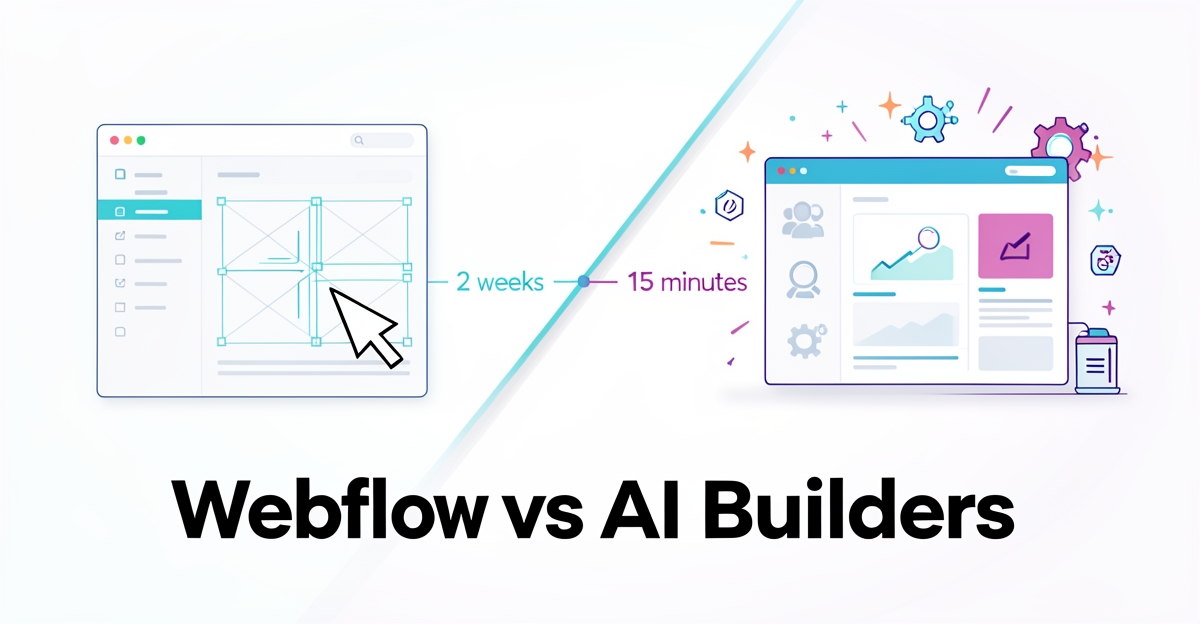
Small businesses face a stark contrast: Webflow projects often start at $5,000 with most full rebuilds landing between $15,000 and $60,000 depending on scope, while AI builders reduce costs by 50–90% for common website types. The time investment is equally divergent—Webflow’s Figma-to-Webflow builds typically ship inside two weeks, whereas leading AI platforms cut website creation time from approximately 72 hours to under 15 minutes. For owners juggling service delivery and client management, this gap isn’t just about convenience—it’s about opportunity cost.
- Webflow requires ongoing technical oversight for updates, hosting, and security—tasks that pull focus from core business operations
- AI-native platforms deliver continuous updates, managed support, and automation as part of a flat monthly fee, eliminating unpredictable maintenance burdens
- The learning curve for AI website builders averages just 15 minutes compared to 4–8 hours for traditional platforms like Webflow
AI Business Sites addresses this tension by combining Webflow’s design sophistication with managed AI automation—delivering production-ready websites that run the business behind them. Rather than choosing between design control and operational ease, owners get a custom site built in 7 days with an AI back office handling content, leads, and follow-up—owned outright, managed entirely, and priced at $1,497 setup plus $497/month. This approach acknowledges Webflow’s relevance for design-focused teams while meeting the urgent need for speed, simplicity, and all-in-one support that defines today’s small business website dilemma.
Where Webflow Still Wins
Where Webflow Still Wins
Despite the rise of AI-powered website builders offering continuous updates and managed support, Webflow retains distinct advantages for specific business needs—particularly where design control, team collaboration, and performance are non-negotiable. Agencies consistently position Webflow as their default choice for B2B websites, citing its approachable CMS and best-in-market editor experience that allows teams to edit content without risking site integrity. Industry experts note that Webflow’s sensible component structure and clean CMS architecture eliminate the "plugin spaghetti" common in traditional platforms, enabling sustainable, long-term maintenance.
Performance remains another key differentiator. Webflow builds regularly achieve sub-second load times and Lighthouse scores exceeding 90—benchmarks critical for user experience and search visibility—especially when deployed for design-sophisticated clients in AI, SaaS, and enterprise sectors. Agency data confirms that most Figma-to-Webflow launches are completed within two weeks, accelerating delivery without sacrificing visual fidelity or functionality. This speed-to-launch capability, combined with production-ready output, makes Webflow ideal for businesses that require pixel-perfect branding and scalable architecture from day one.
For organizations prioritizing long-term partnership over transactional tooling, Webflow’s model supports ongoing collaboration. Unlike AI builders that often abstract away underlying code, Webflow generates clean, standards-compliant HTML, CSS, and JavaScript that any developer can inherit—ensuring clients retain full ownership and flexibility. Client testimonials highlight how teams return repeatedly for updates, redesigns, and expansions, with long-term work comprising over half of some agencies’ pipelines. This enduring value stems from Webflow’s balance of visual development power and developer-friendly output—a middle ground between rigid templates and full custom code. While AI-native platforms excel in speed and automation, Webflow continues to win where visual precision, team editability, and performance-driven design are paramount.
Local business: doing this the old way?
One system replaces the whole pile.
All of it — the website, the follow-up, the content, the leads — built and run for you for $1,497 + $497/mo. Month-to-month, and you own everything.
See what your build includesWhere AI-Native Managed Platforms Pull Ahead
Webflow’s visual development approach remains strong for teams that prioritize design control and collaborative editing, but AI-native managed platforms are redefining expectations for speed, automation, and ongoing support. These platforms offer continuous updates, built-in AI agents, and fully managed infrastructure—eliminating the need for users to maintain integrations, monitor performance, or handle content pipelines themselves. For small and mid-sized businesses, this shift translates into tangible advantages: AI builders reduce website development costs by 50–90% compared to traditional or visual development tools, while cutting build time from an average of 72 hours to under 15 minutes on leading platforms.
This efficiency is driving rapid adoption, particularly among SMEs seeking all-in-one solutions that minimize technical overhead. Research shows 98% of small businesses now use AI-enabled tools, with 68% of AI website builder platforms offering generative AI-powered content creation as of 2026—up from just 21% in 2022. These capabilities allow platforms like AI Business Sites to automate not only site launches but also ongoing operations: publishing 14+ SEO-optimized content pieces monthly, managing lead capture and follow-up, running AI-powered chat and voice agents, and handling invoicing and review requests—all within a single managed subscription.
Unlike Webflow, where users remain responsible for connecting third-party tools, updating content, and monitoring site health, AI-native managed platforms treat the website as part of a broader business operating system. The AI assistant doesn’t just build pages—it delegates tasks to sub-agents, verifies claims in comparison pages, and updates content based on real-time industry news. This done-for-you model removes the dependency on builder expertise, letting business owners focus on operations rather than website maintenance. As a result, SMEs increasingly favor cloud-based platforms that deliver not just a site, but a continuously improving AI-backed system—live in days, owned by the client, and managed entirely by the provider.
Choosing the Right Fit for Your Business
Choosing the right platform comes down to who will own the work after launch and how fast you need the business to run, not just how it looks.
Webflow maintains relevance for design-first B2B teams that need visual control and team editability without developer dependency. Agencies position it as the default for B2B websites because the CMS is approachable and the editor experience is best in market, with builds that let teams edit without breaking anything. That control pairs with proven performance, with agencies citing sub-second loads and 90+ Lighthouse scores and Figma to Webflow builds shipped inside two weeks.
The broader market is moving toward managed automation. The AI-powered website builder market is projected to reach USD 31.5 billion by 2033 from USD 3.17 billion in 2023, representing a CAGR of 25.80% from 2024–2033. Business owner preference shows 67.39% favor AI-driven builders over traditional ones for enhanced customer experience and operational simplicity. Small business AI adoption is widespread, with 98% using AI-enabled tools and 40% specifically using generative AI for content creation.
For small businesses that want a running system, not a design project, the trade is speed and ownership versus control. AI builders are disrupting timelines, reducing costs by 50–90% for common website types and offering 95% time savings for businesses needing rapid launches. The learning curve for AI website builders averages just 15 minutes compared to 4–8 hours for traditional platforms.
That is where AI Business Sites fits. It is built for owners who need a custom website plus an AI back office that answers, writes, sells and remembers the business, live in 7 days with 85+ pages, 14+ new SEO pieces monthly, and jobs, quotes, scheduling and invoicing included. The model is one setup fee and one monthly fee, month-to-month, with client ownership of code, content and data.
Choose Webflow when the priority is:
- Design-first B2B teams that want visual control and team editability without plugin spaghetti
- Agencies and internal marketing teams comfortable managing a CMS and per-seat SaaS stack
- Long-term brand sites where rebuild cycles and component governance matter more than day-one automation
Choose a done-for-you AI operating system when the priority is a business that runs itself. AI Business Sites replaces the patchwork of website builder, CRM, chatbot, content engine and field-service tools with one price and managed support. You get continuous updates, automation and managed support instead of assembling and babysitting tools yourself.
Frequently Asked Questions
Is Webflow still worth using in 2026?
How much does Webflow cost compared to AI website builders?
How long does it take to build a website with Webflow versus AI builders?
Is Webflow too complicated for small business owners?
Who should choose Webflow over an AI website builder?
What do AI website builders offer that Webflow doesn't?
Where Your Website Should Take You Next
The choice between Webflow and AI-powered platforms isn’t about which tool is better—it’s about what your business needs most right now. Webflow remains a strong fit for teams that value design control, collaborative editing, and long-term scalability, especially in B2B or performance-critical contexts. But for owners who want a website that actively runs their business—capturing leads, following up, publishing content, and managing operations without constant oversight—AI-native managed solutions like AI Business Sites deliver speed, simplicity, and all-in-one support at a fraction of the time and cost. With 98% of small businesses already using AI-enabled tools and AI website builders cutting launch time from 72 hours to under 15 minutes, the shift toward managed automation is clear. If you’re ready to stop maintaining a website and start growing your business, book a free strategy call to see how a done-for-you AI operating system could work for you—schedule your no-obligation conversation today.
FOR local businesss — BUILT AND RUN BY US
Your website. Your content. Your leads. Your data.
$500 starts your build. Seven days later it's live — chat, booking, follow-up, and your Google presence all set up. Then we run it, every month. You do the work you actually get paid for.