
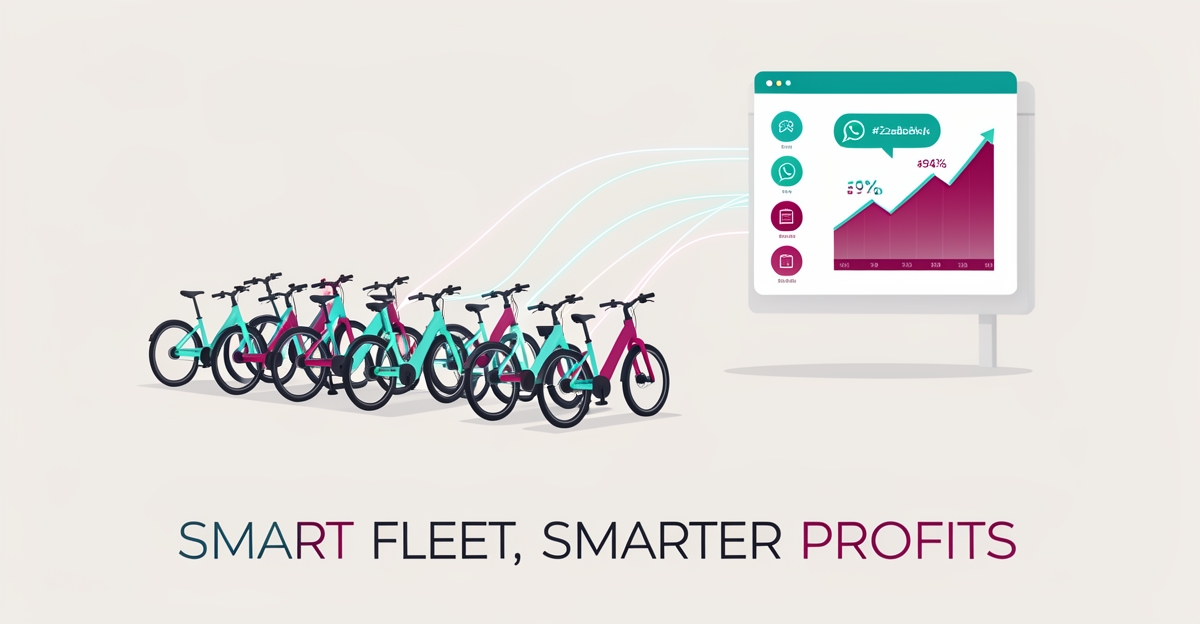
Key facts
- ["The e-bike rental market is projected to reach **$25.3 billion by 2035**, growing at a **13.94% CAGR** according to MarketResearchFuture.", "Asia-Pacific is the **fastest-growing region** for e-bike rentals, driving demand for streamlined operational solutions MarketResearchFuture reports.", "Up to **40% of routine tasks** in e-bike rentals can be automated, reducing operational complexity as noted by Serif.ai.", "E-bike rental businesses take **12-18 months** to become profitable, emphasizing the need for efficient operational systems Serif.ai highlights.", "Platforms like **WorCo** unify fleet tracking, damage documentation, and dynamic pricing, addressing key operational pain points as demonstrated by WorCo's features.", "WhatsApp and Telegram are **dominant booking channels** in tourist-heavy e-bike rental markets, necessitating messenger-first CRM strategies WorCo's experience shows.", "The e-bike rental market faces a **critical gap in ROI data** for AI-powered CRM investments, despite strong operational logic for adoption research indicates."]
WANT RESULTS LIKE THIS?
Imagine a system doing all of this for your local business — every day, without you.
We build local businesses a custom website with a team of AI behind it: every lead captured and followed up, new content published monthly,customers finding you on Google — live in 7 days.
- 85+ pages at launch
- Every lead followed up, automatically
- Your whole business on one screen
Introduction
Is It Worth Investing in an AI-Powered CRM for Your E-Bike Rental Business?
As the e-bike rental market surges towards projected revenues of $4.9 billion by 2025 (growing at a CAGR of 16.3%) and $25.3 billion by 2035, the operational complexity of managing bookings, fleets, and customer interactions is escalating. For e-bike rental businesses, especially those in tourist-heavy areas like Bali, Spain, and Thailand, the challenge lies in streamlining these processes to capitalize on growth.
The Operational Case for AI-Powered CRM
Platforms like WorCo demonstrate the potential of AI-powered CRM solutions, offering 24/7 multilingual support via WhatsApp and Telegram, automated booking conversion, and unified customer profiles. Such systems address key pain points:
- Booking Conflicts: Automated management across channels.
- Damage Disputes: Photo-based damage documentation.
- Invisible Fleet Status: Real-time fleet tracking.
Key Statistics Highlighting the Need:
- Automation Potential: Up to 40% of routine tasks can be automated (Serif.ai).
- Market Growth: Asia-Pacific is the fastest-growing region for e-bike rentals (MarketResearchFuture).
- Startup Challenges: E-bike rental businesses take 12-18 months to become profitable (Serif.ai).
Operational Logic Over Proven ROI
While no direct ROI metrics for AI-powered CRM in e-bike rentals are available, the operational benefits are compelling:
- Unified Platforms: Essential for managing fleet, damage, and customer data in one place.
- Messenger-First Approach: Critical for tourist markets dominated by WhatsApp and Telegram bookings.
- Dynamic Pricing: Automates adjustments for peak seasons (e.g., Bali’s July-August and December-January peaks).
Recommendation for E-Bike Rental Businesses
Given the market context and operational efficiencies: 1. Prioritize Messenger Integration for tourist-heavy markets. 2. Demand Unified Platforms that consolidate operations. 3. Leverage AI for Routine Inquiries to reduce staff burden. 4. Seek Verified ROI Data before committing to an AI-powered CRM.
Conclusion
Though specific ROI data for AI-powered CRM in e-bike rentals is lacking, the market's growth trajectory and operational complexities make a strong case for investing in unified, AI-enhanced systems. As the industry evolves, businesses that adapt with technology are likely to outperform those relying on fragmented tools.
Actionable Insights for E-Bike Rental Owners:
- Adopt a messenger-first CRM strategy for immediate operational gains.
- Ensure your platform supports seasonal and dynamic pricing automation.
- Insist on case studies with measurable outcomes from potential CRM vendors.
By focusing on operational efficiency and customer experience through AI-powered solutions, e-bike rental businesses can better navigate the challenges of a rapidly expanding market.
Learn more about how AI Business Sites helps small businesses like yours streamline operations and enhance customer engagement through custom, AI-driven websites.
Key Concepts
Is It Worth Investing in an AI-Powered CRM for Your E-Bike Rental Business?
Key Concepts
The e-bike rental market is booming, projected to reach $4.9 billion by 2025, growing at a CAGR of 16.3% source. As this industry expands, operational complexity increases, making the case for AI-powered CRM solutions more compelling. Platforms like WorCo demonstrate the value of unified systems, handling bookings, fleet management, and customer communication in one dashboard source.
- 24/7 Customer Support: AI assistants can handle routine inquiries about pricing and availability 24/7, reducing staff workload. For example, WorCo's AI-powered chatbot answers common questions, freeing staff to focus on bookings source.
- Unified Management: Integrating fleet tracking, damage documentation, and dynamic pricing into a CRM reduces operational friction. WorCo's platform, for instance, tracks fleet status and automates seasonal pricing adjustments source.
- Automation Potential: Up to 40% of routine tasks can be automated source, suggesting significant labor savings.
- Messenger-First Approach: Prioritize CRMs with native WhatsApp/Telegram integration for tourist-heavy markets, as seen with WorCo's success in regions like Bali and Spain source.
- Dynamic Pricing: Ensure CRMs support configurable seasonal pricing to maximize revenue during peak seasons (e.g., July-August in Bali) source.
- ROI Transparency: Demand case studies with measurable outcomes from vendors due to the lack of publicly available ROI data for AI-powered CRMs in this sector.
Given the market's rapid growth and the operational challenges faced by e-bike rental businesses, investing in an AI-powered CRM can offer a competitive edge. However, the decision should be guided by the availability of verifiable ROI data, which is currently lacking. AI Business Sites, with its expertise in building integrated business platforms, can help navigate this decision by emphasizing the operational logic and market trends that suggest a strong potential for unified, AI-enhanced systems to improve efficiency and customer retention.
Note on ROI Data Gap: While platforms like WorCo offer promising operational solutions, the absence of specific ROI metrics, customer retention improvements, or revenue impact data for AI-powered CRMs in e-bike rentals means investments should be approached with a cautious, wait-and-see attitude until more concrete evidence emerges.
Best Practices
The e-bike rental market is projected to reach $25.3 billion by 2035 at a 13.94% CAGR, yet most operators still rely on spreadsheets and scattered messaging apps to manage growth. Market research confirms this expansion, while platform analysis shows that messenger-first booking channels like WhatsApp and Telegram now dominate tourist markets worldwide. The operational logic for a unified, AI-enhanced system is clear — but the investment case requires practical evaluation, not just market hype.
Start by auditing how leads actually arrive at your business. If a significant share comes through WhatsApp, Telegram, or social media DMs rather than web forms, prioritize a CRM that natively integrates these channels with AI-powered first-response handling. Vendor data indicates 24/7 multilingual inquiry handling converts casual questions into bookings while staff are offline — critical when industry guides note most businesses take 12–18 months to reach profitability and every lead counts.
- Choose a platform that unifies fleet tracking, damage documentation, and customer history in one dashboard — not a standalone CRM requiring separate fleet software
- Require configurable seasonal and dynamic pricing rules (hourly, daily, weekly) that adapt to regional peaks like Bali's July–August surge or Spain's March–October season
- Verify the AI assistant handles routine inquiries (pricing, availability, policies) automatically, escalating only complex bookings to your team
- Demand case studies with measurable outcomes from similar e-bike rental operations before committing
Research suggests automation can handle up to 40% of routine tasks, but no independent source yet publishes ROI metrics specific to AI-powered CRM in this niche. Request vendor references in your market segment, then run a 30-day pilot measuring lead response time, booking conversion, and staff hours saved. The consolidation argument is strong — replacing disconnected tools with one system reduces subscription sprawl — but the investment thesis must rest on your operational data, not vendor claims alone.
Local business: doing this the old way?
One system replaces the whole pile.
All of it — the website, the follow-up, the content, the leads — built and run for you for $1,497 + $497/mo. Month-to-month, and you own everything.
See what your build includesImplementation
Implementation
Successfully integrating an AI-powered CRM into an e-bike rental business begins with aligning the system to your operational workflows rather than forcing your processes to fit the software. Start by mapping out every customer touchpoint—from initial inquiry via WhatsApp or Telegram to post-rental feedback—and identify where manual handoffs create delays or errors. Research indicates that automation tools can handle up to 40% of routine tasks, making it essential to pinpoint repetitive actions like availability checks, pricing quotes, and damage report follow-ups for automation first.
Next, prioritize platforms that unify fleet management with customer data, as operational pain points in the industry stem from disconnected systems. A CRM that tracks bike availability, maintenance schedules, and damage history alongside customer preferences and rental history eliminates the need for spreadsheets and paper calendars. This integration is especially valuable given regional peak seasons vary significantly—Bali sees demand in July–August and December–January, while Spain’s season runs from March to October—requiring dynamic pricing and inventory adjustments that a unified system can automate.
Finally, implement the CRM in phases, beginning with messenger-based inquiry handling since WhatsApp and Telegram dominate booking channels in tourist markets. Use the AI assistant to manage routine questions about pricing and availability 24/7, capturing leads outside business hours and reducing staff burden. As confidence grows, expand to automated damage documentation via photo uploads and seasonal pricing rules that adjust rates based on local demand patterns. Throughout this process, maintain human oversight for complex bookings or dispute resolution, ensuring the technology enhances—not replaces—your team’s judgment. For businesses seeking a streamlined approach, AI Business Sites offers built-in CRM functionality that consolidates these capabilities within a custom website platform, reducing the need for multiple subscriptions while keeping data ownership intact.
Conclusion
The e-bike rental market is on track to reach $25.3 billion by 2035, growing at a 13.94% CAGR that signals intensifying competition and operational complexity. Research confirms that businesses relying on disconnected tools — spreadsheets, paper calendars, scattered messaging apps — face booking conflicts, damage disputes, and invisible fleet status that directly erode revenue. Platforms like WorCo demonstrate that unified, AI-enhanced systems can consolidate fleet tracking, damage documentation, multilingual messenger support, and dynamic pricing into a single dashboard, replacing the patchwork most operators still depend on.
What the data doesn't yet show is a verified ROI figure for AI-powered CRM adoption in this specific sector. No independent case studies, customer retention metrics, or revenue lift numbers exist in the current research — only vendor claims and general market projections. That gap matters: with startup costs ranging from $65,500 to $114,000 and a typical 12–18 month path to profitability, every technology decision carries weight. The operational logic for consolidation is sound, but the investment case remains qualitative until more operators share measured outcomes.
For e-bike rental owners evaluating next steps, the priority list is clear:
- Demand messenger-first CRM capabilities if you operate in tourist-heavy markets where WhatsApp and Telegram drive bookings
- Require integrated fleet, damage, and pricing automation — not a standalone CRM that needs separate fleet software
- Request vendor case studies with measurable lead response, conversion, and staff-hour savings before committing
- Test AI-powered inquiry handling for after-hours capture, given automation can handle up to 40% of routine tasks
AI Business Sites builds websites that unify these exact workflows — CRM, automation, content, and lead capture — into a single platform that runs itself day to day. The market is moving fast. The operators who consolidate early will spend less time stitching tools together and more time capturing the growth ahead.
Frequently Asked Questions
How much does an AI-powered CRM for e-bike rentals actually cost, and is there a free option?
Can an AI CRM really handle bookings coming through WhatsApp and Telegram instead of my website?
What kind of ROI can I expect from investing in an AI-powered CRM for my e-bike rental business?
How much of my team's routine work can actually be automated with an AI CRM?
Do I need separate software for fleet tracking and damage documentation, or can an AI CRM handle both?
How long does it take to set up an AI-powered CRM for an e-bike rental fleet?
Where Your E-Bike Business Meets Smarter Operations
The e-bike rental market is accelerating toward $25.3 billion by 2035, but success hinges on solving operational friction — booking conflicts, damage disputes, and fragmented tools — before scaling. As we’ve seen, AI-powered CRM platforms like WorCo offer tangible relief: unifying fleet tracking, damage documentation, and 24/7 multilingual support via WhatsApp and Telegram, especially critical in tourist-heavy regions. While direct ROI metrics remain elusive, the operational logic is clear: automating up to 40% of routine tasks frees your team to focus on what machines can’t — building relationships and adapting to seasonal peaks like Bali’s July–August surge. For owners navigating the 12–18 month path to profitability, the next step isn’t waiting for perfect data but testing where it counts. Start by auditing your lead sources — if WhatsApp and Telegram drive bookings, prioritize a CRM that natively integrates them. Demand case studies with measurable outcomes from vendors, then pilot AI-assisted inquiry handling to measure lead response time and staff hours saved. The businesses that consolidate early won’t just keep up — they’ll reclaim time to capture the growth ahead. See how AI Business Sites helps small businesses unify operations under one roof: explore our integrated website platform.
FOR local businesss — BUILT AND RUN BY US
Your website. Your content. Your leads. Your data.
$500 starts your build. Seven days later it's live — chat, booking, follow-up, and your Google presence all set up. Then we run it, every month. You do the work you actually get paid for.