
Key facts
- The AI website builder market is projected to reach $25 billion by 2035 with 25.8% CAGR according to industry forecasts.
- AI builders cut development costs by 50–90% and time-to-launch by up to 95% per aggregated statistics.
- Learning curve averages 15 minutes versus 4–8 hours for traditional platforms research shows.
- 98% of small businesses are utilizing AI-enabled tools market analysis finds.
- Mobile-optimized sites are 67% more likely to rank on Google’s first page SEO data confirms.
- 35% of small businesses believe they are “too small” for a website adoption data reveals.
- AI website builders often have constraints in customization and flexibility market research notes.
WANT RESULTS LIKE THIS?
Imagine a system doing all of this for your local business — every day, without you.
We build local businesses a custom website with a team of AI behind it: every lead captured and followed up, new content published monthly,customers finding you on Google — live in 7 days.
- 85+ pages at launch
- Every lead followed up, automatically
- Your whole business on one screen
The DIY Builder Promise vs Small Business Reality
The DIY Builder Promise vs Small Business Reality
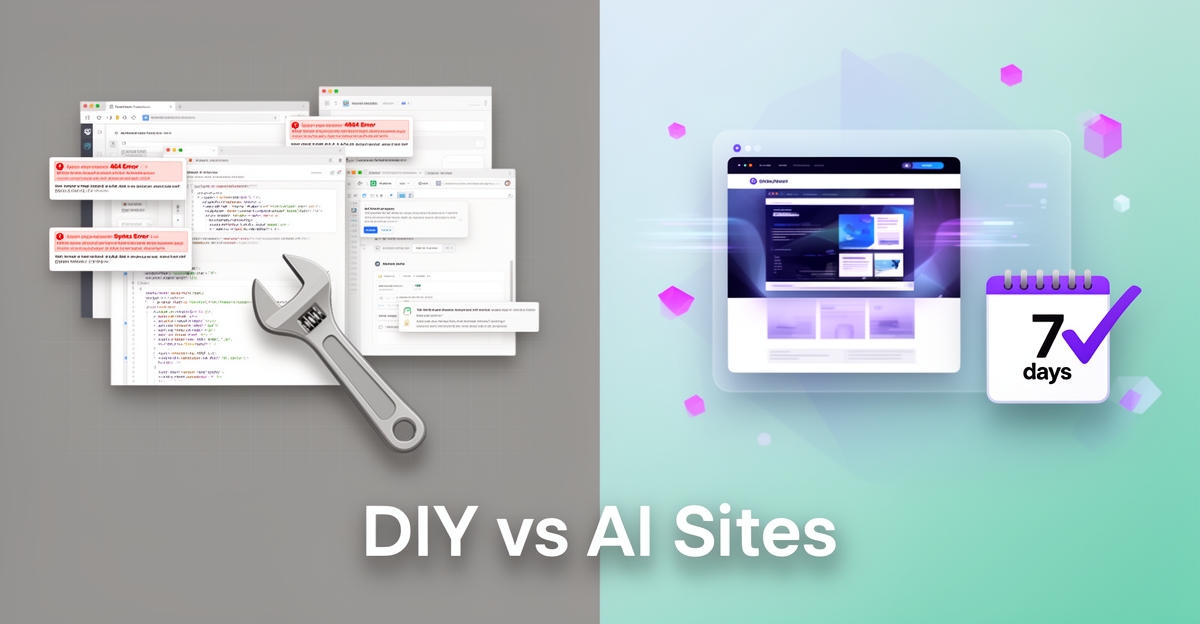
Small business owners are drawn to DIY AI builders by the promise of speed and savings—launching a site in minutes for as little as $2.99 a month with no technical skills required. Research shows these platforms cut development time by up to 95% and reduce costs by 50–90% compared to hiring a developer, with an average learning curve of just 15 minutes versus 4–8 hours for traditional tools. This accessibility fuels adoption, especially among the 98% of small businesses already using AI-enabled tools for tasks like content creation.
Yet the trade-offs emerge quickly in daily operations. Template constraints limit branding flexibility, forcing businesses into generic designs that don’t reflect their unique services or local market. While AI builders automate basic layouts, they often lack the depth for complex needs like integrated quoting, job scheduling, or e-commerce—features critical for service businesses that rely on the quote-to-invoice loop. Industry analysis notes that users seeking highly customized functionality frequently find these tools inadequate, pushing them toward costly add-ons or platform switches.
For owners trading time for technical control, the hidden cost is ongoing maintenance: updating content, managing plugins, and troubleshooting issues eats into core business hours. Data confirms that 35% of small businesses believe they’re “too small” for a website, and 14% cite lack of time and technical knowledge as barriers—pain points DIY builders solve initially but don’t eliminate long-term. AI Business Sites addresses this gap by delivering a done-for-you system where the client owns a custom 85+ page site with built-in CRM, content engine, and field-service tools—managed entirely by our team—so they run their business, not their website.
What Research Says About AI Website Builders Today
What Research Says About AI Website Builders Today
The AI website builder market is experiencing rapid growth, with projections indicating a global valuation of $25 billion by 2035 and a compound annual growth rate of 25.8% from 2024 to 2033. This surge reflects widespread adoption among small businesses, where 98% are now utilizing AI-enabled tools for tasks ranging from content creation to customer engagement. These platforms deliver measurable efficiency gains, reducing website development costs by 50–90% and cutting time-to-launch by up to 95% for common site types, with learning curves averaging just 15 minutes compared to 4–8 hours for traditional builders.
Despite these advantages, AI-powered builders face inherent limitations in customization and flexibility. Research indicates that while templates and automated design suggestions streamline creation, they often fall short for businesses requiring unique branding or complex functionality. Mobile performance remains a strength, with AI tools automatically optimizing layouts for various screen sizes — a critical factor given that mobile-optimized sites are 67% more likely to rank on Google’s first page. However, the trade-off between speed and personalization means DIY builders may not suffice for businesses aiming to stand out in competitive local markets.
For service-based businesses, the real challenge extends beyond initial setup to ongoing management. While DIY platforms lower entry barriers, they leave owners responsible for hosting, security, content updates, and technical troubleshooting — tasks that divert time from core operations. AI Business Sites addresses this gap by offering a done-for-you model that combines the speed and cost efficiency of AI builders with full management, custom development, and ongoing support. Clients receive a live, 85+ page website within 7 days, complete with integrated CRM, content engine, and automation systems — all maintained by our team. This approach eliminates the DIY burden while preserving ownership of code, content, and data, positioning the service not as a tool to learn but as a system that runs the business behind the scenes.
Local business: doing this the old way?
One system replaces the whole pile.
All of it — the website, the follow-up, the content, the leads — built and run for you for $1,497 + $497/mo. Month-to-month, and you own everything.
See what your build includesDone-For-You vs DIY: Where GoDaddy Fits and Where It Falls Short
The appeal of a DIY builder is obvious: drag, drop, publish. But the research behind why small businesses struggle to get online reveals a deeper problem — and it isn't a lack of ambition.
According to industry statistics, 35% of small businesses believe they are "too small" for a website, while 14% cite a lack of time and technical knowledge as the barrier. AI-powered builders respond by shrinking the learning curve to roughly 15 minutes, compared with 4–8 hours for traditional platforms. That solves the starting problem. It doesn't solve the running one.
The real trade-off shows up after launch. As market research notes, AI builders typically constrain users to a set of templates and design options that "may not cater to specific or unique branding requirements." For a local service business, that constraint matters — local SEO and conversion depend on page structure, schema markup, service-area pages, and internal linking that generic templates rarely deliver out of the box.
There's also the hidden cost of your own hours. DIY subscriptions run $15–$50 per month, which looks cheap next to senior freelance developer rates of $75–$150 per hour. But "free is only free if your time is" — someone still has to build, host, connect, and maintain the system, and keep it running month after month.
That's the gap a managed approach fills. Rather than handing you software to learn, a done-for-you model builds the site for you, trains you on it, and keeps running it. AI Business Sites, for example, launches a custom build with 85+ pages in 7 days, then manages hosting, maintenance, and 14+ new SEO content pieces every month on the client's behalf — with no long-term contracts and full ownership of the code, content, and domain if you leave.
The DIY route makes sense for a specific kind of owner:
- You genuinely enjoy building and maintaining your own web stack
- Your needs fit comfortably inside a template's limits
- You have the hours each month for content, updates, and follow-up
- You'd rather trade time than pay for management
For everyone else — the owner quoting jobs, running crews, and serving customers — the honest question isn't "which builder is easiest?" It's "who is actually doing the work?" Convenience gets a site online. A managed system keeps it working while you run the business.
If that tension sounds familiar, a free 30-minute strategy call is a no-obligation way to talk through what your site actually needs to do.
A Practical Path to a Website That Runs Your Business
DIY website builders promise speed, but they still put the build, training, and babysitting on you. For owners who want a site that works while they run their business, the practical path is speed without ongoing maintenance.
The market is moving fast. The global AI-powered website builder market is growing rapidly as businesses seek cost-effective online presence without coding skills industry research. Adoption is already mainstream: almost all small businesses, 98%, are utilizing AI-enabled tools, with 40% using generative AI for content creation market analysis.
The appeal is real. AI builders are disrupting traditional development by reducing costs by 50–90% and cutting development time by up to 95% for common sites aggregated industry statistics. The learning curve averages just 15 minutes, compared to 4–8 hours for traditional platforms aggregated industry statistics.
That convenience comes with trade-offs. AI website builders often come with constraints in customization and flexibility, and may not cater to specific branding requirements market research. Small businesses also face real barriers: 35% believe they are “too small” for a website and 14% cite lack of time and technical knowledge business adoption data.
A done-for-you path removes the babysitting. Instead of learning a builder and stitching together hosting, SEO, CRM and follow-up, the owner gets a custom site built and run for them.
Implementation looks like this:
- Kickoff with a short questionnaire, $500 deposit secures the build slot
- 7-day build delivers 85+ pages live: 25–30 hand-crafted core pages and 60 AI-generated SEO pages with schema
- Launch day lead capture works, Google Business Profile and Search Console are set up, and the AI back office is running
- Training and handover shows the one-screen dashboard; ongoing management publishes 14+ new SEO pieces per month and maintains the system
With AI Business Sites, the setup is $1,497 one-time and $497 per month managed. The client owns everything — code, content, data, domain — and can cancel with 30 days notice. Live in 7 days means the site is answering, writing and selling from day one, not after weeks of template tweaking.
Performance stays on the provider, not the owner. Mobile-optimized sites are 67% more likely to rank on Google’s first page SEO performance data, and ongoing maintenance, content engine and privacy-first analytics keep speed and relevance without owner effort.
The result is a website that runs the business, not a project the owner has to run.
Frequently Asked Questions
Is GoDaddy still a good website builder for small businesses in 2024?
What are the main limitations of DIY website builders like GoDaddy for service-based businesses?
Do DIY website builders save time and money in the long run for small business owners?
What’s the difference between a DIY builder like GoDaddy and a done-for-you service like AI Business Sites?
How fast can I get a website live with a done-for-you service compared to a DIY builder?
Do I own my website and data if I use a done-for-you service like AI Business Sites?
The Real Question Isn't Which Builder—It's Who's Doing the Work
GoDaddy and similar DIY builders deliver on their promise: fast setup, low monthly costs, and a website you can launch yourself. For some owners, that's enough. But the data tells a fuller story—while AI builders cut development time by up to 95%, they still leave you managing updates, content, SEO, and maintenance. The trade-off isn't just features; it's your time. If you're running a service business, quoting jobs, and serving customers, the real cost of DIY isn't the subscription—it's the hours you spend being your own web developer. AI Business Sites removes that burden entirely: a custom 85+ page site, built and launched in 7 days, with CRM, content engine, and ongoing management handled for you. You own everything, and there's no long-term contract. If you're ready to stop managing your website and start letting it work for you, book a free 30-minute strategy call to talk through what your business actually needs.
FOR local businesss — BUILT AND RUN BY US
Your website. Your content. Your leads. Your data.
$500 starts your build. Seven days later it's live — chat, booking, follow-up, and your Google presence all set up. Then we run it, every month. You do the work you actually get paid for.