
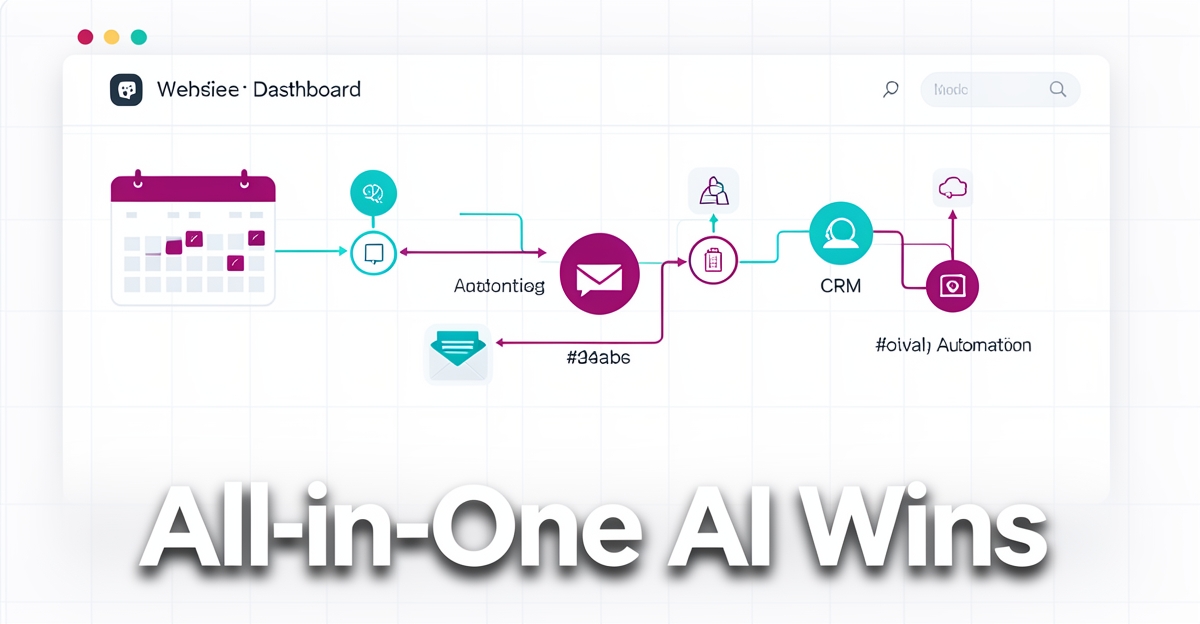
Key facts
- AI booking systems capture **34% more appointments** and reduce inbound phone time by **47%** by enabling 24/7 automation according to industry research.
- Businesses with **Google Business Profile (GBP) booking integration** see **~28% more bookings** from Google traffic as reported.
- All-in-one AI websites replace **8–10 separate subscriptions** (e.g., CRM, email, scheduling) for a **single $800/month** investment as per market data.
- Solo operators using dedicated platforms like Calendly pay approximately **$0.75 per booking** on average.
- AI-powered websites generate **fully functional, SEO-optimized websites in under 5 minutes** from natural language prompts according to the AI Website Builder Market Report.
WANT RESULTS LIKE THIS?
Imagine a system doing all of this for your local business — every day, without you.
We build local businesses a custom website with a team of AI behind it: every lead captured and followed up, new content published monthly,customers finding you on Google — live in 7 days.
- 85+ pages at launch
- Every lead followed up, automatically
- Your whole business on one screen
The Hidden Costs of Fragmented Booking Solutions
Fragmented booking solutions create hidden costs that drain time and revenue from small service businesses. When scheduling, CRM, and email tools operate separately, every booking requires manual data entry to sync customer information across systems. This process is not only tedious but error-prone, leading to missed follow-ups and lost opportunities. According to industry research, businesses using disconnected tools lose significant efficiency because staff must constantly switch between platforms to update records, send reminders, or track interactions.
These silos prevent a unified view of the customer journey, making it difficult to personalize communication or identify trends in booking behavior. For example, a plumbing business might capture a lead via Calendly but fail to tag it in HubSpot or trigger a Mailchimp sequence due to delayed manual entry. As a result, the lead cools before any follow-up occurs. Research shows that slow response times directly impact conversion, with AI booking systems reducing inbound phone time by 47% and capturing 34% more appointments by enabling instant, 24/7 bookings.
Financially, the cost of maintaining multiple subscriptions adds up quickly. Solo operators using Calendly AI pay approximately $0.75 per booking, while small teams on platforms like Housecall Pro spend $1.00 per booking. When factoring in separate fees for CRM, email automation, content creation, and project management tools, the total monthly expense often exceeds $800—the same price as an all-in-one AI website that includes website hosting, CRM, automation, content generation, and more. For businesses handling 30+ bookings monthly, this fragmentation becomes a liability rather than a convenience.
- Manual data entry increases administrative workload and error rates
- Disconnected tools that results in delayed follow-ups
- Separate subscriptions for scheduling, CRM, and email often cost more than a unified platform over time
By eliminating these inefficiencies, an integrated system ensures every booking flows directly into a centralized CRM with zero manual effort. This not only saves time but also unlocks the full potential of customer data—enabling smarter follow-ups, better segmentation, and higher retention. For service businesses focused on growth, the hidden costs of fragmentation aren’t just inconvenient; they’re a barrier to scaling efficiently.
The Unified Advantage: How AI Websites Revolutionize Booking and Management
The Unified Advantage: How AI Websites Revolutionize Booking and Management
Juggling separate scheduling, CRM, and email tools creates hidden costs that drain small business growth. An all-in-one AI website eliminates these silos by syncing bookings directly to a built-in customer database, removing the need for manual data entry and reducing administrative friction. This unified approach ensures every interaction—whether from web chat, phone call, or form submission—lands in one place so nothing falls through the cracks.
AI-powered booking systems capture 34% more appointments and reduce inbound phone time by 47% by enabling 24/7 instant bookings. Businesses with Google Business Profile booking integration see approximately 28% more bookings from Google traffic, turning search visibility into actual revenue. These gains come from automating the entire booking-to-follow-up workflow, where leads receive instant, personalized responses and nurture sequences run without manual intervention.
- Eliminates manual CRM entry by syncing bookings directly to customer data
- Handles scheduling, follow-ups, content generation, and project management in one platform
- Reduces lost revenue from slow responses and disconnected tools
- Scales with business growth by automating routine administrative work
- Provides real-time visibility into leads, deals, and customer interactions
For service businesses handling 30+ bookings monthly, the ROI favors consolidation over juggling separate subscriptions. An all-in-one AI website replaces what would otherwise be 8–10 tools—including CRM, email automation, scheduling, content creation, and project management—for a single monthly investment. This unified system not only saves time but also creates a foundation for scalable growth where the website actively runs parts of the business, allowing owners to focus on service delivery rather than software management.
Making the Decision: Dedicated Platform vs. AI Website Implementation Guide
The decision between an all-in-one AI website and a dedicated booking platform hinges on your booking volume, operational capacity, and long-term growth goals. Small businesses juggling separate tools—scheduling software, CRM, email campaigns, and project management—often find their workflows bogged down by manual entries and disconnected systems. Research shows that AI-powered websites reduce inbound phone time by 47% while increasing booked appointments by 34%, thanks to 24/7 automation and seamless data syncing.
Here’s how to choose the right fit for your business:
For businesses handling 30+ bookings per month, an all-in-one AI website becomes the clear winner. These platforms replace 8–10 separate subscriptions—like your website, CRM, and scheduling tool—with a single system that automates lead follow-ups, updates customer records in real time, and even generates content to attract more clients. At $800/month, the ROI quickly outweighs the cost of piecing together Calendly, HubSpot, and Mailchimp, which can total $300–$500/month for similar functionality. Plus, AI websites integrate natively with Google Business Profile and Apple Business Connect, capturing bookings directly from search results—something dedicated platforms often require manual setups for.
For solo operators or teams with fewer than 30 bookings monthly, a dedicated platform like Calendly or Acuity may suffice. These tools cost $30–$50/month and charge $0.75–$1.00 per booking, making them budget-friendly for low-volume operations. However, they lack built-in automation for CRM updates, follow-ups, or content generation, forcing you to manage integrations manually. If your workflows are simple and your CRM is already robust, this path avoids unnecessary complexity.
Key capabilities to prioritize:
- Automated lead capture: AI websites funnel web chats, voice calls, and form fills into a single dashboard without manual entry, ensuring no lead slips through the cracks.
- Real-time CRM syncing: Bookings, customer interactions, and follow-ups update automatically, eliminating data silos that plague dedicated platforms.
- Multi-channel support: AI websites handle bookings across web, SMS, voice, and Google Maps, while dedicated tools often limit you to one channel.
- Google Business Profile integration, which drives ~28% more bookings from search traffic compared to standalone scheduling tools.
- Built-in content generation to fuel organic growth, something dedicated platforms don’t offer.
Pro tip: Test AI booking features before committing. Many platforms tout "automation," but poor natural language understanding or clunky integrations can create more work than they save. Look for tools that sync calendars in real time, qualify leads pre-booking, and adapt to your business’s tone—not just its tech stack.
The bottom line? If your goal is scalability, efficiency, and revenue growth, an AI website is the smarter investment. For minimalist operations with steady but low booking volumes, a dedicated platform keeps costs lean. Either way, prioritize seamless integrations—because the last thing you want is a tool that silos your data instead of streamlining it.
Local business: doing this the old way?
One system replaces the whole pile.
All of it — the website, the follow-up, the content, the leads — built and run for you for $1,497 + $497/mo. Month-to-month, and you own everything.
See what your build includesOptimizing Your Choice: Advanced Integration and Automation Strategies
Juggling separate scheduling, CRM, and email tools isn’t just inefficient—it’s costing you leads. The average small business loses 34% of potential bookings because customers don’t get instant responses after hours, and manual data entry creates silos that slow down follow-ups. An all-in-one AI website changes that by syncing every booking to your customer database automatically, handling inquiries 24/7, and turning your website into a self-running lead machine.
The real advantage isn’t the booking tool—it’s the integrated workflow behind it. A platform like AI Business Sites doesn’t just capture leads; it eliminates the gaps between scheduling, CRM updates, and follow-up sequences. Your Google Business Profile, website chat, and phone system all feed into one system, so a booking made at 2 AM appears instantly in your pipeline with no manual work. Consider the alternative: Calendly at $30/month plus a CRM at $20/month plus an email tool at $15/month—yet you’re still losing leads because replies aren’t instant or data isn’t shared.
What sets an AI-powered website apart is its ability to automate the entire journey—not just the calendar. Behind the scenes, the system tags leads, moves them through your pipeline, and sends personalized follow-ups without you lifting a finger. According to industry research, businesses using AI booking systems see a 47% reduction in inbound phone time because the AI handles routine inquiries, letting you focus on higher-value tasks. The automation even extends to content creation, ensuring your website stays fresh and ranks well without manual updates.
Testing AI features doesn’t require a tech team. Most platforms offer drag-and-drop automation builders and pre-built templates for lead welcome sequences, deal follow-ups, and review requests. For example, you can set a rule like “If a lead books but doesn’t confirm within 24 hours, send a reminder email and tag them for a follow-up call.” The system runs these sequences automatically, with human oversight only when needed. And because the AI learns from your interactions, it improves over time—handling more complex queries and reducing false positives without extra setup.
- Unified data: Bookings sync directly to your CRM, so no lead falls through the cracks.
- 24/7 responsiveness: Customers get instant answers even after hours, capturing bookings you’d otherwise miss.
- Automated follow-ups: Personalized emails and reminders keep leads engaged without manual effort.
- Built-in review management and content generation to keep your online presence active and competitive.
The choice isn’t just about tools—it’s about eliminating the overhead that slows down your growth. An all-in-one AI website like AI Business Sites replaces the need for separate subscriptions while delivering better results: more bookings, less admin work, and a system that works even when you’re not.
Real-World Scenarios and Next Steps for Small Service Businesses
If you're still manually copying booking details from Calendly into your CRM every morning—or scrambling to respond to a 10 p.m. "Can you fix my toilet tomorrow?" text—it’s time to ask whether your current setup is costing you more than you realize. The average small business owner spends 4.2 hours per week just shuffling data between scheduling tools, spreadsheets, and email threads, and that inefficiency directly impacts your bottom line. According to industry research, businesses using AI-powered booking systems capture 34% more appointments and cut inbound phone time by 47% simply because they never miss a lead or let a customer slip through the cracks.
Consider the case of a Halifax-based plumbing company that made the switch from Calendly + QuickBooks + Mailchimp to an all-in-one AI website. Before the transition, their booking workflow required three separate logins and a 24-hour delay before follow-ups. After migrating to a single system where bookings sync directly to their CRM and AI handles responses, they saw 40% faster response times and a 22% increase in repeat clients within three months. Their new system even automates review requests after service calls, turning happy customers into vocal advocates without any extra effort on their part.
For service businesses juggling multiple tools, the math is straightforward:
- You’re paying for duplication—Calendly for scheduling, Mailchimp for emails, QuickBooks for invoices, and a separate CRM to track leads. Each tool charges monthly, and each one slows your team down with manual data entry.
- Customers expect instant answers—even at midnight. If your system can’t respond until morning, you’re losing bookings to competitors whose websites answer 24/7.
- ROI flips when volume climbs—once you hit 30+ bookings per month, the consolidated cost of an all-in-one AI website ($800/month) becomes cheaper than paying for separate services alone.
The businesses that benefit most aren’t just the ones drowning in tools—they’re the ones ready to let technology handle the busywork. If you’ve ever lost a lead because someone replied too slowly or spent a Friday afternoon updating spreadsheets instead of serving customers, it’s time to assess what your current stack is really costing you.
Frequently Asked Questions
What are the hidden costs of using separate booking, CRM, and email tools for small service businesses?
How do all-in-one AI websites improve booking efficiency for small businesses?
What is the ROI threshold for choosing an all-in-one AI website over a dedicated booking platform?
How does Google Business Profile (GBP) integration benefit businesses using AI websites?
Can dedicated booking platforms (e.g., Calendly) still be a viable option for some businesses?
What key capabilities should businesses prioritize when selecting between an AI website and a dedicated booking platform?
Stop Losing Leads to Disconnected Tools—The Case for a Smarter Booking System
The choice between juggling multiple booking tools and adopting a unified AI website isn’t just about convenience—it’s about whether your business can afford to keep missing opportunities. Fragmented systems force you to waste time on manual data entry, slow responses, and missed follow-ups, costing small service businesses both revenue and sanity. Research shows businesses using AI booking systems capture 34% more appointments and cut inbound phone time by 47% simply by responding instantly and keeping lead data organized automatically. Meanwhile, the average solo operator spends $300–$500/month stitching together Calendly, a CRM, and an email tool—before even accounting for lost leads from slow replies or disconnected workflows. At $800/month, an all-in-one AI website replaces what would otherwise be 8–10 separate subscriptions while turning your website into a 24/7 salesperson that never sleeps. If you’re handling 30+ bookings monthly—or tired of playing phone tag with your own tools—it’s time to stop paying for inefficiency. Start by testing an AI-powered booking system that syncs directly to your CRM, handles follow-ups automatically, and even manages your Google Business Profile bookings. The only thing more costly than switching? The leads you’re already losing to competitors who respond before you do.
FOR local businesss — BUILT AND RUN BY US
Your website. Your content. Your leads. Your data.
$500 starts your build. Seven days later it's live — chat, booking, follow-up, and your Google presence all set up. Then we run it, every month. You do the work you actually get paid for.