
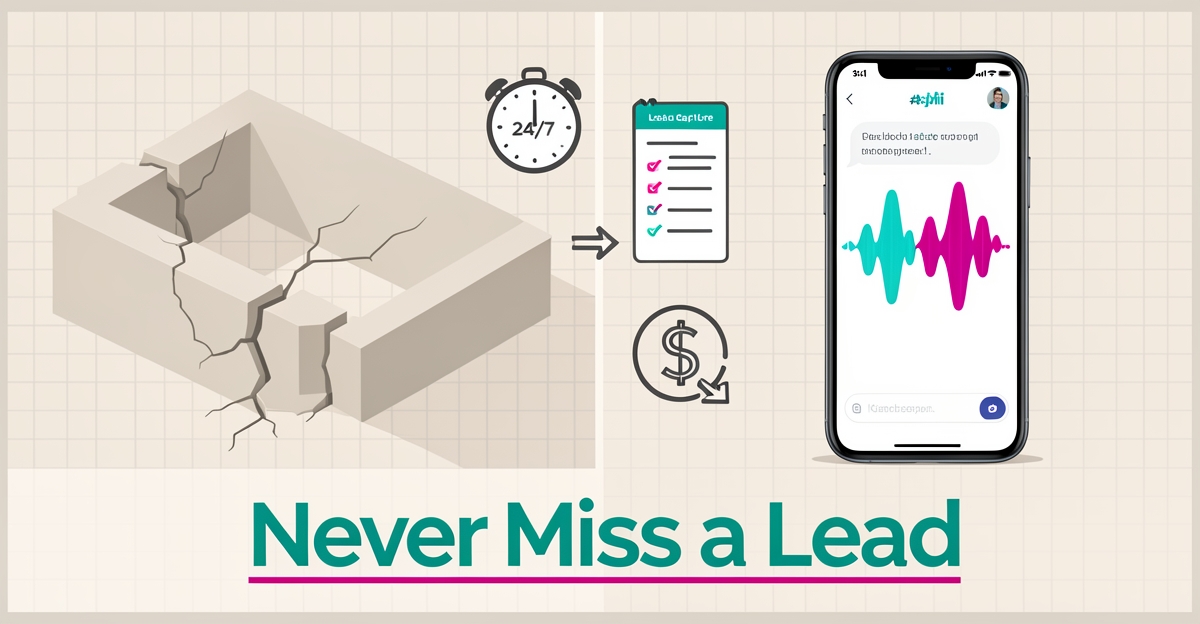
Key facts
- 85% of callers won't retry if their first attempt goes unanswered according to Nextiva research
- 42% of small businesses lose at least $500 monthly to missed calls per industry research
- AI receptionists operate at 98% less expense than human hires per cost comparison data
- AI handles 80% of routine inquiries without human intervention per operational benchmarks
- Only 22% of SMBs have adopted AI voice agents despite clear ROI according to Nextiva
- Foundation repair jobs often exceed $5,000, making one missed call a potential five-figure loss per industry analysis
- By 2029, agentic AI is projected to resolve 80% of common service issues without human help per future projections
WANT RESULTS LIKE THIS?
Imagine a system doing all of this for your local business — every day, without you.
We build local businesses a custom website with a team of AI behind it: every lead captured and followed up, new content published monthly,customers finding you on Google — live in 7 days.
- 85+ pages at launch
- Every lead followed up, automatically
- Your whole business on one screen
The Real Cost of Missed Calls in Foundation Repair
Every missed call in foundation repair isn't just a lost conversation—it's a potential project vanishing into thin air. Given the industry's high-ticket, urgent-service nature, where a single lead can represent thousands in revenue, the cost of unanswered phones adds up fast. Research shows that 42% of small and medium businesses lose at least $500 per month due to missed calls, and a staggering 85% of callers won’t bother to call back if their first attempt goes unanswered industry research. For foundation repair contractors, whose average job often exceeds $5,000, even one missed emergency inquiry could mean losing a five-figure opportunity—especially when homeowners are searching frantically for help after noticing cracks or water intrusion.
The financial bleed becomes clearer when you consider how foundation issues escalate. A homeowner who calls today about a settling foundation might wait only hours before contacting another company if their first call rings unanswered. That delay isn’t just inconvenient—it’s costly. With 85% of callers not retrying, businesses aren’t just missing a lead; they’re handing it directly to a competitor who answered the phone industry research. In an industry where trust and responsiveness influence decisions as much as price, that first interaction often determines who gets the job. When storms hit or seasonal shifts expose foundation problems, call volumes spike—and so does the risk of missing time-sensitive leads that could become major projects.
This is where an AI receptionist integrated directly into a business website transforms vulnerability into reliability. Unlike traditional answering services or voicemail, an AI voice agent can engage callers instantly, 24/7, capturing critical details about the issue, location, and urgency while providing immediate reassurance. It can schedule consultations, answer common questions about repair methods or timelines, and route high-priority leads straight to the appropriate technician—all without hold times or missed opportunities. For foundation repair pros already juggling inspections, estimates, and crew management, this automation ensures the phone never becomes a bottleneck. And because the system lives within the same platform that manages the website, CRM, and follow-ups, every call syncs seamlessly into the business operations, turning what used to be a reactive scramble into a proactive lead engine. For a business built on responsiveness, missing a call isn’t just inefficient—it’s avoidable revenue loss.
AI vs. Human Receptionist: What the Numbers Actually Show
Most foundation repair owners assume a human receptionist is the only way to handle calls with care — until they see what the numbers actually say. The gap between perception and reality is wider than most expect, especially when every missed call carries a potential five-figure project.
According to cost comparison research, AI receptionists operate at 98% less expense than a full-time human hire. That's not a typo — it's the difference between a four-figure monthly payroll line and a predictable, low-three-figure subscription. For a trade where crews are already stretched thin, that savings alone can fund another truck or a new piece of equipment.
But cost is only half the equation. Operational data shows AI handles 80% of routine inquiries without human intervention — things like service area checks, scheduling availability, warranty questions, and basic pricing ranges. It does this 24/7, with zero hold time, zero sick days, and zero "I'll have to call you back." Meanwhile, industry research confirms that 85% of callers won't retry if their first attempt goes unanswered. In foundation repair, where leads often call after hours or during peak season, that stat represents real revenue walking away.
Where humans still win is nuance. Complex judgment calls — evaluating whether a crack is structural or cosmetic, navigating an upset homeowner, or negotiating a high-stakes commercial bid — require empathy and experience no algorithm can replicate. The smartest operators don't choose one or the other. They build a hybrid model:
- AI captures every call, qualifies leads, and books appointments around the clock
- Humans step in for estimates, technical consultations, and relationship-critical moments
- Routine follow-ups and confirmations stay automated so your team stays focused on the job site
This is exactly how AI Business Sites structures the AI receptionist layer — handling the volume so your people handle the value. The result isn't less human service. It's human service deployed only where it actually matters.
Local business: doing this the old way?
One system replaces the whole pile.
All of it — the website, the follow-up, the content, the leads — built and run for you for $1,497 + $497/mo. Month-to-month, and you own everything.
See what your build includesWhy a Hybrid Model Works Best for Foundation Repair
Most foundation repair contractors know the frustration of a phone ringing at 8 p.m. while they're on a job site — or worse, the silence of a missed call that never comes back. Research shows 85% of callers won't retry if their first attempt goes unanswered, and 42% of small businesses lose at least $500 monthly to those gaps (Nextiva). An AI receptionist closes that window instantly, but the real advantage emerges when you pair it with human expertise.
Industry experts consistently recommend a hybrid model: AI handles after-hours lead capture, qualifies routine inquiries like pricing or scheduling, and routes complex structural questions to your team (Safina AI). This approach leverages AI's ability to resolve 80% of basic issues without human intervention (Octavius AI) while preserving the empathy and judgment your clients expect for high-stakes foundation assessments.
- AI answers every call 24/7 — no hold music, no voicemail dead ends
- Routine questions (service areas, warranty basics, booking) resolve instantly
- Complex structural concerns escalate to your technicians with full context
- Every interaction logs automatically in your CRM for seamless follow-up
Only 22% of SMBs have adopted AI voice agents despite clear ROI (Nextiva), which means early adopters in foundation repair gain a tangible competitive edge. Your website becomes a round-the-clock lead engine — capturing, qualifying, and routing inquiries while your crew focuses on the work that requires hands-on expertise. AI Business Sites builds this hybrid capability directly into your custom website, so the phone system, chat assistant, and CRM all share the same intelligence without extra software to manage.
How to Evaluate If It's Right for Your Business
Is an AI Receptionist Right for Your Foundation Repair Business?
Missing calls directly impacts your bottom line, with research showing 42% of small businesses lose at least $500 per month to unanswered calls, and 85% of callers won’t try again if their call goes unanswered. Industry research highlights that these missed opportunities represent significant revenue at stake, especially for time-sensitive services like foundation repair where emergencies drive immediate demand.
To evaluate if an AI receptionist makes sense, start by calculating your current cost of missed calls. Estimate the average job value for your foundation repair services, then multiply it by the number of leads lost to voicemail or unanswered rings each week. Compare this figure against the AI receptionist’s monthly cost, which research shows is 98% less expensive than hiring a human receptionist. This stark cost difference often reveals that even capturing a fraction of missed calls justifies the investment.
Next, analyze your call volume patterns to identify when AI can add the most value. Track peak calling hours, after-hours inquiries, and seasonal spikes—common in foundation repair due to weather-related issues. Experts recommend prioritizing AI coverage for after-hours and peak demand periods, ensuring no lead slips through when your team is unavailable. Real-world implementations show AI excels at handling routine inquiries, booking appointments, and capturing essential details during these high-impact windows.
Finally, define which calls require human judgment. Reserve your team for complex consultations, emotionally sensitive situations, or high-stakes assessments where empathy and expertise are irreplaceable. A hybrid approach—using AI for 24/7 lead capture and routine tasks while keeping humans for nuanced interactions—aligns with expert advice on optimizing both efficiency and customer experience. Industry analyses confirm this model delivers the best balance of cost savings and service quality for service-based businesses.
Frequently Asked Questions
How much money do foundation repair companies actually lose from missed calls?
Is an AI receptionist really cheaper than hiring a person to answer phones?
Can an AI receptionist actually handle the kinds of calls foundation repair businesses get?
What happens when a homeowner has a complex foundation issue that needs human expertise?
How do I know if an AI receptionist will pay for itself for my specific business?
Are other foundation repair companies actually using this, or is it still experimental?
Your Website Should Work While You Sleep
The math is straightforward: every unanswered call in foundation repair is a potential five-figure project walking to a competitor. With 85% of callers never retrying and AI handling 80% of routine inquiries at 98% less cost than a human hire, the hybrid model isn't just efficient — it's the only approach that matches how homeowners actually behave when their foundation fails. Your crew belongs on job sites, not tethered to a phone. An AI receptionist captures the 2 a.m. emergency call, qualifies the lead, and books the consultation before breakfast. Your team steps in for the structural assessment and the relationship. That division of labor is what turns a reactive scramble into a predictable pipeline. If you're losing leads to voicemail after hours or during peak season, the fix isn't hiring another person — it's letting your website handle the volume so your people handle the value. Only 22% of SMBs have adopted AI voice agents, which means the contractors who move now aren't just solving a phone problem — they're claiming a competitive edge that compounds with every storm season.
FOR local businesss — BUILT AND RUN BY US
Your website. Your content. Your leads. Your data.
$500 starts your build. Seven days later it's live — chat, booking, follow-up, and your Google presence all set up. Then we run it, every month. You do the work you actually get paid for.