
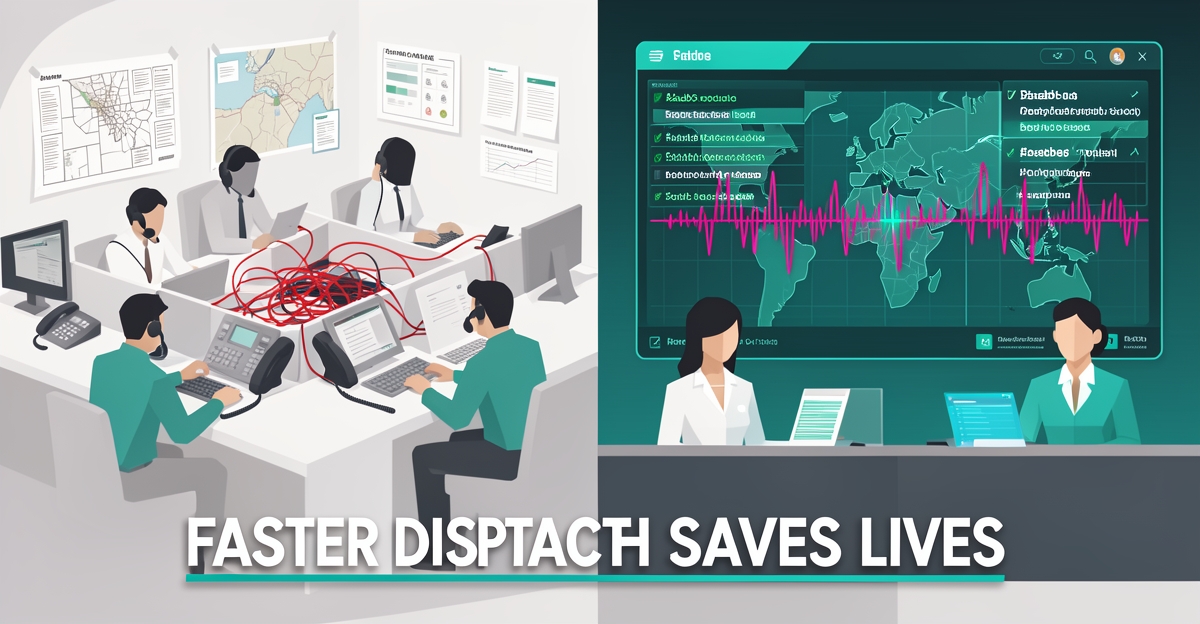
Key facts
- Delaware County Emergency Services achieves nearly 100% accurate dispatchable address population within seconds of a call beginning using AI-assisted transcription.
- South East Coast Ambulance Service (SECAmb) pilots AI transcription through February 2026 to reduce clinical documentation workload across 7 regions.
- AI-assisted emergency dispatch can highlight safety keywords (e.g., weapon mentions) in real-time for responder awareness.
- The AI Business Sites platform consolidates 8-10 separate subscriptions (e.g., website, CRM, automation) into one.
- AI Business Sites setup costs $2,500 with a monthly fee of $800, potentially paying for itself with a few converted leads.
WANT RESULTS LIKE THIS?
Imagine a system doing all of this for your local business — every day, without you.
We build local businesses a custom website with a team of AI behind it: every lead captured and followed up, new content published monthly,customers finding you on Google — live in 7 days.
- 85+ pages at launch
- Every lead followed up, automatically
- Your whole business on one screen
The Hidden Cost of Missed Calls and Delayed Follow-Ups in Emergency Services
When a 911 call comes in, the clock starts ticking before the dispatcher even answers. In emergency services, the gap between a caller's first words and a responder's arrival isn't just a metric — it's the difference between a close call and a tragedy. Yet most dispatch centers still rely on manual processes that leave critical seconds on the table.
The operational toll is measurable. Anthony Mignogna, Chief of Emergency Communications at Delaware County Emergency Services, puts it plainly: "In our industry, seconds matter... The ability to obtain a dispatchable address and have dispatchable information coming in rapidly to our call takers" determines whether help arrives in time. His center now achieves nearly 100% accurate dispatchable address population within seconds of a call beginning using AI-assisted transcription — a capability that directly translates to faster scene arrival.
Beyond the dispatch floor, the administrative burden compounds the problem. NHS ambulance services across Brighton, Hove, East Sussex, West Sussex, Kent, Surrey, and North East Hampshire are currently piloting AI transcription tools through February 2026 specifically to reduce documentation workload for clinicians. Emma Webber, clinical operations manager for integrated care at Secamb, explains the goal: "The technology should support our staff to focus more on the patient and remove some of the administration processes that can be time-consuming."
The hidden costs cascade across three dimensions:
- Missed or delayed calls that never convert to dispatched units
- Inaccurate address or scene details that send responders to the wrong location
- Hours lost to manual documentation that could be spent on patient care
For ambulance maintenance and emergency service providers, these inefficiencies aren't abstract — they show up as overtime costs, liability exposure, and crews stretched thin covering administrative gaps. The Prepared AI platform demonstrates how integrated systems can capture live caller video, highlight safety keywords like weapon mentions in real time, and feed dispatchable data to responders before they roll — all while keeping human judgment at the center of every decision.
AI Business Sites applies this same principle to the business side of emergency services: an AI assistant that answers every incoming inquiry instantly, captures service details accurately, and follows up automatically so no request falls through the cracks. When your website handles the administrative load, your team stays focused on what matters — the response.
How AI Assistants Are Already Improving Emergency Dispatch in Real-World Pilots
Real-world pilots are already proving that AI can make emergency dispatch faster, safer, and more accurate — without removing human judgment from the loop. In Delaware County, Pennsylvania, emergency communications staff now see nearly 100% accurate dispatchable address population within seconds of a call starting, thanks to live AI transcription that feeds address data directly to call takers as the conversation unfolds. Chief Anthony Mignogna puts it plainly: in this industry, seconds matter, and getting dispatchable information to operators rapidly changes what's possible on the ground.
- Real-time transcription captures addresses and critical details while the caller is still speaking
- Keyword highlighting flags safety risks — like weapon mentions — for responder awareness
- Integration with body-worn cameras and digital evidence systems builds fuller situational awareness
- Human dispatchers retain final decision authority on every call
Across the Atlantic, the South East Coast Ambulance Service (SECAmb) is running a pilot through February 2026 across Brighton, East and West Sussex, Kent, Surrey, and North East Hampshire, testing AI clinical note transcription to reduce administrative burden on crews. Clinical operations manager Emma Webber frames the goal clearly: the technology should support staff to focus more on the patient and remove time-consuming administration processes. Tortus, the AI provider, notes their models are continuously refined for accents, background noise, and varying audio quality, with real-time surveillance that automatically flags serious clinical discrepancies for review.
These implementations share a core philosophy: AI handles the routine — transcription, data entry, address capture — so highly trained professionals can apply their judgment where it matters most. For small businesses managing their own emergency-style dispatch and follow-up workflows, the same principle applies. AI Business Sites builds websites with an AI assistant that answers chats and calls instantly, captures service details accurately, and sends personalized follow-ups automatically — reducing missed inquiries and improving response speed without replacing the human decisions that drive quality service.
Local business: doing this the old way?
One system replaces the whole pile.
All of it — the website, the follow-up, the content, the leads — built and run for you for $1,497 + $497/mo. Month-to-month, and you own everything.
See what your build includesWhat AI Business Sites Brings to Emergency Dispatch and Follow-Up Automation
When seconds determine outcomes, the tools handling emergency communications need to do more than just answer — they need to capture, organize, and follow through. AI Business Sites brings that capability to businesses managing urgent service requests, combining voice and chat handling with instant logging and automated follow-up so nothing slips through the cracks.
The platform's AI assistant answers inquiries across chat and phone, extracting service details in real time and routing them directly into a unified system. This mirrors the approach Delaware County Emergency Services uses, where AI delivers nearly 100% accurate dispatchable address population within seconds of a call beginning — giving teams actionable information before the conversation even ends. For ambulance maintenance and similar services, that means every request is logged, categorized, and queued for response without manual entry delays.
Behind the scenes, a visual automation builder moves each lead through a pipeline: tagging by urgency, assigning to the right technician, and triggering personalized follow-up messages at the right intervals. The AI can draft emails, propose next steps, and send reminders — all with human-in-the-loop review so the business stays in control. This reflects the principle NHS ambulance services are piloting: technology that "supports staff to focus more on the patient and remove some of the administration processes that can be time-consuming."
- Voice and chat inquiries answered instantly, day or night
- Service needs logged and categorized automatically
- Personalized follow-ups sent without manual effort
- Every interaction tracked in one unified timeline
- Human review gates before any customer-facing action
The result is a system that reduces missed calls, accelerates response speed, and ensures follow-through on every service request — without adding another tool to manage.
Is It Worth the Investment? Weighing Benefits Against Costs for Small Service Providers
The investment question comes down to whether your website and operations can consolidate the tools you're already paying for — and whether the measurable gains in speed and coverage offset the monthly cost. For a small service business, the math shifts when you stop renting a website, a CRM, a scheduling tool, a newsletter platform, and an answering service as separate subscriptions. One custom-built site with an AI assistant underneath replaces that stack, and the payback shows up in leads you no longer lose to voicemail or slow replies.
Delaware County Emergency Services reports nearly 100% accurate dispatchable address population within seconds of a call beginning using AI-assisted call handling, a capability that translates directly to faster technician dispatch and fewer repeat calls for clarification. In the UK, the South East Coast Ambulance Service is piloting AI transcription across Brighton, Hove, East Sussex, West Sussex, Kent, Surrey, and North East Hampshire through February 2026 to reduce the documentation burden on clinicians. Both implementations keep humans in the loop — AI handles the routine capture and transcription, while dispatchers and clinicians retain final decision authority.
- Consolidated platform replaces 8–10 separate subscriptions (website, CRM, automation, scheduling, newsletter, document tools, project management, analytics, phone answering)
- Instant, personalized follow-up on every lead — web form, chat, voice call, or booking — before the prospect cools off
- AI assistant answers questions, books appointments, and captures details 24/7 with no hold music and no missed calls
- Own your code, content, domain, and data — nothing is rented, no long-term lock-in
At $2,500 setup and $800/month (plus $199/month for the AI voice agent), the platform pays for itself when a handful of captured leads convert to jobs that would otherwise have gone to a competitor who answered faster. The Secamb pilot's clinical operations manager notes the technology should "support our staff to focus more on the patient and remove some of the administration processes that can be time-consuming." For a small service provider, that same logic applies: less admin, more billable work, and a website that actively runs the business instead of just sitting there.
Frequently Asked Questions
How can an AI assistant actually make emergency dispatch faster?
Will an AI assistant replace human dispatchers or paramedics?
What about background noise or accents? Can AI even understand emergency calls clearly?
Does using AI for dispatch transcription reduce clinician burnout?
Isn’t this just another tool to manage? Will it actually save me time and money?
What if I’m not tech-savvy? Can I still use AI Business Sites effectively?
Key Takeaways
{ "title": "Seconds Saved, Lives Changed: The Case for AI in Emergency Dispatch", "content": "Investing in an AI assistant for emergency dispatches and follow-ups is a strategic move for small service providers seeking to bridge critical operational gaps. As seen in Delaware County and SECAmb's pilo
FOR local businesss — BUILT AND RUN BY US
Your website. Your content. Your leads. Your data.
$500 starts your build. Seven days later it's live — chat, booking, follow-up, and your Google presence all set up. Then we run it, every month. You do the work you actually get paid for.