
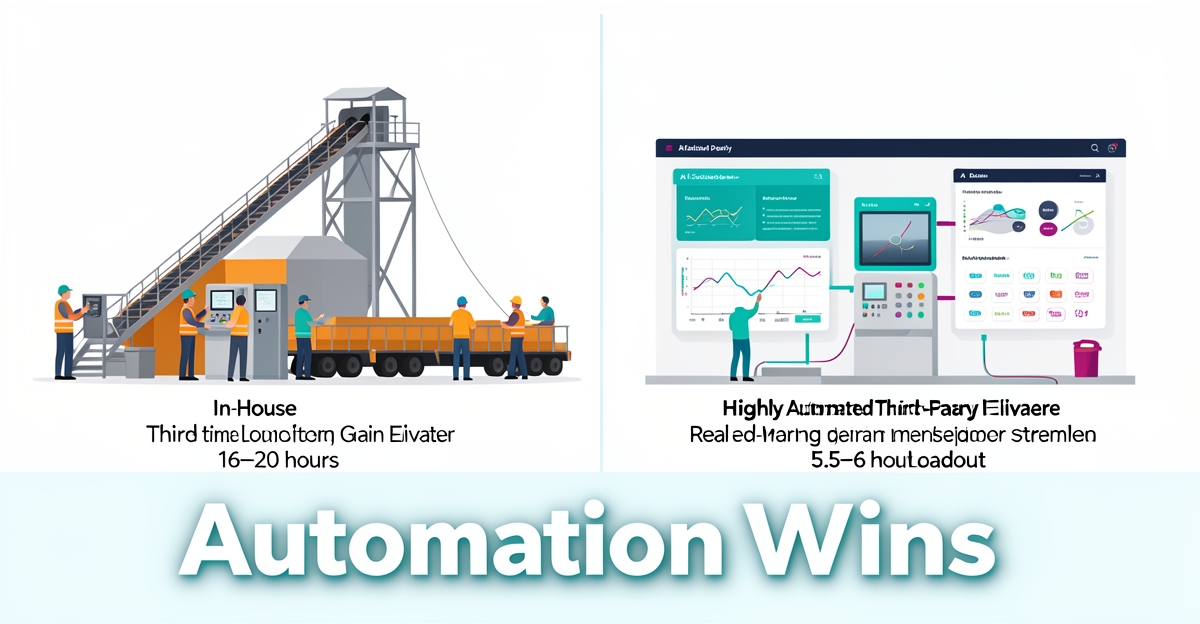
Key facts
- Automation cuts shuttle train loadout from 16–20 hours to just 5.5–6 hours, a ~65% throughput gain at the Milan terminal.
- Facility managers field 30–40 calls daily during harvest, creating bottlenecks that cost real loads and revenue per GrainFlow research.
- The global grain elevator market is projected to reach USD 34.19 billion by 2035 at a 4.70% CAGR per Expert Market Research.
- Mid-capacity elevators (51,000–150,000 tons) dominate the market, while large-capacity (151,000–300,000 tons) grows fastest for export hubs per market analysis.
- Automated systems log motor amperages, bin inventory, and hazard sensors every 60 seconds for real-time control per Kasa Controls data.
- Stricter OSHA and NFPA 61 standards force costly dust collection and temperature sensing retrofits per industry safety trends.
- Third-party operators leverage standardized safety protocols across facilities to reduce shutdowns and insurance costs per compliance expertise analysis.
WANT RESULTS LIKE THIS?
Imagine a system doing all of this for your local business — every day, without you.
We build local businesses a custom website with a team of AI behind it: every lead captured and followed up, new content published monthly,customers finding you on Google — live in 7 days.
- 85+ pages at launch
- Every lead followed up, automatically
- Your whole business on one screen
The Hidden Costs of Traditional Grain Elevator Operations
Grain elevators aren’t just storage hubs anymore—they’re high-stakes operations where inefficiency directly drains revenue. The typical facility manager juggles 30 to 40 daily calls during harvest, chasing trucks that arrive without appointment windows, creating bottlenecks that cascade into lost loads and missed second trips. Without real-time visibility into inbound flows, these facilities swing between overwhelmed morning queues and idle afternoons, a pattern that costs operators more than downtime—it costs actual business.
Automation-driven terminals prove how quickly idle time becomes lost opportunity. Facilities using advanced systems cut shuttle train loadout times from 16–20 hours down to 5.5–6 hours, delivering roughly 65% faster throughput while reducing human error risks. Behind the scenes, these systems log motor amperages, bin inventory, and hazard sensors every 60 seconds, turning raw data into actionable control. But retrofitting legacy sites demands more than new software—it requires capital investments that many in-house teams struggle to justify when weighed against immediate operational demands.
Compliance adds another hidden layer of cost. Stricter OSHA and NFPA 61 standards push operators toward dust collection upgrades, continuous bearing temperature sensing, and improved electrical classifications. Facilities with documented safety records see fewer shutdowns and better insurance terms, yet proving compliance often requires expertise and documentation that stretches thin in-house staff. Meanwhile, labor remains a bottleneck: specialized roles for automation maintenance, quality monitoring, and regulatory reporting inflate payroll while adding vulnerability to turnover or absenteeism.
- Labor-intensive scheduling and manual tracking of 30+ daily calls during peak season
- Equipment bottlenecks from outdated automation that can’t match modern throughput demands
- Compliance risks tied to OSHA/NFPA 61 standards requiring costly retrofits and documentation
- Capital constraints for retrofitting legacy systems with real-time data monitoring
- Hidden inefficiencies in truck flow visibility costing real loads and revenue per missed trip
The math becomes clear when you tally the trade-offs: slowed loadouts, reactive safety upgrades, and over-reliance on human coordination all erode margins faster than most operators anticipate. For businesses weighing these strains, a custom website platform built for real-time tracking and automation can surface operational bottlenecks before they turn into profit leaks—turning what’s currently an invisible cost center into a system that works with you, not against your bottom line.
Why Third-Party Operators Are Scaling Faster With Automation
Why Third-Party Operators Are Scaling Faster With Automation
In the grain elevator sector, where the global market is projected to reach USD 34.19 billion by 2035 at a CAGR of 4.70% source, third-party operators are outpacing in-house operations in scalability, largely due to their strategic leverage of automation, economies of scale, and compliance expertise. A compelling example is the Milan terminal upgrade, where automation reduced shuttle train loadout times from 16-20 hours to 5.5-6 hours, achieving a ~65% faster throughput source.
-
Economies of Scale in Compliance: Third-party operators, benefiting from standardized safety protocols across multiple facilities, can more easily navigate stringent safety regulations (e.g., OSHA, NFPA 61), reducing downtime and insurance costs. Their scale allows for dedicated compliance teams, ensuring continuous adherence to regulatory requirements without the burdens faced by in-house operations.
-
Advanced Automation Adoption: By investing in unified automation systems (like those at the Milan terminal), third-party operators minimize labor costs and maximize efficiency. Automation also enables real-time data-driven decisions, enhancing operational transparency and customer service.
-
Expertise in Data-Driven Services: With access to broader operational data across various clients, third-party operators can refine their services, offering predictive maintenance, optimized storage solutions, and streamlined logistics that in-house operations might struggle to replicate due to limited resources.
- Automation Throughput Improvement: ~65% faster loadout times source
- Scheduling Inefficiency Impact: 30-40 daily calls during harvest, with each extra waiting hour costing real revenue source
- Market Growth Indicator: Projected USD 34.19 billion market size by 2035, highlighting the need for scalable solutions source
Third-party operators' ability to scale efficiently, backed by automation and compliance expertise, positions them favorably in a market driven by digital transformation and safety regulations. For instance, their use of AI-powered scheduling systems with computer vision can revolutionize farm scheduling, reducing queues and enhancing operational visibility—a challenge in-house operations often face due to resource constraints. In-house operations, while beneficial for control, must weigh these advantages against the higher costs of achieving similar scalability and compliance standards internally.
As the grain elevator market continues to evolve, leveraging third-party operators for their scalability, automation capabilities, and compliance strengths may offer a competitive edge, especially for operations seeking rapid adaptation to market demands without the heavy upfront investment in technology and personnel.
Automation Levels the Playing Field: How to Modernize Your Elevator
Automation is no longer a luxury—it’s becoming the baseline for competitive grain elevator operations. Whether you manage your facility in-house or partner with a third-party operator, integrating automation can resolve chronic scheduling, and safety risks that er the playing field is in-house or rely on a third-party operator, modernizing with real-time monitoring, smart scheduling, and safety upgrades delivers measurable gains in throughput, labor efficiency, and compliance. The data shows that automation can cut shuttle train loadout time from 16–20 hours down to just 5.5–6 hours, a ~65% improvement that directly translates to higher revenue potential and reduced bottlenecks during peak harvest.
Facility managers often field 30-40 calls per day during harvest season, creating a reactive environment where trucks wait unnecessarily and second trips are lost. AI-powered scheduling with computer vision eliminates this guesswork by providing real-time queue visibility, dynamic rescheduling, and accurate wait time estimates—turning chaotic mornings into predictable, high-throughput operations. These systems integrate seamlessly with existing infrastructure, whether owned or operated externally, and can be deployed in as little as 12 months, as demonstrated by the Milan, Kansas terminal.
To modernize effectively, prioritize these actionable steps: install sensor networks for continuous bin inventory, temperature, and moisture monitoring; adopt AI-driven loadout automation to minimize human error and improve commodity tracking; upgrade dust collection and bearing temperature sensing to meet OSHA/NFPA 61 standards; and implement modular expansion strategies that match equipment capacity to peak operational needs. These upgrades not only reduce downtime and insurance costs but also position elevators to scale with market demand, which is projected to reach USD 34.19 billion by 2035.
For businesses seeking to track the impact of these changes—whether comparing in-house control versus third-party scalability—a custom AI-powered website can centralize real-time performance data, automate reporting, and support faster, data-backed decisions. By consolidating operations, analytics, and customer engagement into one intelligent platform, grain elevator operators gain the clarity needed to optimize both cost and control, regardless of their operational model.
Local business: doing this the old way?
One system replaces the whole pile.
All of it — the website, the follow-up, the content, the leads — built and run for you for $1,497 + $497/mo. Month-to-month, and you own everything.
See what your build includesThe Real Cost Comparison: In-House vs. Third-Party at a Glance
The Real Cost Comparison: In-House vs. Third-Party at a Glance
Navigating the decision between in-house and third-party grain elevator operators involves weighing significant financial and operational trade-offs. As the global grain elevator market grows toward a projected USD 34.19 billion by 2035 at a 4.70% CAGR, understanding these dynamics is crucial for strategic decision-making.
- Automation and Labor Costs:
- In-House: Higher capital expenditures for automation upgrades and labor costs for specialized roles. For example, traditional loadout times of 16-20 hours can be reduced to 5.5-6 hours with automation, a ~65% improvement, but require significant upfront investment as seen in successful implementations.
-
Third-Party: Potential for economies of scale in automation and compliance, reducing labor dependence. Third-party operators often leverage advanced technologies, such as AI-powered systems for real-time bin logistics and spoilage detection, enhancing efficiency driven by market trends.
-
Scalability and Compliance:
- In-House: Greater control over assets but faces challenges in scaling quickly to meet demand surges, especially in mid-capacity (51,000–150,000 tons) and large-capacity (151,000–300,000 tons) segments dominating the market.
-
Third-Party: Offers scalable, data-driven services and expertise in navigating stricter safety standards (OSHA, NFPA 61), potentially reducing downtime and insurance costs with documented safety benefits.
-
Scheduling Inefficiencies:
- Both models suffer from chronic scheduling issues, with facility managers handling 30-40 calls daily during harvest highlighting the need for AI-powered scheduling solutions.
- Actionable Solution: Adopt AI scheduling with computer vision for real-time visibility and dynamic rescheduling to mitigate revenue losses from delayed trucks.
- Control and Customization: In-House
- Scalability and Compliance Expertise: Third-Party
- Immediate Automation Benefits: Both (with third-party potentially faster to deploy)
The choice between in-house and third-party grain elevator operators hinges on prioritizing control versus leveraging scalability and compliance expertise. While in-house operations offer greater asset control, third-party operators may provide a quicker path to automation, scalability, and reduced labor costs, especially beneficial in a growing market with stringent safety regulations. Regardless of the model, prioritizing automation, addressing scheduling inefficiencies with AI, and ensuring robust safety infrastructure are critical for competitiveness.
AI Business Sites Insight: For grain elevator operators looking to streamline operations or enhance decision-making with real-time data, a custom AI-powered website can provide invaluable insights and automation tools, helping navigate the complexities of both operational models.
Building a Future-Proof Grain Elevator Strategy
The grain elevator industry is evolving faster than many operators realize—with automation cutting loadout times by 65% and third-party operators gaining ground in efficiency and compliance. Building a future-proof strategy isn’t just about choosing between in-house control and outsourcing; it’s about leveraging scalable technology to turn operational bottlenecks into profit drivers.
Start by auditing your current workflows. Facilities still relying on phone calls, whiteboards, and manual scheduling are hemorrhaging revenue—managers field 30-40 calls daily during harvest, and every idle truck represents lost capacity. AI-powered scheduling platforms now provide real-time queue visibility and dynamic rescheduling, turning chaotic mornings into predictable throughput. Pair this with automation for core functions: modern bucket elevators already move thousands of bushels per hour, but sensor networks that log motor amperages and bin inventory every 60 seconds can shave another 10+ hours off loadout times. Integrated automation systems like those in the Milan, Kansas terminal reduced shuttle train turnaround from 16–20 hours to just 5.5–6 hours—proof that data-driven precision beats manual guesswork.
Prioritize modular upgrades over full rebuilds. Mid-capacity elevators (51,000–150,000 tons) dominate the market, but large-capacity terminals are growing fastest as export hubs expand. Right-sizing equipment—matching bins, dryers, and conveyors to peak demand—lets you scale without paralyzing your facility during retrofits. Safety compliance is non-negotiable: stricter OSHA and NFPA 61 standards are forcing retrofits like improved dust collection and continuous temperature monitoring. Third-party operators often bring economies of scale here, with standardized protocols that reduce shutdown risks and insurance premiums. Whether you manage in-house or partner externally, the goal is the same: eliminate manual friction where it hurts most.
Automate customer touchpoints to free up staff for high-value work. Every missed call or delayed email during peak season costs real loads; an AI voice agent and chat assistant can capture leads 24/7 while your team focuses on operations. Behind the scenes, a single platform can handle lead routing, follow-up sequences, and even proposal generation—reducing the administrative overhead that distracts from core business. The same systems tracking truck queues can sync with your CRM to auto-tag contacts by commodity, volume, or urgency, ensuring no opportunity slips through.
The future belongs to operators who treat their elevator as a data-driven asset. Those still operating on spreadsheets and whiteboards will struggle to compete as the market grows to $34.19 billion by 2035. Start small: implement AI scheduling, upgrade safety sensors, then layer in automation that scales with your needs. The goal isn’t to overhaul everything at once—it’s to build a system that gets smarter, faster, and more profitable with every harvest.
Frequently Asked Questions
What are the primary hidden costs associated with traditional in-house grain elevator operations?
How do third-party grain elevator operators leverage automation for scalability?
What are the key benefits of prioritizing automation in grain elevator operations, regardless of the operational model?
How do scheduling inefficiencies impact grain elevator operations during peak seasons?
What is the projected growth of the global grain elevator market, and what drives this growth?
How do third-party operators address compliance challenges more effectively than in-house operations?
From Bottlenecks to Breakthroughs: Your Next Move Starts Here
The numbers don't lie: automation cuts shuttle train loadout from 16–20 hours to 5.5–6 hours, AI scheduling turns 30–40 daily harvest calls into real-time visibility, and compliance upgrades protect both uptime and insurance rates. Whether you keep operations in-house or partner with a third-party operator, the winning formula is the same — eliminate manual friction, invest in modular automation, and treat your elevator as a data-driven asset. The market is heading to USD 34.19 billion by 2035, and the operators who modernize now will capture the margin others leave on the table. Start with one high-impact upgrade — AI scheduling, sensor networks, or safety retrofits — and build from there. Your website should work as hard as your facility does. AI Business Sites builds custom websites that centralize real-time performance data, automate reporting, and turn operational insight into faster decisions — so you can focus on throughput, not paperwork. Ready to see what a smarter digital foundation looks like for your operation? Let's talk.
FOR local businesss — BUILT AND RUN BY US
Your website. Your content. Your leads. Your data.
$500 starts your build. Seven days later it's live — chat, booking, follow-up, and your Google presence all set up. Then we run it, every month. You do the work you actually get paid for.