
Key facts
- 51% of U.S. small businesses have already integrated AI into their customer service operations according to Talkdesk's survey
- 94% of small businesses using AI plan to maintain or grow their human support teams per the same Talkdesk research
- AI can handle up to 70% of routine support inquiries like password resets and status checks as reported by Talkdesk
- Companies adopting AI report 65% faster resolution times according to Talkdesk's small business survey
- Mature AI adopters achieve 17% higher customer satisfaction than peers per IBM's analysis of AI in customer service
- 74% of companies use chatbots but only 29% have advanced to conversational AI based on AIPRM's industry statistics
- 81% of contact centers now use AI for staff training and insights according to AIPRM's research
WANT RESULTS LIKE THIS?
Imagine a system doing all of this for your local business — every day, without you.
We build local businesses a custom website with a team of AI behind it: every lead captured and followed up, new content published monthly,customers finding you on Google — live in 7 days.
- 85+ pages at launch
- Every lead followed up, automatically
- Your whole business on one screen
The Reality of Support Overload in Small Tech Teams
The Reality of Support Overload in Small Tech Teams
For small tech support businesses, relying solely on in-house help desks often leads to a perfect storm of operational strain. Burnout among staff is commonplace, as the weight of handling all inquiries, regardless of hour, falls on a limited team. According to a recent survey by Talkdesk, the human-centric approach to customer service, while valuable, struggles to keep pace with demand, especially during off-hours.
Consequences of Support Overload:
- Slow Response Times: Human teams, no matter how dedicated, cannot match the 24/7 readiness of automated systems, leading to delayed responses that frustrate customers.
- Burnout and High Turnover: The relentless demand on a small team can result in burnout, increasing turnover rates and the associated costs of recruitment and training.
- Missed Opportunities: With bandwidth fully consumed by routine inquiries, teams often lack the resources to engage with more complex, potentially high-value issues or proactive customer outreach.
The Statistics Tell the Story:
- 65% of companies report faster resolution times with AI integration, highlighting the efficiency gap in in-house models.
- A striking 94% of small businesses using AI in customer service plan to maintain or increase their human staffing, indicating a recognized need for a balanced approach.
The Imperative for a Smarter Strategy
Given these challenges, small tech support businesses are faced with a clear imperative: adopt a support strategy that leverages the strengths of both human empathy and AI-driven efficiency. As noted by IBM in their exploration of AI in customer service, the future of support lies in a hybrid model where AI handles the bulk of routine queries, freeing humans to focus on complex, value-added interactions.
This shift not only addresses the operational overload but also positions businesses for enhanced customer satisfaction and strategic growth in a competitive tech support landscape.
Key Takeaways for Small Tech Support Businesses:
- Adopt a hybrid support model to alleviate operational strain.
- Leverage AI for up to 70% of routine inquiries to free human resources.
- Ensure transparency and human oversight in AI interactions for trust and quality.
By acknowledging the limitations of in-house support models and embracing the potential of AI integration, small tech support businesses can break the cycle of overload and pave the way for sustainable, customer-centric growth. AI Business Sites, with its integrated AI assistant capable of handling routine inquiries and learning from past interactions, offers a tailored solution for this very challenge, illustrating how technology can seamlessly support human capabilities without replacing them.
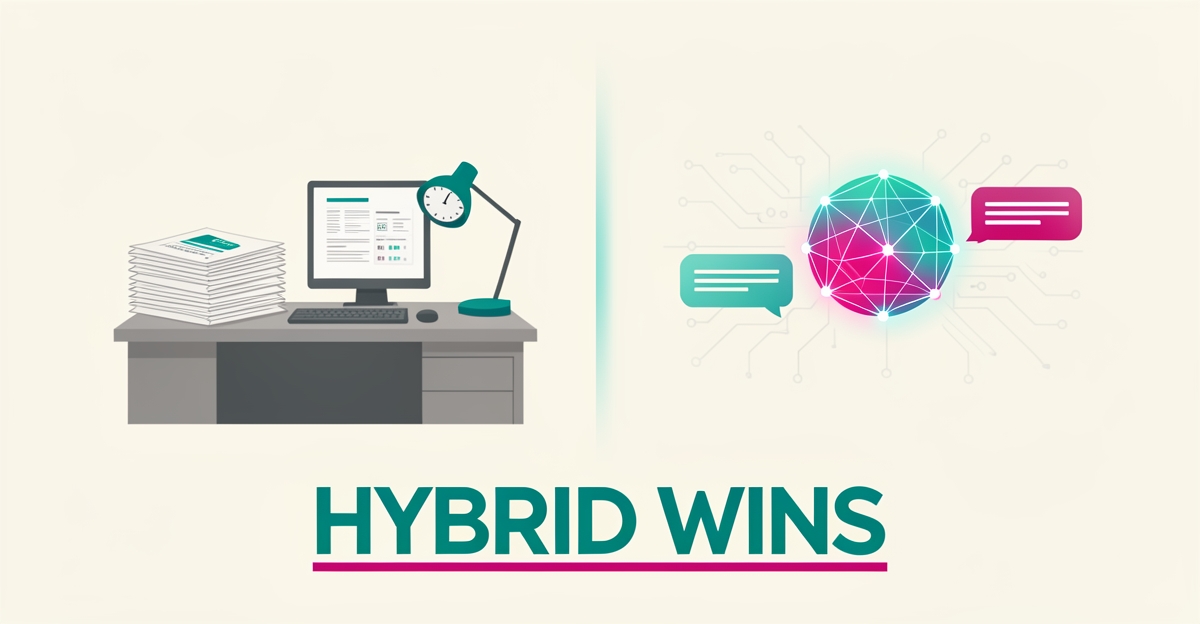
Why a Hybrid Model Delivers the Best Results
The numbers tell a clear story: 51% of U.S. small businesses have already woven AI into their customer service operations, yet 94% of those same companies plan to maintain or grow their human support teams. This isn't a replacement narrative — it's a partnership model that delivers measurable gains.
Research shows AI can handle up to 70% of routine inquiries — password resets, status checks, basic troubleshooting — with 65% faster resolution times and 40% higher customer satisfaction. That volume shift changes what human agents spend their day doing. Instead of clearing ticket queues, they tackle the complex, empathy-driven issues where judgment and relationship-building actually matter.
- AI handles repetitive Tier 1 requests around the clock
- Human agents focus on escalations requiring critical thinking
- Knowledge bases improve continuously from real interactions
- Customers get instant answers without losing the human option
IBM's analysis reinforces this: the best results come from combining the speed and data insights of AI with the empathy and critical thinking people can provide. Mature adopters see 17% higher customer satisfaction than peers who haven't integrated AI thoughtfully. The key is transparency — customers should know when they're talking to AI and when a human is available.
For small tech support businesses, this hybrid approach means scaling support without scaling headcount proportionally. AI Business Sites builds websites that embed this model from day one — an AI assistant answering routine questions instantly while routing complex cases to your team with full context preserved. The website becomes the frontline, not just a brochure.
Local business: doing this the old way?
One system replaces the whole pile.
All of it — the website, the follow-up, the content, the leads — built and run for you for $1,497 + $497/mo. Month-to-month, and you own everything.
See what your build includesHow to Implement AI Support Without Losing Control
Rolling out AI support doesn't mean handing over the keys — it means setting clear guardrails so the technology amplifies your team instead of replacing the trust you've built with customers. According to industry research, the best results come from combining the speed and data insights of AI with the empathy and critical thinking people can provide. That balance starts with transparency: customers should know when they're interacting with an AI and when a human is available, a practice that builds confidence rather than eroding it.
Human oversight remains essential for critical interactions. Survey data shows 94% of AI-adopting small businesses plan to maintain or grow their human customer service teams, reinforcing that AI handles routine volume while people own the moments that require judgment. A comprehensive analysis found 74% of companies now use chatbots, yet only 29% have moved to conversational AI — suggesting most are still in the early stages of learning where the handoff points belong.
- Disclose AI usage upfront in every chat and voice interaction
- Route emotionally sensitive or high-staked or complex cases to human agents immediately
- Set confidence thresholds so the AI escalates when unsure
- Review AI-drafted responses before they reach customers during the first 90 days
- Track escalation rates weekly to refine routing rules
Staff training turns AI from a black box into a force multiplier. The same survey reports 65% faster resolution times and 40% higher customer satisfaction among adopters — gains that only materialize when agents understand the AI's strengths, limitations, and how to intervene effectively. Teams that treat the AI as a collaborative tool, not a replacement, see 17% higher satisfaction scores according to enterprise implementations. AI Business Sites builds this human-in-the-loop philosophy directly into the platform: every AI action can be set to autopilot, approve-first, or manual review, so the business owner chooses exactly how much autonomy the system earns over time.
Frequently Asked Questions
Will adding AI support mean I have to lay off my human support team?
How much of our support workload can AI actually handle without human help?
What if the AI gives a wrong answer or handles a sensitive issue poorly?
Do customers actually trust AI support, or do they just want to talk to a person?
Is AI support only for big companies with technical teams, or can a small tech business implement it easily?
What's the real difference between a basic chatbot and the AI support described here?
Smarter Support, Scalable Growth
In the pursuit of efficient and effective support, small tech support businesses are wisely adopting a hybrid strategy, combining the unparalleled efficiency of AI with the irreplaceable empathy of human agents. By leveraging AI for up to 70% of routine inquiries, these businesses not only alleviate operational strain but also elevate customer satisfaction by 40% source. The key to success lies in transparency, human oversight, and strategic training. For actionable next steps, assess your support workload, identify routine queries ripe for AI handling, and invest in staff training to maximize AI-assisted productivity. Ready to transform your support strategy? Explore how AI Business Sites can help you implement a seamless hybrid model, empowering your team to focus on what matters most — delivering exceptional, high-value support.
FOR local businesss — BUILT AND RUN BY US
Your website. Your content. Your leads. Your data.
$500 starts your build. Seven days later it's live — chat, booking, follow-up, and your Google presence all set up. Then we run it, every month. You do the work you actually get paid for.