
Key facts
- Almost 60% of U.S. small businesses now use AI for operations, more than double the 2023 rate according to the U.S. Chamber of Commerce.
- Over 75% of small businesses are actively using or exploring AI implementation per a national survey by Reimagine Main Street.
- First-month AI adoption for new businesses jumped from 1.2% in 2019 to 6.5% in 2025 per JPMorgan Chase Institute cohort analysis.
- 75% of small businesses struggle with websites that fail to generate leads according to Reimagine Main Street research.
- State-level AI adoption ranges from 77% in Maine to 41% in Vermont per U.S. Chamber of Commerce data.
- Experts warn free ungoverned AI tools risk exposing sensitive business data, calling data 'your greatest commodity' per CDW's Kevin Weachter.
- The SBA recommends testing free or low-cost AI tools first to assess value before committing per official SBA guidance.
WANT RESULTS LIKE THIS?
Imagine a system doing all of this for your local business — every day, without you.
We build local businesses a custom website with a team of AI behind it: every lead captured and followed up, new content published monthly,customers finding you on Google — live in 7 days.
- 85+ pages at launch
- Every lead followed up, automatically
- Your whole business on one screen
Why Most Small Business Websites Fail to Generate Leads
Why Most Small Business Websites Fail to Generate Leads
A staggering 75% of small businesses struggle with websites that fail to generate leads, according to a national survey by Reimagine Main Street. This phenomenon is particularly prevalent among small computer repair shops, where websites often sit idle, missing after-hours leads, requiring constant manual updates, and failing to convert visitors. The core challenge lies in the limited time and technical skills of small business owners to maintain an effective online presence.
The Idle Website Problem
Most small business websites are static, requiring manual updates that many owners lack the time or expertise to perform. This results in outdated content, missed opportunities for search engine optimization (SEO), and an inability to engage with potential customers outside business hours. Almost 60% of U.S. small businesses now use AI for business operations, highlighting a shift towards more dynamic, automated solutions (U.S. Chamber of Commerce).
The Human Resource Gap
Small computer repair shops, in particular, face a human resource gap. They lack the dedicated staff to manage leads, update content, and handle customer inquiries around the clock. This gap leads to missed leads, especially after hours, and a failure to nurture potential customers through automated follow-ups. Experts like Monica Livingston advise defining specific business outcomes before adopting any solution, emphasizing the need for a tailored approach (Innovate Carolina).
The Technical Skill Barrier
Building and maintaining an effective website requires technical skills that many small business owners do not possess. From SEO optimization to integrating lead capture tools, the technical barriers can be daunting. Moreover, the constant need for content updates to attract and retain visitors adds another layer of complexity. Newer businesses are more likely to integrate AI from inception, at a 6.5% first-month adoption rate for the 2025 cohort, indicating a future where AI-driven websites will be the norm (JPMorgan Chase Institute).
The Solution: AI-Powered Websites
Given these challenges, AI-powered website platforms emerge as a viable solution. These platforms can:
- Automate Lead Follow-Ups: Ensure no lead is missed, even after hours.
- Generate Content: Produce SEO-optimized content regularly without manual intervention.
- Integrate CRM and Booking: Manage customer interactions and appointments seamlessly.
- Provide Real-Time Support: Offer instant responses to visitor queries through AI chatbots.
By addressing the idle website problem, the human resource gap, and the technical skill barrier, AI-powered websites can transform a passive online presence into an active lead generation tool. As advised by the SBA, testing such platforms before commitment can help small businesses assess their value (SBA Guidance).
Key Statistics Highlighting the Need for Change:
- Over 75% of small businesses are either using or exploring AI implementation (Reimagine Main Street).
- 60% of U.S. small businesses already use AI for business operations, more than double the 2023 rate (U.S. Chamber of Commerce).
- 6.5% of new businesses in 2025 adopted AI in their first month, signaling a trend toward AI integration from inception (JPMorgan Chase Institute).
Moving Forward
For small computer repair shops, the path forward involves recognizing the limitations of traditional website approaches and embracing AI-powered solutions that can dynamically address the challenges of lead generation, content management, and customer engagement. By doing so, these businesses can ensure their website is not just a static presence but a thriving, lead-generating asset.
As experts like Kevin Weachter suggest, starting small with managed AI solutions and scaling up based on needs is crucial for successful integration (BizTech Magazine). This approach allows businesses to leverage AI without the technical debt of in-house development, aligning with the strategic recommendations derived from the research findings.
Practical Takeaways for Small Business Owners:
- Define specific business outcomes before adopting an AI solution to ensure it addresses your needs.
- Consider a consolidated AI-powered platform to reduce complexity and training burdens.
- Test platforms with a pilot or trial period to assess value before full commitment, as recommended by the SBA.
By focusing on these strategies, small computer repair shops can effectively navigate the challenges of traditional website management and leverage AI to drive business growth.
Sources Used in This Section:
The Research-Backed Shift Toward AI-Powered Solutions
The shift toward AI-powered solutions isn't just a trend—it's becoming the baseline for small businesses looking to stay competitive. According to industry research, nearly 60% of U.S. small businesses now use AI for daily operations, more than double the rate from just two years ago. This rapid adoption reflects a broader change in how owners view technology: not as an optional upgrade, but as essential infrastructure for growth.
What’s especially telling is how quickly newer businesses are embracing AI from the start. Data shows that first-month AI adoption jumped from 1.2% for companies launched in 2019 to 6.5% for those started in 2025—a clear sign that integrating AI early is becoming standard practice. For established shops, delaying adoption risks falling behind competitors who begin with smarter, more automated systems already in place.
Experts consistently advise against building complex custom solutions when starting out. Instead, they recommend beginning with managed platforms that deliver immediate value without requiring technical expertise. As one implementation guide notes, starting small with pilots helps businesses test real-world impact before scaling—especially important for owners who wear many hats and can’t afford steep learning curves.
- Define clear objectives first—don’t adopt AI just because others are doing it
- Prioritize tools that are simple to use, secure, and built for actual workflows
- Choose platforms that keep humans in the loop for safety and quality control
- Opt for consolidated systems over juggling multiple disconnected tools
For a computer repair shop owner focused on fixing devices, not managing software, an AI-powered website platform offers a practical way to harness these benefits. It handles lead capture, booking, content, and follow-up automatically—turning the website into an active part of the business rather than a static brochure. AI Business Sites builds exactly this kind of solution: a custom website that runs itself day to day, so owners can spend less time on admin and more time on what they do best.
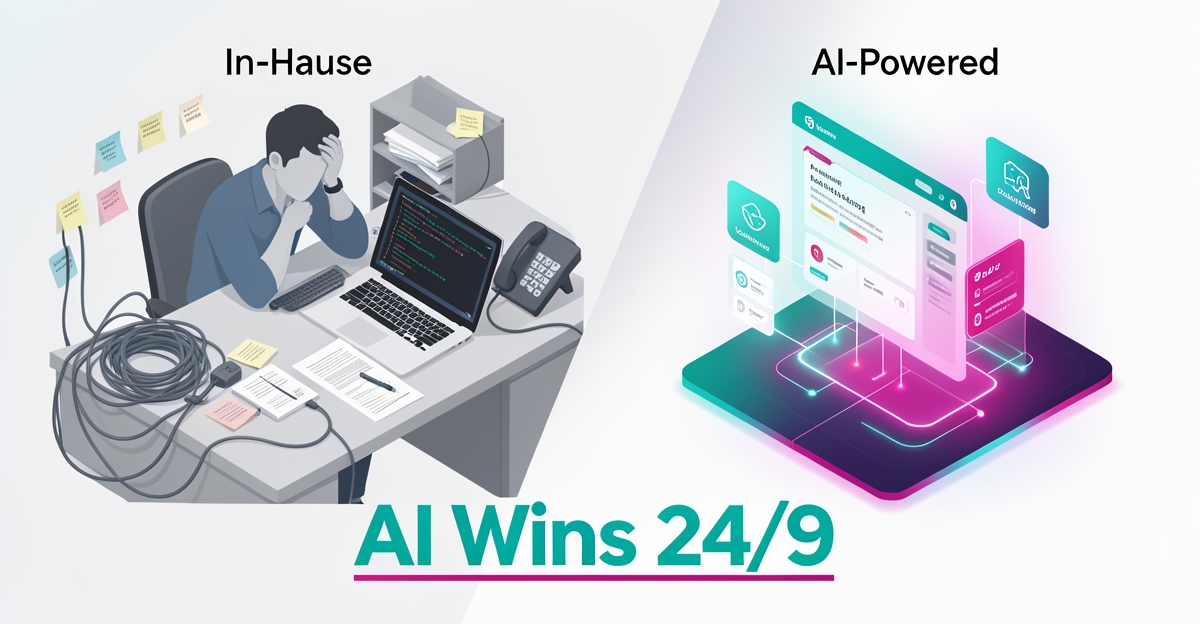
Local business: doing this the old way?
One system replaces the whole pile.
All of it — the website, the follow-up, the content, the leads — built and run for you for $1,497 + $497/mo. Month-to-month, and you own everything.
See what your build includesHow to Choose a Solution That Actually Runs Your Business
The pressure to adopt AI isn't just hype — it's becoming a competitive baseline. Nearly 60% of U.S. small businesses now use AI for operations, more than double the 2023 rate, and newer competitors are integrating it from day one at accelerating speeds source. For a computer repair shop without a technical team, the real question isn't whether to use AI, but how to choose a solution that actually runs the business instead of creating more work to manage.
Experts across the board converge on three evaluation criteria that separate useful platforms from expensive distractions. First, define specific outcomes before comparing features — Kevin Weachter at CDW warns that "investments must map directly to business priorities for measurable ROI" rather than adopting due to competitive pressure source. Second, prioritize data governance and human oversight — ungoverned free tools risk exposing "your greatest commodity" (business data), and "you can't just set AI loose and expect perfect results" source. Third, choose consolidated platforms over fragmented point solutions — the SBA recommends testing low-cost tools first, but the hidden cost of duct-taping eight separate subscriptions is training burden, integration gaps, and missed follow-ups source.
- List your concrete needs: after-hours lead capture, automated booking, local SEO content, instant follow-up
- Verify the platform keeps customer data secure and requires human approval before AI sends communications
- Confirm one system handles website, CRM, automation, content, voice, and analytics — not a patchwork
- Negotiate a 30–90 day pilot with measurable KPIs before committing long-term
This is exactly the evaluation framework AI Business Sites was built around — a custom website that comes with the business operations platform already running underneath it, so the AI assistant, CRM, automation, content engine, voice agent, and newsletter work together from day one. The owner defines the outcomes; the system handles the busywork.
Frequently Asked Questions
Is it really true that most small business websites don't generate leads?
I don't have technical skills — can I actually use an AI-powered website without learning code?
Is AI adoption just a trend, or are other repair shops actually using this?
Will an AI website actually follow up with leads when I'm busy fixing computers?
What if the AI says something wrong to a customer — am I locked into autopilot?
How do I know an AI website will actually work for my shop before I commit?
From Static to Strategic: Unlocking Growth with AI-Powered Websites
The tide has turned in favor of AI-powered websites for small businesses, including computer repair shops, with almost 60% of U.S. small businesses already leveraging AI for operational efficiency (U.S. Chamber of Commerce). The key to success lies in adopting a solution that addresses specific business challenges, such as lead generation, content management, and customer engagement, all while ensuring human oversight and data governance. For a small computer repair shop, the path forward involves transitioning from static, manually intensive websites to dynamic, AI-driven platforms. Next Steps for Small Computer Repair Shops: 1. Define Your Objectives: Identify how an AI-powered website can solve your unique challenges, such as capturing after-hours leads or automating appointment scheduling. 2. Trial Before Commitment: Negotiate a pilot period with an AI-powered website provider to assess real-world value. 3. Consolidate for Simplicity: Opt for a platform that integrates website, CRM, automation, and content generation to reduce complexity. By embracing this strategic shift, small computer repair shops can transform their online presence into a thriving, lead-generating asset. Explore how AI can elevate your business with a trial or consultation tailored to your needs.
FOR local businesss — BUILT AND RUN BY US
Your website. Your content. Your leads. Your data.
$500 starts your build. Seven days later it's live — chat, booking, follow-up, and your Google presence all set up. Then we run it, every month. You do the work you actually get paid for.