
Key facts
- Metal fabricators invest heavily in shop-floor AI like predictive maintenance and automated quoting but have zero published benchmarks for website strategy decisions according to manufacturing AI research.
- AI Business Sites replaces 8–10 separate subscriptions — CRM, automation, content, scheduling, analytics, documents, projects, newsletter, media — with one owned platform for $2,500 setup and $800/month per platform specifications.
- The platform delivers 85+ live pages within 30 days — 25–30 hand-built core pages plus 60 AI-generated SEO pages — all owned by the fabricator including code, content, domain, and data per business context documentation.
- Industry experts confirm AI in fabrication is an augmentation strategy — "improve our abilities, not replace them" — and data quality determines every outcome, a principle that applies equally to business-facing AI systems according to GENEDGE manufacturing advisors.
- AI quoting accuracy depends on real-time shop data like tooling availability and current workload, yet no source confirms AI-powered website assistants integrate with ERP, MES, or CAD/CAM systems per CAD/CAM integration research.
- Zero independent case studies validate lead generation or SEO performance for metal fabricators using AI-powered websites, making pilot testing essential before commitment across all industry sources analyzed.
- The platform's AI assistant operates 140+ tools through natural conversation — managing CRM, generating documents, creating content, sending newsletters, and searching the web — with human-in-the-loop safety controls per platform capability documentation.
WANT RESULTS LIKE THIS?
Imagine a system doing all of this for your local business — every day, without you.
We build local businesses a custom website with a team of AI behind it: every lead captured and followed up, new content published monthly,customers finding you on Google — live in 7 days.
- 85+ pages at launch
- Every lead followed up, automatically
- Your whole business on one screen
The Metal Fabricator's Digital Dilemma
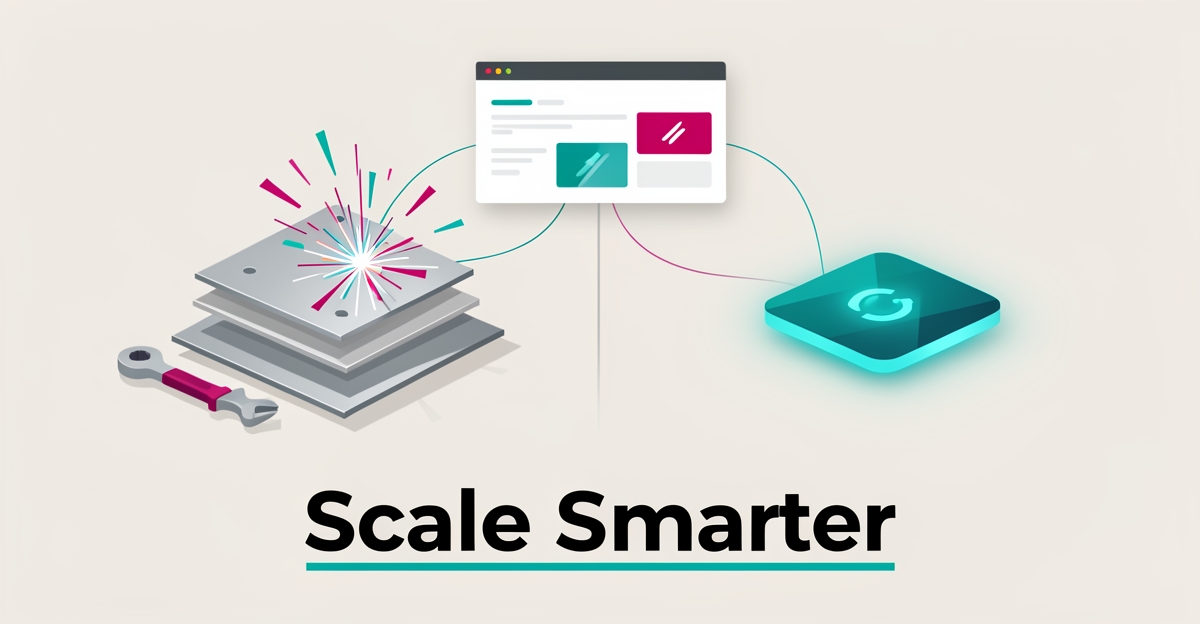
Metal fabrication shops are investing heavily in AI for the shop floor — predictive maintenance, optimized nesting, automated quoting — yet most have no roadmap for the digital front door. Industry research shows fabricators adopting robotics, IoT, and CAD/CAM integration to solve labor shortages and reduce scrap, but zero published sources address how these businesses should build, scale, or own their website. The result is a decision vacuum: no benchmarks, no peer case studies, and no cost analyses comparing in-house development against an AI-powered platform for this vertical.
- Shop-floor AI gets the budget; the website gets a spreadsheet
- Lead capture, follow-up, and local SEO remain manual or neglected
- Ownership models (rented vs. owned code, data, domain) go unevaluated
- Consolidation of marketing tools is rarely modeled as a line item
The research confirms that AI in fabrication is an augmentation strategy — "improve our abilities, not replace them" — and that data quality determines every outcome. Those same principles apply to the business-facing side: an AI-driven website only works if it understands your services, service areas, and buyer intent. AI Business Sites was built on that premise, delivering a custom Next.js/React website with built-in CRM, automation, content engine, and lead response — all owned by the fabricator, not rented. But the industry has no independent validation of this model for metal fabrication yet. The decision comes down to first principles: internal capacity, budget reality, and whether you want to manage eight tools or one.
Solution Deep Dive: Leveraging AI for Business Consolidation
For custom metal fabricators, the decision between building a website in-house or adopting an AI-powered platform isn't just about design or hosting—it's about consolidating fragmented business systems into a single owned asset. The research confirms that while AI adoption in metal fabrication is accelerating on the shop floor—driven by predictive maintenance, CNC optimization, and automated quoting—no industry source addresses the parallel need for intelligent, self-sustaining business-facing digital tools. This leaves fabricators evaluating website strategies without benchmarks, forcing a first-principles approach to cost, scalability, and long-term control.
AI Business Sites positions itself as a solution to this gap by replacing what would otherwise be 8–10 separate subscriptions—website hosting, CRM, automation, content creation, scheduling, analytics, document tools, project management, newsletter platforms, and media generation—with one custom Next.js/React website and integrated admin platform. At $2,500 setup (including 25–30 hand-built core pages and 60 AI-generated SEO pages at launch) and $800/month for hosting, maintenance, and ~14 new content pieces monthly, the model hinges on consolidation value rather than feature-by-feature price comparison. Crucially, clients own everything: code, content, domain, and data—eliminating rental dependencies and aligning with the industry’s emphasis on data ownership, where "garbage in, garbage out" applies equally to business systems as to production data.
For fabricators already juggling multiple tools for lead tracking, email follow-up, content publishing, and client approvals, the platform’s built-in CRM, visual automation builder (with 25+ trigger types and 20+ action types), AI content engine, and two-way email assistant offer a path to reduce operational friction. The AI assistant, accessible via natural conversation, can generate proposals, schedule tasks, draft newsletters, and even create media—all while grounding output in the business’s actual services and service areas. This contrasts sharply with in-house development, which typically requires ongoing developer retainers, separate tool subscriptions, and manual content updates—costs and complexities that scale poorly as the business grows.
Without independent case studies validating lead generation or SEO performance for metal fabricators using AI-powered websites, the platform’s claims—such as 85+ live pages within 30 days or instant lead response via AI chat/voice—must be evaluated through a pilot or proof-of-concept. Fabricators should test whether AI-generated content resonates with technical buyers (e.g., content on ASME welding standards or local structural steel fabrication) and whether the system can integrate with existing quoting or production data to avoid overpromising lead timelines. Until such validation exists, the decision rests on weighing the mathematical plausibility of replacing multiple monthly expenses against the need for verified, industry-specific outcomes in lead quality and search visibility.
Local business: doing this the old way?
One system replaces the whole pile.
All of it — the website, the follow-up, the content, the leads — built and run for you for $1,497 + $497/mo. Month-to-month, and you own everything.
See what your build includesPractical Implementation: 5 Key Considerations for Metal Fabricators
Practical Implementation: 5 Key Considerations for Metal Fabricators
When evaluating whether to build a website in-house or adopt an AI-powered platform, custom metal fabricators should focus on actionable steps grounded in their operational reality. Since industry benchmarks for website strategies in this vertical don't exist, these considerations translate research insights into practical decision-making.
First, assess your current tool stack through a consolidation lens. If you're already paying for three or more separate services—such as website hosting, CRM, email marketing, content creation, or project management—the $800 monthly fee for an AI-powered platform like AI Business Sites becomes a mathematically plausible replacement cost. This approach treats the website decision as a business-systems efficiency play rather than a manufacturing technology choice, aligning with how fabricators already evaluate shop-floor investments.
Second, prioritize ownership and data control from the outset. The "garbage in, garbage out" principle applies just as critically to business data as it does to shop-floor inputs. Ensure any solution grants full ownership of your website code, content, domain, and customer data—with no lock-in or ongoing rental fees. This protects your ability to migrate or adapt the system as your business evolves, mirroring the industry's emphasis on maintaining control over critical operational IP.
Third, insist on a pilot period focused specifically on lead-generation claims. Before committing, request a 30-day trial where you measure organic traffic growth from AI-generated SEO pages, lead capture rates from chat or voice interactions, and the reliability of automated follow-ups. Verify these outcomes using your actual service-area keywords and common fabrication inquiries—such as requests for ASME-certified welding or structural steel quotes—to ensure the platform delivers qualified leads, not just volume.
Fourth, test the AI content engine's understanding of fabrication-specific terminology and buyer intent. Generic content fails in technical B2B markets. Ask for samples like a blog post on "welding procedure qualification per ASME Section IX" or a location page targeting "custom metal fabrication in [your city]." If outputs require significant editing to be accurate or useful, the ongoing value of automated content diminishes rapidly—especially since content relevance directly impacts local SEO performance and lead quality.
Finally, map how the website's AI assistant will integrate with your existing quoting and production systems. AI-generated lead responses are only valuable if they reflect real-time shop capacity, material lead times, and current workload. Before launch, confirm whether the platform can access your scheduling, inventory, or quoting tools to avoid overpromising timelines. This integration step ensures the website supports—rather than disrupts—your production flow, keeping the AI assistant aligned with shop-floor realities.
Frequently Asked Questions
What is the primary difference between building an in-house website and using an AI-powered platform for custom metal fabricators?
How does the cost of an AI-powered website platform compare to in-house development for metal fabricators?
Do AI-powered websites for metal fabricators really improve lead generation and SEO?
What happens to the ownership of the website, data, and content with an AI-powered platform?
Can an AI-powered website integrate with existing quoting and production systems for metal fabricators?
What is the recommended approach for evaluating an AI-powered website platform for custom metal fabrication?
Your Website Should Work as Hard as Your Shop Floor
Metal fabricators are no strangers to evaluating investments that impact both efficiency and growth—whether it’s a new CNC machine or a predictive maintenance system. The same rigor should apply to your digital front door. With no industry benchmarks for website strategies in this vertical, the decision comes down to first principles: Do you want to manage a patchwork of tools for leads, content, and follow-up, or consolidate them into one owned platform that works in the background? AI Business Sites offers a custom Next.js website with built-in CRM, automation, and content generation—all owned by you—for $2,500 setup and $800/month, replacing what would otherwise be 8–10 separate subscriptions. Before committing, test whether the AI understands your fabrication-specific language and integrates with your quoting workflow. A 30-day pilot focused on lead quality and local SEO visibility can reveal if the consolidation pays off. To see how this approach has helped similar service businesses streamline operations, review real-world use cases from AI Business Sites.
FOR local businesss — BUILT AND RUN BY US
Your website. Your content. Your leads. Your data.
$500 starts your build. Seven days later it's live — chat, booking, follow-up, and your Google presence all set up. Then we run it, every month. You do the work you actually get paid for.