
Key facts
- AI website builders cost $15–$50/month but total ~$1,740 over 5 years with zero ownership according to cost analysis.
- Custom websites cost $3,000+ upfront but retain ownership with a 5-year total cost of ~$3,600 per independent testing.
- Custom sites load under 1 second while AI templates take 2–4 seconds, costing 47% of visitors who abandon sites over 2 seconds per design trend data.
- 75% of users judge a company’s credibility based solely on website design, triggering the 'visual elevator music' effect per Utsubo research.
- AI Business Sites builds 85+ pages in 30 days using Next.js/React—the same stack as Netflix and Shopify—while handling lead capture, scheduling, and safety docs automatically per platform documentation.
- 91% of small businesses using AI report increased success, but 77% still prefer human interaction for positive customer experiences per SBA report.
- AI-driven platforms consolidate CRM, scheduling, and content tools into one system, reducing staffing needs for 70% of B2B buyers who research before contacting you per Utsubo analysis.
WANT RESULTS LIKE THIS?
Imagine a system doing all of this for your local business — every day, without you.
We build local businesses a custom website with a team of AI behind it: every lead captured and followed up, new content published monthly,customers finding you on Google — live in 7 days.
- 85+ pages at launch
- Every lead followed up, automatically
- Your whole business on one screen
The Dilemma: In-House Development vs AI-Driven Website Platforms
Most scaffolding firms don't have a marketing department — they have a foreman who checks emails between site visits. That reality makes the website decision feel like a trap: spend months and thousands on a custom build, or launch tonight with an AI builder and hope it works.
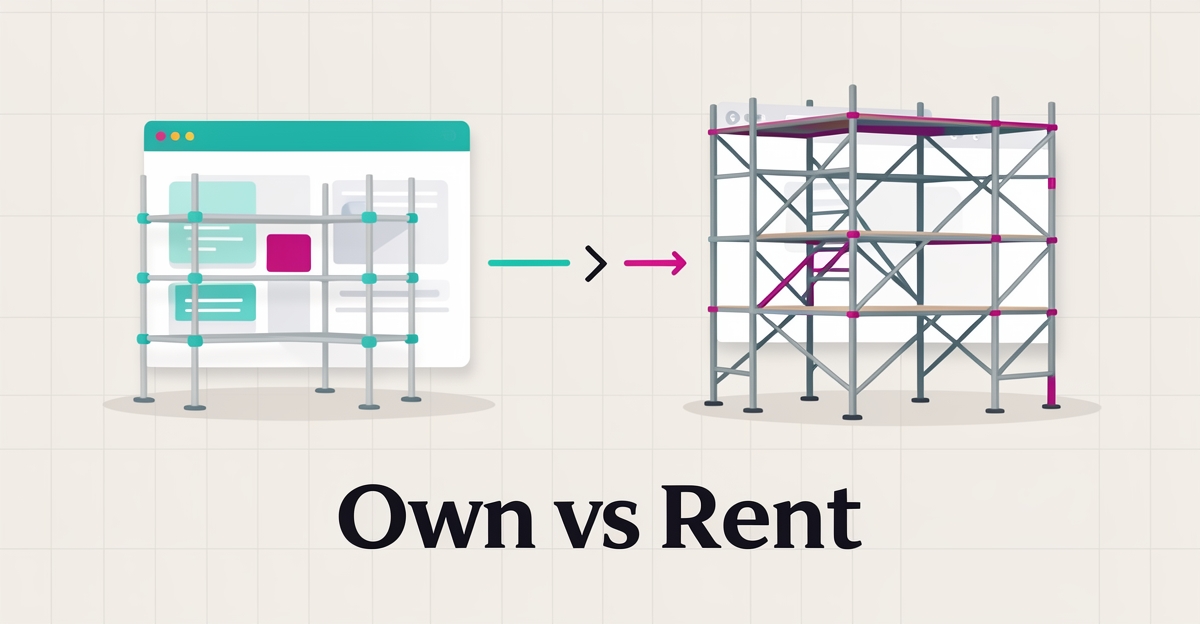
The research reveals a sharper divide than most owners expect. Generic AI builders (Wix ADI, Squarespace Blueprint) cost $15–$50 per month and launch in hours, but a detailed cost analysis shows they total roughly $1,740 over five years with zero ownership — you're renting, not building equity. Custom sites run $3,000+ upfront yet cost but keep the asset; the same five-year window lands near $3,600 with full control of code, content, and data.
Performance gaps widen from there. Independent testing puts AI-builder load times at 2–4 seconds on mid-range phones, while custom Next.js sites come in under one second. That difference isn't academic: design trend data shows 47% of visitors abandon pages that take longer than two seconds, and 88% never return after a bad experience. For a scaffolding firm bidding against three competitors, those seconds decide who gets the call.
- AI templates lack schema markup and Core Web Vitals optimization — critical for local SEO and AI-search visibility
- No portability means a full rebuild when you outgrow the platform
- Generic designs trigger the "visual elevator music" effect — 75% of users judge credibility on design alone
- Scaffolding-specific workflows (safety docs, crew scheduling, project approvals) rarely integrate with closed builders
Agency analysis confirms the pattern: businesses with real competition that choose builders for day-one savings often spend two years stuck below rivals who invested properly. The alternative isn't "hire a dev team" — it's a custom site with AI-powered automation underneath that handles lead capture, follow-ups, and scheduling without adding headcount. AI Business Sites builds on Next.js and React (the same stack as Netflix and Shopify), delivers 85+ pages in 30 days, and includes a business operations platform that answers chats, books calls by voice, and generates monthly SEO content — all while you own everything.
Research-Backed Solution: Weighing Costs, Scalability, and Lead Generation
Research-Backed Solution: Weighing Costs, Scalability, and Lead Generation for Small Scaffolding Firms
When deciding between an in-house custom website and an AI-driven platform for your small scaffolding firm, the decision hinges on cost efficiency, scalability for growth, and lead generation capability. Research reveals distinct advantages for each approach, tailored to the unique needs of scaffolding businesses.
Cost Efficiency Over Time While AI-driven platforms like Wix AI or Squarespace Blueprint offer low upfront costs ($15–$50/month), their long-term costs (~$1,740 over 5 years) and lack of ownership make them less favorable for firms prioritizing long-term growth. In contrast, custom websites (e.g., those built by AI Business Sites) incur a one-time cost of $3,000+ but provide full ownership and a total 5-year cost of ~$3,600, offering better ROI for competitive niches.
Scalability and Lead Generation
- Custom Websites outperform AI builders in SEO, load speed (<1 sec), and conversion rates (2–3x higher), critical for local scaffolding firms. For example, a custom site can optimize for Core Web Vitals and schema markup, improving visibility in Google and AI search results.
- AI-driven Platforms (e.g., AI Business Sites) consolidate tools (CRM, scheduling, content generation) into one system, reducing staffing needs. AI Business Sites, for instance, uses an AI assistant to handle lead capture, follow-ups, and scheduling automatically, crucial for firms lacking dedicated marketing teams.
Actionable Insights for Small Scaffolding Firms
- Prioritize Custom for Long-Term Growth: If competing locally or relying on search/AI traffic, invest in a custom website with AI-powered automation (e.g., AI Business Sites) for superior SEO, ownership, and scalability.
- AI Builders for Temporary Needs: Use platforms like Wix AI for fast, low-cost solutions but plan to migrate to a custom site within 6–12 months to avoid lock-in and improve SEO.
- Balance Automation with Human Touch: While AI excels at automating routine tasks (e.g., lead follow-ups), ensure a human touch remains in critical interactions (e.g., safety consultations, sales calls) to maintain customer trust.
Key Statistics Informing the Decision
- 91% of small businesses using AI report increased success (Source: SBA Report).
- Custom websites deliver faster load times (<1 sec) and outperform in SEO compared to AI builders (Source: ThatDeveloperGuy).
- 75% of users judge a company’s credibility based on website design alone (Source: Utsubo).
For small scaffolding firms, the superior choice for long-term growth, lead generation, and credibility is a custom website built with AI-driven automation under the hood, such as those offered by AI Business Sites, which combines the benefits of rapid deployment with the necessity of custom, scalable solutions.
Local business: doing this the old way?
One system replaces the whole pile.
All of it — the website, the follow-up, the content, the leads — built and run for you for $1,497 + $497/mo. Month-to-month, and you own everything.
See what your build includesImplementation Roadmap: Choosing and Setting Up the Best Option
Start by auditing what your website actually needs to do — capture leads, host safety documentation, schedule crews, and follow up automatically — then match those requirements to the platform that delivers them without adding headcount. Research shows that 70% of B2B buying decisions happen before a prospect ever contacts you, so your site must function as a 24/7 sales and operations tool, not a digital brochure (source).
Use this decision framework to choose the right path:
- If you have no online competition and need a presence this week, a generic AI builder (Wix ADI, Squarespace Blueprint) gets you live fast — but plan to migrate within 6–12 months to avoid lock-in (source).
- If you compete locally and rely on search traffic, invest in a custom site built on modern tech (Next.js, React) with full SEO control, sub-second load times, and ownership of code and data (source).
- If you want speed and portability, a WordPress-native AI tool like Elementor Pro + Angie lets you generate code and automate bulk updates while keeping full site ownership (source).
- If you need lead capture, safety docs, scheduling, CRM, and content generation consolidated into one system without hiring staff, an AI-driven custom platform like AI Business Sites handles all of it under one roof (source).
For migration or customization, prioritize mobile-first design and Core Web Vitals — 47% of users abandon sites that take longer than two seconds to load, and 88% never return after a bad experience (source). Map your existing safety documentation and project workflows into the new platform's project management and approval portals so nothing falls through the cracks during the switch. Set up Google Business Profile and Bing search optimization at launch — not as an afterthought — so local visibility starts on day one. Finally, configure the AI assistant with your actual service knowledge base so it answers visitor questions, books appointments by voice, and follows up on leads automatically from the moment you go live.
Frequently Asked Questions
How much does a custom website for a scaffolding firm cost compared to an AI builder over five years?
Will an AI-built website hurt my scaffolding firm’s credibility with potential clients?
How does website speed affect lead generation for scaffolding firms competing locally?
Can an AI website platform handle scaffolding-specific workflows like safety docs and crew scheduling?
Is it better to start with an AI builder and migrate later if I’m on a tight budget?
Do custom websites really improve my scaffolding firm’s visibility in AI-powered search results like Google Overviews?
Key Takeaways
{ "title": "From Dilemma to Decision: Empowering Small Scaffolding Firms Online", "content": "The choice between an in-house custom website and an AI-driven platform for small scaffolding firms boils down to balancing immediate costs with long-term strategic gains. While AI builders offer rapid depl
FOR local businesss — BUILT AND RUN BY US
Your website. Your content. Your leads. Your data.
$500 starts your build. Seven days later it's live — chat, booking, follow-up, and your Google presence all set up. Then we run it, every month. You do the work you actually get paid for.