
Key facts
- Trucking websites face a dual-audience challenge serving shippers and drivers with almost zero overlap in intent according to industry-specific design research
- Custom trucking website projects take 8 to 14 weeks from kickoff to launch per website design analysis
- All-in-one trucking platforms deploy professional sites in under 5 minutes at roughly $180 annually based on platform deployment data
- Video content increases conversion rates by up to 80% over static posts per digital marketing trend analysis
- Mobile load times exceeding 8 seconds on cell connections erode driver application completion rates per trucking website design research
- Driver application forms targeting under 5 minutes completion time become a recruitment metric per UX optimization findings
- Technical audits every six months prevent silent lead erosion from broken forms and indexing issues per maintenance burden analysis
WANT RESULTS LIKE THIS?
Imagine a system doing all of this for your local business — every day, without you.
We build local businesses a custom website with a team of AI behind it: every lead captured and followed up, new content published monthly,customers finding you on Google — live in 7 days.
- 85+ pages at launch
- Every lead followed up, automatically
- Your whole business on one screen
The Dual-Audience Challenge Unique to Trucking Websites
A trucking company's homepage faces a design problem most industries never encounter: it must convince a shipper to trust your operation and a driver to trust your employment offer — often on the same screen. Shippers arrive checking lanes, equipment specs, FMCSA compliance, and CSA scores, while drivers scan for pay per mile, home time guarantees, and equipment quality, with almost no overlap in what builds confidence for either group. This dual-audience challenge forces a structural split that generic templates rarely solve, leaving both audiences underserved and leads unconverted.
Industry-specific design addresses this by creating separate navigation entry points — typically "Ship With Us" and "Drive For Us" — that route each visitor to service pages organized around their actual decision criteria rather than a single company-centric menu. Custom trucking websites built this way take 8 to 14 weeks from kickoff to launch, reflecting the complexity of mapping two distinct user journeys onto one domain. Mobile performance carries outsized weight here: drivers are almost always on cell connections at truck stops or rest areas, and load times exceeding 8 seconds on mobile directly erode application completion rates. Application forms targeting under 5 minutes completion time become a recruitment metric, not just a UX detail.
- Shippers need compliance proof, lane coverage, and equipment verification before they call
- Drivers need pay transparency, home time clarity, and employer reputation signals before they apply
- Both audiences require trust signals that generic "About Us" pages fail to deliver
- Broken forms, slow loads, and indexing issues erode leads within 6 months without technical review
The maintenance burden compounds the challenge — technical audits every six months prevent the silent lead erosion that occurs when forms break, pages de-index, or mobile performance degrades. For companies without dedicated marketing teams, this creates a resource gap that all-in-one platforms aim to close by consolidating website management, CRM, lead tracking, and content generation into a single system. AI Business Sites builds custom websites that account for this dual-audience reality from day one, embedding the structural separation and trust signals each audience demands while the platform handles the ongoing content, lead follow-up, and technical maintenance that keeps both funnels performing.
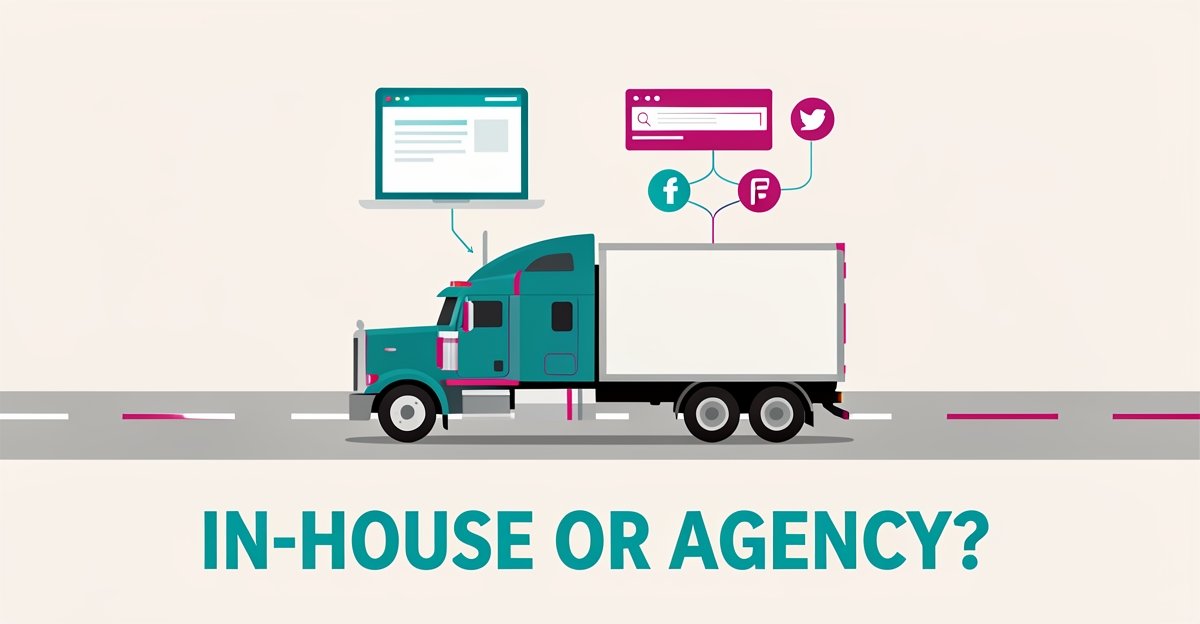
Why Traditional In-House and Agency Approaches Fall Short
Why Traditional In-House and Agency Approaches Fall Short
Managing a trucking company's digital presence is a daunting task, especially when considering the dual-audience challenge of serving both shippers and drivers effectively. Both in-house teams and external agencies have their limitations, which can hinder the success of your online strategy.
The In-House Conundrum: High Overhead, Slow Adaptation Building an in-house team for digital management incurs significant overhead costs, including salaries, training, and infrastructure. Moreover, in-house teams often struggle to keep pace with the latest digital marketing trends, such as the pivotal role of video content, which can increase conversion rates by up to 80% source. The requirement for frequent technical reviews (every 6 months) to prevent lead erosion source further burdens already stretched resources.
The Agency Dilemma: Ongoing Fees, Delays, and Lack of Ownership Hiring an agency brings specialized expertise but comes with ongoing, potentially hefty fees. Custom trucking website projects can take 8 to 14 weeks from kickoff to launch source, delaying your digital presence enhancement. Furthermore, agencies often leave clients without full ownership of their digital assets, a critical concern for long-term strategy and scalability.
Common Pitfalls: Maintenance, Mobile Optimization, and Tool Fragmentation
- Maintenance Cycles: Both approaches risk neglecting regular technical reviews, leading to broken forms, slow load times, and indexing issues that erode leads.
- Mobile Optimization: The failure to ensure mobile load times under 8 seconds on cell connections and driver application forms under 5 minutes to complete can significantly impact driver recruitment source.
- Tool Fragmentation: Both in-house and agency models often result in a patchwork of separate tools for CRM, lead tracking, content generation, and more, increasing complexity and costs.
Key Limitations at a Glance:
- In-House: High overhead, slow adaptation to new trends.
- Agency: Ongoing fees, delayed timelines, lack of asset ownership.
- Both: Struggle with maintenance, mobile optimization, and tool consolidation.
Given these challenges, trucking companies are increasingly looking for alternatives that offer the control of in-house management, the expertise of an agency, and the efficiency of consolidated toolsets, all while ensuring ownership of their digital assets. The emerging trend of all-in-one platforms source promises to address these shortcomings with rapid deployment (under 5 minutes), comprehensive functionality, and affordable pricing ($180 annually), making it an attractive solution for managing a trucking company's digital presence effectively.
Local business: doing this the old way?
One system replaces the whole pile.
All of it — the website, the follow-up, the content, the leads — built and run for you for $1,497 + $497/mo. Month-to-month, and you own everything.
See what your build includesThe All-in-One Platform Alternative: Ownership, Speed, and Consolidation
Between the agency route and the in-house build sits a third path that trucking companies are starting to adopt: an all-in-one platform that consolidates website, CRM, automation, content, and lead tracking into a single owned system. Instead of stitching together eight to ten separate subscriptions — each with its own login, billing cycle, and integration headache — you get one environment that handles the dual-audience demands of shippers and drivers without the technical debt. Research on trucking-specific digital platforms shows this model can deploy a professional site in under five minutes at roughly $180 per year, a fraction of the timeline and cost associated with custom agency builds.
- One system replaces website builder, CRM, marketing automation, content writer, scheduling tool, analytics, document generator, project management, newsletter platform, and media creation tools
- Ongoing SEO content — blog posts, service pages, location pages — publishes automatically with internal linking that compounds over time
- Video integration and mobile-optimized lead forms address the driver-recruitment reality that 8-second load times on cell connections lose applicants
- Google Business Profile and Bing search setup included at launch, not as an upsell
- You own the code, content, domain, and data — no renting your own digital assets
The consolidation argument matters because trucking websites face a structural problem most industries don't: serving shippers and drivers on the same homepage with almost zero overlap in intent. Industry-specific design research confirms that generic templates fail this test, while custom agency projects typically run 8 to 14 weeks from kickoff to launch. An all-in-one platform bridges that gap by baking the dual-audience architecture — separate navigation entry points, audience-specific trust signals, freight-type service pages — into the foundation, then layering on the automation that keeps it current without a marketing team on payroll.
AI Business Sites builds on this same principle: the website is the product, and the platform underneath is what makes it run itself. When your site can answer driver questions at 2 a.m., follow up with a shipper lead instantly, publish a new location page for a lane you just added, and send a newsletter without you lifting a finger, the maintenance burden that erodes leads every six months simply doesn't accumulate. Video content alone lifts conversion rates up to 80% over static posts, and having that capability built in — not bolted on — means you actually use it. The result is a digital presence that scales with your fleet, not your overhead.
Frequently Asked Questions
What's the unique challenge in designing a trucking company's website?
How long does a custom trucking website project typically take?
Why are mobile load times critical for trucking company websites?
What's the benefit of an all-in-one platform for trucking companies?
How often should trucking company websites undergo technical reviews?
What's the impact of video content on conversion rates for trucking companies?
Your Trucking Company's Digital Presence Deserves Better
Managing a trucking company's digital presence doesn't have to mean choosing between the high overhead of an in-house team or the ongoing fees and delays of an agency. As we've seen, both approaches struggle with the unique dual-audience challenge of serving shippers and drivers effectively, while also falling short on maintenance, mobile optimization, and tool consolidation. The smarter path forward is an all-in-one platform that gives you ownership of your digital assets, deploys in under five minutes, and handles everything from lead tracking to content generation—so your website works as hard as you do. If you're ready to stop juggling tools and start growing, explore how AI Business Sites helps trucking companies build a digital presence that runs itself. See how fast you can get started.
FOR local businesss — BUILT AND RUN BY US
Your website. Your content. Your leads. Your data.
$500 starts your build. Seven days later it's live — chat, booking, follow-up, and your Google presence all set up. Then we run it, every month. You do the work you actually get paid for.