
Key facts
- 70% of users avoid businesses with unprofessional websites, emphasizing the need for cohesive digital presence according to Aarav Infotech
- Fragmented digital tools cost repair shops up to 40 hours/month in admin time, reducible to under 8 hours with AI-integrated platforms as seen in case studies
- 53% of website visits are abandoned if pages load slower than 3 seconds, highlighting the need for high-performance solutions per Aarav Infotech
- Unified AI-integrated platforms can save repair shops up to $4,200/month in missed credits and $350/month in phone inefficiencies according to WickedFile
- Over 60% of auto repair shops are expected to use AI by late 2026, driven by operational efficiencies as forecasted
- AI-integrated platforms reduce reconciliation time from 40+ to under 8 hours/month, significantly boosting operational efficiency as demonstrated
WANT RESULTS LIKE THIS?
Imagine a system doing all of this for your local business — every day, without you.
We build local businesses a custom website with a team of AI behind it: every lead captured and followed up, new content published monthly,customers finding you on Google — live in 7 days.
- 85+ pages at launch
- Every lead followed up, automatically
- Your whole business on one screen
The Hidden Cost of Fragmented Digital Tools
The Hidden Cost of Fragmented Digital Tools
Managing separate subscriptions for hosting, booking, chat, CRM, and analytics can quietly erode revenue for independent repair shops. A recent study highlights that 70% of users avoid businesses with unprofessional websites, underscoring the importance of a cohesive digital presence source. Beyond aesthetics, the operational inefficiencies of disconnected systems are alarming.
Blocked Bays, Lost Time, and Gaps in Communication
- Admin Time Loss: Juggling multiple tools leads to significant administrative overhead. For instance, manually reconciling payments across different platforms can consume up to 40 hours/month, a burden that AI-integrated platforms can reduce to under 8 hours source.
- Communication Gaps: Disparate systems often result in missed leads, delayed responses, and poor customer experience. 53% of website visits are abandoned if pages load slower than 3 seconds, further emphasizing the need for streamlined, high-performance solutions source.
- Blocked Bays Due to Inefficiencies: Incomplete or disconnected data can lead to operational bottlenecks, such as delayed part orders or missed appointments, directly impacting revenue.
The Consolidation Solution
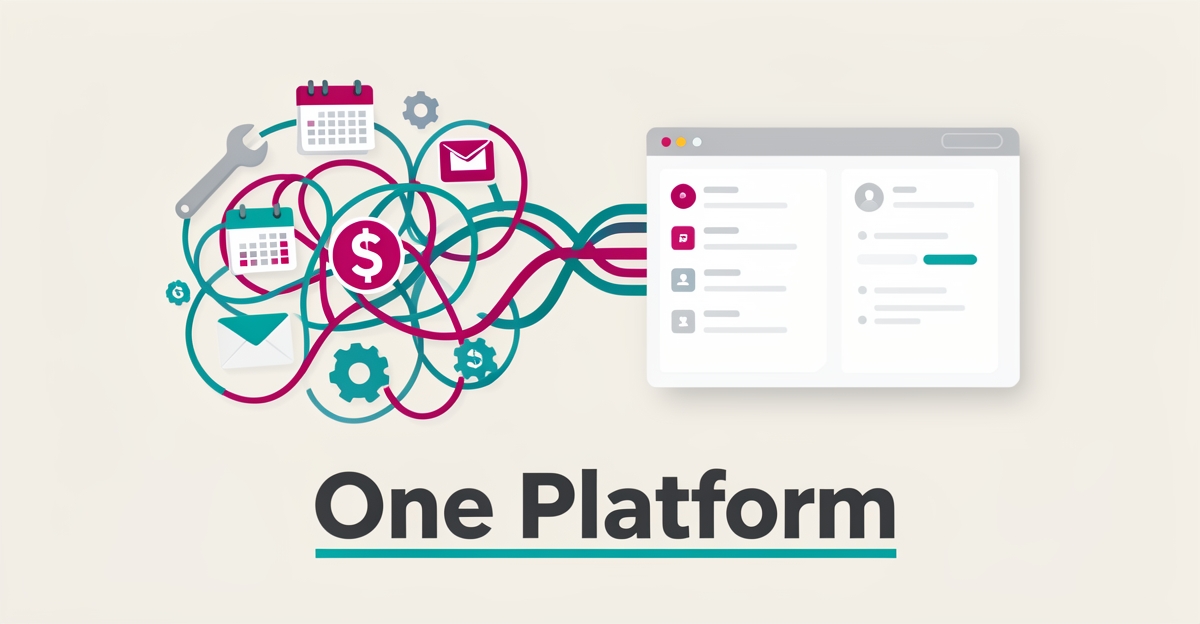
Adopting a unified AI-integrated platform can mitigate these issues by replacing the jigsaw of subscriptions with a single, cohesive solution. This approach not only reduces the financial burden of multiple subscriptions but also:
- Simplifies Vendor Management: One platform, one point of contact.
- Enhances Operational Efficiency: Automated workflows and unified data access.
- Improves Customer Experience: Professional, responsive, and integrated web presence.
AI Business Sites, for example, offers a custom website solution that comes with a built-in business operations platform, handling everything from lead follow-up to content generation, without the need for separate subscriptions. By consolidating these functions, repair shops can save up to $4,200/month in missed credits and $350/month in phone system inefficiencies, as seen in case studies source.
Key Takeaway
For independent repair shops, the path to mitigating the hidden costs of fragmented digital tools lies in consolidation and integration. By leveraging a unified, AI-driven platform, shops can streamline operations, enhance customer experience, and protect their revenue from the silent drain of disjointed digital management. With over 60% of auto repair shops expected to use AI by late 2026 source, the shift towards integrated solutions is not just beneficial but increasingly necessary for competitiveness.
Why the In-House vs. Agency Debate Misses the Point
The traditional in-house versus agency debate misses the real issue for repair shops: managing fragmented digital tools that don't communicate. While in-house teams carry fully loaded costs of 1.25–1.4× base pay plus $20K–$100K annually in tooling, and agencies charge $25K–$45K/month for a full bench, neither approach solves the core problem of juggling 8–10 separate subscriptions for hosting, booking, chat, CRM, and more. Industry research confirms these cost structures but overlooks how vendor fragmentation creates hidden inefficiencies.
What repair shops actually need is a unified system that eliminates the headache of managing disconnected tools. Research shows that over 60% of auto repair shops are expected to use AI by late 2026, driven by the need to streamline operations and capture lost revenue from manual processes. Case studies reveal AI implementations save shops thousands monthly—such as $4,200 in recovered AP credits and $350 from automated phone systems—while reducing reconciliation time from 40+ to under 8 hours per month.
The most effective strategy combines in-house oversight for strategic direction with selective agency support for complex technical work, all built on a single AI-integrated platform. This hybrid model leverages internal business understanding while accessing external expertise only when needed, avoiding the pitfalls of pure in-house or agency reliance. Crucially, a unified platform replaces what would otherwise be 8–10 separate monthly subscriptions—website, CRM, automation, content, scheduling, analytics, document tools, project management, newsletter, and media generation—into one cohesive system. Performance data underscores why this matters: 70% of online users avoid businesses with unprofessional websites, and 53% abandon pages loading slower than 3 seconds, making seamless, fast digital operations a direct revenue driver rather than just a cost center. For AI Business Sites, this means delivering a website that doesn’t just exist—it actively runs the business behind the scenes.
Local business: doing this the old way?
One system replaces the whole pile.
All of it — the website, the follow-up, the content, the leads — built and run for you for $1,497 + $497/mo. Month-to-month, and you own everything.
See what your build includesThe Unified Platform Alternative: One System Replaces Ten
The Unified Platform Alternative: One System Replaces Ten
In the fragmented landscape of digital management tools, repair shops often find themselves drowning in a sea of subscriptions—hosting, booking, chat, CRM, and more. However, a transformative shift is underway, driven by AI-integrated platforms that consolidate these disparate elements into a single, cohesive system. For repair shops, this unified approach promises not just efficiency but a tangible return on investment (ROI) within a remarkably short timeframe.
Consolidation with Immediate ROI
Research underscores the compelling case for unified platforms. By replacing up to ten separate subscriptions, repair shops can achieve significant cost savings and operational streamlining. A notable case study highlights savings of $4,200/month in AP reconciliation alone, alongside a 45% improvement in page load speeds and ROI realization within 60-90 days (Source: AI Adoption in Auto Repair Shops). These statistics illuminate the direct financial and operational benefits of migrating to a unified, AI-driven solution.
Key Components of a Unified Platform
- Website & CRM: Custom-built for speed and SEO, with a full CRM for contact and deal management.
- Automation & Content Generation: AI-powered tools for automatic follow-ups, personalized responses, and monthly content creation optimized for local SEO.
- Scheduling & Analytics: Integrated scheduling with real-time analytics for data-driven decisions.
- Project Management & Approvals: Kanban boards for project tracking and secure, client-facing approval portals.
- Newsletter & Media Creation: Automated newsletter generation and AI-assisted media (images, videos, voiceovers) creation.
Breaking Down the Benefits
- Reduced Subscription Costs: Replaces 8-10 subscriptions with a single, comprehensive platform.
- Enhanced Efficiency: Automates routine tasks, from lead follow-ups to content publishing.
- Improved Website Performance: Ensures fast, secure, and SEO-optimized web presence.
Expert Insights Align with Unified Platforms
Industry experts, like those at Aarav Infotech, emphasize the critical role of website performance and security in driving revenue, noting that "70% of online users won’t buy from a business with an unprofessional website". Unified platforms, by their integrated nature, better address these concerns, providing a professional, high-performance web presence without the complexity of managing multiple vendors.
Conclusion
For repair shops, the choice is clear: embracing a unified, AI-integrated platform not only streamlines operations but also offers a swift and significant ROI. By consolidating digital management into one system, shops can focus on what matters most—delivering excellent service to their customers, backed by the efficiency and cost savings of a modern, unified platform.
AI Business Sites, with its custom websites built to "run themselves" through integrated AI operations, exemplifies this solution, offering repair shops a pathway to professional digital operations without the headache of managing multiple vendors.
Further Reading on Unified Platforms for Repair Shops: Explore how AI Business Sites combines website design, CRM, automation, and more into one powerful system designed specifically for service-based businesses.
Implementation Roadmap: Start High-ROI, Scale Strategically
The smartest repair shops don't try to do everything at once. They start with the changes that pay for themselves immediately, then layer on capabilities as capacity grows. Research from Deloitte's 2026 State of AI report shows that over 60% of auto repair shops are expected to use AI by late 2026, but the ones seeing the fastest returns follow a clear sequence: financial reconciliation first, phone automation second, then customer communication and content.
- Phase 1 — Financial reconciliation: AI-powered accounts payable tools catch missed credits and vendor errors automatically. One shop reduced reconciliation time from 40+ hours to under 8 hours monthly while recovering $4,200 in missed credits
- Phase 2 — Phone automation: An AI voice agent answers every call, books appointments, and captures lead details — eliminating the $350/month cost of missed calls and pushing capture rates to nearly 100%
- Phase 3 — Customer communication: Automated follow-ups, review requests, and two-way email keep conversations moving without manual effort
- Phase 4 — Content & SEO: Monthly blog posts, service pages, and location pages built around your actual services and service areas
- Phase 5 — AI diagnostics: Data-backed repair recommendations that reduce labor costs by 25% within six months
The decision framework is straightforward: keep strategy and brand voice in-house, engage specialists for complex integrations or advanced SEO. Gartner advises CMOs to keep strategy aligned with business goals internally while deciding case by case which capability gaps to resource externally. Hybrid models consistently outperform pure in-house or pure agency approaches because they match the right expertise to the right problem. A unified platform like AI Business Sites handles the operational layers — CRM, automation, content, scheduling, analytics — so your team focuses on the decisions that actually grow the shop.
Frequently Asked Questions
What percentage of users avoid businesses with unprofessional websites, and what's the impact of slow-loading pages?
How much time and money can repair shops save by adopting an AI-integrated platform for financial reconciliation?
What is the projected market size for the auto repair software market by 2033, and the current average net margin for independent shops?
By what percentage is labor cost reduced within six months of implementing AI diagnostics in auto repair shops?
What percentage of auto repair shops are expected to use AI by late 2026, and what's the growth in sanctioned AI tool access in the past 12 months?
How many separate subscriptions can a unified AI-integrated platform replace for repair shops, and what are the key benefits?
Key Takeaways
{ "title": "Streamline, Automate, Thrive: The Future of Independent Repair Shops", "content": "Independent repair shops face a clear choice: continue managing fragmented digital tools at a hidden cost or embrace a unified, AI-integrated platform. By consolidating hosting, booking, chat, CRM, and mor
FOR local businesss — BUILT AND RUN BY US
Your website. Your content. Your leads. Your data.
$500 starts your build. Seven days later it's live — chat, booking, follow-up, and your Google presence all set up. Then we run it, every month. You do the work you actually get paid for.