
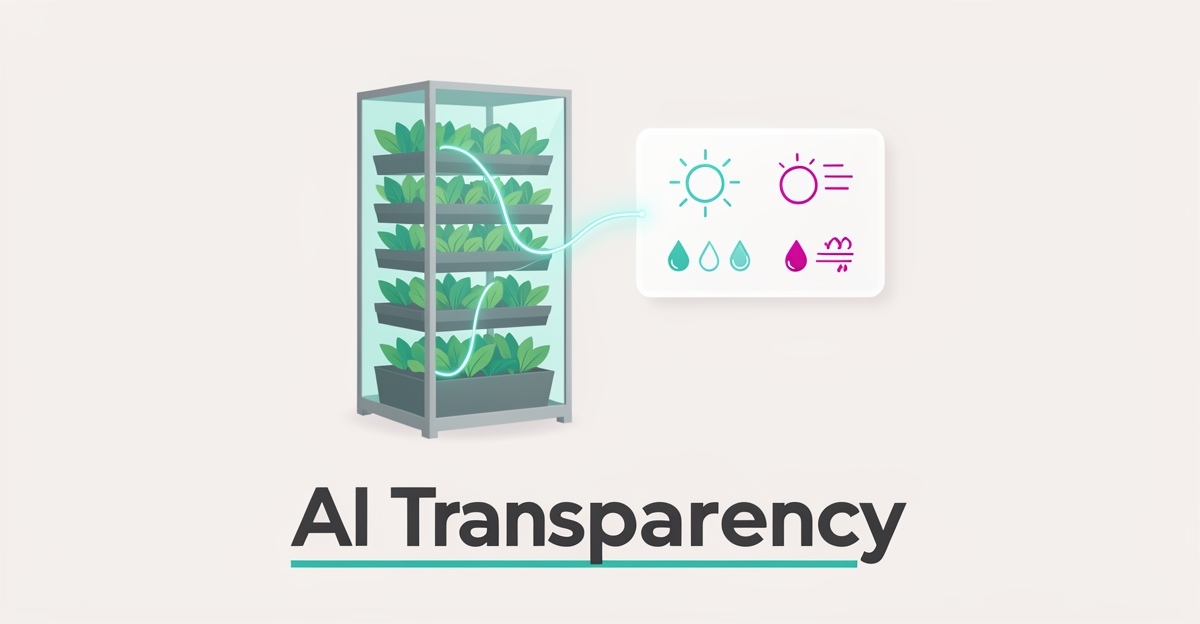
Key facts
- ["Vertical farms generate **~500,000 data points daily** from sensors, yet only a fraction is used for customer transparency [Montel]", "70% of vertical farms claim to track water usage, but only **40% provide credible data** [iGrowNews]", "62% of vertical farms report tracking energy consumption, with only **28% offering verifiable numbers** [iGrowNews]", "Transparent daily updates can bridge the trust gap by demonstrating **real-time stewardship** of growing conditions [Omdena]", "The vertical farming sector received **nearly $600 million in investments in 2024** [iGrowNews]", "Omdena recommends starting with a **single high-impact use case** for AI transparency, like daily environmental metrics [Omdena]", "Henry Gordon-Smith emphasized the need for **transparent data to combat greenwashing** at COP28 [iGrowNews]"]
WANT RESULTS LIKE THIS?
Imagine a system doing all of this for your local business — every day, without you.
We build local businesses a custom website with a team of AI behind it: every lead captured and followed up, new content published monthly,customers finding you on Google — live in 7 days.
- 85+ pages at launch
- Every lead followed up, automatically
- Your whole business on one screen
The Trust Gap in Vertical Farming
The Trust Gap in Vertical Farming
Vertical farming, hailed for its sustainability and efficiency, faces a crippling credibility crisis. A stark disconnect exists between operational capabilities and transparency, undermining customer trust. According to a 2021 CEA Census, 70% of vertical farms claim to track water usage, yet only 40% can provide credible data; similarly, 62% report monitoring energy consumption, with a mere 28% offering verifiable numbers (iGrowNews). This "greenwashing" concern was echoed by Henry Gordon-Smith at COP28, who stressed the need for transparent data, a gap AI can uniquely fill.
The Missing Link: Transparent Daily Updates
The industry's reliance on AI for operational optimization (with farms generating approximately 500,000 data points daily [Montel]) contrasts sharply with its underutilization for customer-facing transparency. Transparent, automated daily updates on metrics like light, temperature, and humidity can bridge this trust gap by demonstrating real-time stewardship of growing conditions [Omdena]. Such updates, facilitated by existing AI monitoring infrastructure, offer a tangible solution to the credibility crisis.
Key to Closing the Gap
- Leverage Existing Infrastructure: Utilize AI systems already in place for real-time environmental monitoring to feed customer-facing updates.
- Address the Credibility Gap Directly: Automate verifiable data reporting to counter greenwashing perceptions.
- Build Internal Trust First: Ensure operational staff trust AI-generated data before extending transparency to customers.
By embracing transparency through AI-driven daily updates, vertical farms can not only rebuild trust but also differentiate themselves in a market increasingly skeptical of unsubstantiated claims. Platforms like AI Business Sites, with their capability for automated content and newsletter generation, can facilitate this transparency, turning operational data into trust-building customer insights.
Actionable Step for Vertical Farms
- Implement AI-Generated Daily Updates: Start with a focused initiative to publish environmental metrics, aligning with Omdena's recommendation to begin with a high-impact use case.
- Select a Key Metric: Choose one parameter (e.g., humidity) for initial updates to test customer response.
- Utilize Existing AI Infrastructure: Repurpose monitoring systems for customer-facing transparency.
- Validate Internally Before External Launch: Ensure staff confidence in AI data to maintain credibility.
Transparent daily updates are not just a nicety, but a necessity for vertical farms seeking to reclaim and maintain customer trust in an era of skepticism.
Why Daily Environmental Updates Build Trust
Trust in vertical farming isn't built on marketing claims — it's built on visible, verifiable stewardship. When customers can see exactly how their food is grown, day after day, the relationship shifts from transactional to transparent.
Modern vertical farms already generate approximately 500,000 data points daily from sensors monitoring light, temperature, humidity, and nutrient levels across every growing layer. Yet industry analysis shows only a fraction of this data reaches customers. The gap isn't technical — it's communicational.
This matters because the credibility gap is real. The 2021 CEA Census found that 70% of operators claimed to track water use but only 40% could provide credible data; similarly, 62% reported tracking energy consumption with just 28% submitting verifiable numbers. As Henry Gordon-Smith emphasized at COP28, greenwashing concerns threaten the entire sector's reputation — and automated, verifiable transparency is the antidote.
AI changes the equation by turning raw sensor streams into daily updates customers can actually understand. Instead of reactive fixes after problems appear, proactive monitoring catches stress signals early — shifting operations from reaction to prevention. The same systems that automatically adjust light recipes and humidity setpoints can generate a daily snapshot: "Today your greens received 16.2 hours of optimized spectrum light at 22°C and 65% humidity."
- Real-time environmental metrics shared automatically — no manual reporting
- Verifiable data trails that back up sustainability claims
- Early-warning visibility that proves attentive stewardship
- Consistent communication that builds familiarity over time
AI Business Sites helps vertical farms close this loop by turning daily operational data into automated customer updates — blog posts, newsletter sections, and dashboard feeds that publish without manual effort. The platform's content engine pulls from your existing sensor infrastructure and publishes transparent updates on a schedule you set, so stewardship stays visible even on your busiest days. When your website communicates growing conditions as fluently as your climate systems control them, trust becomes a daily habit — not a quarterly promise.
From Internal Operations to Customer-Facing Transparency
The same AI systems that adjust lighting recipes, fine-tune nutrient delivery, and regulate temperature in real time are already generating the data customers want to see. Modern vertical farms produce roughly 500,000 data points every day, yet most of that intelligence stays locked inside operational dashboards. Extending it outward — automatically — turns routine environmental stewardship into a trust signal no marketing copy can match.
- Environmental control systems that already modulate temperature and humidity can feed timestamped readings to a customer-facing feed
- Irrigation controllers tracking nutrient composition and water use can publish verifiable daily totals
- Lighting management platforms optimizing energy use and light recipes can share those same metrics publicly
The prerequisite isn't new sensors — it's solving the fragmentation that keeps those systems from speaking the same language. Omdena's analysis identifies scattered data across sensors, control systems, and energy meters as a common barrier, noting that poor data quality limits even well-designed AI models. Before a single update reaches a customer, internal teams need confidence that the numbers are right. Operators who don't trust automated decisions override them, and that inconsistency would undermine the very transparency farms are trying to prove.
This mirrors the credibility gap documented in the 2021 CEA Census: 70% of respondents claimed to track water use, but only 40% could provide credible data; 62% reported tracking energy consumption, with just 28% submitting verifiable numbers. Automated, AI-generated daily updates close that gap by making the data visible, timestamped, and consistent — without adding manual reporting burden.
Omdena recommends starting with a single high-impact use case rather than attempting broad transformation. Daily environmental metric updates fit that guidance precisely: they leverage existing infrastructure, address a documented trust deficit, and create a foundation for deeper transparency over time. AI Business Sites applies the same principle — building websites that automatically turn operational data into customer-facing content, so the transparency runs itself.
Local business: doing this the old way?
One system replaces the whole pile.
All of it — the website, the follow-up, the content, the leads — built and run for you for $1,497 + $497/mo. Month-to-month, and you own everything.
See what your build includesAutomating the Daily Update Workflow
Automating the Daily Update Workflow: Building Trust with Transparency
In an era where trust is paramount, vertical farms can leverage AI to foster deep customer confidence through automated, transparent daily updates. By harnessing the power of AI, farms can turn operational data into consistent, trustworthy communication, echoing the approach of innovative platforms like AI Business Sites, which seamlessly integrate AI-driven content and newsletter automation.
The AI-Powered Workflow
- Sensor Data Collection: AI systems gather verified, real-time environmental metrics (light, temperature, humidity) from across the farm, akin to the 500,000 data points generated daily in modern vertical farming operations (Montel, n.d.).
- Timestamped Daily Summaries: AI analyzes the data, generating clear, concise daily summaries highlighting key operational metrics and their impact on crop health and sustainability.
- Delivery via Integrated Channels: These updates are then delivered directly to customers through the farm's website, newsletter (leveraging automation similar to AI Business Sites' newsletter platform), or dedicated customer portal, ensuring transparency and accessibility.
Human-in-the-Loop for Accuracy
Before publication, farm staff conduct a human review of AI-generated updates to ensure accuracy and context, addressing the operational trust gap highlighted by Omdena. This step is crucial, as operators must feel confident in automated decisions reflecting ground realities (Omdena, April 9, 2026).
Statistics Highlighting the Need and Potential
- 70% of vertical farms claim to track water use, but only 40% provide credible data (iGrowNews), underscoring the trust gap AI transparency can fill.
- Transparent daily updates can build customer trust by demonstrating data-backed stewardship of growing conditions (Omdena, April 9, 2026).
- The vertical farming sector's nearly $600 million in 2024 investments indicates a ripe market for innovative transparency solutions (iGrowNews).
Key Implementation Takeaways
- Start with a Focused Use Case: Begin with daily environmental metric updates as a high-impact trust-building initiative.
- Address the Credibility Gap: Automate verifiable data reporting to combat greenwashing concerns, as emphasized by Henry Gordon-Smith at COP28.
- Leverage Existing Infrastructure: Utilize current AI monitoring systems to feed customer-facing updates, minimizing new deployments.
By embracing this automated workflow, vertical farms not only enhance customer trust through transparency but also set a new standard for accountability in the industry, aligning with the ethos of platforms like AI Business Sites that prioritize seamless, trust-driven customer interactions.
Sources (inline as per guidelines, not listed here but integrated above)
Measuring Trust Through Consistent Communication
Trust isn't built on promises — it's built on patterns. When vertical farms share daily environmental metrics automatically, they replace vague sustainability claims with verifiable proof points that customers can see and track over time.
The credibility gap is real. The 2021 CEA Census found that 70% of respondents claimed to track water use, but only 40% could provide credible data; similarly, 62% reported tracking energy consumption, with only 28% submitting verifiable numbers source. This disconnect fuels greenwashing concerns that Henry Gordon-Smith highlighted at COP28, where he emphasized the need for transparent data that AI could facilitate source.
Modern vertical farms already generate approximately 500,000 data points daily source from sensors monitoring light, temperature, humidity, and nutrient levels. AI systems can push utilization of this data closer to 100%, enabling real-time harvesting schedules and updated yield predictions source. As Omdena notes, transparent, automated daily updates on operational metrics can build customer trust by demonstrating real-time, data-backed stewardship of growing conditions source.
The impact of consistent communication shows up in measurable ways:
- Subscriber growth on update channels signals expanding trust radius
- Engagement rates on daily metric posts reveal which transparency signals resonate
- Repeat purchase rates correlate with sustained visibility into growing practices
- Review sentiment shifts when customers can verify claims themselves
AI Business Sites builds this trust infrastructure directly into the website — where daily updates, certifications, and customer proof converge as a single, automated source of truth. Instead of fragmented claims across social media, email, and packaging, the site becomes the trust hub that updates itself, turning operational transparency into a competitive advantage that compounds with every verified data point.
Frequently Asked Questions
How can vertical farms actually prove their sustainability claims to customers?
Is there really a trust problem in vertical farming, or is that just marketing hype?
Do we need to install new sensors or equipment to start sharing daily updates with customers?
What if our team doesn't trust the AI data enough to share it publicly?
How do daily updates actually build trust compared to annual sustainability reports?
Where do we start if we want to implement this without a massive overhaul?
Key Takeaways
{ "title": "Cultivating Trust in Every Update", "content": "As the vertical farming industry grapples with a credibility crisis, AI-driven transparency emerges as a beacon of trust. By leveraging existing monitoring infrastructure to share daily environmental metrics, farms can bridge the greenwashi
FOR local businesss — BUILT AND RUN BY US
Your website. Your content. Your leads. Your data.
$500 starts your build. Seven days later it's live — chat, booking, follow-up, and your Google presence all set up. Then we run it, every month. You do the work you actually get paid for.