
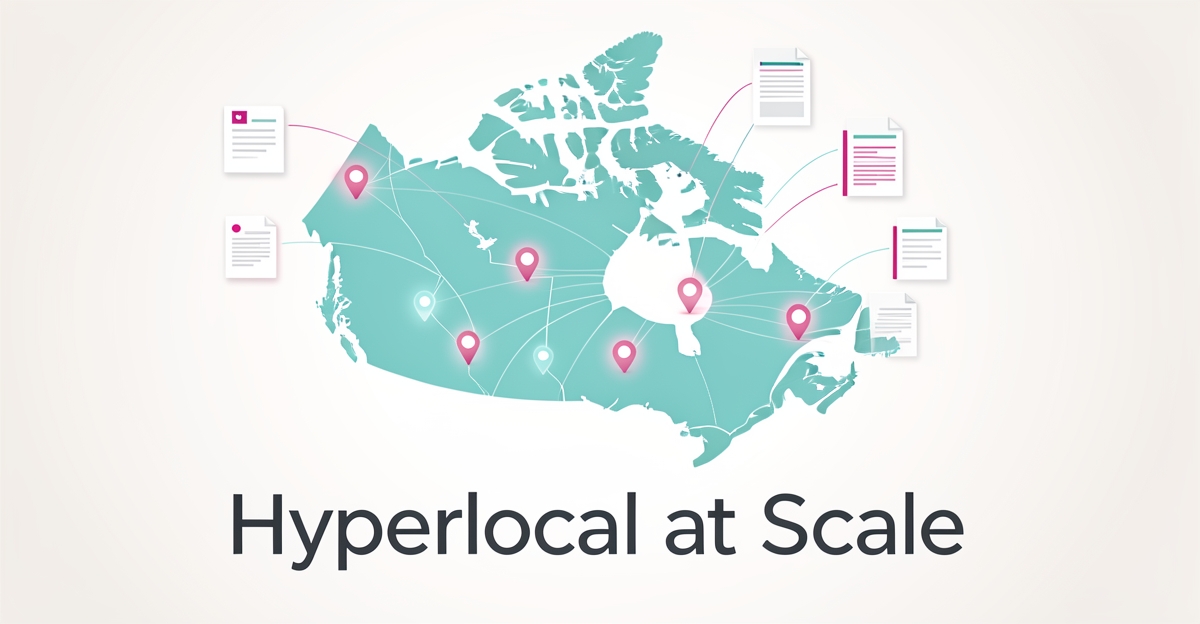
Key facts
- The Canadian private tutoring market is projected to grow by USD 5.36 billion through 2029 at a 10% CAGR driven by STEM education demand.
- Hyperlocal content scores 107% ranking signal strength — the highest of any attribute studied for multi-location businesses in AI-powered search.
- 59% of Canadian students now use AI for schoolwork, up from 52% roughly one year earlier according to a KPMG survey.
- Google Business Profiles untouched for over a month lose search visibility as AI systems interpret inactivity and pull unverified data.
- IHOP scales 1,400+ locations using intent/specialty pages with /city/service-type URL structures proven for local SEO.
- Only British Columbia and New Brunswick had issued official K-12 AI guidance as of October 2024 leaving most provinces without policy.
- Service-area businesses like tutors need pages built around served postcodes and travel boundaries not storefront amenities.
WANT RESULTS LIKE THIS?
Imagine a system doing all of this for your local business — every day, without you.
We build local businesses a custom website with a team of AI behind it: every lead captured and followed up, new content published monthly,customers finding you on Google — live in 7 days.
- 85+ pages at launch
- Every lead followed up, automatically
- Your whole business on one screen
The Local Visibility Challenge for Multi-City Tutoring Centers
The Canadian private tutoring market is expanding fast — projected to grow by USD 5.36 billion between 2025 and 2029 at a 10% CAGR — yet most multi-city tutoring centers remain invisible in the local searches that actually drive enrollment. Parents don't search for brand names; they search for "math tutor in Vancouver" or "science tutor in Toronto." When a center operates across five cities but publishes a single generic "Our Services" page, Google has no reason to surface it for any of those hyperlocal queries.
The problem compounds in a fragmented market where national chains like Mathnasium, Sylvan Learning, and Oxford Learning already dominate branded search. Independent and regional centers compete for the same long-tail keywords with a fraction of the SEO resources. Research on multi-location visibility shows that hyperlocal content — unique copy referencing specific neighborhoods, school boards, landmarks, and curriculum standards — carries a 107% ranking signal strength, the highest of any attribute studied. Generic content simply doesn't register.
For tutoring centers that travel to students or teach virtually across a metro area, the structural mismatch is even sharper. Service-area businesses need pages built around served postcodes, regional case studies, and travel boundaries — not storefront amenities. Yet most websites treat every city as an afterthought, if they address it at all.
- One "Locations" page listing city names without unique content per city
- Service pages that never mention provincial curriculum differences (Ontario vs. BC math standards)
- No Google Business Profile for individual service areas, leaving AI systems to pull unverified data
- Zero neighborhood-level signals — landmarks, school references, local tutor bios — that tell search engines "we actually serve here"
AI-driven discovery has shifted the goalposts. The question is no longer "how do we rank number one?" but "how do we become the business AI recommends?" Google Business Profiles now function as entity anchors for AI systems, and profiles untouched for over a month lose visibility. At AI Business Sites, we've seen tutoring centers close this gap by generating localized service pages at scale — pages that combine brand-consistent methodology with city-specific curriculum alignment, tutor availability, and parent FAQs. The fixed-plus-variable architecture that works for 1,400-location brands works just as well for a center serving six Canadian cities.
Why Hyperlocal Content Is the #1 Ranking Signal for AI-Powered Search
The fundamental question of local search has flipped. Instead of asking how to rank number one, multi-location businesses now need to ask how to become the option AI systems recommend. Research from Search Engine Journal confirms this shift: visibility now distributes across Google Maps "Ask Maps," AI Overviews, ChatGPT, Perplexity, Apple Maps, and social search, where confidence and trustworthiness across multiple sources matter more than traditional authority signals alone.
For tutoring centers operating across Canadian cities, this change creates both urgency and opportunity. The private tutoring market in Canada is projected to grow by USD 5.36 billion through 2029 at a 10% CAGR, driven largely by STEM education demand. Parents search for "math tutor in Vancouver" or "science tutor in Toronto" — not brand names — making hyperlocal relevance the decisive factor. A location page study found that hyperlocal content scored 107% ranking signal strength, the highest of all attributes tested, because it demonstrates unique relevance to a specific city, neighborhood, and service area.
The scalable solution is a fixed-plus-variable page architecture. Roughly half the page holds brand-wide content — methodology, tutor qualifications, pricing philosophy — while the other half dynamically populates with local data: served postcodes, provincial curriculum alignment, regional case studies, nearby landmarks that define travel boundaries, and city-specific FAQs. For service-area businesses like tutors who travel to students, this structure replaces storefront details with the signals AI systems actually evaluate.
- Semantic triples (Subject → Predicate → Object) that make entity relationships explicit for AI — e.g., "Toronto Tutoring Center → offers → Grade 12 Calculus tutoring"
- Intent/specialty URLs like
/toronto/grade-12-calculus-tutorthat mirror IHOP's proven 1,400+ location strategy - Google Business Profiles optimized as entity anchors for each service area, not just storefronts
- Reputation signals diversified across Yelp, Apple Maps, and education directories beyond Google
AI Business Sites builds this architecture into every website, using structured data feeds and AI content generation to populate variable sections at scale — so each service area gets a unique, trustworthy page without manual writing. The result: a web presence that speaks the language AI recommendation engines understand, across every Canadian community you serve.
Local business: doing this the old way?
One system replaces the whole pile.
All of it — the website, the follow-up, the content, the leads — built and run for you for $1,497 + $497/mo. Month-to-month, and you own everything.
See what your build includesHow AI Business Sites Automates Localized Content Generation at Scale
How AI Business Sites Automates Localized Content Generation at Scale
In Canada's burgeoning private tutoring market, projected to grow by USD 5.36 billion at a 10% CAGR by 2029, leveraging AI for localized content generation is pivotal for tutoring centers seeking to dominate local search visibility. AI Business Sites' built-in AI content engine streamlines this process, enabling tutoring centers to serve multiple Canadian cities effectively.
Master Template Approach for Scalability AI Business Sites employs a master template strategy, dividing location pages into 50% fixed brand content (methodology, tutor qualifications, pricing) and 50% AI-populated local data. For instance, a Toronto-based math tutor page might include fixed content on the center's teaching philosophy alongside AI-generated sections highlighting Toronto District School Board curriculum alignment, local case studies (e.g., "Improved grades for 15 North York students in Grade 10 math"), and served neighborhoods (e.g., North York, Scarborough).
Structured Data Feeds for Personalization The platform utilizes structured data feeds from Google Business Profile (GBP) reviews, tutor bios, and provincial curriculum specifics to populate variable sections. For example, a Vancouver page might automatically include:
- GBP Reviews: "Excellent service for our child's BC Provincial Exam prep."
- Tutor Bios: "Meet Jane, our experienced tutor for Vancouver's School District #41."
- Provincial Curriculum: "Aligned with BC's Grade 12 Calculus curriculum requirements."
Intent/Specialty Pages for Enhanced Visibility
AI Business Sites automatically generates intent/specialty pages using /city/service-type URL structures (e.g., /toronto/grade-12-calculus-tutor), combining fixed brand elements with dynamic local content. This approach, inspired by IHOP's successful multi-location strategy, enhances search visibility for high-intent queries like "math tutor in Vancouver."
Technical SEO Optimization Each page is automatically linked to relevant existing content, maintaining a robust internal link structure. Schema markup is also applied to enhance discoverability, incorporating Semantic Triples (e.g., "Toronto Tutoring Center → offers → Grade 12 Calculus Tutoring") to align with AI recommendation engine requirements.
Ongoing Content Updates and Maintenance The AI content engine ensures continuous content updates without manual effort, adapting to changes in service areas, tutor availability, and local educational trends. This automated process keeps content fresh and relevant, supporting long-term SEO success.
Key Statistics Highlighting the Approach:
- 107% ranking signal strength of hyperlocal content (Search Engine Journal)
- USD 5.36 billion projected Canadian private tutoring market growth by 2029 (Technavio)
- 10% CAGR growth rate, driven by STEM education emphasis (Technavio)
By leveraging AI Business Sites' automated localized content generation, tutoring centers across Canada can efficiently scale their online presence, improve search visibility, and attract more location-specific leads.
- Hyperlocal Content: 107% ranking signal strength (SEO Journal)
- Market Growth: USD 5.36 billion by 2029, driven by STEM (Technavio)
- CAGR: 10% through 2029, emphasizing the need for scalable SEO strategies
According to a recent study, hyperlocal content is the strongest ranking signal, making AI Business Sites' approach particularly effective. As the market grows, leveraging such targeted content strategies will be crucial for tutoring centers.
Frequently Asked Questions
Why do multi-city tutoring centers struggle with local search visibility?
What is the projected growth of the Canadian private tutoring market by 2029?
How can tutoring centers improve local SEO with AI-generated content?
Why are Google Business Profiles (GBPs) crucial for multi-location tutoring centers?
What is the significance of 'Semantic Triples' in AI-driven search for tutoring centers?
How does AI Business Sites automate localized content generation for tutoring centers?
Your Next Student Is Searching Right Now
The Canadian tutoring market isn't waiting — it's growing by USD 5.36 billion through 2029, and parents are already searching for "math tutor in Vancouver" or "science tutor in Toronto." Research confirms that hyperlocal content carries a 107% ranking signal strength, making it the single strongest factor in AI-driven local visibility. The fixed-plus-variable page architecture — half brand methodology, half city-specific curriculum alignment, tutor availability, and neighborhood signals — scales this approach across every service area without manual writing. Google Business Profiles optimized as entity anchors, semantic triples that make your services explicit to AI systems, and reputation signals diversified beyond Google complete the picture. At AI Business Sites, we build websites that generate this localized content automatically each month, so your center shows up in the exact searches parents are making — in every city you serve. Ready to see what localized pages would look like for your service areas? Start a conversation with our team and we'll walk you through the strategy.
FOR local businesss — BUILT AND RUN BY US
Your website. Your content. Your leads. Your data.
$500 starts your build. Seven days later it's live — chat, booking, follow-up, and your Google presence all set up. Then we run it, every month. You do the work you actually get paid for.