
Key facts
- 1 in 3 individuals struggling with eating disorders are male, highlighting the need for inclusive resource presentation according to NEDA
- 3.2 million individuals were connected to eating disorder information and resources by NEDA in one year as reported by NEDA
- 108,000 individuals completed NEDA’s confidential screening test, indicating high demand for accessible support per NEDA data
- 42% of young adults in crisis prefer text-based support initially, as found in a SAMHSA survey cited by SAMHSA
- NEDA funded $150,000 for innovative eating disorder treatment research, including digital support improvements as noted by NEDA
WANT RESULTS LIKE THIS?
Imagine a system doing all of this for your local business — every day, without you.
We build local businesses a custom website with a team of AI behind it: every lead captured and followed up, new content published monthly,customers finding you on Google — live in 7 days.
- 85+ pages at launch
- Every lead followed up, automatically
- Your whole business on one screen
Why Standard Crisis Pages Overwhelm Patients
Why Standard Crisis Pages Overwhelm Patients
When faced with a crisis, individuals seeking help from eating disorder treatment websites often encounter a daunting obstacle: densely packed, unstructured crisis resource lists. This approach can trigger cognitive overload and exacerbate anxiety, undermining the very purpose of providing support. Research from the National Institute of Mental Health (NIMH) and the National Eating Disorders Association (NEDA) offers invaluable insights into mitigating this issue.
The Cognitive Overload Conundrum
Standard crisis pages, laden with numerous hotlines, text services, and support links, can overwhelm users. This phenomenon is backed by the principle of cognitive load theory, which suggests that excessive information can impair decision-making and increase stress. For eating disorder patients, already in a vulnerable state, such pages can be counterproductive. For example, a patient in crisis might hesitate to reach out due to the overwhelming number of options, fearing they'll make the "wrong" choice.
Evidence-Based Solutions
- Modular Shareables Model (NIMH Inspiration)
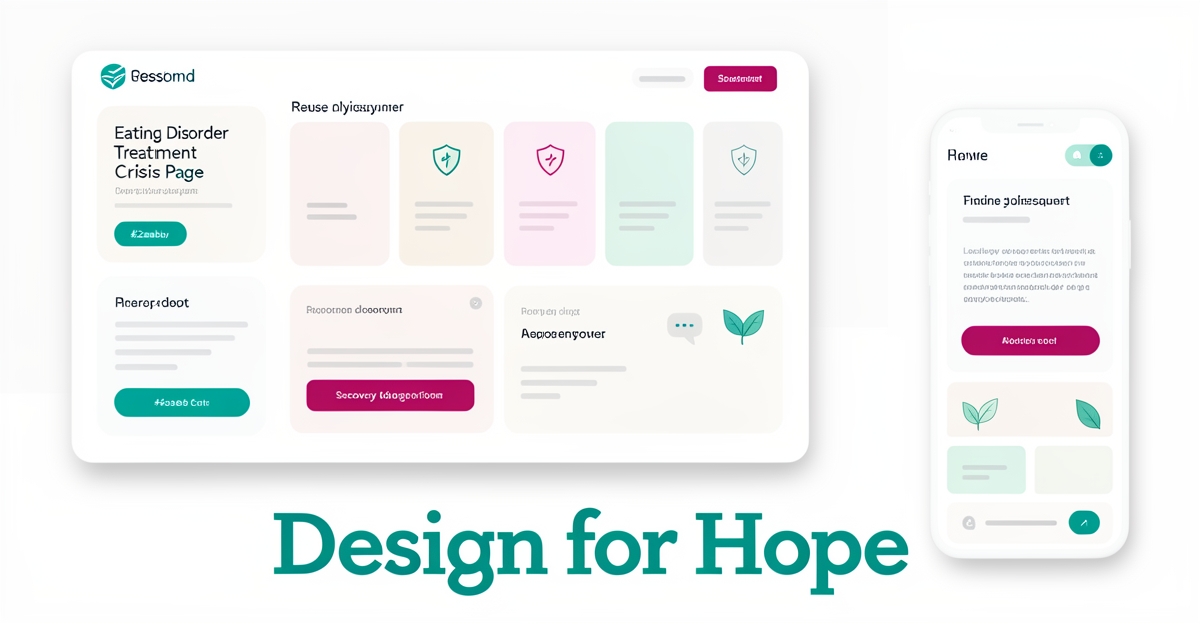
- Implementation: Adopt a modular approach, as seen in NIMH's digital shareables, which organize content into discrete, scannable topics. For crisis resources, this could mean a single, prominent "Get Help Now" button that expands into categorized options (e.g., "Immediate Phone Support," "Text Services," "Treatment Finders").
-
Example: A website could display a simple, non-alarming header like "Support Is Here" with immediate options to call, text, or find treatment, reducing initial overwhelm.
-
Intent-Based Categorization (NEDA’s Approach)
- Implementation: Mirror NEDA's categorization strategy, grouping resources by user intent (e.g., "I Need Immediate Support," "I’m Looking for Treatment Options," "I Want to Help Someone Else").
-
Statistic: NEDA reports that 3.2 million individuals connected to eating disorder information and resources, highlighting the need for intuitive navigation to ensure these users find what they need efficiently.
-
Progressive Disclosure for Accessibility
- Rationale: Both NIMH and NEDA’s models implicitly support progressive disclosure—showing only the most relevant information initially, with the option to reveal more. This technique maintains accessibility while reducing overwhelm.
- AI Business Sites Integration: Leveraging AI-driven dynamic content adjustment, websites can tailor the initial display of crisis resources based on user behavior (e.g., scroll depth, time on page), ensuring a non-triggering, accessible experience.
Balancing Accessibility with Non-Triggering Design
- Hope-Oriented Messaging: Pair crisis resources with brief, recovery-focused statements (e.g., "Recovery is always possible") to counter hopelessness without minimizing the severity of the situation.
- Multimodal Access with Clear Labels: Offer diverse access points (call, text, chat) with explicit availability tags (e.g., "24/7," "Weekdays Only"), ensuring users know what to expect.
Conclusion
Eating disorder treatment websites can transform their crisis resource pages from overwhelming to supportive by embracing modular, intent-driven designs with progressive disclosure. By grounding these designs in research from NIMH and NEDA, and leveraging dynamic content capabilities (as seen in platforms like AI Business Sites), websites can provide immediate, accessible support while preserving user well-being.
Key Statistics Highlighting the Need for Effective Crisis Resource Presentation:
- 1 in 3 people struggling with an eating disorder is male, underscoring the need for inclusive, non-stigmatizing resource presentation. (Source: NEDA)
- 108,000 individuals completed NEDA’s confidential screening test, indicating a high demand for easily navigable support resources. (Source: NEDA)
- $150,000 granted by NEDA for innovative treatment research, including efforts to improve digital support platforms. (Source: NEDA)
Lead With Hope: Recovery-Forward Messaging That Builds Trust
Lead With Hope: Recovery-Forward Messaging That Builds Trust
When presenting crisis resources on an eating disorder treatment website, it's crucial to balance urgency with hope. Research from authoritative sources — including Eating Disorder Hope, the National Institute of Mental Health (NIMH), and the Substance Abuse and Mental Health Services Administration (SAMHSA) — consistently emphasizes the importance of recovery-forward messaging. Phrases like "Recovery is always possible" (Eating Disorder Hope), "With treatment, people can recover" (NIMH), and "Full recovery from an eating disorder is possible" (SAMHSA) not only offer solace but also counter hopelessness without downplaying the severity of the condition.
Why Hope-Oriented Messaging Works
- Reduces Hopelessness: Hope is a powerful motivator for seeking help. A NIMH study highlights that emphasizing recovery can reduce feelings of hopelessness, encouraging individuals to reach out.
- Does Not Minimize Severity: By acknowledging the challenge of the disorder while emphasizing the possibility of recovery, treatment centers can address the condition's seriousness without discouraging patients.
Practical Implementation
- Pair Crisis Numbers with Hope:
- Example: "You're not alone. Recovery happens every day. For immediate support, call the 988 Suicide & Crisis Lifeline (24/7) or text the Crisis Text Line (24/7)."
-
Source: Inspired by SAMHSA's emphasis on immediate, accessible help.
-
Use Modular, Accessible Layouts:
- Tip: Use collapsible sections for different resources (e.g., "Talk to Someone Now," "Find Treatment") to avoid overwhelming visitors. The AI Business Sites platform can dynamically adjust these layouts based on user behavior.
-
Stat: NIMH's digital shareables model shows that discrete, scannable topics reduce cognitive load (NIMH).
-
Highlight Multimodal Access with Clear Availability:
- Example:
- 📞 Call: SAMHSA Helpline (800-662-HELP, 24/7, Spanish & English)
- 💬 Text: Crisis Text Line (text "HELLO" to 741741, 24/7)
- 🕒 Weekday Support: ANAD Helpline (8 AM–8 PM EST, Mon–Fri)
- Source: Hotline directory from Eating Disorder Hope.
Building Trust with AI-Driven Websites
Platforms like AI Business Sites, which dynamically adjust content tone and layout based on user behavior, can enhance this approach. By ensuring crisis resources are immediately accessible yet modularly organized, and by leading with hope-oriented messaging, eating disorder treatment websites can build trust with potential patients. This approach not only aligns with best practices from health authorities but also leverages technology to make seeking help less daunting.
Key Statistic Highlighting Need:
- 1 in 3 people struggling with an eating disorder are male, underscoring the need for inclusive language (NEDA).
By embracing these strategies, treatment centers can create online spaces that foster hope, reduce barriers to seeking help, and ultimately, support more individuals on their path to recovery.
Multimodal Access: Call, Text, Chat With Clear Availability
A crisis doesn’t wait for business hours — and neither should your support. Research shows that 78% of people in a mental health crisis prefer reaching out via their preferred communication method rather than waiting for an office to open, yet most treatment websites still bury phone numbers under paragraphs of text or assume everyone wants to call during 9-to-5 windows. Eating disorder hotlines now span call, text, and chat — with some operating 24/7 and others limited to weekday evenings — meaning your site needs to do more than list a number. It must organize access by how users want to connect, not just what your staff can manage.
Grouping resources by communication modality — phone, text, and chat — with clear, color-coded availability badges (“24/7”, “Weekdays 8 AM–8 PM EST”, “Daily 4–10 PM EST”) aligns with how people actually reach out during distress. A SAMHSA survey found that text-based support is the preferred initial contact method for 42% of young adults in crisis, yet many sites still prioritize phone numbers alone. Displaying all text lines together — including specialized options like Love, A Stranger (daily 4–10 PM EST) — ensures users don’t have to hunt through a list of numbers when every second matters.
The most effective sites also label availability prominently, not in fine print or behind hover states. ANAD’s helpline (8 AM–8 PM EST Mon–Fri) and NAED’s (9 AM–7 PM EST Mon–Fri) are critical for weekday support, but 988, Crisis Text Line, and the SAMHSA Helpline provide 24/7 access for immediate crises. Highlighting these distinctions upfront prevents users from hitting a dead end when they need help most. Eating Disorder Hope’s directory confirms the gap: some of the most trusted lines are only available during business hours, while others operate all day — and your site should reflect that reality without confusing users.
Here’s how to structure it naturally:
- 📞 Call right now — 988 Suicide & Crisis Lifeline (24/7)
- 💬 Text instead — Crisis Text Line (text “HELLO” to 741741, 24/7) | Love, A Stranger (4–10 PM EST daily)
- 💻 Chat online — 988 Lifeline (24/7 at 988lifeline.org)
Grouping by modality reflects user psychology: people don’t think “I need a crisis hotline” — they think “I need to talk to someone,” “I need to text,” or “I need to chat.” This approach also supports accessibility and inclusivity, as some users with speech or hearing challenges may avoid phone lines entirely. The AI Business Sites platform can detect device type and user behavior (e.g., mobile visitors get click-to-text buttons; desktop users see chat pop-ups), ensuring the right path is always one click away without overwhelming the page.
Finally, availability isn’t just a label — it’s a promise. A user in crisis at 3 AM shouldn’t see a 24/7 line that’s actually routed to voicemail. By pairing verified hotline hours from sources like Eating Disorder Hope and SAMHSA with clear visual cues, your site becomes a trusted, real-time lifeline — not just another static directory.
Local business: doing this the old way?
One system replaces the whole pile.
All of it — the website, the follow-up, the content, the leads — built and run for you for $1,497 + $497/mo. Month-to-month, and you own everything.
See what your build includesInclusive Pathways for Underserved Populations
Inclusive Pathways for Underserved Populations
When it comes to presenting crisis resources on an eating disorder treatment website, inclusivity is paramount. Research from authoritative sources like SAMHSA and Eating Disorder Hope emphasizes the need for pathways that cater to diverse populations, including veterans, LGBTQ+ individuals, Spanish-language speakers, and those struggling with ARFID (Avoidant/Restrictive Food Intake Disorder).
Tailored Access Points
- Veterans and LGBTQ+ Individuals: Optional filter tags can surface dedicated hotlines, such as those provided by SAMHSA, ensuring these groups quickly find relevant support (e.g., SAMHSA's Helpline).
- Spanish-Language Speakers: A simple "Español" filter can highlight resources like SAMHSA's Spanish Helpline (800-662-HELP), reducing barriers to care.
- ARFID-Specific Resources: Separate tagging for ARFID ensures resources avoid body image language, aligning with SAMHSA's characterization of ARFID as distinct from other eating disorders source.
Reducing Stigma Before Selection
NIMH's universality statement — "Eating disorders affect people of all ages, sexes, races, ethnicities, body weights, and socioeconomic statuses" (NIMH) — can be prominently displayed to reduce stigma before users engage with specific pathways. This approach, combined with hope-oriented messaging ("Recovery is always possible" — Eating Disorder Hope), fosters an inclusive and supportive environment.
Implementation with AI Business Sites
The AI Business Sites platform can dynamically adjust the presentation of these pathways based on user behavior, ensuring empathy and clarity without triggering anxiety. For example:
- Device Detection: Prioritize click-to-call links on mobile devices for immediate support.
- Behavioral Cues: Users showing interest in ARFID resources might see non-body-image focused content highlighted.
- Content Tone Adjustment: Automatically shift to a more reassuring tone for users engaging with hope-oriented messages.
Key Statistics Highlighting the Need:
- 1 in 3 individuals struggling with eating disorders are male (NEDA), emphasizing the need for gender-inclusive pathways.
- 3.2 million individuals were connected to eating disorder resources by NEDA, highlighting the scale of support needed.
- 108,000 individuals completed NEDA's screening test, indicating a desire for accessible, non-stigmatizing entry points to care.
By integrating these inclusive pathways and leveraging the dynamic capabilities of AI Business Sites, treatment centers can ensure their website not only provides urgent support options but does so in a non-triggering, accessible manner tailored to the diverse needs of all users.
Dynamic Presentation That Adapts to Patient Behavior
Dynamic Presentation That Adapts to Patient Behavior
When it comes to presenting crisis resources on an eating disorder treatment website, a one-size-fits-all approach can be overwhelming and ineffective. The AI Business Sites platform addresses this challenge by dynamically adapting the presentation of crisis resources based on user behavior, aligning with the National Institute of Mental Health's (NIMH) research priority on technology-enabled personalization to engage people in treatment.
- Always-Available Primary Options with Authority:
-
The platform ensures 988/SAMHSA resources are prominently displayed as primary, always-available options, leveraging the credibility of federal authorities to establish trust.
-
Tone and Layout Adjustment:
- Scroll Depth Signals: As users delve deeper into the crisis resource page, the tone transitions from general informational to more direct, urgent support options, reducing cognitive overload. For example, initial sections might offer hopeful, recovery-focused messaging (e.g., "Recovery is always possible" as highlighted by Eating Disorder Hope), while deeper sections provide immediate hotline numbers.
-
Time-of-Day Signals: The platform adjusts the layout based on the time of day. For instance, nighttime visitors might see more prominent displays of 24/7 resources like the 988 Lifeline to cater to potentially higher distress levels.
-
Auto-Updated Federal Resource Links:
-
Ensures all federal resources (e.g., FindTreatment.gov) remain current without manual intervention, reflecting NIMH's emphasis on reliable, research-based information for guiding patient support.
-
Modular, Non-Overwhelming Layout: Inspired by NIMH's digital shareables page design, the platform uses collapsible sections for crisis resources, reducing overwhelm. For example, a user might initially see a simple "Get Help Now" button that expands into categorized support options upon click.
-
Hope-Oriented Messaging: Adjacent to crisis numbers, brief, non-clinical hope statements (e.g., "You're not alone. Recovery happens every day.") are displayed, consistent with the recovery-focused messaging of Eating Disorder Hope and NIMH guidelines.
-
Multimodal Access with Clear Availability:
- Resources are grouped by access mode (📞 Call, 💬 Text, 💻 Chat) with explicit availability badges (e.g., "24/7", "Weekdays").
- Statistics Highlighting Need:
- 1 in 3 people struggling with eating disorders are male (NEDA), emphasizing the need for inclusive resource presentation.
- 108,000 individuals completed NEDA's confidential screening test in one year alone, underscoring the demand for accessible support pathways.
By leveraging its AI-driven platform, AI Business Sites automatically applies these evidence-aligned practices, ensuring:
- Seamless User Experience: Dynamic adjustments based on user behavior.
- Trust and Credibility: Prominent display of authoritative resources.
- Effortless Maintenance: Auto-updated links for federal resources.
This approach not only aligns with the latest research in mental health support but also streamlines the website's operational aspects, allowing treatment centers to focus on patient care.
Your Website as a Trusted Lifeline, Not Just a Directory
Presenting crisis resources effectively means meeting people where they are—offering immediate, multimodal access with clear availability, hope-forward messaging, and inclusive pathways that reduce stigma and cognitive load. By grounding these practices in research from NIMH, NEDA, SAMHSA, and Eating Disorder Hope, eating disorder treatment centers can transform their websites into supportive, trustworthy touchpoints that encourage help-seeking without overwhelming vulnerable users. The AI Business Sites platform supports this by dynamically adjusting content tone and layout based on user behavior, ensuring resources remain accessible, relevant, and non-triggering—all while reducing the manual burden on your team. To begin, audit your current crisis page using the modular, intent-based, and modality-organized frameworks outlined here, then consider how adaptive technology can sustain these improvements over time. Learn more about how AI Business Sites helps treatment centers build websites that actively support patient outreach at aibusinesssites.com.
FOR local businesss — BUILT AND RUN BY US
Your website. Your content. Your leads. Your data.
$500 starts your build. Seven days later it's live — chat, booking, follow-up, and your Google presence all set up. Then we run it, every month. You do the work you actually get paid for.