
Key facts
- 38% of organizations delay adopting help desk platforms due to integration issues with legacy systems according to Business Research Insights
- 68% of consumers prioritize efficient customer service and 75% expect immediate resolutions per Future Market Insights
- Autonomous AI agents like Intercom's Fin and Gorgias' AI Agent now handle 59–60% of routine queries without human input per Freshworks
- AI-driven automation in service desks has grown 31% over three years with 41% of organizations now using it per Business Research Insights
- Automation reduces manual ticket costs by ~22%, dropping average costs from ~$22 to ~$17 per ticket per Future Market Insights
- A 'totally satisfied' customer contributes 17X more revenue than a 'somewhat dissatisfied' one per Future Market Insights
- Cloud-based help desk solutions now hold 61.3% market share due to scalability without lag per Future Market Insights
WANT RESULTS LIKE THIS?
Imagine a system doing all of this for your local business — every day, without you.
We build local businesses a custom website with a team of AI behind it: every lead captured and followed up, new content published monthly,customers finding you on Google — live in 7 days.
- 85+ pages at launch
- Every lead followed up, automatically
- Your whole business on one screen
Why Most Help Desk Platforms Fail Small Businesses
When it comes to help desk solutions, small businesses, especially local service providers, face a unique set of challenges that many enterprise-grade tools fail to address. The gap between what these platforms offer and what small businesses actually need is stark, often leading to integration failures, slow response times, and a lack of local relevance.
A whopping 38% of organizations delay adopting help desk platforms due to difficulties integrating these systems with their legacy infrastructure source. For small businesses with limited IT resources, this can be a deal-breaker. The cost and complexity of custom integrations often outweigh the benefits of adopting a new help desk platform, leading to the continuation of inefficient, manual processes.
Small businesses thrive on quick customer service and strong local presence. 68% of consumers prioritize efficient customer service, and 75% expect immediate resolutions source. However, many help desk platforms fail to provide the instant response capabilities that small businesses need to compete. Moreover, integrating with local SEO strategies, such as optimizing Google Business Profiles and Bing listings, is often an afterthought, if considered at all.
Effective AI in help desk platforms should learn from every interaction to improve future customer service. While 41% of organizations now use AI-driven automation in their service desks source, with chatbot integration seeing a 31% growth over three years, many platforms fail to deliver on the promise of continuous learning and adaptation. This results in stagnant, non-personalized customer interactions that fail to improve over time.
In today’s digital landscape, cloud-native, multi-channel support platforms have become the baseline for any viable help desk solution. These platforms must offer seamless integration with various channels (web, phone, social media) and legacy systems, all while being accessible and manageable without requiring a dedicated IT team. For small businesses, the emphasis is on simplicity, scalability, and the ability to enhance local customer engagement.
- Prioritize Cloud Integration: Ensure the platform seamlessly integrates with your existing cloud services.
- Demand Local SEO Capabilities: Opt for platforms that can enhance your Google Business Profile and local search visibility.
- Autonomous AI is Key: Choose platforms where AI can handle a significant portion of routine queries autonomously.
- Scalability and Learning Capability: Select a platform that grows with your business and improves its service through continuous learning.
By focusing on these critical aspects, small businesses can navigate the challenges posed by traditional help desk platforms and find a solution that truly meets their needs for instant response, local relevance, and adaptive AI support.
For example, consider a plumbing service in a small town. An ideal help desk platform would not only answer frequent questions about emergency repairs instantly but also learn from these interactions to provide more accurate and personalized responses over time. It would integrate seamlessly with the business's Google Business Profile, ensuring that local customers find and engage with the service efficiently. Moreover, it would handle multi-channel inquiries (from website chats to phone calls) without requiring the business to manage multiple separate tools, thus streamlining operations and improving customer satisfaction.
In contrast, many traditional platforms would either lack the local SEO integration, fail to adapt to the specific needs of a plumbing service over time, or require extensive IT support to integrate with existing systems, ultimately failing to meet the unique challenges of small, local businesses.
| Feature | Description |
|---|---|
| AI Learning Capability | Continuously improves response accuracy based on interaction history |
| Local SEO Integration | Automatically optimizes and manages Google Business Profile and Bing listings |
| Cloud-Native & Multi-Channel | Seamless integration with cloud services and support across all customer touchpoints |
| Scalability | Grows with the business without requiring additional IT infrastructure |
What AI-Powered Support Actually Looks Like in Practice
Most help desk platforms still treat AI as a drafting tool — useful, but not transformative. The real shift happens when AI stops assisting and starts resolving.
Research shows autonomous AI agents like Intercom's Fin and Gorgias' AI Agent now handle 59–60% of routine queries without any human input. That's not a typo — more than half of common support tickets vanish before a person ever sees them. For a local business juggling plumbing calls, HVAC estimates, or legal consults, that translates directly into hours reclaimed every week.
The difference comes down to learning capability. Assistive AI drafts replies based on static templates. Autonomous AI improves from every interaction — analyzing what worked, what didn't, and adjusting future responses automatically. Platforms with this capability reduce long-term support costs by ~22% per ticket, dropping the average from roughly USD 22 to USD 17 according to industry analysis. Over thousands of tickets, that compounds into meaningful margin.
- Assistive AI: Suggests replies, summarizes threads, flags priority — human still hits send
- Autonomous AI: Resolves common issues end-to-end, learns from outcomes, escalates only what truly needs judgment
- Learning loop: Each resolution makes the next one more accurate without manual retraining
This is exactly how the AI assistant behind AI Business Sites works — it doesn't just answer questions. It builds a knowledge base from every chat, call, and form submission, so future customers get better answers automatically. The website becomes a support engine that improves itself, not a static brochure that needs constant feeding.
The Integration Checklist: What Must Connect on Day One
Most businesses don't realize how much friction a disconnected help desk creates until leads start falling through the cracks. Research shows that 38% of organizations delay platform adoption specifically because of integration issues with existing systems. For a local business, that delay means missed calls, lost leads, and reviews that never get answered.
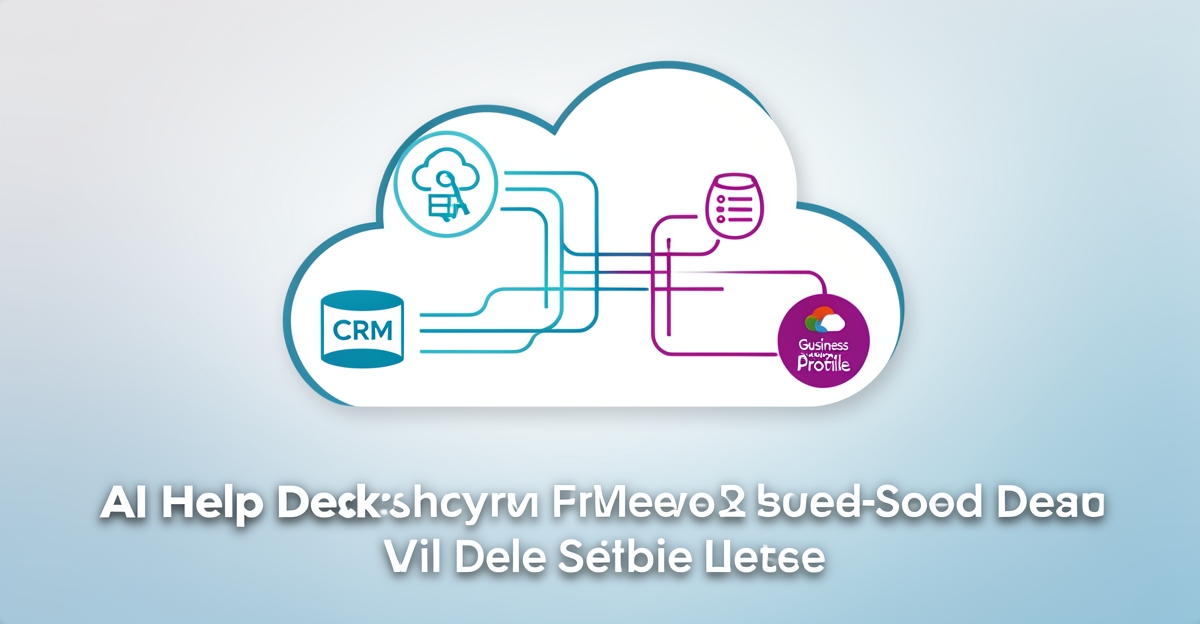
- CRM — every conversation, form fill, and booking must land in one contact record automatically
- Google Business Profile & Bing listings — review responses and local SEO updates need to flow both ways
- Scheduling — appointments booked by AI voice or chat should sync instantly to your calendar
- Email — two-way conversations tracked per contact without manual forwarding
The difference between a platform that connects on day one and one that requires weeks of custom work comes down to three technical factors. First, verify API access — not just "integrations exist," but documented endpoints your team (or your website partner) can actually use. Second, check for pre-built connectors to the tools you already use; platforms like Freshdesk advertise 1,000+ apps, but the relevant question is whether your specific CRM, scheduler, and GBP tools are on that list. Third, confirm multi-cloud support so you're not locked into a single provider's infrastructure as you scale.
Multi-cloud deployment is a growing trend precisely because it prevents the vendor lock-in that makes future integrations painful. When your website, help desk, and local search presence all share the same underlying platform — as they do with AI Business Sites — those connections exist by default. The AI assistant answering your chat and phone already knows the customer's history, your service areas, and your pricing because it's drawing from the same CRM and knowledge base that powers your website content and newsletter. No middleware. No sync delays. No "we'll build that integration next quarter."
Local business: doing this the old way?
One system replaces the whole pile.
All of it — the website, the follow-up, the content, the leads — built and run for you for $1,497 + $497/mo. Month-to-month, and you own everything.
See what your build includesLocal Relevance: The Overlooked Factor in Platform Choice
Local Relevance: The Overlooked Factor in Platform Choice
When selecting an AI help desk platform, businesses often focus on integration and response speed, but overlook a critical aspect: local relevance. For local businesses, multi-language support, region-specific compliance (e.g., GDPR, HIPAA), and automated optimization of Google Business Profile (GBP) are not just nice-to-haves, but necessities.
The Statistics Behind Local Relevance
- Multi-language support is critical for businesses serving multilingual audiences, yet there's a notable gap in quantitative data on its adoption rates (Source: https://www.deskdirector.com/dd-blog/your-guide-to-choosing-help-desk-software).
- Region-specific compliance (GDPR, HIPAA) is a must for global or healthcare-focused businesses, with no clear benchmarks on platform adherence (Source: https://www.deskdirector.com/dd-blog/your-guide-to-choosing-help-desk-software).
- Local SEO optimization, including GBP management, directly impacts local search visibility. AI Business Sites, for example, sets up and optimizes GBP profiles as part of its launch process, ensuring clients show up in local search and Google Maps results (Source: Business Context).
Questions to Ask Vendors
To ensure your AI help desk platform handles regional search presence effectively:
- Does the platform offer multi-language support for chatbots and ticket responses?
- Is the platform compliant with region-specific regulations (e.g., GDPR for EU, HIPAA for US healthcare)?
- Can the platform automatically optimize Google Business Profile for improved local SEO?
Why It Matters for Local Businesses
- Enhanced Customer Experience: Multi-language support ensures all customers, regardless of language, receive timely assistance.
- Regulatory Compliance: Avoid fines by ensuring your help desk platform adheres to regional data protection laws.
- Increased Visibility: Automated GBP optimization boosts local search rankings, driving more foot traffic and online inquiries.
Actionable Advice
Given the research gap in quantitative local-relevance data, prioritize platforms with transparent compliance measures and customizable language settings. For AI Business Sites clients, the integrated approach—where the website, GBP optimization, and AI-powered help desk work in tandem—provides a holistic solution for local market dominance.
By focusing on these overlooked factors, local businesses can select an AI help desk platform that not only streamlines customer support but also amplifies their regional presence.
How to Test Before You Commit: A 30-Day Evaluation Framework
Most help desk platforms promise automation, but the real test is whether they actually reduce the work on your plate. A 30-day trial is your only chance to see if the AI handles your customers, your FAQs, and your workflow — not a demo script. Research shows that 41% of organizations already use AI-driven automation in service desks, with chatbot integration growing 31% in just three years, so the bar for "good enough" is rising fast (industry research).
- Week 1: Load your actual FAQs and measure autonomous resolution rate — platforms like Intercom's Fin resolve up to 59% of routine queries without human input (vendor benchmarks)
- Week 2: Verify CRM and Google Business Profile integration works end-to-end — 38% of businesses delay adoption due to legacy system compatibility issues (integration study)
- Week 3: Stress-test response speed under load — cloud-based solutions now hold 61.3% market share because they scale without lag (market analysis)
- Week 4: Confirm the AI learns from each interaction — the platform should serve future customers better based on what it handled this month
Each test ties directly to business outcomes: fewer missed leads when the AI captures every inquiry, faster replies that turn "somewhat dissatisfied" customers into ones who deliver 17X more revenue (customer value research), and better local visibility when your help desk feeds review responses and FAQ updates straight to your Google Business Profile. The AI Business Sites platform was built around this exact logic — your website handles the busywork so you don't have to, learning from every conversation to make the next one easier.
Frequently Asked Questions
Why do most help desk platforms feel too complex for my small local business?
Will an AI help desk actually save my business time, or will it just add more work?
Does local SEO matter for an AI help desk platform, or is that extra?
Is AI really going to improve over time, or will it just give the same responses forever?
How do I know if an AI help desk will actually work with my existing tools?
What’s the difference between 'assistive' and 'autonomous' AI for customer support?
Do I need to hire an IT person to set up an AI help desk for my local business?
Stop Losing Leads Before They Even Click ‘Contact’—Here’s Your AI Help Desk Checklist
Choosing the right AI-powered help desk platform isn’t just about answering faster—it’s about answering *smarter* while saving your team hours every week. For local businesses, the stakes couldn’t be higher: 68% of consumers prioritize efficient service, and 75% expect immediate resolutions, yet 38% of companies delay adoption entirely due to integration headaches. The platforms that succeed aren’t just reactive tools; they’re proactive extensions of your business, learning from every interaction to refine future responses and automatically optimizing your local search presence. Whether it’s a plumbing service bookings inquiries or a dental office’s appointment requests, the right system handles the busywork so you can focus on what matters—closing deals and serving customers. Start by testing how the AI handles *your* specific FAQs in a 30-day trial. Does it resolve routine queries without human input? Does it seamlessly sync with your CRM, Google Business Profile, and booking system? And crucially, does it actually *get better* over time? The platforms that pass this test don’t just reduce manual ticket costs by ~22%—they reclaim the time and attention your business can’t afford to lose. Ready to see it in action? Book a quick demo or sign up for a trial today.
FOR local businesss — BUILT AND RUN BY US
Your website. Your content. Your leads. Your data.
$500 starts your build. Seven days later it's live — chat, booking, follow-up, and your Google presence all set up. Then we run it, every month. You do the work you actually get paid for.