
Key facts
- 60% of NWFA survey respondents expect sales growth in 2025 according to industry reports
- 87% of businesses report better project outcomes after adopting CRM-driven workflows per Nimble research
- By 2026, 40% of enterprise applications will deploy task-specific AI agents Computerworld forecasts
- Separate CRM and delivery tools force re-entering client data at every handoff Scoro analysis shows
- Teams prioritizing AI-driven power skills see 27% lower project failure rates research reveals
- The U.S. hardwood flooring industry employs 45,000 people and generates $8.5 billion in economic output NWFA data confirms
- Automated follow-ups within 15 minutes of lead capture significantly improve conversion rates for service businesses
WANT RESULTS LIKE THIS?
Imagine a system doing all of this for your local business — every day, without you.
We build local businesses a custom website with a team of AI behind it: every lead captured and followed up, new content published monthly,customers finding you on Google — live in 7 days.
- 85+ pages at launch
- Every lead followed up, automatically
- Your whole business on one screen
Why Most Flooring Websites Fail to Convert Leads Into Projects
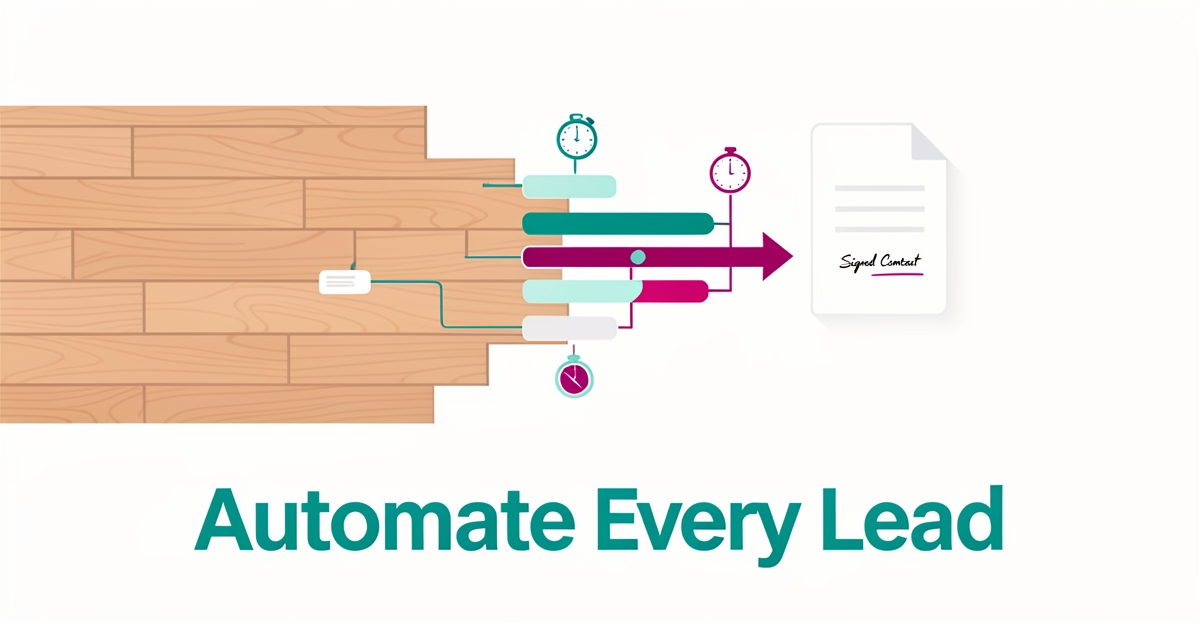
Most flooring websites look fine on the surface — clean photos, service lists, a contact form — but underneath, they're static brochures. They capture a name and email, then leave the rest to chance: no automatic follow-up, no project link, no system that knows the difference between a quote request and a signed contract. Meanwhile, NWFA data shows 60% of businesses expect sales growth in 2025, and every unanswered inquiry is revenue walking out the door.
The gap isn't design. It's infrastructure. A typical site treats a lead as a notification. A system built for flooring businesses treats it as the start of a project — tagging the source, logging the conversation, and triggering a personalized response within 15 minutes. Research confirms 87% of businesses report better outcomes with CRM-driven workflows, yet most contractors still rely on spreadsheets, text threads, and memory to track what came in, what was quoted, and what needs a follow-up call.
Experts note that separating CRM from project delivery forces teams to re-enter client data at every handoff, creating errors and delays. The alternative is a unified platform where the website, the pipeline, and the project board all share the same record — so a won deal automatically becomes a scheduled job with the right template, assignee, and starting stage.
- Brochure sites capture contact info; conversion systems capture context
- Manual follow-up loses leads; automated sequences nurture them on schedule
- Disconnected tools duplicate work; integrated platforms eliminate handoff friction
- Memory-based tracking misses details; centralized databases preserve every interaction
AI Business Sites builds websites that function this way from day one — not by bolting on plugins, but by designing the lead-to-project flow into the core architecture. The result is a site that doesn't just show your work; it helps you win and manage more of it.
The 5 Non-Negotiable Features Your Website Platform Must Have
The 5 Non-Negotiable Features Your Website Platform Must Have
Choosing the right website platform for your hardwood flooring business is crucial, especially when it comes to automatically tracking projects and following up with leads. With the hardwood flooring industry expected to grow, with 60% of NWFA survey respondents anticipating sales increases in 2025, efficient lead and project management is key. Here are the five research-backed criteria to evaluate platforms, grounded in insights from Scoro, Nimble, and Computerworld.
1. Native CRM and Project Management Integration Eliminate manual data re-entry with a platform that integrates CRM and project management natively. As Scoro emphasizes, "A project management tool with a built-in CRM closes the gap between sales and delivery, providing real-time margin tracking." This ensures quotes seamlessly transition into projects and invoices, reducing errors and saving time.
2. Automated Workflows with 15-Minute Follow-Up Triggers Timely responses are critical. Opt for a platform that automates workflows, triggering personalized follow-ups within 15 minutes of lead capture. This capability is backed by the principle that swift responses significantly improve lead conversion rates in service-based industries.
3. AI-Powered Lead Nurturing and Project Routing By 2026, 40% of enterprise applications will leverage task-specific AI agents, as highlighted by Computerworld. Ensure your platform includes AI for predicting project deadlines, categorizing work requests, and automatic task routing, enhancing efficiency and decision-making.
4. Integration with Accounting and Scheduling Tools Verify integration with essential tools like QuickBooks, Xero, Gmail, and Outlook. This syncs financial and activity data, streamlining operations. Nimble notes, "CRM for project management is about centralization, combining customer data with project specifics for smoother collaboration."
5. Centralized Client Dashboard with Visual Pipeline Management Choose a platform offering a single dashboard that combines client relationship data with project specifics, using visual pipeline management (e.g., Kanban boards). This centralization, as Nimble suggests, reduces mistakes and improves outcomes by providing a clear overview of client interactions and project statuses.
By focusing on these non-negotiable features, you'll find a website platform that not only captures leads but also streamlines your hardwood flooring business operations, setting you up for success in a growing market.
Scoro's analysis on integrated CRM and project management, Nimble's insights on centralization, and Computerworld's forecasts on AI adoption guided these recommendations, ensuring your platform choice is both informed and future-proof.
Local business: doing this the old way?
One system replaces the whole pile.
All of it — the website, the follow-up, the content, the leads — built and run for you for $1,497 + $497/mo. Month-to-month, and you own everything.
See what your build includesHow to Evaluate Platforms Without Getting Lost in Feature Lists
Most flooring businesses don't need more features — they need a system where a won quote actually becomes a project without anyone re-entering data. The gap between sales and delivery is where margins disappear, and Scoro notes that when CRM and delivery tools are separate, "you're stuck re-entering the same client data at every handoff" (source). A practical evaluation starts by asking for a live demo of that exact handoff: show me a quote turning into a project, then an invoice, all in one flow.
- Test whether follow-ups trigger within 15 minutes and adapt based on lead source — not just a generic template
- Verify AI features are production-grade by asking how the system handles a real email thread, not a scripted chat
- Confirm you own the code, the data, and the domain — no platform lock-in
- Calculate total cost of consolidation versus piecemeal tools (CRM, automation, project management, newsletter, document generation)
Pricing context makes the consolidation math concrete. Scoro's plans range from $19.90 to $49.90 per user monthly (source), Nimble sits at $24.90 annually (source), and Flowla starts at $49 per user (source) — and that's before adding separate tools for content, scheduling, voice, and media. The real question isn't which feature list is longest. It's whether the platform eliminates the handoffs that cost you time and margin every week.
What Implementation Actually Looks Like for a Flooring Business
Most flooring businesses don't struggle with the work — they struggle with what happens between the estimate and the signed contract. When leads sit untouched for hours or project details get lost in text threads, revenue slips away. Research shows that 87% of businesses report better project outcomes after adopting CRM-driven workflows, yet many contractors still rely on spreadsheets and memory to run multi-thousand-dollar jobs.
The first 48 hours set the tone. Day one means connecting your Google Business Profile so every map lead lands directly in your pipeline, then wiring in referral sources and web forms so nothing enters through a side door. Automated follow-up sequences should fire within 15 minutes — one track for estimate requests, another for referral partners — each personalized to the source. Project templates come next: sand-and-finish jobs need moisture-reading checkpoints and cure-time buffers, while installation templates track subfloor prep, acclimation windows, and trim schedules. The visual pipeline then replaces the whiteboard, giving every crew lead and office manager the same real-time view.
- Connect Google Business Profile and all lead sources on day one
- Build source-specific follow-up sequences that trigger in under 15 minutes
- Create distinct project templates for sand-and-finish versus installation workflows
- Train the team on the visual Kanban pipeline so every stage is visible
- Enable weekly AI-generated business reports covering leads, deals, and project health
Nimble's research emphasizes that successful adoption requires internal champions and regular workflow reviews — buying the system is only the first step. Teams that schedule monthly pipeline audits and designate a point person for automation tweaks see faster ramp-up and fewer stalled deals. By 2026, 40% of enterprise applications will deploy task-specific AI agents, making this kind of embedded intelligence the baseline, not the differentiator. AI Business Sites builds this operational layer into every custom website so the follow-up, the project tracking, and the reporting happen without a separate software stack to manage.
Frequently Asked Questions
Why do most flooring websites fail to turn leads into actual projects?
What's the difference between a regular website and one that actually manages flooring projects?
How important is it that my website connects to QuickBooks, Gmail, and my calendar?
Do I really need AI features on my flooring website, or is that just hype?
What does implementation actually look like for a flooring business — is it months of setup?
How do I know if a platform will actually save me time versus adding more software to manage?
Turn Your Website Into a Lead-Generating Powerhouse—Here’s How
Your hardwood flooring website shouldn’t just look good—it should work as hard as you do. The difference between a brochure site and a high-converting lead machine comes down to infrastructure: a system that captures context, not just contact info, and automatically moves leads from inquiry to project without the usual handoffs and rework. With 60% of hardwood flooring businesses expecting sales growth in 2025, the cost of slow follow-ups and disconnected tools is measured in lost revenue every hour. The solution isn’t more software—it’s a single platform where your website, CRM, and project board all speak the same language. Built-in automation triggers personalized responses within 15 minutes, AI routes leads to the right team member, and won deals automatically become scheduled jobs with templates, checklists, and milestones ready to go. For flooring businesses, that means fewer missed calls, faster closures, and more time spent on installations—not chasing paperwork. The platform you choose should do the heavy lifting so you can focus on delivering exceptional floors. Start by testing a live demo that shows a quote turning into a project in one flow. Then build source-specific follow-up sequences, create project templates for sand-and-finish and installation workflows, and train your team on the visual pipeline. The result? A website that doesn’t just represent your work—it helps you win and manage more of it, automatically.
FOR local businesss — BUILT AND RUN BY US
Your website. Your content. Your leads. Your data.
$500 starts your build. Seven days later it's live — chat, booking, follow-up, and your Google presence all set up. Then we run it, every month. You do the work you actually get paid for.