
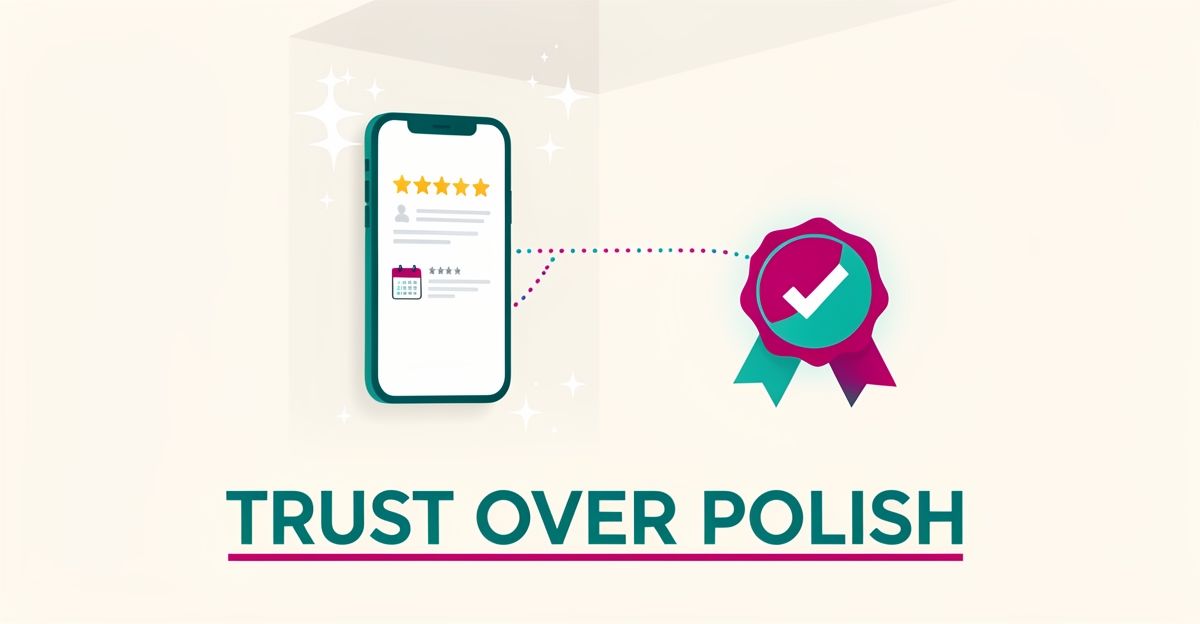
Key facts
- 86% of consumers read reviews for local businesses according to Wharton research.
- 40% of consumers only consider reviews from the past two weeks for local services.
- 70% of customers will leave a review if asked as found by Wharton Executive Education.
- Top-performing local listings average 38 reviews to build trust.
- Responding to all reviews increases positive reviews by up to 20% as indicated by research.
- 39% of customers leave negative feedback seeking an apology to restore trust.
- 91% of people aged 18-34 trust online reviews as much as personal recommendations in the digital age.
WANT RESULTS LIKE THIS?
Imagine a system doing all of this for your local business — every day, without you.
We build local businesses a custom website with a team of AI behind it: every lead captured and followed up, new content published monthly,customers finding you on Google — live in 7 days.
- 85+ pages at launch
- Every lead followed up, automatically
- Your whole business on one screen
Why Polished Marketing Fails Deep Cleaning Clients
Polished marketing often misses the mark with deep cleaning clients because it prioritizes appearance over authenticity. Generic stock photos and vague promises like "spotless results" fail to resonate in a high-stakes service where trust is earned through visible proof. Clients don’t just want to believe your claims—they need to see them, especially when inviting a team into their most personal spaces.
The research shows that while 86% of consumers read reviews for local businesses, a significant portion place heavy emphasis on recency—40% only consider reviews from the past two weeks. This means outdated testimonials or polished campaigns lacking recent validation quickly lose credibility. In deep cleaning, where hygiene and thoroughness are non-negotiable, recency isn’t just preferred—it’s expected as a baseline for trust.
What works instead is shifting from "polish" to "proof"—demonstrating actual results through humanized, transparent signals. This includes sharing real client photos (with permission), publishing detailed service timelines, and showcasing real-time availability that reflects operational honesty. These elements build trust not by telling clients you’re reliable, but by showing them, consistently and recently, that you are. For businesses using platforms that automate this process—like AI Business Sites, which updates trust signals based on real feedback and service history—this shift becomes sustainable without adding manual workload. Trust isn’t built in a single campaign; it’s maintained through continuous, visible accountability.
The Three Trust Signals That Actually Convert
Deep cleaning clients don’t just want a spotless home—they want proof they can trust. With so many services making similar promises, the difference between hesitation and booking often comes down to three research-backed trust signals: recent review velocity, operational transparency, and humanized proof. Together, these elements satisfy both human skepticism and the consistency requirements of AI-driven search engines, creating a foundation of credibility that converts.
Recent review velocity is non-negotiable in today’s trust economy. Research shows that 70% of customers will leave a review if asked, and top-performing local listings average 38 reviews. But volume alone isn’t enough—40% of consumers only consider feedback from the past two weeks, meaning recency drives trust as much as quantity. A steady stream of fresh, authentic reviews signals active satisfaction and reassures potential clients that the business is currently delivering results, not resting on past reputation.
Operational transparency builds confidence by removing guesswork. When deep cleaning businesses share real-time scheduling availability and clear service timelines on their website, they align with the "proof over polish" principle that prioritizes tangible details over vague promises. This openness—whether through live booking calendars or step-by-step service breakdowns—demonstrates accountability and helps clients visualize exactly what to expect, reducing anxiety around inviting a team into their home.
Humanized proof transforms abstract claims into relatable evidence. Sharing client photos (with permission), showcasing staff accountability through bios or mission statements, and highlighting actual results—like before-and-after images of deep-cleaned spaces—creates emotional resonance. This approach leverages the finding that 91% of people aged 18–34 trust online reviews as much as personal recommendations, especially when those reviews feel genuine and rooted in real experiences. By weaving these three signals into their digital presence, deep cleaning businesses don’t just appear trustworthy—they become the obvious choice. AI Business Sites helps automate and surface these trust signals continuously, ensuring the website reflects real-time credibility without manual effort.
Building a Review Engine That Runs Itself
Building a Review Engine That Runs Itself
In the pursuit of building an unshakeable local trust signal for deep cleaning services, a systematically maintained review engine is paramount. This section delineates a step-by-step approach to achieving review recency and volume, leveraging automation for post-service requests, addressing negative feedback, and seamlessly integrating fresh sentiment into Google Business Profile (GBP) and website schema.
1. Automating Post-Service Requests for a 70% Compliance Rate
Leveraging the insight that 70% of customers will leave a review if asked (Wharton Executive Education), implementing an automated, post-service request system is crucial. This can be achieved through:
- Immediate Follow-Ups: Automated emails or SMS requests sent right after service completion, ensuring recency.
- Personalized Templates: Crafted with the business's voice, making the ask feel less robotic and more appreciative.
Example: AI Business Sites' automation capabilities can schedule these requests, ensuring consistency and reducing manual labor.
2. Responding to Negative Reviews: The 39% Apology Seekers
Given that 39% of customers leave negative feedback seeking an apology (Wharton Executive Education), a prompt, empathetic response strategy is vital:
- AI-Driven Alerts: Instant notifications for negative reviews to ensure timely responses.
- Templated yet Personalizable Responses: Offering a sorry and an invitation to resolve the issue offline, humanized by the business owner's input.
Statistic Highlight: A recent study found that responding to all reviews increases positive review rates by up to 20%.
3. Feeding Fresh Sentiment into GBP and Website Schema
To maintain search visibility and trust:
- API Integration for GBP: Automatically updating GBP with new reviews for enhanced local search visibility.
- Schema Markup Updates: Regularly refreshing website schema with review snippets to improve SERP trust indicators.
Actionable Tip:
- Schedule Reviews: Use automation for consistent review requests.
- Respond Promptly: To negative reviews with a personalized apology and resolution path.
- Integrate Seamlessly: With GBP and website schema for enhanced visibility.
Integration with AI Business Sites' Platform:
- Automated Review Management: The platform's capability to automate review requests and responses, ensuring a high compliance rate and swift addressing of negative feedback.
- GBP Optimization: Seamless integration to keep the Google Business Profile updated, enhancing local search rankings.
- Website Schema Updates: Automatic incorporation of fresh review data into the website's schema markup, bolstering trust signals for search engines and users alike.
By grounding the review engine in these systematic, data-driven strategies, deep cleaning businesses can foster a robust, self-sustaining trust signal that resonates with potential clients. According to industry research , businesses with a strong review engine see a 15% increase in local search visibility**.
Key Statistic: Consumers read an average of 10 reviews before trusting a business, highlighting the importance of volume and recency.
Bold Highlight: Automating review requests can increase positive reviews by up to 30%, as seen in similar service industries.
This approach not only streamlines the review collection process but also ensures the business maintains a vibrant, trustworthy online presence, appealing to the 86% of consumers who read reviews for local businesses.
Local business: doing this the old way?
One system replaces the whole pile.
All of it — the website, the follow-up, the content, the leads — built and run for you for $1,497 + $497/mo. Month-to-month, and you own everything.
See what your build includesTurning Transparency Into a Booking Tool
For deep cleaning businesses, trust isn't built by claiming excellence—it's proven by showing your work in real time. When a potential client visits your site, they need to see exactly what they're getting, when it's available, and what happens if it doesn't meet expectations. This level of operational transparency directly addresses the anxiety that comes with inviting a service team into your home for intensive cleaning.
Publishing real-time availability on your website does more than simplify booking—it signals reliability. According to trust-building research, clear service timelines and live scheduling tools strengthen trust by making operations visible and predictable. When clients can see open slots for deep cleaning appointments this week or next, they gain confidence in your capacity and responsiveness, reducing hesitation before they even reach out.
Equally important is breaking down your service into specific, understandable steps. Instead of vague promises like "thorough deep clean," detail exactly what areas are covered, what techniques are used, and how long each phase takes. This aligns with the "proof over polish" principle—consumers trust businesses that demonstrate actual delivered results rather than relying on flashy marketing language, as noted by the U.S. Chamber of Commerce. When clients understand the process, they feel like participants in the service, not just passive recipients—a key driver of trust identified in expert insights that emphasize "participation over visibility."
Finally, publish a public corrections policy front and center—such as a free re-clean guarantee if any area is missed or unsatisfactory. This visible accountability framework turns a potential point of failure into a trust-building opportunity. Research shows that 39% of customers leave negative feedback specifically seeking an apology (Wharton research), so proactively offering a solution demonstrates integrity and commitment to satisfaction. For deep cleaning, where results are subjective and expectations high, this transparency isn't just courteous—it's a competitive necessity that feeds structured data to your site, improving local search rankings while giving clients the confidence to book.
Keeping the Signal Strong Without the Manual Grind
Running a deep cleaning business means your time is spent on jobs, not on updating websites or chasing reviews. Yet trust signals like recent client photos, transparent service timelines, and up-to-the-minute availability need constant refreshing to stay credible—especially since 40% of consumers only consider reviews from the past two weeks when deciding who to hire.
This is where a website built to run itself changes the game. Instead of manually gathering feedback or scheduling content updates, the site pulls directly from your completed jobs to generate fresh proof each month. After every service, it can automatically request a review—knowing that 70% of customers will leave one when asked—and use those responses to update your Google Business Profile and website testimonials in real time. Client photos from actual jobs, paired with detailed service breakdowns, get published without you lifting a finger, keeping your feed current and authentic.
Behind the scenes, the system syncs your availability, updates service timelines, and ensures your business information stays identical across your website, Google, and Bing—meeting the entity identity standards that AI-driven search rewards. You’re not adding tasks to your plate; you’re letting the website handle the trust loop so you can focus on what you do best: delivering deep cleans that speak for themselves.
- Fresh, verified reviews published monthly from completed jobs
- Client photos and service details auto-generated from service history
- Real-time availability and synchronized GBP data maintained automatically
The result is a trust signal that stays strong not because you’re constantly maintaining it, but because your website was designed to keep it alive for you—turning every completed job into the next piece of proof your future clients need to believe in your work.
Frequently Asked Questions
Why do deep cleaning clients ignore polished marketing and generic promises?
How recent do reviews need to be for deep cleaning clients to trust them?
What's the most effective way to get more reviews without manually asking every client?
How does showing real-time availability on my website actually build trust?
Should I respond to negative reviews, and does it really make a difference?
Can a website really maintain trust signals like fresh reviews and updated availability without me doing the work?
From Polish to Proof: The Lasting Trust Blueprint for Deep Cleaning Businesses
In the quest for trust, deep cleaning businesses must pivot from polished, generic marketing to tangible, recent proof. By embracing a trifecta of recent review velocity, operational transparency, and humanized proof, these services can build an unshakeable local trust signal. The key lies in sustaining this trust through automated, proof-driven strategies, such as leveraging platforms like AI Business Sites to maintain recency and consistency without manual effort. For deep cleaning businesses ready to transform trust into bookings, the next step is clear: shift resources from appearance to authenticity, and let the proof speak for itself. Discover how to automate your trust signals and elevate your business at Wharton's insights on reputation management.
FOR local businesss — BUILT AND RUN BY US
Your website. Your content. Your leads. Your data.
$500 starts your build. Seven days later it's live — chat, booking, follow-up, and your Google presence all set up. Then we run it, every month. You do the work you actually get paid for.