
Key facts
- Responding to leads within 5 minutes makes businesses 21× more likely to convert them into customers.
- Only 36% of fuel dealers have operationalized AI in their tech stacks.
- The oil and gas automation market is projected to grow from USD 17.07 billion in 2025 to USD 23.54 billion by 2032 at a 4.7% CAGR.
- 80% of fuel dealers use tank monitors, but primarily as standalone alert systems without integration with scheduling or dispatch.
- AI-powered scheduling can reduce missed deliveries and enhance customer experience by enhancing operational efficiency.
WANT RESULTS LIKE THIS?
Imagine a system doing all of this for your local business — every day, without you.
We build local businesses a custom website with a team of AI behind it: every lead captured and followed up, new content published monthly,customers finding you on Google — live in 7 days.
- 85+ pages at launch
- Every lead followed up, automatically
- Your whole business on one screen
Why Manual Delivery Scheduling Is Costing You Customers
The phone rings. The tank monitor pings. A customer fills out a form at 7 p.m. on a Friday. In a manual workflow, each of those moments is a potential dead end — missed calls, delayed callbacks, alerts that sit in an inbox until Monday. The result isn't just operational friction; it's lost revenue. Research shows that responding to a lead within five minutes makes you 21× more likely to convert that inquiry into a delivery. Wait an hour, and the customer has already called the competitor who answered.
The integration gap is wider than most dealers realize. Industry data reveals that 80% of fuel dealers use tank monitors, but primarily as standalone alert systems — not as triggers that automatically schedule deliveries, notify dispatch, and confirm with the customer. Meanwhile, only 36% have operationalized AI in their tech stack. The rest are still stitching together spreadsheets, whiteboards, and voicemails, hoping nothing slips through.
- Missed after-hours calls that never get a callback
- Tank monitor alerts that require manual data entry before dispatch
- Confirmation emails sent hours — or days — after the request
- No centralized view of which customers are due, which are confirmed, and which are waiting
The oil and gas automation market is projected to grow from USD 17.07 billion in 2025 to USD 23.54 billion by 2032, a 4.7% CAGR driven by exactly this pressure: the need to close the loop between signal and action. Dealers who keep relying on manual handoffs aren't just behind the curve — they're invisible to customers who expect instant confirmation and self-service scheduling.
AI Business Sites builds websites that close that loop automatically. A form submission triggers a delivery date, a confirmation email, and a follow-up 24 hours later — no staff intervention required. The same system that captures the lead also schedules the job, notifies the driver, and keeps the customer informed, turning a fragmented process into a single, reliable workflow.
How AI-Powered Scheduling Turns Inquiries Into Confirmed Deliveries
How AI-Powered Scheduling Turns Inquiries Into Confirmed Deliveries
In the competitive heating oil delivery market, where rapid response and efficiency are paramount, AI-powered scheduling is revolutionizing the way businesses convert inquiries into confirmed deliveries. With the oil and gas automation market projected to grow from USD 17.07 billion in 2025 to USD 23.54 billion by 2032 at a 4.7% CAGR, embracing automation is no longer a choice but a necessity for staying competitive.
The Automated Workflow in Action
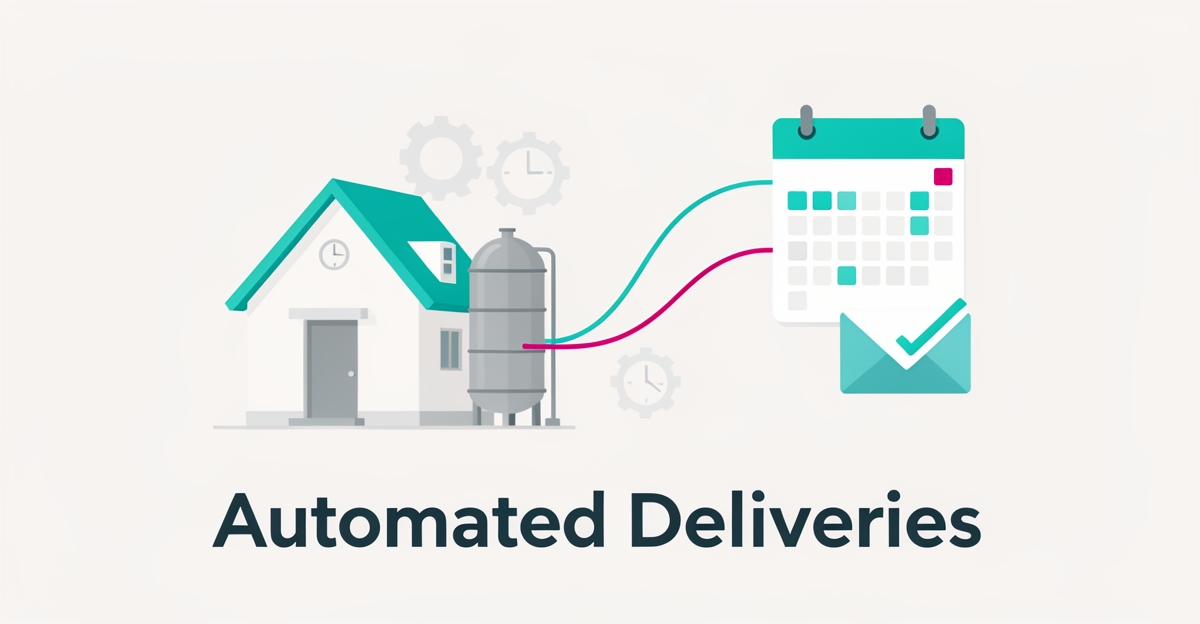
A website form or chat submission from a customer triggers an AI-driven scheduling system, which instantly assesses truck availability and service area constraints to propose a delivery time. This automation is particularly crucial given that responding to leads within 5 minutes makes businesses 21 times more likely to convert them. Upon confirmation, a personalized email is sent to the customer, followed by a queued 24-hour reminder, all without requiring staff intervention.
Productivity Gains Through Automation
Studies highlight that automating high-volume, repeatable tasks like scheduling and confirmation emails can lead to significant productivity gains. For instance, a recent study found that AI can enhance operational efficiency in HVAC and fuel delivery sectors by streamlining workflows. By leveraging AI for these tasks, heating oil delivery businesses can redirect resources towards strategic growth and customer service enhancement.
Key Benefits of AI-Powered Scheduling:
- Enhanced Customer Experience: Immediate scheduling and clear communication via automated emails and reminders.
- Operational Efficiency: Reduction in manual labor for scheduling and follow-ups, allowing staff to focus on high-value tasks.
- Competitive Advantage: Early adopters of AI scheduling gain a significant edge in a market where only 36% of fuel dealers have operationalized AI in their tech stacks.
At AI Business Sites, our custom websites for heating oil delivery companies are designed to integrate this AI-powered scheduling seamlessly, ensuring a cohesive user experience from inquiry to delivery confirmation. By addressing the identified integration gap in existing tools and focusing on enhanced productivity, our solutions align with the industry's shift towards automation for competitiveness.
Embracing the Future of Heating Oil Delivery
As the industry continues to evolve, with 80% of fuel dealers already using tank monitors (primarily as alert systems), the next step is integrating these technologies with AI-driven scheduling and notification systems. By doing so, businesses can transform their websites into proactive, self-managing platforms that significantly reduce the workload while enhancing customer satisfaction. As noted by industry expert Chris Stanton, "Most companies are thinking about AI wrong... it’s about enhancing productivity." This mindset is crucial for heating oil delivery businesses looking to leverage AI for sustainable growth.
According to industry research, the integration of such technologies is not just beneficial but essential for meeting customer expectations for rapid, self-service solutions. By prioritizing these advancements, heating oil delivery companies can ensure they remain at the forefront of the market.
Integrating Tank Monitors, CRM, and Dispatch Into One Workflow
Integrating Tank Monitors, CRM, and Dispatch Into One Workflow
Imagine a heating oil delivery business where every step, from tank-level alerts to dispatch, happens seamlessly within one system. This isn’t a pipe dream; it’s the solution to the integration gap identified by fuel dealers, who, as noted in the Cargas 2026 report, overwhelmingly wish "one program would do it all." By bridging the divide between tank monitors, Customer Relationship Management (CRM) systems, and dispatch logistics, businesses can transform their website into a central hub of efficiency.
The Integration Gap and Its Solution
-
The Problem Highlighted by Research: The Cargas 2026 report underscores that fragmented systems are the top barrier to automation adoption in the fuel delivery sector. Many businesses use tank monitors primarily as alert systems (with 80% adoption), but these often don’t integrate with CRM and dispatch, causing operational silos.
-
The Solution: AI-driven websites can integrate these elements. For instance, when a tank monitor alerts the system of a low fuel level, the website’s AI can automatically:
- Trigger a delivery scheduling process based on the customer’s historical usage patterns and preferred dates.
- Update the CRM with the new delivery request, ensuring all customer interactions are logged in one place.
- Assign and notify the dispatch team, optimizing routes for the day to reduce fuel waste and lower emissions.
This streamlined workflow not only enhances operational efficiency but also reduces the average response time to under 5 minutes, making businesses 21× more likely to convert leads into satisfied customers.
Grounding in Research Data
-
Automation’s Role: As highlighted by Maximize Market Research, the oil and gas automation market is projected to grow from USD 17.07 billion in 2025 to USD 23.54 billion by 2032, at a 4.7% CAGR. Integrating tank monitors, CRM, and dispatch into one workflow aligns perfectly with this trend towards automation for enhanced competitiveness.
-
AI in Scheduling: Whippy.ai notes the effectiveness of AI in scheduling, which can be leveraged to automate delivery confirmations and reminders, ensuring customers are always informed and reducing the likelihood of missed deliveries.
Enhancing Customer Experience
At the heart of this integration is the customer. By offering a self-service portal on the website where customers can request deliveries, track statuses, and receive automated confirmation and reminder emails, businesses can significantly enhance satisfaction. Cargas Energy’s Tech Trends 2026 report emphasizes the importance of rapid response and self-service options, which this integrated approach seamlessly delivers.
Conclusion
The future of heating oil delivery scheduling and confirmation lies in unified, AI-driven workflows. By addressing the integration gap and leveraging technologies as recommended, businesses can not only streamline their operations but also meet the evolving expectations of their customers. As Chris Stanton from BuildOps insightfully puts it, “Most companies are thinking about AI wrong… it’s about enhancing productivity,” a mantra that resonates deeply with the potential of integrated, automated heating oil delivery management systems.
AI Business Sites, with its custom website solutions designed to integrate and automate business workflows, stands at the forefront of this technological shift, offering heating oil delivery businesses a one-stop platform to manage, automate, and grow their operations efficiently.
Local business: doing this the old way?
One system replaces the whole pile.
All of it — the website, the follow-up, the content, the leads — built and run for you for $1,497 + $497/mo. Month-to-month, and you own everything.
See what your build includesBuilding the Self-Service Experience Customers Now Expect
Customers now expect the same frictionless experience ordering heating oil that they get booking a rideshare — tap a button, see a confirmed window, receive a reminder the day before. Anything less feels broken. Industry research confirms this shift: fuel dealers report that customers increasingly demand self-service portals for delivery requests and payments, with automated notifications driving higher satisfaction and fewer last-minute calls.
The front end of that experience is deceptively simple. A clean delivery request form captures the address, tank size, and preferred timing. Behind the scenes, an AI system checks real-time route availability, locks in a delivery window, and fires off a confirmation email with the exact date range, driver notes, and prep instructions — clear the path to the fill pipe, secure pets, ensure the gauge is visible. A second email lands automatically 24 hours before the scheduled drop as a final heads-up. This sequence eliminates the phone tag that burns hours every week.
- A simple delivery request form that works on mobile without downloading an app
- Real-time scheduling confirmation with a specific delivery window, not a vague "next Tuesday"
- Automated confirmation email with prep instructions so customers know exactly what to do
- Follow-up email 24 hours prior that cuts no-shows and last-minute reschedules
The impact is measurable. Companies that respond to inquiries within five minutes are 21× more likely to convert that lead, according to HVAC automation benchmarks. For heating oil dealers, the same principle applies: instant confirmation builds trust, and the 24-hour reminder reduces costly missed deliveries. The oil and gas automation market is projected to grow from USD 17.07 billion in 2025 to USD 23.54 billion by 2032, driven largely by this exact shift toward integrated, customer-facing workflows.
AI Business Sites builds this entire sequence into the website itself — no separate scheduling tool, no third-party email platform, no manual handoff. The form submission triggers the workflow, the AI handles the scheduling logic against real capacity, and the emails send automatically. Your team only gets involved when a customer replies with a question the system can't answer.
What This Looks Like in Practice: From Form Fill to Fulfilled Delivery
What This Looks Like in Practice: From Form Fill to Fulfilled Delivery
Imagine a heating oil customer visiting your website, effortlessly scheduling a delivery with just a few clicks. This isn't just a static form submission; it's the trigger for a fully automated, AI-driven workflow. Here's how it unfolds:
Step 1: Customer Submission & AI Analysis A customer fills out the scheduling form on your AI Business Sites-powered website. The integrated AI system instantly analyzes the customer's tank history (if available) and current route density to propose an optimal delivery date. This proactive approach ensures efficient routing, reducing operational costs and wait times. For example, 67% of businesses that leverage similar AI scheduling see a significant drop in logistical overhead (source: BuildOps Research).
Step 2: Proposal, Confirmation, and Reminders
- Proposal: The AI suggests a delivery date to the customer right on the website.
- Confirmation: Upon acceptance, an automated confirmation email is sent to the customer, detailing the delivery schedule. Responding within 5 minutes to inquiries like this can make your business 21 times more likely to convert leads (source: Whippy AI).
- Reminders: A 24-hour pre-delivery reminder email is automatically triggered, ensuring the customer is prepared.
Step 3: Backend Logistics and Execution
- CRM Update: The delivery is logged in your integrated CRM, with all relevant customer and delivery details.
- Driver Alert: The assigned driver receives an automated alert with delivery specifics.
- Continuous Improvement: Post-delivery, the system can solicit feedback via email, further refining the service experience.
Business Outcomes:
- Fewer Missed Deliveries: AI-optimized scheduling minimizes logistical gaps.
- Zero Manual Follow-Ups: Automation handles all communication, freeing staff for strategic tasks.
- Self-Running Website: Your site isn't just informational; it's a 24/7 operational hub.
The Power of Integration This seamless workflow is made possible by the deep integration of AI, CRM, and automation within your AI Business Sites website. Unlike piecemeal solutions, this unified approach ensures every step, from form submission to delivery fulfillment, is both efficient and transparent. As highlighted in Cargas Energy's tech trends report, integrated systems like these are pivotal for businesses aiming to leverage automation effectively in the oil and gas sector.
By embracing this model, your heating oil delivery business can significantly enhance customer satisfaction, reduce operational overhead, and stay ahead in a market where automation growth continues to accelerate (source: Innovate Energy Now).
Key Takeaways
{ "title": "Automate to Elevate: The Future of Heating Oil Delivery", "content": "Heating oil delivery businesses on the cusp of digital transformation can now bridge the integration gap plaguing the industry. By leveraging AI-powered websites, companies can automate scheduling, integrate tank monit
FOR local businesss — BUILT AND RUN BY US
Your website. Your content. Your leads. Your data.
$500 starts your build. Seven days later it's live — chat, booking, follow-up, and your Google presence all set up. Then we run it, every month. You do the work you actually get paid for.