
Key facts
- 1 in 3 calls to home service businesses go unanswered, frustrating customers and losing leads according to Tommaso Maria Ricci.
- AI-based pest management market to reach $8.36B by 2032, growing at a 16.32% CAGR (OpenPR).
- AI chatbots fail on urgent/emotional pest calls, recommending a hybrid human/AI approach (Callvix Solutions).
- Pest control operators save 30–60 minutes daily with AI routing, increasing appointments by 20–25% (PestPac).
- Homeowners expect instant, personalized responses akin to online booking in other industries (Tommaso Maria Ricci).
- AI answering plans for pest control start under $100/month, contrasting with $50,000/year for human CSRs (Callvix Solutions).
- The global AI market is projected to reach $826.7 billion by 2030, driving innovation in service industries (NPMA PestWorld).
WANT RESULTS LIKE THIS?
Imagine a system doing all of this for your local business — every day, without you.
We build local businesses a custom website with a team of AI behind it: every lead captured and followed up, new content published monthly,customers finding you on Google — live in 7 days.
- 85+ pages at launch
- Every lead followed up, automatically
- Your whole business on one screen
The Weather Problem: When Customers Need Answers Now
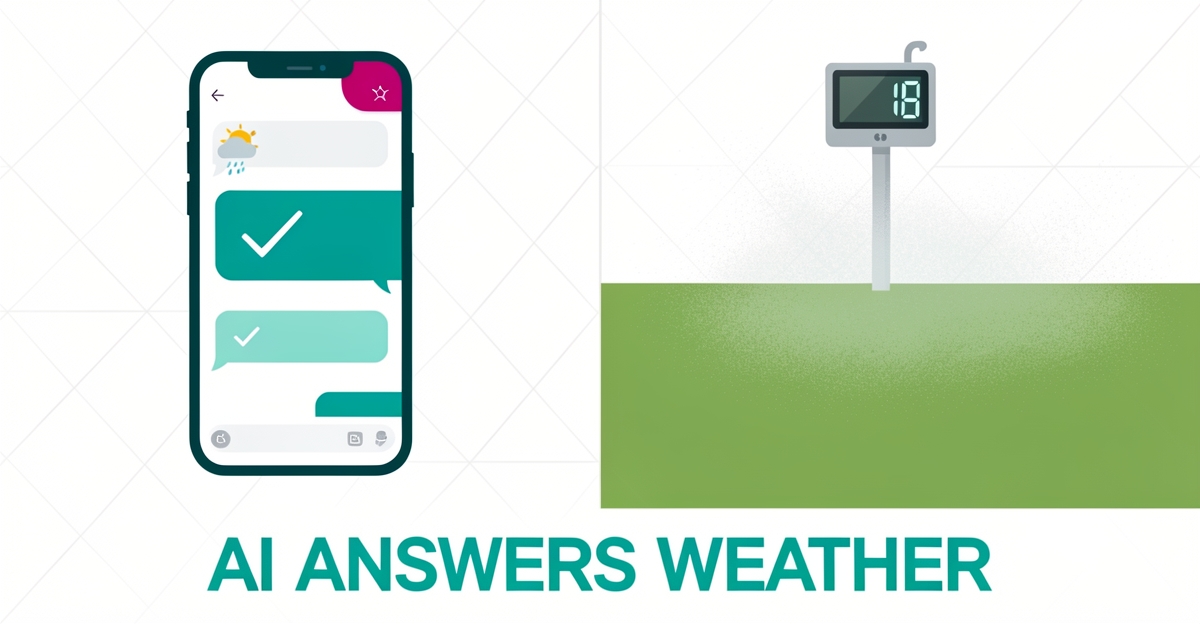
When storms roll in or temperatures spike, homeowners don’t just wonder about the weather — they wonder what it means for their pest problem. A sudden downpour might wash away a recent treatment, while a heatwave could trigger a mosquito surge overnight. In these moments, customers reach for their phones, expecting immediate, personalized advice on whether to proceed, delay, or reschedule service. Yet research shows that roughly one in three calls to home service businesses go unanswered, leaving customers frustrated and more likely to turn to a competitor who responds faster. This delay isn’t just inconvenient — it erodes trust at the exact moment a homeowner is seeking reassurance. AI Business Sites’ platform is designed to close this gap by enabling websites to answer weather-related questions instantly, using real-time data and the business’s own service knowledge to guide customers without delay. Industry research confirms that homeowners expect service interactions as seamless as online booking in other industries, and when that expectation isn’t met, leads are lost before a conversation even begins. Studies also show that seasonal pest activity is deeply tied to weather patterns, making timely, localized advice not just helpful — but essential for effective treatment and customer satisfaction. Without a system that can interpret live weather forecasts and translate them into actionable guidance, pest control businesses miss critical opportunities to engage customers when their attention and intent are highest. The result? Missed appointments, unclear communication, and a perception that the business isn’t responsive enough to meet modern service expectations. Industry experts note that while AI struggles with urgent, emotional pest calls, it excels at handling routine, data-driven questions — exactly the type of inquiry triggered by weather changes. By leveraging real-time weather APIs and integrating them with a business-specific knowledge base, AI-powered chatbots can answer questions like “Should I treat for ticks today with 90% humidity?” or “Is it safe to spray for ants if rain is forecasted in 6 hours?” — turning weather uncertainty into a chance to demonstrate expertise and reliability. This approach doesn’t replace human judgment for complex situations; instead, it ensures that customers get instant clarity on routine weather impacts, freeing up technicians to focus on the urgent cases that truly need a human touch. When a website can respond to a weather-related question in seconds — with advice rooted in local conditions and the company’s actual treatment protocols — it transforms a moment of anxiety into an opportunity to build trust and secure the booking. Market analysis shows the AI-driven pest management sector is growing rapidly, yet few providers have adapted this technology for real-time, customer-facing weather responsiveness in urban service contexts. AI Business Sites fills that gap by combining real-time web search, automation tools, and a dynamic knowledge base into a single system that doesn’t just answer questions — it helps customers make confident, informed decisions about when to act. In an industry where timing is everything, the ability to turn weather uncertainty into clear, immediate guidance isn’t just a convenience — it’s a competitive advantage that keeps leads warm, schedules full, and customers confident in the service they’re receiving.
The AI Solution: Real-Time Weather Chatbots That Actually Help
For pest control businesses, weather isn't just small talk — it's a critical factor in treatment effectiveness and customer decisions. Yet, many struggle to answer routine weather-related questions instantly, especially outside business hours. This is where AI chatbots, when properly integrated with live data and business-specific knowledge, can transform a point of friction into a seamless experience.
Generic chatbots often fail here because they lack access to real-time weather APIs or the nuanced understanding of how local conditions affect specific treatments. According to research, one in three calls to home service businesses go unanswered, and customers increasingly expect instant, personalized responses — a gap AI can help close when deployed thoughtfully. AI Business Sites' platform addresses this by enabling chatbots that pull live weather data and cross-reference it with the business's own service guidelines, such as dry-time requirements or wind thresholds for spraying.
For example, when a customer asks, "Should I spray if rain is forecast for tomorrow?", an AI assistant equipped with real-time search and a tailored knowledge base can instantly respond: "Our mosquito treatment needs 4 hours dry time — with 80% chance of rain at 2 PM, we’d recommend rescheduling to morning or delaying until Friday." This isn’t a scripted guess; it’s a data-driven recommendation grounded in the company’s actual protocols.
What makes this effective is the fusion of three elements: real-time weather information, the business’s specific treatment rules, and the AI’s ability to communicate it conversationally. Unlike generic bots that offer vague or irrelevant advice, this approach delivers precision — turning weather uncertainty into clear, actionable guidance. As noted by industry experts, predictive services that anticipate customer needs are a growing opportunity in pest control, and weather-responsive chatbots are a practical way to operationalize that insight today.
Local business: doing this the old way?
One system replaces the whole pile.
All of it — the website, the follow-up, the content, the leads — built and run for you for $1,497 + $497/mo. Month-to-month, and you own everything.
See what your build includesHow to Implement It: Using Your Website’s AI to Close the Loop
How to Implement It: Using Your Website’s AI to Close the Loop
Pesticide services can revolutionize customer interaction by leveraging AI to instantly respond to weather-related inquiries. Here’s how to deploy this capability seamlessly using the AI Business Sites platform:
1. Embed Real-Time Weather API within Your AI Assistant Integrate a weather API directly into your website’s AI chatbot, enabling it to fetch and interpret real-time, location-specific weather data. This allows the AI to answer queries like "Will tomorrow’s rain affect my scheduled treatment?" with precise, localized advice. For example, if a customer asks, "Can you treat my yard tomorrow with an 80% chance of rain?" the AI can respond, "Given the forecast, we recommend rescheduling for [next available dry day] to ensure treatment efficacy."
2. Ground Responses in Your Knowledge Base, Not Generic Scripts Ensure the AI’s weather-related responses are grounded in your company’s specific service knowledge base. This might include rules like, "Treatments require 2 hours of dry time," ensuring the AI provides tailored, trustworthy advice (e.g., "Given the 2 PM rain forecast, we can treat your yard by 12 PM today or reschedule for Thursday"). This approach aligns with the platform's capability to use the business's own knowledge base, as highlighted in the Never Miss a Customer section of the business context.
3. Automate Follow-Ups for Weather-Dependent Leads Utilize the platform’s automation builder to tag leads generated from weather-related chats. Set up targeted follow-ups (e.g., "Rain Postponement: Re-Schedule Your Treatment") using the visual automation builder, which can handle over 25 trigger types and 20+ action types. This ensures no opportunity is lost due to weather conditions. For instance, if a treatment is postponed due to rain, the system can automatically send a follow-up email or notification to reschedule.
4. Track Conversions with CRM Tagging Tag interactions related to weather queries in your CRM. Monitor how these leads convert into booked treatments, providing invaluable insights into the ROI of your weather-responsive AI strategy. According to Callvix Solutions, AI answering plans can start under $100/month, significantly lower than the cost of hiring customer service representatives (up to $50,000/year with benefits, as noted by NPMA PestWorld).
- Integrate Weather API: Enhance your AI chatbot with live weather data for instant, informed responses.
- Customize Knowledge Base: Ensure AI responses reflect your service’s unique operational rules.
- Automate Weather Lead Follow-Ups: Never miss a rescheduling opportunity with targeted, timed communications.
Statistics Highlighting the Need:
- 1 in 3 calls to home service businesses go unanswered, emphasizing the need for instant AI-driven responses source.
- The AI-based pest management market is projected to grow at a 16.32% CAGR, indicating a fertile ground for innovative AI applications source.
- Hybrid human/AI models are recommended for optimal conversion rates, especially for urgent calls source.
By integrating these steps into your AI Business Sites platform, you not only enhance customer experience with timely, weather-aware support but also position your pesticide service at the forefront of innovation in the industry. This integration aligns with the platform's core capability to run your business day-to-day, handling routine tasks automatically while you focus on high-value decisions.
Frequently Asked Questions
Why do customers contact pesticide services about weather conditions, and how can AI help?
Can AI fully replace human customer support in pesticide services?
How does integrating real-time weather data into AI chatbots benefit pesticide services?
What is the growth potential of AI in pest management, and how does it apply to urban services?
How can pesticide services implement AI for weather-related customer inquiries effectively?
Is there a documented success or failure of using AI for weather-responsive customer service in pest control?
Key Takeaways
{ "title": "From Forecast to Follow-Up: The Lasting Impact of AI-Driven Pest Control Solutions", "content": "As the pest control industry navigates the intersection of weather unpredictability and customer expectations, integrating AI-powered chatbots with real-time weather APIs emerges as a piv
FOR local businesss — BUILT AND RUN BY US
Your website. Your content. Your leads. Your data.
$500 starts your build. Seven days later it's live — chat, booking, follow-up, and your Google presence all set up. Then we run it, every month. You do the work you actually get paid for.