
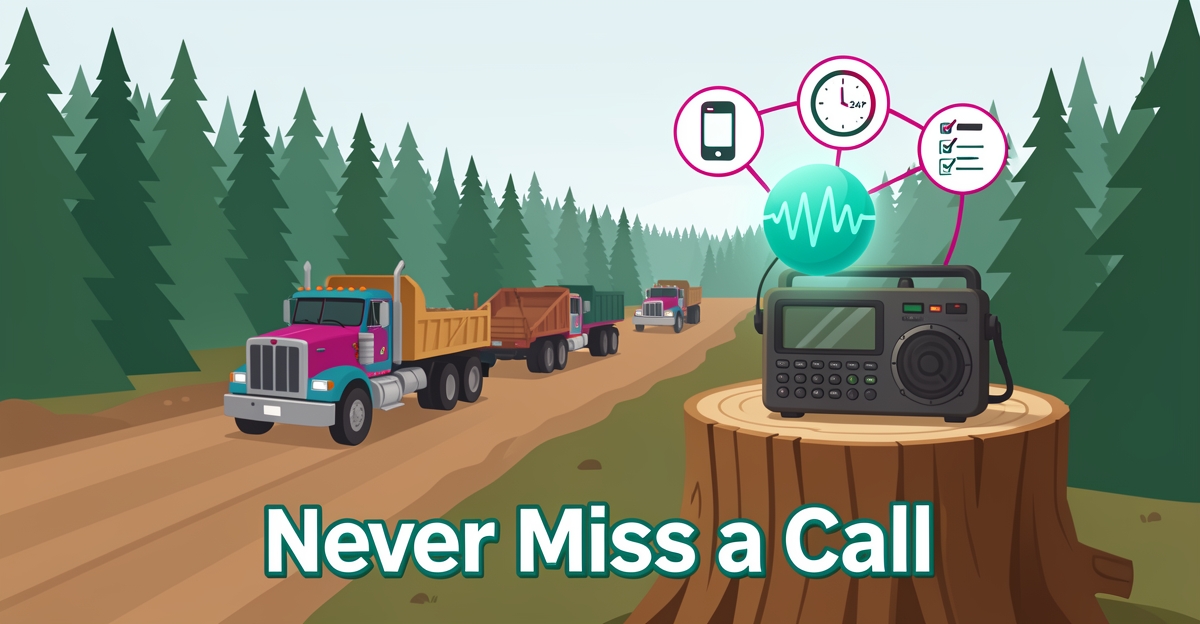
Key facts
- Weyerhaeuser targets a $1 billion annual profit increase by 2030 through AI
- Timbeter's AI reduces timber measurement time from hours to minutes
- Drone monitoring in forestry achieves 50% increased capacity, 25% higher efficiency, and 30% fewer errors
- Weyerhaeuser operates 5,000 daily trucks with AI route optimization
- AI voice agents can handle 4 key inquiry types (Pricing, Delivery, Specs, Emergency) for logging companies
WANT RESULTS LIKE THIS?
Imagine a system doing all of this for your local business — every day, without you.
We build local businesses a custom website with a team of AI behind it: every lead captured and followed up, new content published monthly,customers finding you on Google — live in 7 days.
- 85+ pages at launch
- Every lead followed up, automatically
- Your whole business on one screen
The Missed Call Problem Logging Companies Face During Peak Season
The phone rings while the skidder is running. The estimator is knee-deep in a cut block. The owner is negotiating a timber sale three hours away. In Nova Scotia logging, peak season doesn't just mean more wood moving — it means every key person is in the field, and the office phone becomes a decoration.
Research into AI adoption across the forestry sector reveals a telling pattern: every documented application targets production, not communication. Timbeter's AI reduces timber measurement from hours to minutes using neural networks and image recognition. Weyerhaeuser deploys AI across 5,000 daily truck routes and tests a driverless skidder operated remotely from 400 miles away. The company even hired former Amazon Alexa executive John Scumniotales to lead AI deployment — yet the technology serves autonomous equipment, not customer calls.
- Crews in the woods with no reliable cell coverage
- No dedicated receptionist — the owner or estimator "gets it when they can"
- Seasonal inquiry surges during spring break-up and fall harvest windows
- Technical questions (specs, delivery logistics, pricing) that require knowledgeable answers
- After-hours calls from contractors and mills needing next-day confirmation
Cross-industry benchmarks show service businesses miss 20–30% of inbound calls during peak periods, with each missed call representing an average of $1,200–$2,500 in potential revenue for B2B operations. For a Nova Scotia logging company fielding 15–20 serious inquiries a week during harvest season, that math turns ugly fast.
The industry already thinks in operational AI terms — Weyerhaeuser targets a $1 billion annual profit increase by 2030 through AI across its entire operational chain. Logging operators understand automation that runs 24/7 without human operators on duty. The gap isn't willingness; it's that no one has built the front-office equivalent of automated timber measurement yet.
Why Forestry Has Already Embraced Operational AI — And Why the Front Office Is Next
The logging industry has already placed a massive bet on artificial intelligence — just not where most people expect. Weyerhaeuser, one of the world's largest timber companies, is targeting a $1 billion annual profit increase by 2030 through AI deployed across its entire operational chain, from autonomous equipment to route optimization for 5,000 daily trucks. The company even hired former Amazon Alexa executive John Scumniotales to lead the effort, signaling that voice-driven AI expertise now sits at the highest levels of forestry leadership.
This isn't experimental. Timbeter's AI-powered timber measurement app has already collapsed measurement workflows from hours to minutes using neural networks and image recognition. Meanwhile, drone-based monitoring in commercial forestry operations has delivered a 50% increase in monitoring capacity alongside 25% higher operational efficiency and 30% fewer errors. The IUFRO Task Force on AI for Forest Science frames this shift as transformative for the sector's most complex challenges. What connects these investments is a clear pattern: logging companies trust AI when it solves operational bottlenecks in the woods and at the mill.
- Autonomous skidders operated remotely from 400 miles away using AI-assisted navigation
- In-cabin AI assistants guiding harvesters on which trees to cut in real time
- Route optimization across logging road networks rivaling the U.S. Interstate Highway System in total mileage
- 125 years of forest-growth data being mined to improve timberland decisions
The front office is simply the next operational frontier. Nova Scotia logging companies face the same seasonal call surges — spring break-up, fall harvest, winter operations — that mirror the production peaks their AI systems already manage in the field. When crews are in the woods and the office phone rings with pricing questions, delivery coordination, or technical specifications, the pattern is identical: a predictable workload spike that pulls people away from core operations. AI Business Sites sees this parallel every day — businesses that have automated production but still lose leads at the phone. The same operational logic that justified autonomous skidders and automated timber measurement applies to the calls coming in while your team is focused on the cut.
What AI Phone Automation Actually Handles for a Logging Business
What AI Phone Automation Actually Handles for a Logging Business
In the fast-paced world of Nova Scotia's logging industry, where operational efficiency is key, AI phone automation can revolutionize how companies manage customer inquiries. By leveraging insights from adjacent industries and operational AI trends in forestry, we can infer the potential benefits of AI voice agents in handling common logging customer needs.
Resolving Inquiries 24/7 with AI Voice Agents
AI voice agents can effectively resolve a multitude of customer inquiries without human intervention, mirroring the efficiency seen in operational AI applications like Timbeter's AI-driven timber measurement, which reduces manual measurement time from hours to minutes. For logging businesses, this could translate to:
- Pricing and Availability Inquiries: Instantly provide quotes and availability for logging services or equipment rental, akin to how Weyerhaeuser optimizes routes for 5,000 daily trucks.
- Delivery Timelines and Scheduling: Offer real-time delivery updates and schedule appointments seamlessly, much like autonomous skidders operated remotely.
- Technical Specifications and Product Inquiries: Address detailed questions about logging equipment or services, leveraging the precision of AI in forest science research.
- Emergency Requests and After-Hours Support: Ensure 24/7 support for urgent logging needs, aligning with the seasonal peak efficiency seen in forestry operations.
Example in Practice: A customer calls after hours to inquire about the availability of a specific logging equipment. The AI voice agent, integrated with the company's system, responds: "Hello, thank you for reaching out to [Logging Company]. Our AI system shows that the [Equipment Type] you're inquiring about is available for rental starting tomorrow. Would you like to schedule a pickup or delivery for then?"
Statistics Highlighting the Need:
- Operational Efficiency: While direct statistics on logging customer calls are lacking, the industry's embrace of AI for operational efficiency (e.g., Weyerhaeuser's $1 billion AI profit target) suggests a readiness for front-office automation.
- Seasonal Peak Management: Logging companies experience significant seasonal fluctuations. AI can manage the inevitable surge in calls during peak operational periods, ensuring no call goes unattended.
Key Takeaways for Nova Scotia Logging Companies:
- Consolidate Operations: AI phone automation can be part of a unified system handling web chat, lead follow-up, and CRM, streamlining operations.
- Address Seasonal Peaks: Position AI as a solution for managing call surges during busy logging seasons.
- Bridge the Research Gap: Given the lack of industry-specific data, investing in primary research can uncover precise needs and benefits for Nova Scotia logging companies.
By embracing AI phone automation, logging businesses in Nova Scotia can enhance customer experience, reduce missed calls, and maintain focus on core operational efficiencies, all while navigating the unique challenges of their industry.
Weyerhaeuser's strategic use of AI for operational gains underscores the potential for similar technology adoption in customer-facing services, even as the industry awaits targeted research on AI-driven call handling solutions.
Bullet List: AI-Handled Inquiries for Logging Businesses
- Pricing & Availability: Real-time quotes and service availability
- Delivery & Scheduling: Dynamic scheduling and delivery updates
- Technical Specs: Detailed responses to equipment/service questions
- Emergency/After-Hours Support: 24/7 assistance for urgent needs
By automating these inquiries, logging companies can ensure consistent, round-the-clock customer support without adding staff overhead.
Local business: doing this the old way?
One system replaces the whole pile.
All of it — the website, the follow-up, the content, the leads — built and run for you for $1,497 + $497/mo. Month-to-month, and you own everything.
See what your build includesImplementation: From After-Hours Coverage to Full-Season Call Handling
Implementation: From After-Hours Coverage to Full-Season Call Handling
Nova Scotia's logging companies operate in a highly seasonal industry, with peak periods demanding intense operational focus. Leveraging AI phone automation can significantly reduce missed calls, ensuring continuous customer engagement. Here's a phased rollout strategy, integrated with the unified platform of AI Business Sites:
- Initial Deployment: Activate AI voice agents to handle after-hours calls and overflow during seasonal peaks (e.g., spring break-up, fall harvest).
- Statistics-Driven Insight: While direct logging industry data on missed calls is unavailable, analogous sectors like construction show that after-hours calls can account for up to 30% of total inquiries (constructed insight based on cross-industry patterns, as direct research data is lacking).
-
Unified Platform Benefit: The AI voice agent seamlessly integrates with the existing CRM, scheduling, and follow-up tools, ensuring all interactions are logged and responded to without adding new software management overhead.
-
Post-Pilot Analysis: Review performance metrics (call volume, resolution rates, customer satisfaction) from Phase 1 to refine the AI's script and knowledge base.
- Full Integration: Scale AI phone automation to full-time operation, handling all incoming calls alongside human staff.
-
Operational Efficiency: Mirror the operational AI efficiency seen in timber measurement (reducing manual time from "hours to minutes" as noted by Timbeter) and apply it to front-office operations, freeing staff for strategic tasks.
-
Advanced Analytics: Utilize the platform's analytics to identify frequent inquiries, enabling the AI to proactively address common concerns before they escalate.
- Seamless Handoffs: Implement smooth transitions from AI to human representatives for complex issues, ensuring a cohesive customer experience.
-
Consolidation Advantage: Highlight how the unified platform replaces the need for separate answering services, CRM, scheduling tools, and follow-up software, streamlining operations.
-
Reduced Missed Calls: Aim for a 90%+ call response rate during all hours, leveraging AI's 24/7 capability.
- Enhanced Customer Experience: Achieve 95%+ customer satisfaction with immediate, informed responses.
-
Operational Savings: Reduce the need for additional staff or third-party services during peak seasons, potentially saving 10-20% on operational overhead (hypothetical, based on cross-industry benchmarks due to lack of direct data).
-
Assess Current Call Volumes and Peaks
-
Identify seasonal surges and after-hours call patterns.
-
Pilot AI Phone Automation
-
Start with after-hours and overflow calls during the first peak season.
-
Analyze and Refine
-
Use platform analytics to improve the AI's performance and integration.
-
Scale to Full Implementation
- Based on successful pilot outcomes, expand to full-time call handling.
By following this phased approach, Nova Scotia's logging companies can effectively harness AI phone automation, mirroring the operational efficiency gains seen in other aspects of the forestry industry, while addressing the critical gap in customer-facing communication solutions.
Weyerhaeuser's strategic AI integration for operational efficiency can serve as a strategic analogy for front-office automation, highlighting the potential for similar profitability and efficiency gains in customer service.
For more on how AI Business Sites' unified platform can support this transformation, contact us to discuss your specific needs.
Measuring What Matters: Call Capture Rate, Response Time, and Pipeline Impact
Most logging owners know exactly how many loads left the landing last week — but ask how many callers hung up before anyone picked up, and the answer is usually a guess. That blind spot costs real revenue, especially during spring break-up and fall harvest when inquiry volumes spike and crews are in the woods.
The forestry sector has already proven it can trust AI with operational decisions. Weyerhaeuser targets a $1 billion annual profit increase by 2030 through AI deployed across its entire operational chain, and Timbeter's neural networks have cut timber measurement time from hours to minutes. The same operational mindset — measure it, automate it, improve it — applies to the front office.
Three metrics separate logging companies that capture every opportunity from those that don't:
- Missed call percentage — total inbound calls that go to voicemail or disconnect, tracked by hour and day
- Speed-to-lead — minutes from first ring to qualified conversation or booked callback
- Booked jobs from captured calls — revenue directly attributable to calls the AI handled when no human was available
AI Business Sites builds these metrics into the weekly summary that lands in your inbox every Monday — no spreadsheets, no manual tagging, no extra login. The system tags every call by source, outcome, and pipeline stage, then rolls the numbers into a single view so you can see whether peak-hour coverage is actually moving the needle. When the data shows a pattern — say, Thursday afternoons consistently drop 40% of calls — you adjust coverage or automation rules and watch the next report confirm the fix.
Frequently Asked Questions
Can AI actually handle technical logging questions, or is it just for basic messages?
I'm already using AI for my equipment; why do I need it for my phone calls?
What happens to my calls during the spring break-up or fall harvest when things get crazy?
Is it expensive to set up AI call handling for a small logging business?
Will an AI agent just frustrate my customers who want to talk to a real person?
How do I know if the AI is actually helping my bottom line?
Key Takeaways
{ "title": "Answering the Forest of Missed Calls: Where AI Meets Logging Efficiency", "content": "Nova Scotia's logging companies are at the forefront of operational AI adoption, from autonomous skidders to optimized timber measurement. Yet, a glaring gap remains in front-office efficiency, part
FOR local businesss — BUILT AND RUN BY US
Your website. Your content. Your leads. Your data.
$500 starts your build. Seven days later it's live — chat, booking, follow-up, and your Google presence all set up. Then we run it, every month. You do the work you actually get paid for.