
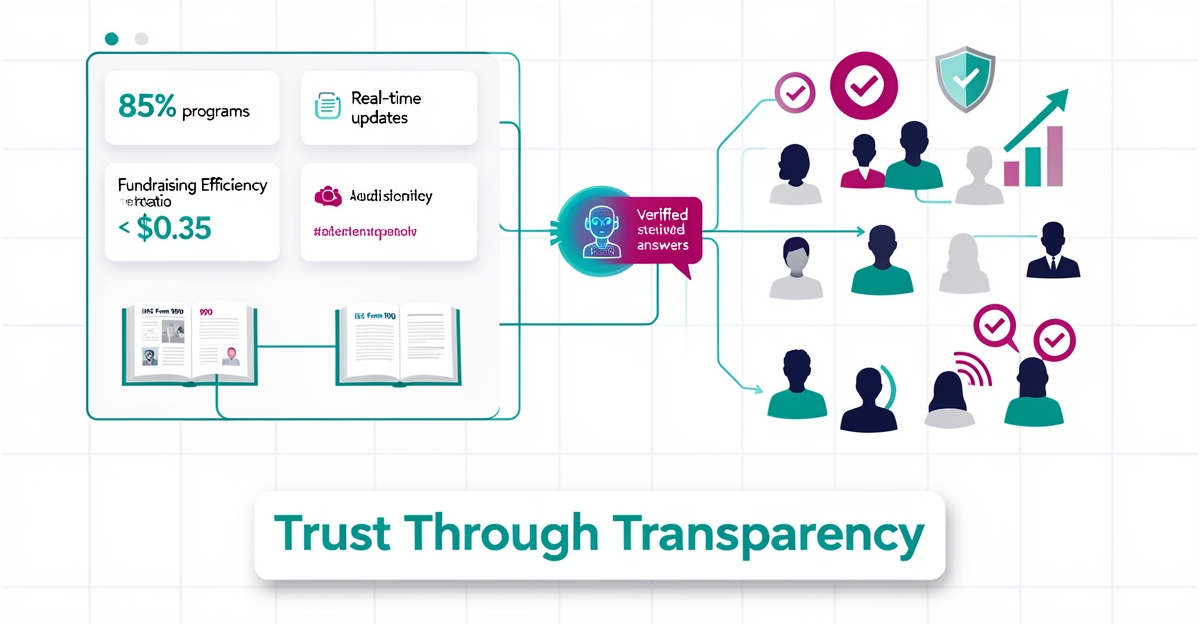
Key facts
- Perceived financial transparency directly boosts donor trust and perceived nonprofit performance according to peer-reviewed research
- A Fundraising Efficiency Ratio below $0.35 per dollar raised is considered excellent by nonprofit financial reporting standards
- 85% of donations fund community programs while 15% covers administrative costs in a proven allocation model
- Digital financial document hosting significantly enhances transparency per the National Council of Nonprofits
- Transparent nonprofits attract more trust and donations, leaving opaque organizations at a competitive disadvantage
- Pairing financial data with mission narratives and visuals transforms spreadsheets into emotional proof of impact
- Automated monthly updates with real-time dashboards keep donors informed without adding administrative burden
WANT RESULTS LIKE THIS?
Imagine a system doing all of this for your local business — every day, without you.
We build local businesses a custom website with a team of AI behind it: every lead captured and followed up, new content published monthly,customers finding you on Google — live in 7 days.
- 85+ pages at launch
- Every lead followed up, automatically
- Your whole business on one screen
The Donor Trust Gap: Why Financial Doubts Hurt Nonprofits
The Donor Trust Gap: Why Financial Doubts Hurt Nonprofits
Donor trust is the lifeblood of nonprofits, yet many face a significant challenge: the donor trust gap, fueled by doubts over financial transparency. Perceived financial transparency directly impacts donor trust and perceived nonprofit performance, as highlighted in a peer-reviewed article source. When donors question how their money is used, nonprofits risk losing not just funds, but long-term relationships and reputation.
The Direct Link Between Transparency and Trust
Transparency is not merely about compliance; it requires making financial information accessible, understandable, and honest source. Donors want to see a clear picture of financial health and operations. For instance, publishing detailed financial statements (audited statements, IRS Form 990, annual reports) on a nonprofit's website can significantly enhance trust. A Fundraising Efficiency Ratio below $0.35 per dollar raised is considered excellent source, indicating efficient use of donations.
Risks of Perceived Opacity
- Donor Retention: Lack of transparency can lead to a decline in repeated giving, as donors seek causes that provide clear financial accountability.
- Reputational Damage: Perceived opacity can attract negative publicity, deterring potential donors.
- Competitive Disadvantage: Transparent nonprofits attract more trust and, consequently, more donations, leaving less transparent organizations at a disadvantage.
Breaking the Trust Gap
To rebuild donor trust, nonprofits can take the following steps:
- Proactive Transparency: Publish detailed financial statements online, making them easily accessible. For example, nonprofits can use AI-generated reports that automatically update with real-time financial data, ensuring transparency and efficiency.
- Engaging Financial Storytelling: Use narratives and visuals to connect financial data to mission impact, making reports more compelling. AI can help generate these narratives by analyzing financial data and crafting engaging stories.
- Regular Communication: Share financial updates and successes through newsletters and social media, fostering long-term relationships. AI-powered content generators can assist in crafting and scheduling these communications.
The Role of Technology in Transparency
Digital Transparency Tools, such as online financial document hosting, can significantly enhance transparency source. For nonprofits, leveraging technology not only streamlines financial reporting but also makes it more accessible to donors, bridging the trust gap efficiently. AI Business Sites, for example, offers integrated solutions for transparent reporting and automated content generation, aligning with the need for clear, accessible financial storytelling.
By embracing transparency and leveraging technology to facilitate open communication, nonprofits can effectively close the donor trust gap, ensuring a stronger, more sustainable base of support for their missions.
Make It Visible: How to Display Financial Health Clearly and Consistently
Financial transparency isn’t just about compliance—it’s about making your nonprofit’s financial health impossible to ignore. Donors want to see proof, not promises, and the easiest way to build that confidence is to put your numbers on display in formats they can trust and understand instantly. Research shows that when nonprofits make financial data accessible and engaging, donor trust and perceived organizational performance rise significantly, with clear reporting acting as a cornerstone of accountability.
Start by making your most critical documents unmissable. Publish your latest audited financial statements, IRS Form 990, and annual reports on your website’s “Transparency” or “Financials” page, formatted as downloadable PDFs and interactive summaries. Keep them updated quarterly—even better, monthly—to show momentum. A leading nonprofit resource emphasizes that digital hosting of these documents isn’t just helpful; it’s expected by today’s donors, who increasingly evaluate impact before giving. Pair each report with a plain-language summary that highlights key ratios, like a Fundraising Efficiency Ratio below $0.35 per dollar raised—widely regarded as excellent—so supporters can quickly grasp your stewardship without digging through spreadsheets.
Make your financial story dynamic by turning data into visuals. Embed an interactive dashboard right on your site that shows real-time program spending versus overhead, using charts or infographics that update automatically as new reports are filed. A transparency guide recommends pairing narratives with visuals to connect dollars to impact—like explaining how 85% of donations go directly to community programs, while 15% covers essential administrative needs. This approach not only clarifies your financial narrative but also aligns with donor expectations for clarity over complexity.
Keep donors engaged with regular updates that feel personal and timely:
- Real-time dashboards that show monthly giving trends and program expenses
- Automated email digests that spotlight financial milestones or challenges
- Live Q&A sessions on social media to discuss financial decisions openly
- Embedded links in your website that let donors download reports with one click
- Clear visuals that compare year-over-year allocations and efficiency
An organization that makes its financial health visible isn’t just compliant—it’s building a reputation for trustworthiness. When donors can see exactly where their contributions go, and when they receive updates that make those numbers meaningful, trust grows organically. Platforms like AI Business Sites help streamline this process by automating report updates and content distribution, so your team can focus on impact—not formatting. The result? A nonprofit that doesn’t just say it’s transparent—it proves it, every time someone visits your site.
Turn Numbers Into Stories: Use Data to Show Impact, Not Just Dollars
Numbers alone don’t move donors—stories do. When a nonprofit reports that it spent $850,000 on programs and $150,000 on administration, the headline tells only part of the story. But when that same report shows that $1 spent on programs supported $2.86 worth of community impact—and pairs that figure with a short video of a child receiving tutoring thanks to those dollars—donors suddenly feel the difference. Pairing financial data with mission narratives, visuals, and clear KPIs like the Program Efficiency Ratio transforms dry spreadsheets into emotional proof that every gift delivers real change.
Transparency thrives on clarity, not complexity. Donors want to see where their money goes, but they also need to understand what it accomplishes. A Fundraising Efficiency Ratio below $0.35 per dollar raised signals strong stewardship, yet donors rarely grasp what that means for their $25 gift. Instead, pair the ratio with a simple infographic showing how many meals, tutoring hours, or shelter beds their contribution enabled. Visuals like heat maps, progress bars, or before-and-after photos make abstract numbers tangible. AI Business Sites’ integrated reporting dashboards can auto-update these visuals monthly, pulling real-time stats from your CRM to ensure every donor-facing report reflects the most current—and accurate—picture of your impact.
Engagement rises when donors see their role in your mission. Rather than burying financials in a dense PDF, embed them in a donor-friendly annual report that balances charts with short narratives, staff quotes, and beneficiary testimonials. Highlight key milestones, such as a 12% increase in program participants, and link it to a photo gallery of the new participants. Use interactive elements—like hover-over tooltips on expense categories—to let donors explore deeper without overwhelming them. An AI-generated content engine can streamline this process, automatically drafting narrative sections grounded in your actual services and service areas, so your team spends less time formatting and more time connecting.
- Pair KPIs with real outcomes: Show that 85% of donations fund programs alongside a story of a family who received emergency food assistance.
- Use visuals to simplify ratios: Turn the Fundraising Efficiency Ratio into a progress bar that grows as donations increase.
- Make reports interactive: Embed tooltips, clickable sections, and embedded videos to let donors explore at their own pace.
- Automate the update cycle: Let your website’s AI system refresh reports monthly with the latest data, so donors always see current impact.
- Tell the story behind the numbers: Replace jargon with plain language—“Your $100 helped 4 families prepare for winter”—to build emotional resonance.
Local business: doing this the old way?
One system replaces the whole pile.
All of it — the website, the follow-up, the content, the leads — built and run for you for $1,497 + $497/mo. Month-to-month, and you own everything.
See what your build includesCommunicate Proactively: Keep Donors Informed with Automated Updates
Keeping donors informed with regular, automated updates builds confidence in your nonprofit’s financial stewardship. Proactive communication through newsletters, websites, and social media ensures supporters see exactly how their contributions advance your mission. Research shows that perceived financial transparency directly strengthens donor trust and perceptions of organizational performance, making consistent updates a critical trust-building practice.
Automated tools simplify this process by delivering timely financial summaries and impact stories without manual effort. For example, nonprofits can share metrics like a fundraising efficiency ratio below $0.35 per dollar raised — considered excellent — or highlight that 85% of donations fund community programs while 15% cover administrative costs. These concrete figures, when shared regularly, reassure donors that resources are used wisely and in alignment with stated goals.
- Schedule monthly email newsletters that include updated financial dashboards and program outcomes
- Post quarterly impact reports on your website with downloadable financial statements and visual KPIs
- Use social media to share bite-sized updates, such as how donations supported specific initiatives last month
- Set up automated alerts for donors when new financial documents, like IRS Form 990 filings, are published online
- Create recurring content that connects financial data to mission impact through storytelling and visuals
By integrating these updates into your website’s native capabilities, nonprofits maintain transparency without adding administrative burden. AI Business Sites supports this through built-in newsletter automation and content generation, allowing organizations to focus on mission delivery while keeping donors consistently informed. This approach transforms financial transparency from a periodic obligation into an ongoing dialogue that nurtures long-term trust.
Close the Loop: Respond to Donor Questions with Real-Time Clarity
Close the Loop: Respond to Donor Questions with Real-Time Clarity
In the era of heightened donor scrutiny, nonprofits must prioritize transparency and responsiveness to rebuild trust. A crucial step in this journey is ensuring that every donor inquiry about finances receives a clear, immediate response. Leveraging technology can streamline this process, making transparency both efficient and visible.
Instant Insights via Website AI Assistants Donors increasingly expect immediate answers. Integrating AI assistants on nonprofit websites can provide real-time responses to frequently asked financial questions (e.g., allocation of donations, administrative cost ratios). For instance, if a donor asks, "What percentage of my donation goes to administrative costs?" the AI can instantly respond with the exact figure, backed by a link to the nonprofit's transparent financial report (as advocated by the National Council of Nonprofits).
FAQs: Beyond the Basics Comprehensive, regularly updated FAQs can address common financial transparency queries. Example:
- Q: How are donations allocated? A: 85% to community programs, 15% to administrative costs.
- Q: Are financial reports publicly available? A: Yes, view our latest audited statements here.
- Q: What is your Fundraising Efficiency Ratio? A: We maintain an excellent ratio of below $0.35 per dollar raised (as per best practices in nonprofit financial reporting).
Dedicated Support Channels for Deeper Inquiries For more complex questions, designated email addresses or phone lines staffed by knowledgeable representatives ensure timely, informed responses. According to industry research (Nature), nonprofits that respond promptly to donor inquiries see a significant boost in trust and repeat donations.
The AI Business Sites Advantage Nonprofits leveraging platforms like AI Business Sites can automate the generation of transparent, SEO-optimized financial reports and FAQs, ensuring consistency and ease of access. This not only streamlines the response process but also enhances the nonprofit's online presence, making financial transparency visibly integral to their brand.
By closing the loop with immediate, clear responses to financial inquiries, nonprofits can effectively rebuild donor trust, leveraging technology to make transparency not just a virtue, but a visible, actionable practice.
Frequently Asked Questions
How does financial transparency actually affect whether donors trust my nonprofit and keep giving?
What specific financial documents should I publish on our website to prove transparency without overwhelming visitors?
What counts as a good Fundraising Efficiency Ratio, and how do I explain it to donors who don't speak nonprofit finance?
We're a small team — how can we keep financial updates consistent without adding hours of manual work every month?
Donors keep asking what percentage of their gift goes to overhead — how do we answer clearly without sounding defensive?
Does posting financial reports online really lead to more donations, or is it just a compliance checkbox?
Turn Financial Transparency Into a Donor Magnet: The Trust-Building Playbook
Financial uncertainty erodes donor confidence faster than almost any other factor—and the cost isn’t just lost gifts, but long-term relationships that take years to rebuild. The good news? Transparency isn’t a mystery. By making your financial health unmissable, turning numbers into stories, and responding to donor questions in real time, you can transform skepticism into sustained trust. Start by publishing your audited statements, Form 990, and impact reports where donors already look—your website—and update them quarterly. Pair each figure with a plain-language summary, like showing how 85% of gifts fund programs while keeping overhead at 15%, so donors grasp the value of their $25 gift instantly. Turn dry data into visuals with interactive dashboards that update automatically, and use AI-powered storytelling to connect dollars to real impact—like pairing a fundraising efficiency ratio below $0.35 per dollar with a video of families your programs supported. Close the loop by answering donor questions instantly through AI assistants and FAQs that reference your latest reports, proving transparency isn’t a promise, but a practice. With tools that automate updates and insights—like those built into AI Business Sites—you’re not just sharing numbers; you’re building a reputation for openness that turns donors into advocates. Start small: pick one report to make public this week, then let technology handle the rest.
FOR local businesss — BUILT AND RUN BY US
Your website. Your content. Your leads. Your data.
$500 starts your build. Seven days later it's live — chat, booking, follow-up, and your Google presence all set up. Then we run it, every month. You do the work you actually get paid for.