
Key facts
- 47% of website delivery delays stem from clients providing content late, industry research shows.
- 89% of B2B website projects experience scope changes that directly impact delivery times, according to WebFX data.
- Professional business websites typically take 3-4 weeks to launch, per 2025 industry benchmarks.
- AI-assisted teams can cut standard delivery timelines from 8-12 weeks down to 6-9 weeks, timeline analysis finds.
- With AI planning, you can go from concept to wireframe in just 20 minutes, Elementor documentation reports.
- Website bounce rates jump 32% when a site takes over 3 seconds to load, web development data shows.
- Most businesses see meaningful search results within 60-90 days after launch as Google indexes new pages, according to industry research.
WANT RESULTS LIKE THIS?
Imagine a system doing all of this for your local business — every day, without you.
We build local businesses a custom website with a team of AI behind it: every lead captured and followed up, new content published monthly,customers finding you on Google — live in 7 days.
- 85+ pages at launch
- Every lead followed up, automatically
- Your whole business on one screen
Why Most Website Projects Take 3-4 Weeks (And What Slows Them Down)
Why Most Website Projects Take 3-4 Weeks (And What Slows Them Down)
For most professional business websites, the standard launch timeline falls between 3-4 weeks, according to industry benchmarks. This timeframe reflects a structured phased approach that balances design, development, and refinement while accounting for real-world variables that often extend timelines beyond initial estimates. Grover Web Design's 2025 timeline guide confirms this range as typical for sites requiring custom functionality, local SEO optimization, and integrated business tools—not just basic brochureware.
The two most significant bottlenecks consistently derailing these timelines are client content delays and scope creep. Research shows that 47% of website delivery delays stem directly from clients providing content late, making it the single largest factor in project holdups. Whether it's service descriptions, team bios, or location-specific details, waiting for client-supplied materials stalls the content creation and development phases, even when technical work could otherwise proceed. Simultaneously, 89% of B2B website projects experience scope changes, where additional features, design tweaks, or functionality requests emerge mid-project, forcing teams to revisit planning and development stages.
These challenges create unpredictability that frustrates both clients and developers. While AI-assisted tools can accelerate certain phases—like generating wireframes in approximately 20 minutes—they don't eliminate the need for timely client input or disciplined scope management. At AI Business Sites, we address these pain points through our done-for-you model: we handle content generation using our AI engine, maintain fixed scope via our all-inclusive pricing, and guide clients through a streamlined 7-day launch process that minimizes reliance on delayed client deliverables. This approach transforms what is typically a 3-4 week variable timeline into a predictable, rapid deployment—without sacrificing the customization or quality expected from a professional business website.
How AI Compresses Website Development From Weeks to Days
Wireframing a site used to take days. Now AI can compress the early technical work to minutes, but the human part still sets the pace.
AI-assisted tools significantly accelerate website creation, enabling users to go from concept to wireframe in approximately 20 minutes and complete styling and content within hours depending on site complexity. Platform documentation notes that with AI planning, you can go from concept to wireframe in 20 minutes, then complete styling and content in hours. That compression applies to the design and build phases, not the business decisions behind them.
The speed gain is real across standard projects. Industry analysis finds AI-assisted teams can potentially reduce delivery timelines from 8-12 weeks to 6-9 weeks for standard projects. Drag-and-drop builders can further reduce simple landing page creation to 1-3 days compared to custom coding approaches. Timeline research confirms those gains are phase-specific.
AI removes technical bottlenecks, it does not remove the need for business input. Content readiness remains the #1 bottleneck in website delivery, with 47% of delays stemming from clients providing content late rather than developer issues. HubSpot data cited in industry research highlights that same 47% figure. Scope creep is also pervasive, affecting 89% of B2B website development projects and directly impacting delivery times. WebFX data reports that scope changes are the norm.
In a managed setup, the accelerator is paired with a structured process that keeps client involvement focused. At AI Business Sites, the build starts with a short kickoff questionnaire, then a 7-day build where the AI pipeline designs, writes, and builds the site, sets up Google presence, and configures the knowledgebase, FAQ bot, CRM, and automations. The client approves before launch.
Training and handover are built into the launch sequence, not added later. The team provides a full walkthrough of the dashboard and assistant so the owner can run everything through conversation, while ongoing management keeps content publishing, maintenance, and system improvements running monthly.
What AI compresses best is the technical execution:
- Wireframing and sitemaps generated in minutes instead of days
- Styling and first-pass content completed within hours for simpler sites
- Parallel content production that shortens the design-to-build handoff
The net effect is faster technical delivery with the same human checkpoints. Client responsiveness, content availability, and design decisions remain the critical factors that can either accelerate or delay launch.
Local business: doing this the old way?
One system replaces the whole pile.
All of it — the website, the follow-up, the content, the leads — built and run for you for $1,497 + $497/mo. Month-to-month, and you own everything.
See what your build includesThe 7-Day Launch: When the Platform Does the Heavy Lifting
Most business owners expect a website in a few weeks, but the clock rarely starts when you think it does.
The standard timeline for professional business websites in 2025 is 3-4 weeks, structured across design conceptualization, development and building, and refinement and launch industry timeline guidance. Simple small business sites can land in 1-2 weeks, while complex e-commerce or custom functionality sites stretch to 5 weeks or longer current development benchmarks.
That range assumes the client is ready. In practice, content readiness is the #1 bottleneck. HubSpot data cited in industry research shows 47% of website delivery delays stem from clients providing content late, not from developer issues. Scope creep is equally pervasive, affecting 89% of B2B website development projects and directly impacting delivery times WebFX research.
AI-assisted tools can compress technical phases. With AI planning, users can go from concept to wireframe in 20 minutes, then complete styling and content in hours Elementor platform documentation. AI-assisted teams can potentially reduce delivery timelines from 8-12 weeks to 6-9 weeks for standard projects Enosta insights. Drag-and-drop builders can reduce simple landing page creation to 1-3 days compared to custom coding development timeline analysis.
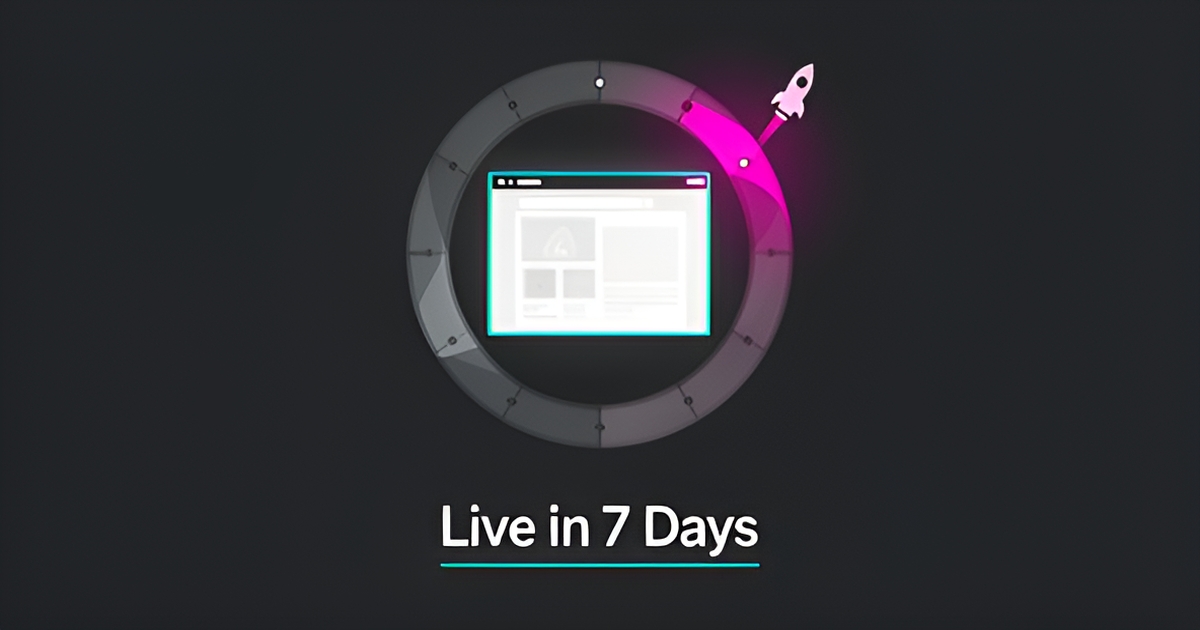
The 7-Day Launch removes the client content bottleneck entirely. AI Business Sites delivers 85+ pages live in 7 days by handling content creation, technical setup, and ongoing management through a done-for-you model.
Instead of waiting on copy approvals and asset uploads, the provider runs the system for you. The 7-day build covers:
- Custom-built website with 25-30 hand-crafted core pages and 60 AI-generated SEO pages at launch
- Google Business Profile, Search Console, sitemaps, and knowledgebase setup completed by the team
- Chat and voice, booking calendar, lead-capture flow, CRM and leads inbox configured and live
- Training and handover walkthrough of the dashboard and AI assistant so the client can run everything through conversation
Because the AI content engine writes, verifies, and publishes, the client approves the build before it goes live without touching a single technical tool. Ongoing management continues after launch with 14+ new SEO pieces per month, daily industry news, hosting, maintenance, and system monitoring included.
It is the done-for-you contrast to the phased discovery, planning, design, content creation, development, testing, and launch process that typically drives delays phased development methodology.
What Happens After Launch: Training, Support, and the First 90 Days
Launch day is the midpoint, not the finish line. Most website timelines end at "go live," but the real work of turning a website into a business asset happens in the weeks that follow.
The first phase is learning the system. With AI Business Sites, this happens through a guided walkthrough of the dashboard and AI assistant — but here's the key difference: you don't have to use it. Every function runs through conversation (typing or talking), yet the system operates whether you touch it or not. This matters because industry research shows that 47% of website delays stem from clients struggling with content and technical decisions — a managed model removes that bottleneck entirely.
The second phase is watching search visibility build. According to web development data, most businesses see meaningful search results within 60-90 days as Google indexes new pages. This is where launch size matters: starting with 85+ pages (versus the typical 5-10 page brochure site) gives search engines substantially more content to rank from day one.
The third phase is continuous improvement without client effort:
- 14+ new SEO pages monthly — blog posts, service pages, location pages, and comparison guides published automatically
- Daily industry news articles keeping the site fresh and relevant
- 24/7 chat and voice agents capturing leads while you sleep
- Automated follow-up on every inquiry within seconds
- Monthly performance reports with AI-generated recommendations
This ongoing optimization addresses what timeline research identifies as a critical gap: traditional launches hand over a static product, but search performance and lead generation require sustained effort. The managed model means the system improves weekly — new content, refined automations, updated knowledge — without the business owner writing a single word or touching a single setting.
The first 90 days separate websites that sit idle from websites that work. One approach delivers a finished product; the other delivers a system that keeps building momentum long after launch day.
Frequently Asked Questions
How long does it typically take to launch a professional business website?
What are the main reasons website projects get delayed?
Can AI tools really speed up website development?
How does AI Business Sites achieve a 7-day launch timeline?
What happens after my website launches with AI Business Sites?
Do I own my website and data if I use AI Business Sites?
Stop Waiting Weeks. Start Building Momentum.
The timeline for launching a website depends on who is doing the heavy lifting. Traditional projects stretch to 3-4 weeks or longer because they rely on client-supplied content and suffer from scope creep—research shows 47% of delays stem from late content and 89% of projects encounter scope changes. AI compresses the technical phases, but only a managed approach removes the bottlenecks entirely. With AI Business Sites, the 7-day launch delivers 85+ pages, complete Google setup, and an AI back office that keeps working after launch—publishing content, capturing leads, and optimizing performance without you writing a word. You get a system that builds momentum from day one, not a static brochure that sits idle. If you are ready to skip the delays and launch a website that actually runs your business, book a free strategy call to see how the done-for-you model works.
FOR local businesss — BUILT AND RUN BY US
Your website. Your content. Your leads. Your data.
$500 starts your build. Seven days later it's live — chat, booking, follow-up, and your Google presence all set up. Then we run it, every month. You do the work you actually get paid for.