
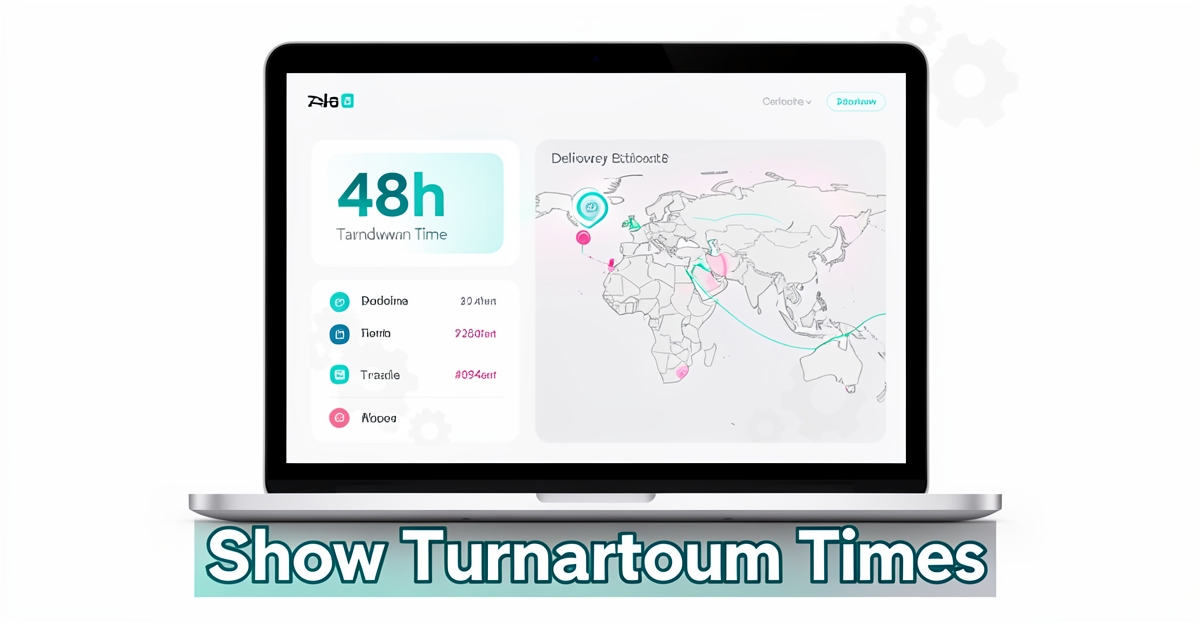
Key facts
- Service margins for industrial equipment manufacturers have grown 3.2% over three years and now exceed product margins for the first time according to TSIA research.
- Millennials now make up 74% of B2B buyers who expect real-time self-service access to information like delivery estimates per AEM analysis.
- Quality failures roughly double lead time from order to customer while every day in backlog increases average turnaround Atlassian’s framework shows.
- Lead time comprises six measurable components and five distinct types, making static delivery promises outdated and unreliable per Atlassian’s breakdown.
- 83% of manufacturers believe smart factory solutions will transform production within five years per Goodwin University citing Deloitte.
- Service revenues grew 2.4% year-over-year despite economic slowdowns, highlighting the structural shift toward service-centric profitability TSIA reports.
- Diversifying suppliers (nearshore, offshore, domestic) is a key strategy to reduce lead times and improve regional delivery speed per Fishbowl Inventory research.
WANT RESULTS LIKE THIS?
Imagine a system doing all of this for your local business — every day, without you.
We build local businesses a custom website with a team of AI behind it: every lead captured and followed up, new content published monthly,customers finding you on Google — live in 7 days.
- 85+ pages at launch
- Every lead followed up, automatically
- Your whole business on one screen
Millennial Buyers Demand Real-Time Service Answers—But Most Manufacturers Aren’t Listening
The B2B buying landscape has shifted beneath many manufacturers' feet. Millennials now represent almost three-quarters of B2B buyers who expect a strong online presence and the ability to engage in meaningful ecommerce, fundamentally changing how purchasing decisions are made. This generational cohort demands instant access to information that was once gatekept by sales teams, including transparent service timelines and real-time equipment availability.
For industrial equipment manufacturers still relying on manual processes to communicate turnaround times, this creates significant friction. When a millennial buyer visits a website seeking clarity on delivery estimates or service response windows, they expect to find it immediately — not wait for a sales representative to return an email or update a static page. The pressure is compounded by the industry's historic shift toward service-centric profitability, where service margins have increased 3.2% over the last three years and now exceed product margins, making transparent service communication not just a convenience but a revenue protection imperative.
Meeting these expectations requires moving beyond static service pages that quickly become outdated. Manufacturers need systems that automatically reflect regional delivery times based on current production capacity, inventory levels, and supplier status — updating without human intervention. This is where AI-driven website automation becomes essential: by integrating live operational data into location-specific service pages, manufacturers can deliver the self-service experience millennial buyers demand while freeing sales teams to focus on complex consultations rather than routine timeline inquiries. The result is a website that doesn't just inform visitors but actively builds trust through consistent, accurate transparency — turning a operational challenge into a competitive advantage in the evolving B2B marketplace.
Service Margins Now Beat Product Margins—But Poor Visibility Undermines Your Highest-Profit Stream
For the first time in the TSIA Industrial Equipment 40 Index, service margins have overtaken product margins — a 3.2% climb over three years while product margins stay under pressure. Service revenue grew 2.4% year-over-year even as the broader economy slowed. This isn't a blip; it's a structural shift documented by TSIA research that makes transparent service delivery your most critical profit lever.
Millennials now represent almost three-quarters of B2B buyers, and they expect the same self-service transparency they get as consumers — real-time inventory, delivery estimates, and instant responses. AEM notes that "a strong online presence and the ability to engage in meaningful ecommerce is becoming more and more important for manufacturers today." When your highest-margin revenue stream depends on service trust, opaque timelines become a direct margin leak.
Lead time isn't a single number — it's six measurable components (pre-processing, processing, wait time, storage, transportation, inspection) across five distinct types (customer, material, production, cumulative, delivery) according to Atlassian's framework. Quality failures roughly double lead time from order to customer. Every day an order sits in backlog, average lead time climbs. Static promises on a spec sheet can't keep pace with this variability.
- Service margins now exceed product margins for the first time (3.2% increase over three years)
- 74% of B2B buyers are millennials who expect self-service timeline transparency
- Quality failures double lead time; backlog directly increases average turnaround
- 83% of manufacturers believe smart factory solutions will transform production within five years
The infrastructure for real-time visibility exists — 83% of manufacturers say smart factory solutions will transform production within five years. But that data lives in ERPs and production systems, not on service pages where buyers actually look. AI Business Sites bridges that gap by turning operational data into automated, region-specific service pages that update without manual intervention — so your highest-margin revenue stream gets the transparent communication it deserves.
Why Static Delivery Estimates Are Killing Trust (And How Dynamic Data Can Fix It)
Most manufacturers still treat delivery estimates as a single number on a spec sheet — a promise that ignores the six distinct components of lead time: pre-processing, processing, wait time, storage, transportation, and inspection. Each component behaves differently under pressure, and research shows that quality failures roughly double the total timeline from order to customer, while every day an order sits in backlog pushes the average even higher. When a static "4–6 weeks" meets a real-world disruption, the gap between promise and reality becomes a trust problem no sales call can fix.
The industry has shifted. Service margins now exceed product margins for the first time, growing 3.2% over three years while product margins remain under pressure. At the same time, millennials represent almost three-quarters of B2B buyers who expect self-service access to timelines, availability, and regional delivery data — not a callback next Tuesday. Static estimates don't just frustrate these buyers; they signal that a manufacturer's digital maturity hasn't caught up to its production capability.
- Display ranges for each lead time component (e.g., "Processing: 2–3 days, Transportation: 1–2 days") instead of a single aggregate number
- Surface real-time factors like current production capacity, regional supplier status, and inventory levels that automatically update from ERP data
- Break out the five lead time types — customer, material, production, cumulative, delivery — so buyers see exactly where their order sits
- Flag variability drivers upfront: quality rework rates, seasonal demand spikes, geopolitical supply disruptions
This level of transparency used to require a dedicated operations team updating pages daily. AI Business Sites builds websites that pull live data into service area and location pages automatically — showing regional delivery windows, equipment availability, and lead response commitments without manual intervention. The AI assistant handles the updates; the business owner steps in only when judgment is needed, not for routine data entry. When your website communicates turnaround times as dynamically as your factory manages them, you meet the millennial buyer's expectation for instant accuracy and protect the service revenue that now drives your margins.
Local business: doing this the old way?
One system replaces the whole pile.
All of it — the website, the follow-up, the content, the leads — built and run for you for $1,497 + $497/mo. Month-to-month, and you own everything.
See what your build includesTurn Supply Chain Volatility Into a Competitive Advantage (Without Adding Staff)
Volatility in the supply chain doesn’t have to be a liability—it can become your biggest competitive edge when your website does the heavy lifting. Manufacturers who diversify suppliers and integrate real-time supplier geography data transform supply chain resilience into customer-facing speed advantages without adding staff. The result? Regional delivery estimates update automatically on your service pages, so buyers see accurate timelines the moment they land on your site, not after they call your overworked team.
Diversifying suppliers isn’t just about risk mitigation—it’s about speed. According to Fishbowl Inventory, diversifying suppliers (nearshore, offshore, and domestic) is a key strategy to reduce lead times, and manufacturers overwhelmingly prefer local suppliers for faster turnaround. When your website automatically pulls supplier locations and inventory data into regional delivery estimates, buyers in Northern Ontario see faster service windows than those in British Columbia—no sales call required.
Lead time is made up of six measurable components, and every one affects trust. Atlassian identifies pre-processing, processing, wait time, storage, transportation, and inspection as the core drivers of turnaround times—while quality failures roughly double the total. When your site displays real-time status for these components, buyers gain confidence in your estimates. An AI-driven service page can show ranges like “Processing: 2–4 days” and “Transportation: 1–3 days,” factoring in supplier location, current inventory, and production capacity automatically.
The real win is turning supply chain resilience into a customer-facing advantage. Manufacturers with diversified supplier networks can highlight faster regional delivery on location pages, making geography a selling point rather than a hidden variable. AI Business Sites builds service pages that update automatically, pulling from ERP and logistics systems to display accurate timelines per region—so your website, not your sales team, handles the busywork of keeping estimates current.
Build Trust Before the Sale—With a Website That Updates Itself
The first impression your website makes could be the difference between a prospect reaching out or moving on to a competitor. For industrial equipment manufacturers, transparency in turnaround times isn’t optional—it’s expected, especially as millennials now make up nearly three-quarters of B2B buyers who demand online self-service capabilities. But without a sales team to manually update every service page, how can you keep this critical information accurate and accessible?
The answer lies in automation that pulls real-time data from your existing systems. By integrating your ERP and production data into AI-driven service pages, you can dynamically display regional delivery times, equipment availability, and lead response windows without lifting a finger. The key is balancing automation with human oversight—letting your website update itself while keeping final control in your hands.
Here’s how to make it work:
- Pull live production data from your ERP to show real-time equipment availability by location, eliminating guesswork for customers.
- Update regional delivery estimates automatically based on logistics and supplier networks, factoring in variables like distance, customs, and seasonal demand.
- Display lead response windows that adjust dynamically, giving prospects confidence in when they’ll hear back without relying on staff to log replies.
- Set human-in-the-loop thresholds so the AI handles routine updates but flags exceptions—like a sudden surge in orders—for your review before publishing.
- Ground every estimate in measurable components (processing time, wait time, transportation, inspection) to avoid overpromising and build trust through transparency.
This approach doesn’t just save your team time—it turns your website into a 24/7 sales asset that builds credibility before a single call is made. According to industry research, service margins for industrial equipment manufacturers have grown 3.2% over three years and now exceed product margins, making service-centric transparency a direct revenue driver. Yet most manufacturers still rely on static pages that require manual updates, leaving gaps in customer trust and operational efficiency.
With the right integration, your website becomes the single source of truth for turnaround times—updating itself while you focus on high-value work. The result? Fewer dropped leads, happier customers, and a sales process that runs smoother without the constant manual updates.
Frequently Asked Questions
Why is it crucial for industrial equipment manufacturers to display turnaround times on their website?
What happens if manufacturers use static delivery estimates instead of dynamic data?
How can industrial equipment manufacturers leverage supplier diversification for competitive advantage?
Why is it important to break down lead time into components on the website?
How does the shift to service-centric profitability impact the need for transparent turnaround times?
What role does AI-driven website automation play in solving the turnaround time communication challenge?
Key Takeaways
{ "title": "Turn Transparency into a Competitive Edge", "content": "Industrial equipment manufacturers are at an inflection point, where service-centric models and millennial buyer expectations converge. By embracing AI-driven website automation, manufacturers can dynamically display regional delive
FOR local businesss — BUILT AND RUN BY US
Your website. Your content. Your leads. Your data.
$500 starts your build. Seven days later it's live — chat, booking, follow-up, and your Google presence all set up. Then we run it, every month. You do the work you actually get paid for.