
Key facts
- 70% of American adults actively seek more protein, driving poultry demand according to recent research
- U.S. chicken consumption per capita projected to reach 104.5 lbs by 2025 per industry forecasts
- 8–10% of U.S. adults (20–25 million) use GLP-1 medications favoring lean poultry as noted in consumer trends
- Marketing is 'one of the least loved and most time-intensive tasks' for 66% of direct-to-consumer farms per UNH Cooperative Extension
- Generative AI tools can save farms significant time on marketing tasks, such as creating seasonal event posts and transforming harvest logs into market announcements as demonstrated by UNH Extension research
- AI Business Sites generates ~14 new content pieces/month for client sites, automatically linked for SEO as per platform capabilities
WANT RESULTS LIKE THIS?
Imagine a system doing all of this for your local business — every day, without you.
We build local businesses a custom website with a team of AI behind it: every lead captured and followed up, new content published monthly,customers finding you on Google — live in 7 days.
- 85+ pages at launch
- Every lead followed up, automatically
- Your whole business on one screen
The Seasonal Visibility Gap Poultry Farms Face
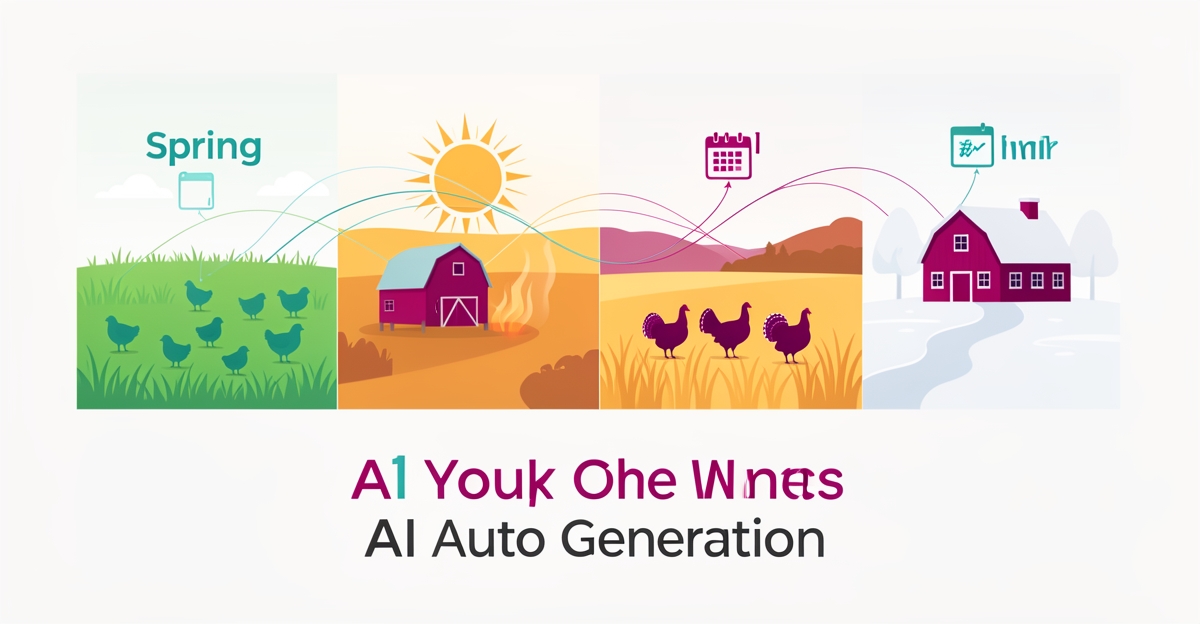
Most poultry farms have a rhythm — spring chick days, summer heat advisories, fall processing, winter feed planning — but their websites don't. When a family searches "Christmas turkey farm near me" in November or "heat stress chickens" in July, a static site with last year's pricing and a generic "About Us" page simply doesn't show up. Search engines reward fresh, relevant content that matches seasonal intent, and farms that go quiet during off-peak months lose visibility exactly when customers are looking.
The numbers back this up: 70% of American adults are actively seeking more protein, and U.S. chicken consumption is projected to hit 104.5 pounds per capita in 2025. Meanwhile, 8–10% of U.S. adults — roughly 20–25 million people — use GLP-1 medications that favor lean proteins like poultry. That demand doesn't pause in February, but most farm websites do.
- Spring: chick sales, breed selection guides, brooder setup tips
- Summer: heat stress prevention, ventilation checks, water management
- Fall: processing schedules, holiday turkey deposits, flock culling decisions
- Winter: feed adjustments, supplemental lighting, biosecurity refreshers
Each cycle demands distinct, timely content — not a blog post from two years ago. Yet marketing remains "one of the least loved and most time-intensive tasks" for direct-to-consumer farms, according to University of New Hampshire Cooperative Extension. Generative AI tools can create customized seasonal content with minimal effort, but only when grounded in the farm's actual services and knowledge base — otherwise the output feels canned and risks hallucinating facts like feed ratios or medication dosages.
AI Business Sites addresses this by building websites that generate localized, seasonal content monthly — blog posts, service pages, and location pages tied to the farm's real operations and service areas — with automatic internal linking that builds topical authority over time. The platform also sets up and optimizes Google Business Profile and Bing listings at launch, so when someone searches "spring chicks for sale [your county]" or "Thanksgiving turkey orders," the farm appears in Maps and local results from day one. The result is a website that doesn't just sit there — it keeps pace with the seasons, the searches, and the customers.
Why Generic AI Fails for Farm Seasonal Content
Why Generic AI Fails for Farm Seasonal Content
As poultry farms navigate the challenges of seasonal operations, from spring breeding to winter feed management, leveraging AI for content generation might seem appealing. However, generic AI tools often fall short in producing effective, farm-specific seasonal content. Research by the University of New Hampshire Cooperative Extension highlights that these tools tend to generate "canned" content lacking the depth and personalization required for agricultural businesses, unless provided with detailed, iterative prompting and farm-specific knowledge.
For instance, while AI can efficiently create marketing copy, event descriptions, and customer FAQs, it is not suitable for technical advice such as feed ratios or medication dosages, where accuracy and farm-specific expertise are crucial. The UNH Extension warns that AI "can and does just make stuff up," emphasizing the need for fact-checking and careful use, particularly in areas requiring precise agricultural knowledge.
- Lack of Farm-Specific Knowledge: Without detailed prompting and feedback, AI content feels generic and fails to capture the unique aspects of a poultry farm's operations and brand voice.
- Inapplicability to Technical Aspects: AI is not reliable for generating content that requires precise agricultural expertise, such as biosecurity protocols or nutritional advice.
-
Seasonal Relevance: Generic AI struggles to align content with the nuanced seasonal cycles of poultry farming (e.g., holiday turkey orders, summer heat management tips).
-
70% of American adults seek more protein, with poultry demand projected to increase, emphasizing the need for targeted, seasonal marketing strategies source.
- Generative AI tools require iteration for effective content, a challenge for farms without the time or expertise to engage in detailed prompting source.
For poultry farms, the solution lies in platforms like AI Business Sites, which integrate AI content generation grounded in the farm's actual services, service areas, and knowledge base. This approach ensures:
- Localized, Timely Content: Automatically generated blog posts, service pages, and location pages aligned with seasonal poultry cycles.
- SEO Optimization: Content designed for local search visibility, including optimized Google Business Profiles and Bing listings.
- Safe Application of AI: Limited to marketing copy, event descriptions, and FAQs, where AI excels without compromising technical accuracy.
By understanding the limitations of generic AI and leveraging tailored, farm-centric AI solutions, poultry farms can effectively maintain year-round online visibility and relevance.
How an AI-Powered Website Grounds Content in Your Actual Farm
The problem with most AI content isn't the writing — it's the prompting. University of New Hampshire research found that without detailed, iterative feedback, generative tools produce marketing copy that feels "canned" rather than authentic to a farm's voice. The same study notes that AI "can and does just make stuff up," making it risky for technical advice but powerful for seasonal storytelling when grounded in real operations.
AI Business Sites solves this by building a website that runs on your farm's actual knowledge base — your services, your service areas, your seasonal cycles. The AI content engine doesn't guess what to write; it researches and publishes blog posts, service pages, and location pages each month using your real offerings as the source of truth. Every new page is automatically linked to relevant existing content, building the topical clusters Google rewards without any manual link building.
- Spring chick sales and breeding program pages that rank for local "chicks for sale near me" searches
- Summer heat management guides tied to your specific ventilation and cooling services
- Fall processing and holiday turkey order pages optimized for November "turkey farm near me" traffic
- Winter feed and lighting management content that keeps your site active during the off-season
The platform also sets up and optimizes your Google Business Profile and Bing listing at launch — critical when 70% of American adults are actively seeking more protein and seasonal demand spikes for poultry. Your AI assistant can generate content on request through conversation — "write a blog post about winter chicken care" — or run on a recurring schedule you set once. Meanwhile, the built-in newsletter platform repurposes that seasonal content into email campaigns automatically, using a five-agent workflow that handles planning, writing, and spam validation without a separate subscription.
Local business: doing this the old way?
One system replaces the whole pile.
All of it — the website, the follow-up, the content, the leads — built and run for you for $1,497 + $497/mo. Month-to-month, and you own everything.
See what your build includesBuilding a Recurring Seasonal Content Calendar That Runs Itself
Building a Recurring Seasonal Content Calendar That Runs Itself
Poultry farms face distinct seasonal challenges, from spring chick arrivals to winter feed management. Leveraging AI to generate and schedule seasonal content can keep farms visible and relevant in search results year-round. Here’s how to map poultry cycles to automated content schedules using AI Business Sites’ conversational scheduling and built-in newsletter automation.
Seasonal Content Mapping with AI
-
Spring Chick Day Announcements: Utilize AI Business Sites' conversational scheduling to generate and post blog updates every Monday in February and March, highlighting new chick arrivals and care tips. According to UNH Cooperative Extension, generative AI tools can significantly reduce marketing burdens by creating customized seasonal content, such as event posts, with minimal effort source.
-
Summer Heat Stress Guides: Schedule heat management tips and best practices to publish automatically in June and July. AI-generated content can focus on marketing copy, such as these guides, leaving technical advice (like feed ratios) to experts. For example, a scheduled post could link to a recent study on poultry heat stress mitigation strategies source.
-
Fall Holiday Turkey Pre-Orders: Automate newsletter campaigns in September and October using the platform’s built-in newsletter automation, repurposing blog content to drive pre-orders. Given the projected growth in poultry consumption (104.5 lbs per capita in 2025), targeted seasonal content can capitalize on demand source.
-
Winter Lighting and Feed Management: Generate and publish expert advice on efficient lighting solutions and feed strategies every other Monday from December to February.
Key Statistics Driving the Strategy
- Growing Demand: U.S. chicken consumption per capita is projected to reach 104.5 pounds in 2025, up from 102.5 lbs in 2024 source.
- Marketing Efficiency: Generative AI tools can save farms significant time on marketing tasks, ideal for seasonal content creation source.
- Local Visibility: AI Business Sites ensures farms are optimized for local search from launch, critical for seasonal queries like "Christmas turkey farm near me" source.
Actionable Content Calendar Example
- Spring (Feb-Mar): Weekly "Chick Day" blog posts and social updates via conversational AI scheduling.
- Summer (Jun-Jul): Bi-weekly heat stress management guides published automatically.
- Fall (Sep-Oct): Monthly newsletters repurposing pre-order content for holidays.
- Winter (Dec-Feb): Fortnightly lighting and feed management advice, generated and posted by AI.
By grounding seasonal content in the farm’s actual services and leveraging AI Business Sites’ automation capabilities, poultry farms can maintain a consistent, SEO-optimized online presence without the manual labor, ensuring they stay ahead of seasonal demands and consumer trends.
Measuring What Works: Visibility, Leads, and Local Search Presence
You publish a blog post about spring chick care in March. By May, it's driving calls. By July, it's buried. Most farms never know which seasonal pages actually brought paying customers — and which just sat there.
The platform's privacy-first analytics show exactly which pages drive traffic, where visitors come from, and what device they used — no creepy tracking, no Google Analytics complexity. Automated business reports land in your inbox daily or weekly, summarizing leads, deals, calls, content performance, and site analytics with AI-generated recommendations on what to double down on. According to University of New Hampshire Cooperative Extension, generative AI tools offer "huge time saving solutions by creating customized, relevant content with minimal effort" — and the reporting layer closes the loop so you see the return.
Meanwhile, your Google Business Profile and Bing listing — set up and optimized at launch — keep the farm visible in "near me" searches when seasonal demand peaks. Think "Christmas turkey farm near me" in November or "spring chicks for sale" in March. The platform monitors reviews, analyzes competitor reviews, and helps you respond — improving local search standing over time without adding another tool to manage.
- Privacy-first analytics show traffic sources, geography, devices, and top pages in real time
- Automated daily or weekly reports with AI recommendations — no manual dashboards
- Google Business Profile and Bing optimization included at launch for seasonal "near me" visibility
- Review management and competitor analysis built in, not bolted on
With U.S. chicken consumption projected at 104.5 pounds per capita in 2025 and 70% of American adults seeking more protein, seasonal demand isn't slowing down. The farms that capture it are the ones who know which content works — and show up when customers search.
Frequently Asked Questions
Why do poultry farms lose visibility during off-peak months?
What types of content should poultry farms generate seasonally?
Why does generic AI fail for poultry farm seasonal content?
How can AI Business Sites solve the seasonal content gap for poultry farms?
What are the key statistics driving the need for seasonal content in poultry farming?
How does AI Business Sites ensure accurate and relevant content for poultry farms?
Turn Seasonal Demand into Year-Round Visibility
Poultry farms thrive on rhythm — spring chick days, summer heat management, fall holiday orders, and winter feed planning — but their online presence often falls out of sync. As this article showed, generic AI can’t capture the nuances of your operation, and static websites miss seasonal search spikes when customers are actively looking. The solution lies in grounding AI in your actual services, locations, cycles, and real customer needs, so content stays timely, accurate, and discoverable. With AI Business Sites, your website runs on autopilot: generating localized blog posts, optimizing your Google Business Profile, and turning seasonal insights into email campaigns — all without adding to your workload. Start by mapping your annual cycle to content themes, then let your site handle the rest. See how a self-running website can keep you visible when it matters most: AI Business Sites.
FOR local businesss — BUILT AND RUN BY US
Your website. Your content. Your leads. Your data.
$500 starts your build. Seven days later it's live — chat, booking, follow-up, and your Google presence all set up. Then we run it, every month. You do the work you actually get paid for.