
Key facts
- 129 million Americans—40% of the U.S. population—live with at least one chronic condition according to IMARC Group.
- 28.5% of patients report symptom worsening after initial urgent care visits based on Infermedica pilot data.
- AI-driven follow-up systems reduce readmission risk by addressing medication reconciliation gaps and inconsistent discharge instructions per Bluebash research.
- The AI healthcare market is projected to grow from $9.8B in 2025 to $71.6B by 2034—driven by demand for proactive care per IMARC Group.
- Automated two-way messaging boosts treatment adherence by 40% while cutting no-show rates through personalized check-ins Bluebash case studies.
- Structured AI follow-up workflows include symptom tracking and specialist referrals, flagging 20% of triage users for follow-up services Infermedica’s six-step process.
- Manual discharge workflows increase readmission risk by 28.5% due to administrative overload and inconsistent instructions per Bluebash workflow analysis.
WANT RESULTS LIKE THIS?
Imagine a system doing all of this for your local business — every day, without you.
We build local businesses a custom website with a team of AI behind it: every lead captured and followed up, new content published monthly,customers finding you on Google — live in 7 days.
- 85+ pages at launch
- Every lead followed up, automatically
- Your whole business on one screen
The Hidden Cost of Missed Follow-Ups in Urgent Care
Walk-in clinics operate at a pace that leaves little room for anything beyond the patient in front of them. Once a patient walks out the door, the clinical encounter often ends — no structured check-in, no medication review, no plan for what comes next.
The data backs up what clinicians already know. With 129 million Americans living with at least one chronic condition, representing 40% of the population, the stakes of a missed follow-up are high. A patient discharged after an urgent visit for uncontrolled hypertension or a diabetic foot issue doesn't just need a prescription — they need a system that ensures they fill it, take it, and report problems before they escalate. Research shows 28.5% of patients report symptom worsening after initial assessment, yet most clinics have no mechanism to catch that signal.
Manual workflows collapse under the weight of volume. Staff juggle phone calls, paperwork, and room turnover while discharge instructions vary from provider to provider. Administrative overload and inconsistent instructions directly increase readmission risk. The gaps are structural, not incidental:
- No standardized timeline for post-visit outreach
- Medication changes go unreconciled after discharge
- Patients with worsening symptoms have no clear path to report them
- Follow-up appointments are suggested but rarely scheduled before the patient leaves
These failures compound. A missed medication adjustment becomes an ER return. A skipped wound check becomes an infection. The AI healthcare market is projected to grow from $9.8 billion to $71.6 billion by 2034 precisely because the cost of doing nothing is no longer sustainable. Clinics that treat follow-up as optional aren't just losing revenue — they're losing patients to preventable complications.
How AI Generates Personalized, Timely Follow-Up Messages
The gap between an urgent care visit and a patient's full recovery is where many healthcare outcomes falter. When follow-ups are handled manually, inconsistent instructions and administrative overload often lead to poor adherence and higher readmission risks.
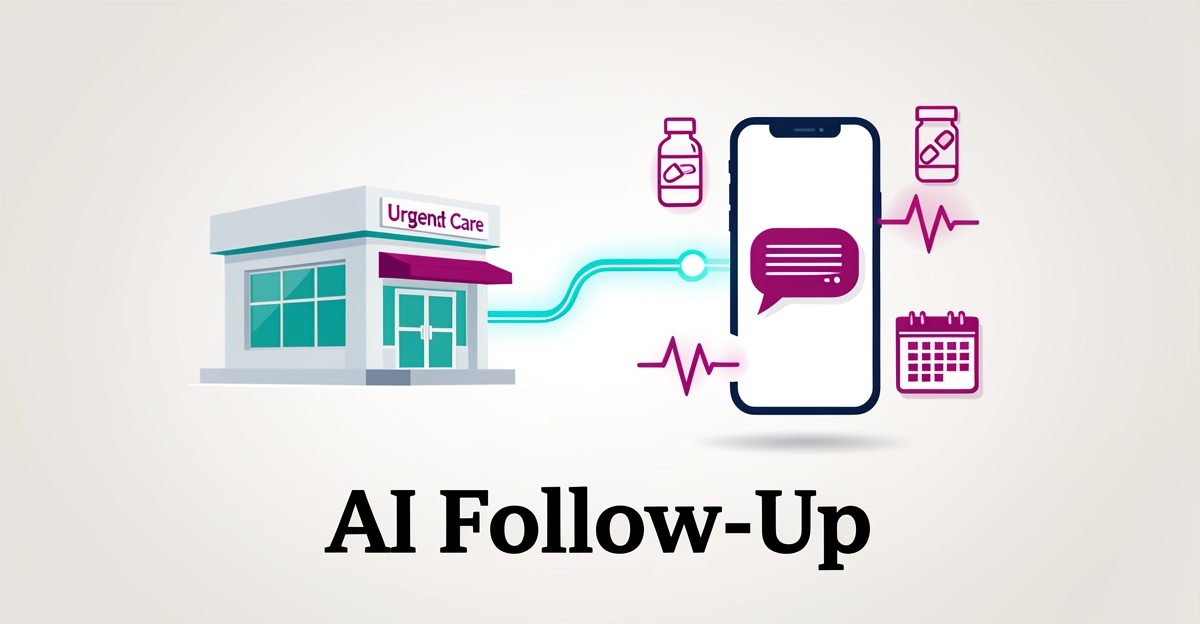
AI-powered systems close this gap by integrating directly with electronic health records (EHRs) to trigger automated, condition-specific communication. Using natural language processing (NLP), these systems can generate personalized messages—such as blood sugar checks for diabetic patients—via SMS or email to ensure improved treatment adherence.
To ensure these messages are clinically relevant, some systems employ a structured six-step workflow. As detailed by Infermedica, this process begins with an invitation based on triage results, followed by user verification and a general health assessment. It then tracks symptom changes, evaluates new symptoms, and links the results to specific health services or specialist referrals.
This proactive approach is critical because recovery is rarely linear. Data from Infermedica’s pilot studies shows that 28.5% of users reported their symptoms worsened slightly or significantly after an initial assessment.
Effective automation transforms a static check-in into a dynamic care pathway:
- Automated medication reconciliation to prevent prescription errors.
- Two-way communication channels that allow patients to ask questions or reschedule.
- Real-time tracking of discharge readiness to reduce hospital bed shortages.
- Intelligent task assignments that alert staff only when a patient's status deteriorates.
By enabling two-way communication, clinics can significantly reduce no-shows and minimize the administrative burden on staff. This shift from manual outreach to automated engagement allows providers to focus on high-risk patients while the system handles routine monitoring.
At AI Business Sites, we build custom websites that integrate these types of operational automations, ensuring that patient follow-ups happen reliably without adding to the clinic's daily workload. This ensures that no critical change goes unnoticed, fostering stronger patient-provider relationships.
The scale of this need is evident in the U.S., where 129 million people live with at least one chronic condition. For these patients, AI-driven proactive care is not just a convenience—it is a necessity for managing long-term health and reducing the frequency of urgent care readmissions.
Local business: doing this the old way?
One system replaces the whole pile.
All of it — the website, the follow-up, the content, the leads — built and run for you for $1,497 + $497/mo. Month-to-month, and you own everything.
See what your build includesImplementing AI Follow-Up Without Overhauling Your Workflow
Clinics can implement AI-powered follow-up without disrupting existing workflows by using tools that integrate directly with their current electronic health record (EHR) and practice management systems. These solutions operate behind the surface, generating personalized messages via SMS or email based on patient data such as visit reason, medications prescribed, and chronic conditions—without requiring staff to manually draft or send each communication. The AI assistant works within the clinic’s established digital environment, pulling relevant clinical details to create timely check-ins that support recovery monitoring and medication adherence. This approach minimizes training needs and avoids the complexity of overhauling established processes, allowing staff to focus on patient care rather than administrative follow-up tasks.
Successful implementation hinges on maintaining clinical oversight through human-in-the-loop safeguards, where AI-generated messages are reviewed and approved by staff before being sent to patients. This ensures accuracy, compliance with privacy standards, and alignment with the clinic’s communication tone—addressing concerns about data privacy and message appropriateness highlighted in healthcare AI research. Systems can be configured to require approval for all messages or use confidence thresholds, allowing routine follow-ups to send automatically while flagging complex cases for human review. This balance of automation and oversight supports both efficiency and patient safety, particularly important in urgent care settings where clinical judgment remains critical.
Targeting chronic disease patients for proactive follow-up maximizes impact, given that 129 million Americans—40% of the U.S. population—live with at least one chronic condition, driving demand for consistent post-visit engagement. AI systems can prioritize these individuals for tailored messages, such as blood sugar checks for diabetic patients or blood pressure reminders for those with hypertension, based on their visit history and risk profiles. By focusing automation on high-need populations, clinics improve adherence, reduce no-shows, and prevent complications—all while keeping the clinician in control of the care pathway. This strategic use of AI transforms follow-up from a reactive task into a proactive, scalable component of patient retention and outcomes management.
Frequently Asked Questions
Why are missed follow-ups after urgent care visits so common, and what are the consequences?
How does AI automate patient follow-up, and what benefits does it offer?
What is the projected growth of the AI healthcare market, and why?
How do AI-powered follow-up systems ensure patient safety and data privacy?
Can AI follow-up systems be implemented without disrupting existing clinical workflows?
What percentage of patients experience worsening symptoms after an initial assessment, highlighting the need for effective follow-up?
Turn Every Urgent Care Visit Into a Patient for Life
The cost of a missed follow-up isn't just a forgotten text—it’s a preventable complication that lands patients back in the ER and leaves clinics hemorrhaging revenue. With 40% of Americans managing chronic conditions, the window between an urgent visit and a full recovery is where many outcomes are won or lost. AI doesn’t just send generic check-ins; it turns every discharge into a structured, personalized care pathway—reconciling medications, tracking symptom changes, and flagging red flags before they escalate. By automating the busywork behind the scenes, clinicians reclaim time for what matters most: patient care. For clinics ready to close the follow-up gap without overhauling their workflow, this isn’t about adopting new software—it’s about ensuring that every patient, especially those with chronic needs, stays connected to the care they deserve. Explore how a custom website platform with built-in AI can handle the follow-ups for you at AI Business Sites.
FOR local businesss — BUILT AND RUN BY US
Your website. Your content. Your leads. Your data.
$500 starts your build. Seven days later it's live — chat, booking, follow-up, and your Google presence all set up. Then we run it, every month. You do the work you actually get paid for.