
Key facts
- Agricultural consultants face an increasingly volatile landscape where traditional advisory models struggle to keep pace with rapid environmental and market shifts.
- Traditional crop risk methods often rely on manual field scouting and historical averages, leaving advisors trapped in a cycle of reacting to emergencies rather than preventing them.
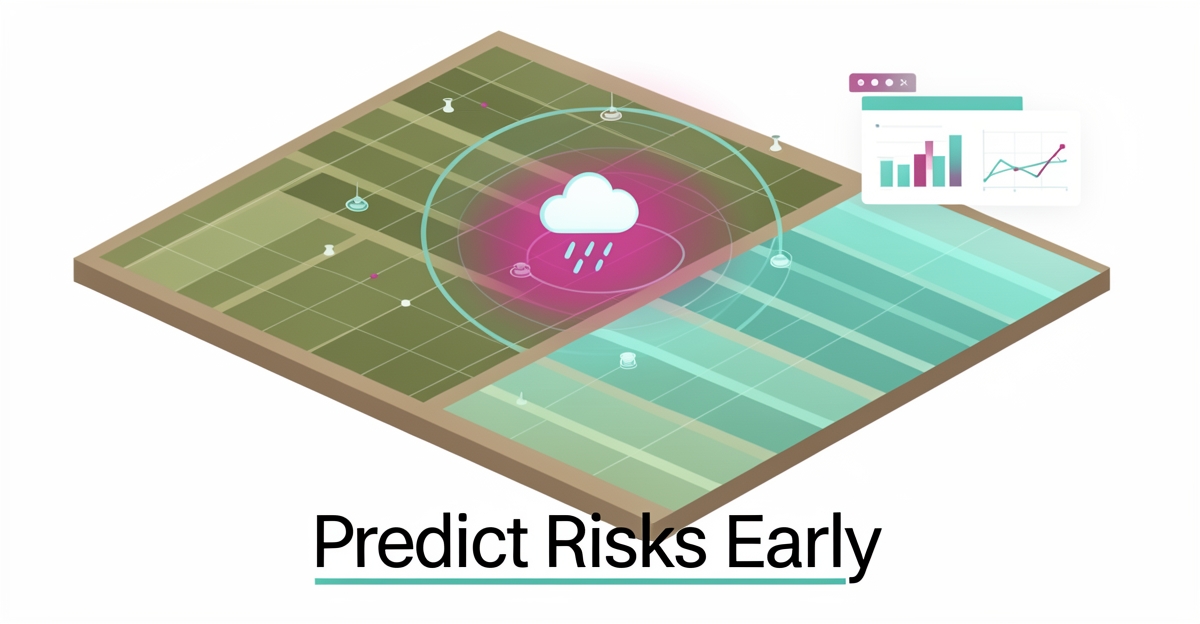
- AI systems can ingest hyperlocal weather models, satellite soil moisture readings, vegetation indices, commodity price feeds, and pest pressure maps to generate field-level risk scores updated daily.
- Ensemble forecasting blends multiple weather and crop models to narrow uncertainty bands around temperature, precipitation, and evapotranspiration at the field scale.
- Agricultural consultants can use AI-generated risk reports to provide proactive, data-driven guidance to farmers, including field-level risk scores, 7- to 14-day outlooks, and threshold alerts.
- AI Business Sites enables agricultural consultants to focus on high-value advisory services by automating the flow of information and streamlining how advisory services are delivered.
- By leveraging AI, agricultural consultants can turn predictive insights into a scalable consulting advantage, offering tiered service offerings, real-time alerts, and weekly synthesized outlooks to clients.
WANT RESULTS LIKE THIS?
Imagine a system doing all of this for your local business — every day, without you.
We build local businesses a custom website with a team of AI behind it: every lead captured and followed up, new content published monthly,customers finding you on Google — live in 7 days.
- 85+ pages at launch
- Every lead followed up, automatically
- Your whole business on one screen
Why Traditional Crop Risk Methods Fall Short for Consultants
Agricultural consultants today face an increasingly volatile landscape where traditional advisory models struggle to keep pace with rapid environmental and market shifts. Relying on manual field scouting and historical averages often leaves advisors trapped in a cycle of reacting to emergencies rather than preventing them, creating significant blind spots that clients can no longer afford.
The challenge is that the modern consultant’s toolkit is often fragmented, disconnected from the real-time signals required to manage today’s risks. When data sources like soil moisture levels, hyper-local weather alerts, and market fluctuations remain siloed, consultants lose the ability to provide the proactive, data-driven guidance that farmers now demand. As noted in industry insights on supply chain flexibility, being prepared for unforeseen situations is essential for operational continuity; in agriculture, this means moving beyond static planning toward a model that anticipates disruption.
The limitations of these conventional methods often manifest in several critical areas:
- Delayed Response Times: Manual data collection prevents consultants from acting before a localized weather event impacts crop health.
- Data Fragmentation: Important soil and market signals are often disconnected, preventing a holistic view of the farm’s risk profile.
- Communication Gaps: Advisors often struggle to translate complex technical findings into the clear, actionable insights their clients need to make immediate decisions.
For many firms, the difficulty lies in managing these disparate data points while trying to maintain a consistent client experience. This is where a modern web presence becomes a powerful asset. By utilizing a platform like AI Business Sites, consultants can consolidate their operations—from lead management to content generation—into one system that keeps clients informed without requiring a massive team.
Just as technical experts are learning to bridge the gap between their complex knowledge and the needs of their clients, as highlighted in recent sales training research, consultants must now communicate their expertise in terms that are both immediate and accessible. Adapting to this new standard requires moving away from the "wait and see" approach and embracing tools that turn raw data into a competitive advantage.
By automating the flow of information and streamlining how advisory services are delivered, firms can shift their focus from administrative busywork to the high-level strategy that truly defines their value. This transition sets the stage for a more intelligent, AI-driven approach to crop management that anticipates challenges before they reach the field.
How AI Turns Weather, Soil, and Market Data into Real-Time Risk Reports
Agricultural consultants once relied on weekly crop walks and regional weather summaries to spot trouble. Now, AI systems ingest hyperlocal weather models, satellite soil moisture readings, vegetation indices, commodity price feeds, and pest pressure maps to generate field-level risk scores updated daily. This shift turns scattered data streams into a single, actionable view that consultants can share with growers before a stress event becomes a yield loss.
The mechanics rely on three complementary model types working in concert. Ensemble forecasting blends multiple weather and crop models to narrow uncertainty bands around temperature, precipitation, and evapotranspiration at the field scale. Anomaly detection flags deviations in NDVI, soil moisture, or canopy temperature that precede visible symptoms by days or weeks. Scenario simulation runs thousands of "what-if" paths — drought, heat spike, price collapse — so consultants can stress-test a grower's marketing and input plans under realistic conditions. According to industry research, digital manufacturing implementation is increasing globally to mitigate supply chain risk, a principle that mirrors how diversified data inputs reduce blind spots in agricultural risk models.
A usable risk report for a consultant's client is concise, visual, and decision-oriented. It typically includes:
- Field-level risk scores (0–100) for moisture stress, heat stress, disease pressure, and market exposure
- 7- to 14-day outlook with probability-weighted scenarios
- Threshold alerts tied to the grower's specific crop stage and variety
- Action triggers — e.g., "If soil moisture drops below 35% at V6, initiate irrigation within 48 hours"
- Market implication notes linking local yield risk to regional basis and futures moves
This output shifts the consultant's role from reporter to strategist. Instead of explaining what happened last week, the consultant walks the grower through what could happen next week and what to do about it today. The AI handles data ingestion, model weighting, and report generation; the consultant applies local knowledge, calibrates thresholds, and translates probabilities into farm-specific decisions.
Erwin Wils, who has 25+ years of corporate experience and a Master of Science in Electrical Engineering, emphasizes that technical experts often hide behind complexity while others capture the value — a dynamic that changes when consultants own the interpretation layer. AI Business Sites applies a similar principle: the platform generates locally relevant content and automated reports so consultants can focus on high-value advisory work rather than manual data assembly. The next section explores how this workflow integrates into a consultant's weekly rhythm and client communication cadence.
Local business: doing this the old way?
One system replaces the whole pile.
All of it — the website, the follow-up, the content, the leads — built and run for you for $1,497 + $497/mo. Month-to-month, and you own everything.
See what your build includesBuilding a Repeatable Workflow: From Data Ingestion to Client Delivery
Predicting crop risks is only valuable if the insights reach farmers before planting decisions are finalized.
Most agricultural consultants struggle with the manual labor of compiling weather, soil, and market data into actionable reports for their clients.
A repeatable workflow transforms raw data streams into trusted advisory services without requiring a large technical team.
The process begins with automated data ingestion from reliable API sources.
Consultants connect live weather feeds, soil sensor networks, and commodity market trackers to a central system.
This ensures that the underlying data for risk models is always current and consistent.
However, raw data is rarely clean or immediately useful for local farming conditions.
Data quality checks must be implemented at the ingestion stage.
The system should flag missing values, outliers, or sensor errors before they skew predictive models.
Once data is verified, consultants define risk thresholds per crop and region.
A 10% drop in soil moisture might be critical for corn in Iowa but negligible for drought-resistant crops in California.
Local agronomy knowledge is essential for calibrating these models accurately.
AI systems can process vast datasets, but human expertise defines what constitutes a "warning" versus a "critical alert."
This hybrid approach ensures that predictions reflect real-world farming realities, not just statistical anomalies.
When a risk threshold is crossed, the workflow triggers automated report generation.
Instead of manually drafting emails, the system compiles a summary of the risk, its potential impact, and recommended mitigation strategies.
These reports can be scheduled for weekly delivery or triggered instantly by severe weather events.
Delivering these insights effectively is the final step in the workflow.
Consultants can distribute reports through multiple channels to ensure engagement:
- Client portals for detailed, interactive risk dashboards
- Email alerts for immediate, high-priority warnings
- Embedded website content for broader market insights
AI Business Sites facilitates this delivery by generating custom, locally relevant content that ranks in local search.
This keeps clients informed and helps consultants establish authority in their specific service areas.
However, maintaining trust is crucial when AI flags a risk that doesn’t materialize.
False positives can erode client confidence if not handled transparently.
Consultants should explain the probabilistic nature of the predictions and review past accuracy rates.
Building a feedback loop where clients report actual outcomes helps refine future models.
This continuous improvement process ensures that the AI becomes more accurate over time.
By automating the heavy lifting of data analysis and report generation, consultants can focus on high-value advisory services.
They spend less time compiling spreadsheets and more time advising farmers on strategic decisions.
This workflow not only improves efficiency but also enhances the reliability of crop risk predictions.
Farmers receive timely, actionable insights that help them protect their yields and optimize resources.
The integration of AI into agricultural consulting is no longer a luxury; it is a necessity for staying competitive.
Consultants who adopt these workflows can offer superior service levels without increasing their headcount.
This approach scales easily as the client base grows, maintaining consistent quality across all deliverables.
The key is to start with a simple, repeatable process and iterate based on client feedback.
Next, we explore how to select the right AI tools and data sources for your specific consulting practice.
Turning Predictive Insights into a Scalable Consulting Advantage
The gap between raw data and revenue often comes down to packaging. Most agricultural consultants still deliver insights through static PDFs and seasonal newsletters — formats that clients file away and forget. Firms that structure AI-generated risk intelligence into tiered service offerings turn predictive analytics into a recurring asset: real-time alerts for high-value accounts, weekly outlook reports for retainer clients, and public-facing crop risk content that drives local search visibility.
A recent industry analysis found that supply chain disruption awareness increased significantly over the last 18 months as businesses faced pandemic and logistics crises. The same urgency applies to crop risk — growers need timely intelligence, not quarterly summaries. Digital implementation is accelerating globally to mitigate exactly this type of risk, and consulting firms that digitize their delivery gain a structural advantage.
Three tiers that scale:
- Real-time alert stream — instant weather, pest, and market anomaly notifications for premium clients who make daily decisions
- Weekly synthesized outlook — curated risk reports with actionable recommendations for retainer accounts planning weekly operations
- Public crop risk briefings — locally optimized content that ranks in search, captures leads, and demonstrates expertise before the first conversation
This structure mirrors how technical experts scale their impact — by translating complex analysis into formats decision-makers actually use. The firms seeing higher client retention and new revenue streams aren't just running better models; they're delivering insights through channels clients already trust. AI Business Sites enables this by generating the localized, search-optimized content layer that keeps the pipeline full while consultants focus on advisory work.
The next section explores how to operationalize this workflow without adding headcount.
Frequently Asked Questions
How does AI actually predict crop risks before they happen?
What kind of data do agricultural consultants need to feed into AI for accurate crop risk predictions?
How do consultants turn AI-generated risk reports into actionable advice for farmers?
What happens if the AI gives a false alarm about crop risk—will farmers lose trust?
Can small consulting firms use AI for crop risk prediction without hiring a data science team?
How do consultants package AI crop risk insights into services that clients actually pay for?
From Reactive Scouting to Proactive Advisory
Agricultural consultants can no longer afford to rely on fragmented data and delayed responses while managing modern crop risks. To truly help clients plan ahead, advisors must move beyond manual scouting and embrace predictive, data-driven insights. Translating complex weather, soil, and market signals into clear, actionable guidance is exactly where a modern web presence becomes a powerful asset. With AI Business Sites, your website does more than just sit there—it automatically generates locally relevant, custom content that ranks in search and keeps your clients informed about emerging risks without requiring you to hire a team of expert writers. Instead of being trapped in a cycle of reacting to emergencies, you can position your firm as a proactive leader. Ready to turn your website into an automated advisory hub that works for your clients around the clock? Reach out to AI Business Sites today to see how we can build a platform that runs your business alongside you.
FOR local businesss — BUILT AND RUN BY US
Your website. Your content. Your leads. Your data.
$497 starts your build — your first month's payment, not a deposit. Seven days later it's live — chat, booking, follow-up, and your Google presence all set up. Then we run it, every month. You do the work you actually get paid for.