
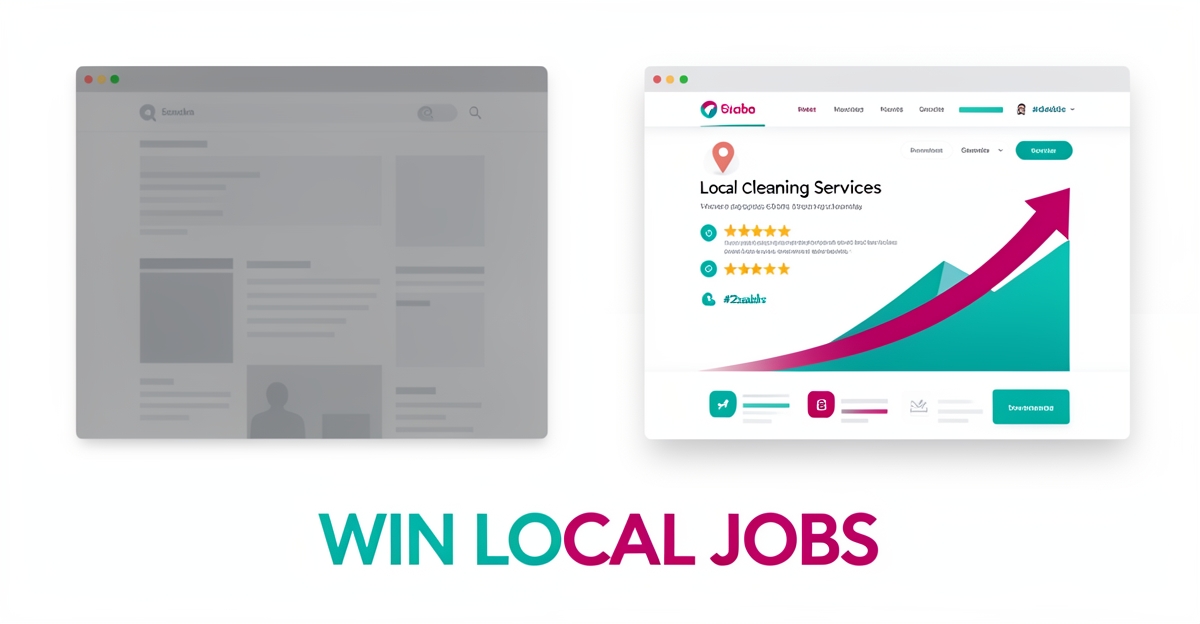
Key facts
- Websites have only 50 milliseconds to establish trust, with visual appeal and security being key trust signals.
- Trust signals can increase conversions by up to 42% according to Verlua.
- Personalized CTAs outperform generic ones by 202% as per Matomo.
- 93% of customers read reviews before making a purchase decision Verlua reports.
- Generic templates fail to build trust due to lack of personalization and localization.
- AI-powered, localized websites can generate qualified leads at a higher rate than generic templates.
- Smart, localized websites see a significant increase in conversion rates compared to generic ones.
WANT RESULTS LIKE THIS?
Imagine a system doing all of this for your local business — every day, without you.
We build local businesses a custom website with a team of AI behind it: every lead captured and followed up, new content published monthly,customers finding you on Google — live in 7 days.
- 85+ pages at launch
- Every lead followed up, automatically
- Your whole business on one screen
The Trust Gap: Why Generic Templates Fail Cleaning Businesses
Your cleaning website has about 50 milliseconds to convince a homeowner you're trustworthy enough to enter their house. Research shows visual appeal and security signals drive immediate credibility judgments — before a single word is read (The Digital Maze). Generic templates fail this test instantly. They serve the same stock photos and boilerplate copy whether the visitor lives in a historic district or a new subdivision, signaling "we don't know your neighborhood" at exactly the moment trust matters most.
Trust signals aren't decorative — they're conversion multipliers. Sites displaying reviews, visible contact information, and security badges see up to 42% higher conversions (Verlua). For cleaning services, where strangers cross thresholds daily, the trust bar sits higher than almost any other local business. A generic template with a stock photo of a smiling model in a pristine kitchen doesn't prove you've cleaned homes on Maple Street. It proves you bought a template.
Personalization closes the gap. Companies using personalized calls-to-action outperform generic ones by 202% (Matomo). That's not marketing fluff — it's the difference between "we clean houses" and "we deep-clean Victorian homes in Old Town every Tuesday." Neighborhood-specific proof — real reviews from nearby clients, photos of actual jobs on local streets, service details that match the housing stock — tells the visitor "we're already working here, and your neighbors trust us."
- Stock photos replace proof with promises
- Boilerplate copy ignores local housing types and seasonal needs
- No neighborhood reviews means no social proof where it counts
- Generic contact forms feel like a black hole, not a conversation starter
AI Business Sites builds cleaning websites that lead with local trust signals — real project photos from your service areas, neighborhood-specific service pages, and review integrations that show nearby homeowners vouching for you. The platform generates this content automatically each month, so your site keeps the site gets more specific, more credible, and more effective at turning visitors into booked jobs.
Localization as a Conversion Lever: What the Data Shows
Generic websites look the same across cities and fail to build the immediate trust needed to convert local visitors into customers. In the cleaning industry, where service areas and neighborhood specifics matter, this one-size-fits-all approach misses high-value clients who expect relevance and familiarity. Smart, localized websites change that by reflecting the actual communities they serve — turning generic pages into neighborhood-specific touchpoints that resonate.
Personalization isn’t just a nice-to-have; it’s a proven conversion lever. Companies that use personalized CTAs see a 202% better performance compared to generic ones, according to industry research on conversion rate optimization. That gap isn’t accidental — it reflects how much more likely users are to act when content speaks directly to their location, needs, and expectations. For a cleaning business, that means swapping city-wide banners for hyperlocal service pages that mention specific suburbs, street names, or known local pain points like hard water or seasonal pollen buildup.
Trust builds in milliseconds, and reviews are among the fastest ways to earn it. A significant 93% of customers read reviews before making a purchase decision, making social proof a non-negotiable element of any service website. When those reviews come from real neighbors — mentioning the same zip code, school district, or local landmark — they carry far more weight than anonymous testimonials. Smart sites leverage this by surfacing area-specific feedback prominently, turning satisfaction into a localized trust signal that generic templates simply can’t replicate.
Beyond testimonials, localization includes neighborhood FAQs that address region-specific concerns — like mold prevention in humid coastal zones or pet hair removal in areas with high dog ownership. These details signal expertise and attentiveness, showing prospects that the business understands their environment better than a national chain ever could. When combined with visible contact info, clear service boundaries, and locally optimized content, these elements create a cohesive experience that feels less like a transaction and more like a community service.
AI Business Sites builds websites that do this automatically — generating location pages, weaving in local testimonials, and updating content based on actual service areas — so the site stays relevant without constant manual updates. The result isn’t just higher engagement; it’s a steady stream of qualified leads from people who already feel understood before they even pick up the phone. In a competitive local market, that familiarity isn’t just comforting — it’s the difference between being overlooked and being chosen.
Local business: doing this the old way?
One system replaces the whole pile.
All of it — the website, the follow-up, the content, the leads — built and run for you for $1,497 + $497/mo. Month-to-month, and you own everything.
See what your build includesSmart Website Architecture: AI-Powered Personalization at Scale
Most cleaning websites still operate like digital brochures — static pages that look identical whether a visitor lands from downtown or the suburbs. A smart architecture flips that model: the site detects where someone is searching from and instantly serves neighborhood-specific service details, crew photos, and real reviews from that area.
According to industry research, personalized calls-to-action outperform generic ones by 202%. That gap exists because visitors make trust calculations in milliseconds — experts note that websites have only 50 milliseconds to establish credibility before a prospect bounces. Static templates can't meet that standard across multiple service zones.
AI Business Sites builds this intelligence into the foundation. The platform auto-generates location pages at scale — each one grounded in actual service boundaries, local landmarks, and neighborhood-specific FAQs — without the owner writing a single word. Internal linking between those pages happens automatically, creating the topical clusters that search engines reward.
- Dynamic content blocks swap service details, pricing hints, and crew bios based on the visitor's detected location
- AI-generated location pages launch in batches of 60+ at setup, then expand monthly with new neighborhood coverage
- Automatic internal linking connects every new page to relevant existing content — no manual link building required
- Real reviews from each area surface automatically, reinforcing trust where it matters most
The same architecture powers instant lead response. When a request comes in — whether through chat, a form, or a phone call answered by the AI voice agent — the system replies with a personalized message referencing the exact service and neighborhood the prospect asked about. Data shows trust signals like relevant reviews and visible local details can lift conversions by up to 42%. The website becomes a 24/7 lead engine that never sleeps, never forgets a follow-up, and never serves a generic "we serve your area" page to someone standing three blocks from your last job.
Implementation Roadmap: From Template to Trust-Building Asset
Most cleaning businesses don't need a complete rebuild — they need a clear sequence that turns a passive brochure into a lead-generating asset. The gap between a generic template and a smart, localized site isn't technical; it's trust. Research shows visitors calculate credibility in roughly 50 milliseconds, and trust signals alone can lift conversions by up to 42%. Start with an audit: HTTPS enforced, phone number clickable in the header, Google Business Profile linked, local schema markup on every service page, and at least ten recent reviews displayed with schema so they appear in search results.
- Replace the single "Services" page with neighborhood-specific pages — "House Cleaning in [Neighborhood]" — each with local photos, testimonials, and FAQs
- Deploy an AI chat widget that answers pricing, availability, and scope questions instantly, then hands off to a human for booking
- Add an AI voice agent so after-hours calls are answered, qualified, and logged without voicemail
- Automate review requests via SMS and email within 30 minutes of job completion
- Publish two localized blog posts per month — seasonal tips, neighborhood spotlights — with automatic internal linking to service pages
Each step compounds. Neighborhood pages capture long-tail search traffic that generic pages miss. Personalized CTAs outperform generic ones by 202%, so the chat and voice agents convert visitors who would otherwise bounce. Automated review collection feeds fresh trust signals back into the loop, while the content engine keeps the site expanding without owner effort. Custom-built sites structured this way consistently outrank template competitors in local pack results. AI Business Sites builds this roadmap into every launch — hand-built core pages, local schema, AI chat and voice, automated review flows, and a monthly content engine — so the site starts earning trust from day one and keeps compounding it every week.
Frequently Asked Questions
How long does a cleaning website have to establish trust with a visitor?
What impact do trust signals like reviews and visible contact information have on conversions?
Why are generic templates less effective for local cleaning services?
How much better do personalized calls-to-action (CTAs) perform compared to generic ones?
What percentage of customers read reviews before making a purchasing decision?
How does AI-powered personalization in website architecture benefit local cleaning services?
Key Takeaways
{ "title": "Trust in an Instant: Why Smart Websites Sweep Generic Templates Off the Map", "content": "In the blink of an eye—50 milliseconds to be exact—your cleaning website must establish trust to secure a homeowner’s business. Generic templates fall short, lacking the personal touch and neigh
FOR local businesss — BUILT AND RUN BY US
Your website. Your content. Your leads. Your data.
$500 starts your build. Seven days later it's live — chat, booking, follow-up, and your Google presence all set up. Then we run it, every month. You do the work you actually get paid for.