
Key facts
- Average website conversion rates across all industries sit at just 3.3%.
- Mobile and desktop visitors convert at a lower rate of 2.8% each.
- Tablet users edge out other devices with a 3.1% conversion rate.
- Static availability badges erode trust and drive high-intent prospects toward competitors who communicate honestly.
- Dynamic availability updates based on weather and staffing build the trust signals that convert visitors.
- Explicit service-area naming and mobile-first design are crucial for local business visibility.
- Modern AI-driven builders make complex real-time data integration accessible without custom development.
WANT RESULTS LIKE THIS?
Imagine a system doing all of this for your local business — every day, without you.
We build local businesses a custom website with a team of AI behind it: every lead captured and followed up, new content published monthly,customers finding you on Google — live in 7 days.
- 85+ pages at launch
- Every lead followed up, automatically
- Your whole business on one screen
The Hidden Cost of Static 'Available' Statuses
When a storm knocks out power across your service area, a prospect visiting your website sees a green "Available" badge — but your crews are already booked solid for the next 48 hours. That static status isn't just inaccurate; it actively erodes trust at the exact moment a homeowner needs confidence most. Research shows the average website conversion rate across industries sits at just 3.3%, and mobile visitors convert at only 2.8% — meaning every misleading signal costs you measurable revenue.
Static availability badges create a dangerous gap between perception and reality. During widespread outages, generator installers face surging demand, limited crew capacity, and supply chain constraints that change hourly. A website that still reads "Available Now" while your dispatch board is full doesn't just disappoint — it drives high-intent prospects to competitors who communicate honestly about capacity. Conversion optimization experts consistently emphasize that clear, dynamic information builds the trust signals that turn visitors into leads, yet most generator installer sites treat availability as a set-it-and-forget-it setting.
The problem compounds on mobile, where tablet users convert at 3.1% — slightly higher than desktop or phone — suggesting that on-the-go homeowners researching during an outage are primed to act if the information feels reliable. But static statuses can't reflect:
- Real-time crew availability tied to active job schedules
- Weather-driven demand spikes in specific ZIP codes
- Equipment inventory levels for specific generator models
- Emergency vs. scheduled service tier capacity
Industry-specific research confirms that generator installer websites often lack the dynamic updates needed to convert during high-stakes moments. The sites that win are those treating availability as a live data feed — pulling from dispatch software, weather APIs, and inventory systems to show prospects exactly what's possible right now. AI Business Sites builds this capability into every generator installer website, so your site reflects real-world readiness without manual updates. When a homeowner searches "generator installation near me" during an outage, they see current capacity — not a hopeful placeholder.
Dynamic Availability: The Data-Driven Solution
Static "available" badges create a dangerous illusion during outages — they tell every visitor the same thing regardless of crew capacity, parts inventory, or the storm barreling toward your service area. Research shows the average conversion rate across industries sits at just 3.3%, with desktop and mobile both hovering at 2.8% — margins too thin to waste on misleading signals. Conversion benchmarks confirm that trust erodes the moment a prospect calls and hears "we're booked for three days."
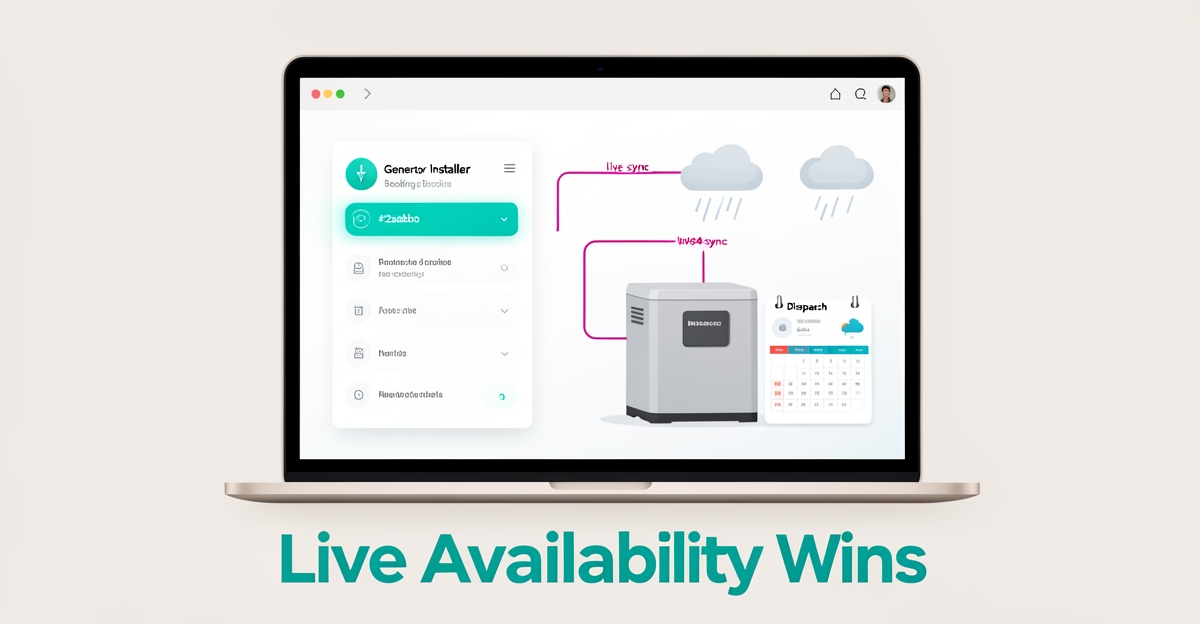
Dynamic availability flips that equation by feeding real-time data — weather alerts, active job logs, technician schedules — directly into the website experience. CRO best practices emphasize clear value propositions and trust signals; nothing builds trust faster than a status that updates the same way your dispatch board does. When a homeowner sees "2 crews available today — next install Thursday" instead of a generic green checkmark, they make faster decisions and you field fewer unqualified calls.
- Weather API integration triggers capacity alerts before outages hit
- Service log sync shows real crew bandwidth, not theoretical coverage
- Staffing calendar updates automatically when techs call out or overtime opens
- Inventory flags prevent selling installs you can't supply
Generator-specific redesign guidance stresses explicit service-area naming and mobile-first design — both prerequisites for dynamic data to render cleanly on the devices prospects use during emergencies. Modern AI-driven builders now make this level of integration accessible without custom development, turning what was once a six-figure dispatch software project into a configuration task. The result: a website that doesn't just market your availability — it honors it.
Local business: doing this the old way?
One system replaces the whole pile.
All of it — the website, the follow-up, the content, the leads — built and run for you for $1,497 + $497/mo. Month-to-month, and you own everything.
See what your build includesImplementing Real-Time Availability for Immediate Impact
A static "available" badge on your generator installer website might feel reassuring, but during a widespread outage it can actively mislead prospects who need help right now. Research shows the average conversion rate across industries sits at just 3.3%, with desktop and mobile both hovering around 2.8% — leaving massive room for improvement when your site reflects real-time reality instead of a fixed label.
- Feed live crew capacity and truck status into a dynamic banner that updates every few minutes
- Pull hyper-local weather alerts and utility outage maps to show neighborhood-level readiness
- Surface the same data on your Google Business Profile so searchers see current availability before they click
- Use an AI-driven website builder that can ingest these feeds without custom development work
Mobile-first design isn't optional — tablet conversion rates edge out desktop at 3.1%, and Google rewards explicit service-area naming in local results. AI Business Sites builds custom Next.js websites that handle these dynamic feeds natively, so your availability updates flow through the same system that manages leads, follow-ups, and content. The platform also optimizes your Google Business Profile as part of launch, ensuring the real-time status you show on-site appears in Maps and local pack results. When your website runs on live data instead of static promises, you stop losing prospects to uncertainty and start converting the urgency that outages create.
Frequently Asked Questions
Why is a static 'Available' status on my generator installer website harmful during power outages?
What's the average conversion rate for websites, and how can dynamic availability improve it?
How does dynamic availability integrate with other operational data for generator installers?
Why is mobile-first design crucial for generator installer websites, especially during outages?
How can AI-driven website builders solve the dynamic availability challenge without custom development?
What specific benefits does implementing real-time availability bring to generator installers?
Key Takeaways
{ "title": "Powering Conversions: Why Dynamic Availability Matters for Generator Installers", "content": "The static 'available' status on most generator installer websites is a silent lead killer, especially during power outages. By failing to reflect real-time crew availability, demand spikes,
FOR local businesss — BUILT AND RUN BY US
Your website. Your content. Your leads. Your data.
$500 starts your build. Seven days later it's live — chat, booking, follow-up, and your Google presence all set up. Then we run it, every month. You do the work you actually get paid for.