
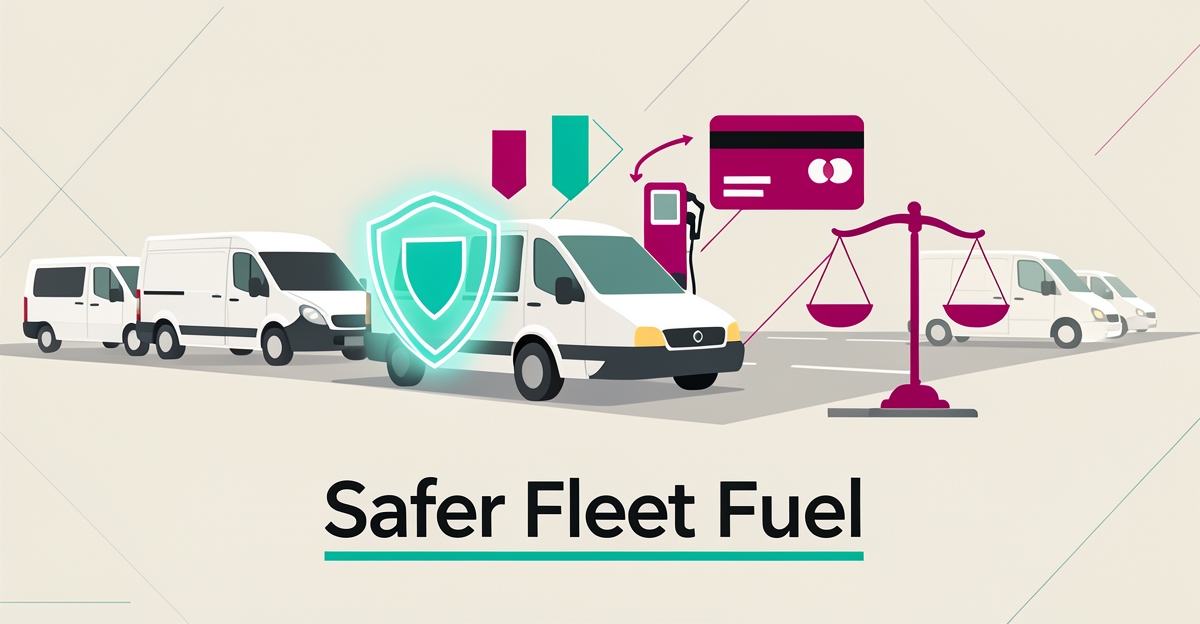
Key facts
- Fuel cards reduce fraud exposure by 50–70% compared to standard credit cards through real-time monitoring and AI-driven anomaly alerts according to SkyQuest research.
- Service businesses waste 4–6 hours weekly manually tracking fuel expenses, while fuel cards automate receipt capture and expense reports Straits Research reports.
- Fuel card fraud incidents average $1,500–$3,500 in losses before detection, with open-loop networks being prime targets SkyQuest data.
- The global fuel card market is projected to grow at 11.4% CAGR through 2034, reaching $2.64 trillion Straits Research.
- Fuel cards capture odometer readings, fuel grades, and driver IDs automatically, creating audit trails that survive IRS scrutiny Straits Research analysis.
- Branded fuel cards are the fastest-growing segment due to enhanced security and restricted merchant networks SkyQuest.
- AI-powered fuel card analytics flag anomalies like unusual fuel volumes or location mismatches in real time, preventing fraud escalation SkyQuest report.
WANT RESULTS LIKE THIS?
Imagine a system doing all of this for your local business — every day, without you.
We build local businesses a custom website with a team of AI behind it: every lead captured and followed up, new content published monthly,customers finding you on Google — live in 7 days.
- 85+ pages at launch
- Every lead followed up, automatically
- Your whole business on one screen
The Hidden Cost of Generic Payment Tools
The first time you swipe a company credit card for fuel, vehicle maintenance, or even a coffee run, you’re not just spending money—you’re opening the door to hidden costs most service businesses overlook. Those generic cards lack the safeguards needed to protect your fleet’s financial health, leaving you exposed to fraud, mismanagement, and hours of manual cleanup that drain your bottom line.
Security gaps are the most dangerous hidden cost. Unlike purpose-built tools, standard credit cards offer no transaction-level controls—no way to restrict purchases to fuel stations, cap daily spending per vehicle, or verify fuel grades or odometer readings at the pump. Fraudsters exploit this: open-loop networks (where credit cards can be used anywhere) are prime targets for skimming and unauthorized use, with losses averaging $1,500–$3,500 per incident before detection. Fuel cards, by contrast, operate in restricted networks—even universal cards limit merchants to gas stations and approved suppliers—cutting fraud exposure by 50–70% through real-time monitoring and AI-driven anomaly alerts source.
The inefficiency tax adds up faster than you’d expect. With a company credit card, every fuel receipt requires manual entry, every expense must be categorized by hand, and reconciling discrepancies means digging through vague statements with zero context. Fleet managers report wasting 4–6 hours per week on manual tracking—time that could be spent servicing customers or growing the business. Fuel cards automate this with:
- Real-time transaction feeds tied to vehicle and driver IDs
- Automated expense reports synced to QuickBooks or Xero
- Instant receipt capture via mobile apps—no shoeboxes full of crumpled receipts
- Tax data auto-populated for deductions, reducing audit stress
Then there’s the audit blind spot. When a credit card charge shows up as “Oil Change LLC,” you have no proof it was for the correct vehicle, at the right mileage, or even a legitimate business expense. Fuel cards log odometer readings, fuel types, and location data alongside each transaction, creating an audit trail that survives IRS scrutiny. Without this, disputes or fraud claims become a he-said-she-said scramble—costly even if you win.
For service businesses juggling fleets, expenses, and compliance, generic payment tools are the digital equivalent of handing keys to an unsupervised intern. A custom-built website with built-in CRM and automation—like AI Business Sites—mirrors the focus fuel cards provide: a single system that enforces controls, tracks everything, and eliminates the manual drudgery that drains your team’s energy. The difference isn’t just security; it’s reclaiming hours every week to put back into your business instead of cleaning up after someone else’s mistakes.
Why Fleet Fuel Cards Are Built for Safety
Fleet fuel cards are engineered with safety as a core design principle, offering service businesses a level of control that generic credit cards simply cannot match. Unlike open-loop payment methods, fuel cards provide granular spending limits, real-time fraud detection, and detailed audit trails that capture vehicle-specific data like odometer readings and fuel grades. These features are not just convenient—they actively reduce exposure to unauthorized use and data breaches by restricting transactions to approved merchants and flagging anomalies instantly.
One of the most significant advantages is the integration of AI-powered analytics and telematics, which enables predictive monitoring of fuel consumption and route efficiency while flagging suspicious activity such as unusual fuel volumes or location mismatches. This technology-driven oversight helps prevent fraud before it escalates, with industry reports indicating that such controls can reduce fraud risks by 50–70% compared to generic credit cards. Additionally, instant card deactivation for lost or stolen cards ensures that potential threats are neutralized immediately, minimizing financial damage.
For service businesses managing fleets, these security features translate directly into operational peace of mind. Fuel cards eliminate the guesswork of expense tracking by automating data capture and simplifying accounting through integrated reporting tools. Just as AI Business Sites consolidates fragmented software into a unified, secure platform built for local service needs, fuel cards replace generic payment methods with a specialized solution designed to protect your business at every transaction. This focus on precision and control is why specialized tools consistently outperform one-size-fits-none alternatives in high-risk, high-volume environments.
When Company Credit Cards Are the Riskier Choice
For service businesses running trucks and vans every day, a generic company credit card is a blind spot waiting to be exploited. Standard cards simply weren't built for fleet expenses — they offer no way to restrict purchases to fuel stations, no automatic capture of odometer readings, and no real-time visibility into whether a charge matches the vehicle that made it. Research shows fuel cards provide granular controls — per-card limits, fuel-type restrictions, and geography fences — that generic credit cards lack entirely source.
- No merchant restrictions mean drivers can swipe at any retailer, not just approved fuel stations source
- Missing vehicle metadata — odometer, fuel grade, driver ID — makes it impossible to verify a charge against actual operations source
- Manual receipt chasing and spreadsheet reconciliation replace the automated expense reports fuel cards generate by default source
- Generic fraud alerts lack the context to flag a fill-up that exceeds the truck's tank capacity or happens three states away from the job site source
The gap shows up in the audit trail. A credit card statement tells you what was spent and where, but never which truck, which driver, or whether the numbers make sense. Fuel cards capture that context automatically, and AI-powered analytics flag anomalies — like unusual fuel volumes or location mismatches — in real time source. It's the same principle behind AI Business Sites: a specialized tool built for a specific job outperforms a generic one forced to fit. Just as a fuel card replaces a credit card for fleet expenses with tighter controls and cleaner data, a unified platform replaces a duct-taped stack of CRM, content, and project tools with security and automation baked in from day one.
Local business: doing this the old way?
One system replaces the whole pile.
All of it — the website, the follow-up, the content, the leads — built and run for you for $1,497 + $497/mo. Month-to-month, and you own everything.
See what your build includesImplementing a Smarter Payment System in 3 Steps
Implementing a smarter payment system starts with choosing the right tool for the job. For service businesses managing vehicle fleets, fuel cards provide the specialized controls that generic credit cards lack, offering real-time monitoring, restricted merchant use, and automated expense tracking—much like how AI Business Sites replaces fragmented software with a unified platform built for local service needs.
Begin by selecting a fuel card provider that matches your operational scope. Universal (open-loop) cards, which hold 55% of the market share, offer cross-location usability and expense management tools ideal for businesses operating across multiple service areas source. If security is the priority, branded (closed-loop) cards provide enhanced fraud prevention through restricted networks, making them the fastest-growing segment in the industry source. Pair your choice with a provider that integrates AI-powered analytics and telematics, enabling features like odometer tracking and anomaly detection to flag unusual fuel volumes or location mismatches in real time source.
Next, configure spending controls and security protocols directly tied to your workflow. Set granular limits per card—such as fuel type, daily spend caps, and geographic boundaries—to prevent unauthorized use and ensure purchases align with vehicle-specific needs source. Require PIN protection for all drivers and enable instant deactivation for lost or stolen cards, reducing exposure to skimming and misuse source. Finally, automate expense reporting by linking your fuel card platform to accounting software like QuickBooks or Xero, eliminating manual receipt collection and simplifying tax compliance with real-time transaction data source.
Train your team to treat the fuel card as a specialized tool, not a generic payment method. Conduct quarterly sessions on security best practices, emphasizing how merchant restrictions and real-time alerts reduce fraud risks by 50–70% compared to standard credit cards source. Reinforce that these controls aren’t just about prevention—they create cleaner audit trails, capture critical data like fuel grades and driver IDs, and free up time previously spent on reconciliations. Just as AI Business Sites consolidates 8–10 separate subscriptions into one secure system, a fuel card replaces the guesswork of credit card tracking with purpose-built controls designed for the realities of service business operations.
Your Website Should Work Like a Fuel Card
Your website should work like a secure fuel card—designed to protect your business while handling the busywork for you. Most service businesses lose valuable time and customers to scattered software stacks and disconnected tools. Your website shouldn’t just sit there; it should act as a centralized command center, just like a fuel card restricts spending to approved vendors and tracks every transaction in real time.
Instead of juggling separate subscriptions for CRM, content, scheduling, and project management, imagine everything running seamlessly under one roof. Every lead captured, every email sent, and every follow-up handled automatically—with audit trails and controls tailored for your business. The AI assistant doesn’t just answer questions; it manages your pipeline, generates proposals, and even sends personalized emails based on your actual data.
Here’s how it delivers the same security and efficiency as a fuel card:
- Granular controls that limit spending by service type, location, or customer tier
- Real-time alerts for suspicious activity or stalled deals
- Automated workflows that replace manual handoffs between sales and delivery
- Audit trails for every interaction, from calls to contracts
- Built-in fraud prevention with human review safeguards
With a fuel card, you’d restrict spending to approved fuel stations. With your website running on AI Business Sites, you get the same focus—restricting tools to your business’s needs while eliminating the risks of generic, one-size-fits-none software. No more fragmented subscriptions. No more missed leads. Just a system that works like a specialized tool, not another thing to manage.
Frequently Asked Questions
Are fuel cards really safer than company credit cards for fleet expenses?
Can I use a regular credit card for fuel and vehicle expenses instead of a fuel card?
What kind of fraud risks do company credit cards have for fleets?
How much time do fleet managers waste managing fuel expenses with company credit cards?
Do fuel cards provide better expense tracking than company credit cards?
Can fuel cards help with IRS audits or disputes?
What types of fuel cards should I consider for my service business?
Do fuel cards offer any cost savings beyond fraud prevention?
Is there a way to integrate fuel cards with accounting software like QuickBooks?
What’s the biggest advantage of using a specialized tool like a fuel card instead of a generic credit card?
Key Takeaways
{ "title": "Secure Your Fleet, Streamline Your Business", "content": "As service businesses navigate the complexities of managing fleets, the choice between fleet fuel cards and company credit cards for expenses couldn’t be clearer. Fuel cards emerge as the unequivocal winner, offering **granular sp
FOR local businesss — BUILT AND RUN BY US
Your website. Your content. Your leads. Your data.
$500 starts your build. Seven days later it's live — chat, booking, follow-up, and your Google presence all set up. Then we run it, every month. You do the work you actually get paid for.