
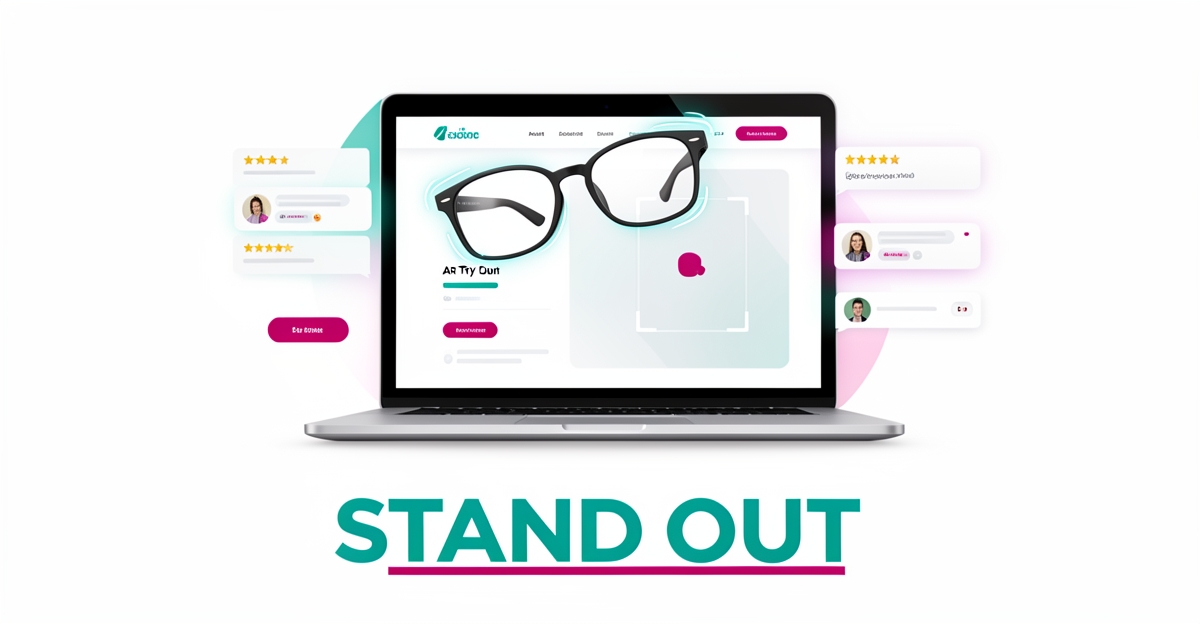
Key facts
- AR virtual try-on tools boost online eyewear conversions by up to 250% according to Auglio.
- 69% of consumers report increased purchase confidence after using AR try-on tools per Auglio.
- 73% of consumers prioritize customer experience over price or product quality per Auglio.
- 63% of customers say AR would improve their shopping experience Threekit reports.
- Online single-vision glasses average $15–$100+ versus $100–$1,000+ in-store Wirecutter testing shows.
- Social commerce sales will reach $1.2 trillion by 2025—3x faster than traditional eCommerce Threekit projects.
- 40% of shoppers are more likely to buy after trying frames in AR industry analysis finds.
WANT RESULTS LIKE THIS?
Imagine a system doing all of this for your local business — every day, without you.
We build local businesses a custom website with a team of AI behind it: every lead captured and followed up, new content published monthly,customers finding you on Google — live in 7 days.
- 85+ pages at launch
- Every lead followed up, automatically
- Your whole business on one screen
The Visibility Crisis: Why Eyewear Stores Struggle Online
The online eyewear market is fiercely competitive, with countless retailers vying for the attention of the 68% of U.S. adults who wear prescription eyeglasses. Yet many stores struggle to convert website visitors into customers, facing average e-commerce conversion rates of just 2%–3%—a stark contrast to the potential uplift seen when immersive tools are implemented. This visibility crisis stems not from lack of traffic, but from websites that fail to address core consumer hesitations: uncertainty about fit, lack of trust, and fragmented shopping experiences.
Without features that build confidence and simplify decision-making, eyewear stores lose sales to competitors offering more engaging, transparent, and personalized journeys. Shoppers increasingly expect to visualize products on their own faces before buying, with 69% reporting increased purchase confidence after using AR try-on tools and 40% being more likely to buy after trying frames in AR. Meanwhile, 73% of consumers prioritize customer experience over price or product quality, making trust signals like transparent pricing, real customer photos, and generous return policies essential for reducing cart abandonment.
Stores relying on static image galleries and generic product descriptions miss critical opportunities to connect. They fail to leverage the omnichannel expectations of modern buyers, who seamlessly move between online research and in-store visits. As social commerce grows 3x faster than traditional eCommerce—projected to reach $1.2 trillion by 2025—eyewear retailers without integrated, interactive websites risk becoming invisible in local search results and losing foot traffic to more digitally adept competitors. The gap between consumer expectations and typical eyewear store websites isn’t just a usability issue; it’s a direct threat to revenue and market relevance in an increasingly experience-driven industry.
Science-Backed Solutions: AR Try-On, Trust Signals, and Personalization
The gap between browsing and buying in eyewear comes down to one thing: confidence. Shoppers hesitate when they can't see how frames actually look on their face, and that hesitation kills conversions.
AR virtual try-on technology has moved from novelty to necessity. Research shows 69% of consumers report increased purchase confidence after using AR try-on tools, while 40% are more likely to buy after trying frames virtually (industry analysis). Shopify Plus merchants using AR/3D try-on have seen conversion rates improve by up to 250% (same source). Major brands like Warby Parker and Zenni Optical have set the benchmark — independent retailers need equivalent capabilities to compete.
Trust signals close the remaining gap. Research confirms 73% of consumers prioritize customer experience over price or product quality. Transparent pricing (online single-vision glasses range from $15–$100+ versus $100–$1,000+ in-store per Wirecutter testing), generous return windows (30-day returns, 90-day exchanges at retailers like 39DollarGlasses per same source), and optician-reviewed orders all reduce purchase anxiety. Real customer photos — not stock imagery — build the authenticity that generic sites lack.
AI-driven personalization turns browsers into buyers. Tools like GlassesUSA's "Pairfect Match" recommend frames based on face shape, while advanced filtering by pupillary distance, frame material, and low-bridge fit solves the fit-accuracy problem (Forbes Vetted analysis). These features don't just improve UX — they directly increase conversion by removing guesswork.
A website platform that consolidates these capabilities — AR try-on integration, trust-signal displays, AI personalization, and automated lead follow-up — lets optical retailers compete with national chains without managing a dozen disconnected tools. AI Business Sites builds websites with these features native, not bolted on, so your site handles the busywork while you focus on patients.
Local business: doing this the old way?
One system replaces the whole pile.
All of it — the website, the follow-up, the content, the leads — built and run for you for $1,497 + $497/mo. Month-to-month, and you own everything.
See what your build includesBuilding a Winning Website: Implementation Strategies and Tools
Building a Winning Website: Implementation Strategies and Tools
As eyewear stores strive to stand out in a crowded market, crafting a website that not only impresses but also efficiently captures leads and converts visitors is paramount. Leveraging the latest insights, here’s how to turn your website into a powerhouse:
With 67% of post-COVID-19 consumers shopping differently source, embracing innovation is key. Auglio’s research source highlights that AR try-on tools can boost conversion rates by up to 250% and increase customer confidence by 69%. Integrating such technology seamlessly into your website is no longer optional but a necessity.
- Seamless AR/VTO Integration
- Why: Enhance customer experience and conversion rates.
-
How: Choose a platform (like AI Business Sites) that supports real-time AR try-on across all devices without needing a large IT team. Ensure social sharing capabilities to leverage user-generated content.
-
Consolidate Tools for Efficiency
- Why: Reduce operational overhead and enhance lead capture.
-
How: Opt for a custom website solution (e.g., AI Business Sites) that includes:
- Built-in CRM for unified lead management.
- Automation for instant, personalized responses to leads.
- AI-driven content generation for monthly SEO-optimized content.
- Ownership of code, content, and data to avoid vendor lock-in.
-
Leverage Local SEO for Visibility
- Why: 68% of adults in the U.S. wear prescription eyeglasses, making local visibility crucial source.
-
How: Ensure Google Business Profile (GBP) and Bing profiles are optimized. Invest in mobile-first, fast-loading designs for better search rankings.
-
AI-Powered Website Platforms: For integrated CRM, automation, and AI assistants.
- AR/VTO Software: Seamless try-on experiences (e.g., Auglio, Threekit).
- Local SEO Optimization Tools: For GBP management and mobile-first design audits.
By focusing on these strategic implementations and leveraging the right tools, eyewear stores can not only stand out but also streamline their online presence for maximum impact. For instance, a platform like AI Business Sites can handle everything from instant lead responses to automated newsletter sending, freeing up time for what matters most—customer service and sales.
Frequently Asked Questions
Why do many eyewear stores struggle to convert website visitors into customers?
How effective is AR try-on technology in increasing purchase confidence?
What is the impact of social commerce on the eyewear market?
Why are trust signals crucial for eyewear store websites?
How can AI-driven personalization enhance the shopping experience for eyewear customers?
What percentage of U.S. adults wear prescription eyeglasses, highlighting the market size?
Seeing Clearly: Your Next Step Toward a Website That Works as Hard as You Do
The evidence is clear: eyewear stores that invest in AR try-on, trust-building transparency, and AI-driven personalization aren’t just keeping up—they’re converting browsers into buyers at rates up to 250% higher. With 69% of shoppers reporting increased purchase confidence after virtual try-ons and 73% prioritizing experience over price, the gap between expectation and execution is where sales are won or lost. The good news? You don’t need a dozen disconnected tools to close it. A website built to run itself—capturing leads, following up automatically, generating fresh content, and optimizing for local search—lets you focus on what matters most: helping customers find the perfect pair. If you’re ready to turn your online presence into your quietest, most effective salesperson, explore how a custom website with built-in automation can work for your store. Learn more about the platform behind the results and take the first step toward a website that doesn’t just look good—it gets to work.
FOR local businesss — BUILT AND RUN BY US
Your website. Your content. Your leads. Your data.
$500 starts your build. Seven days later it's live — chat, booking, follow-up, and your Google presence all set up. Then we run it, every month. You do the work you actually get paid for.