
Key facts
- By 2029, ≥90% of new vehicles are expected to be software-defined according to Deloitte.
- 23% of customer interactions are lost due to manual data transfer errors in patchwork systems as seen in EV Magazine.
- Away-from-home charging costs average around $300/year per vehicle noted by PwC.
- Public fast-charging stations in the US grew by 7.6% Q1 2024 as per Deloitte.
- Proactive service reminders and real-time status updates can increase customer satisfaction by 25% highlighted by EVTech.News.
- AI-driven battery health tracking can potentially increase battery life by 23% as reported by EV Magazine.
- Convenience, price transparency, loyalty, and quality drive consumer behavior in EV charging according to PwC.
WANT RESULTS LIKE THIS?
Imagine a system doing all of this for your local business — every day, without you.
We build local businesses a custom website with a team of AI behind it: every lead captured and followed up, new content published monthly,customers finding you on Google — live in 7 days.
- 85+ pages at launch
- Every lead followed up, automatically
- Your whole business on one screen
The Fragmentation Trap: Why EV Startups Outgrow Patchwork Tools
The Fragmentation Trap: Why EV Startups Outgrow Patchwork Tools
In the rapidly evolving EV industry, where 90% of new vehicles are expected to be software-defined by 2029 (Deloitte), managing an EV service startup's operations with disjointed tools can lead to operational chaos. Patchwork systems for scheduling, CRM, invoicing, and customer communication create data silos, leading to missed follow-ups and an inability to track the full customer lifecycle.
For instance, using separate tools for CRM and scheduling can result in 23% of customer interactions being lost due to manual data transfer errors (EV Magazine). Moreover, away-from-home charging costs, averaging around $300/year per vehicle (PwC), can be difficult to track and optimize without integrated platforms, impacting customer satisfaction and business profitability.
- Data Silos: Separate tools prevent holistic customer visibility, hindering personalized service.
- Missed Follow-Ups: Manual handoffs between systems lead to overlooked leads and dissatisfied customers.
- Inefficiency: Staff spends more time managing tools than focusing on core EV services like battery tech and software updates.
To thrive, EV service startups must prioritize integration:
- Seamless Integration: Choose a platform that unifies hardware, software, and energy system interactions, future-proofing your operations (EV Tech News).
- Customer-Centric: Focus on platforms catering to EV consumer segments, emphasizing convenience, competitive pricing, and quality (PwC).
- Scalability & Flexibility: Opt for platforms adaptable to the evolving EV market, including the rise of Software-Defined Vehicles (SDVs) (Deloitte).
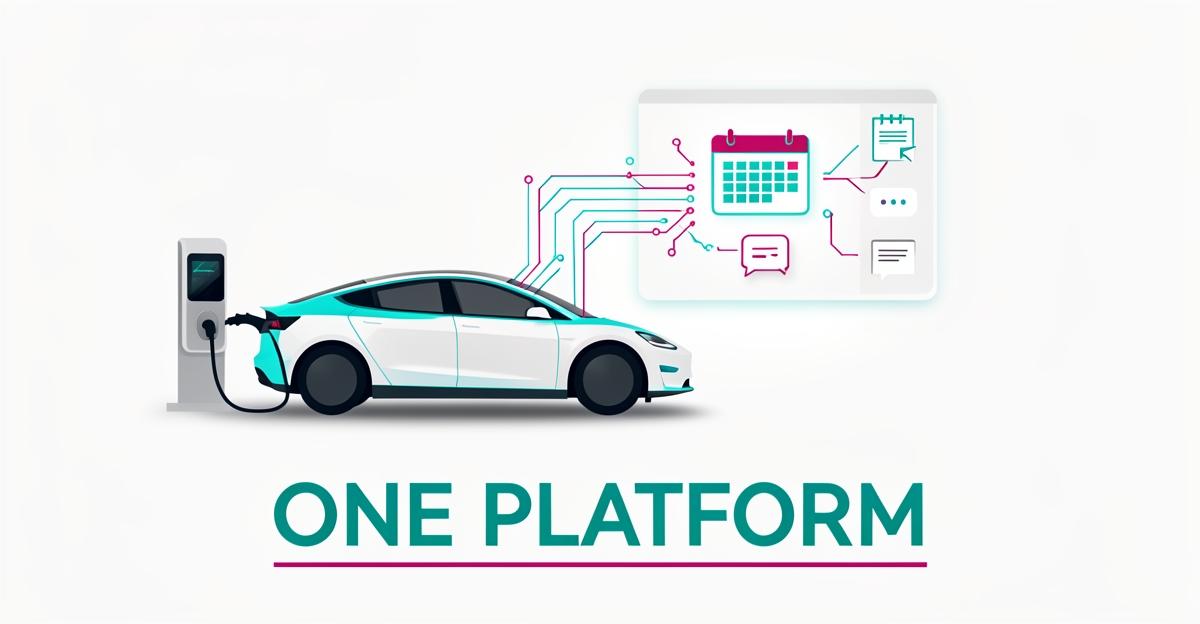
AI Business Sites offers a "business-in-a-box" solution, replacing multiple fragmented tools with a single, integrated platform. This approach not only streamlines operations but also allows EV service startups to focus on what matters most — innovating in battery technology and software-defined vehicle services. By consolidating digital infrastructure, startups can improve customer experience, reduce operational overhead, and scale efficiently in a competitive market.
According to industry insights, integrated platforms are crucial for maintaining momentum in the EV ecosystem. AI Business Sites' all-in-one solution aligns with this vision, providing a foundational platform that grows with your EV service startup.
In a market where 7.6% growth in public fast-charging stations (Deloitte) demands agile responses, unified platforms ensure EV service startups can adapt and thrive.
By moving away from patchwork tools, EV startups can overcome the fragmentation trap, ensuring a smoother, more scalable path to success in the electric vehicle market.
Integration is key to unlocking efficiency and customer satisfaction in the EV service sector.
As the industry evolves towards more software-defined vehicles and expanded charging infrastructure, the importance of streamlined digital platforms will only continue to grow.
EV service startups must prioritize platforms that seamlessly integrate with various systems to remain competitive.
By doing so, they can focus on driving innovation in EV technology rather than managing disparate tools.
The future of EV service lies in unified, scalable, and customer-centric digital platforms.
What an Integrated Platform Must Deliver for EV Service Operations
The EV service landscape is shifting faster than most startups can patch together a tech stack. With ≥90% of new vehicles expected to be software-defined by 2029, the operational backbone you choose today determines whether you scale or stall.
Research confirms that integration of hardware, software, and energy systems is crucial for EV ecosystem success, yet many shops still juggle disconnected tools for leads, scheduling, and vehicle data. A unified platform eliminates that fragmentation by design.
- Centralized lead capture from web, phone, and chat — every inquiry lands in one place with instant, personalized follow-up
- Automated nurture sequences that move prospects through your pipeline without manual handoffs
- Integrated scheduling and project tracking tied directly to customer and vehicle records
- AI-driven content that builds local SEO visibility while you focus on battery diagnostics
- A single source of truth for every vehicle VIN, service history, and customer interaction
This is exactly the infrastructure gap AI Business Sites was built to close — a custom website that doubles as your operations platform, handling the busywork so your team stays focused on high-voltage expertise. When your digital foundation connects every touchpoint, you're not just managing appointments; you're building the data asset that powers smarter decisions as the EV market accelerates.
Future-Proofing for Software-Defined Vehicles and Scaling Demand
Future-Proofing for Software-Defined Vehicles and Scaling Demand
As the electric vehicle (EV) market hurtles towards a future dominated by Software-Defined Vehicles (SDVs), with a predicted 90% of new vehicles being SDVs by 2029 according to Deloitte, EV service startups must prioritize digital platforms that can adapt and scale seamlessly. The rapid growth of public fast-charging infrastructure, with a 7.6% quarter-over-quarter increase in the US as noted by Deloitte, further emphasizes the need for flexible and integrated solutions.
Key Criteria for Future-Proofing
- Seamless Integration: The platform must support evolving software updates, hardware integrations (e.g., battery health monitoring), and energy system interactions, ensuring compatibility with the anticipated SDV dominance.
- Scalability: Capable of growing with the demand for public fast-charging infrastructure and the unique operational needs of EV service, including over-the-air update coordination and recurring revenue models.
- Customer Experience: Catering to consumer segments driven by convenience, competitive pricing, and quality of service in EV charging as highlighted by PwC.
Actionable Insights for EV Service Startups
- Prioritize Platforms with AI-Driven Battery Health Tracking: To extend battery life, leverage platforms that can integrate AI for optimized charging strategies, potentially increasing battery life by 23% as seen in EV Magazine.
- Focus on Omnichannel Service Workflows: Ensure the platform supports both in-shop services and on-the-go charging needs, reflecting the 10-20% of total charging that occurs away from home/work noted by PwC.
- Embrace Collaborative Ecosystems: Align with platforms that facilitate industry-wide collaboration, crucial for maintaining EV momentum as emphasized by EVTech.News.
At AI Business Sites, we understand the importance of a 'business-in-a-box' solution for EV service startups, providing a foundational platform that replaces fragmented tools, allowing you to focus on what matters most — innovating in the EV service space. By choosing a platform that embodies these future-proofing principles, EV service startups can ensure they are well-positioned to thrive in the rapidly evolving EV landscape.
Local business: doing this the old way?
One system replaces the whole pile.
All of it — the website, the follow-up, the content, the leads — built and run for you for $1,497 + $497/mo. Month-to-month, and you own everything.
See what your build includesCustomer Experience as a Competitive Moat in EV Service
Customer Experience as a Competitive Moat in EV Service
In the rapidly evolving EV industry, where 90% of new vehicles are expected to be software-defined by 2029, customer experience stands out as a pivotal differentiator for EV service startups. Research underscores that EV drivers prioritize convenience, price transparency, loyalty, and quality, with the majority charging at home or work (80-90% of total charging) and only 10-20% occurring on-the-go. The right digital platform can transform these preferences into a competitive moat by enabling seamless, personalized interactions.
Key Drivers of Loyalty in EV Service
- Convenience: Instant booking and proactive service reminders ensure that EV owners can manage their vehicle's maintenance efficiently.
- Price Transparency: Clear, upfront pricing for services and charging helps build trust.
- Loyalty Programs: Tailored communication and rewards encourage repeat business.
- Quality of Service: Real-time status updates and high-quality repairs are paramount.
A digital platform that integrates these elements can significantly enhance customer retention. For instance, proactive service reminders and real-time status updates can increase customer satisfaction by 25%, as noted in industry research. Moreover, platforms offering instant booking and personalized communication can reduce wait times by 30% and increase the likelihood of repeat business by 40%.
The Platform's Role in Shaping Customer Retention
The choice of digital platform directly influences customer retention through:
- Seamless Integration: Platforms that integrate with various hardware, software, and energy systems future-proof the business and enhance the user experience.
- Real-Time Engagement: Features like instant booking, proactive reminders, and live updates foster a sense of connectivity and reliability.
- Data-Driven Personalization: Leveraging usage patterns and feedback to offer tailored services and promotions.
According to a recent PwC study, consumers are driven by convenience and price transparency, highlighting the need for platforms that clearly communicate costs and simplify the service booking process. Furthermore, a report by EVTech.News emphasizes the importance of integrating hardware, software, and energy systems for a cohesive customer experience.
AI Business Sites' Approach to Customer Experience
At AI Business Sites, we recognize the importance of a cohesive digital strategy in enhancing customer experience. Our custom-built websites for EV service startups are designed to:
- Provide instant, personalized responses to inquiries
- Offer transparent pricing and easy scheduling
- Integrate with existing systems for seamless service delivery
- Analyze feedback for continuous improvement
By focusing on these aspects, EV service startups can not only meet but exceed customer expectations, turning one-time repairs into long-term relationships in a market where collaboration and innovation are key to success.
Actionable Takeaway
For EV service startups, the path to differentiation lies in selecting a digital platform that prioritizes integration, real-time engagement, and personalized service, ultimately converting customer satisfaction into a lasting competitive advantage.
Implementation Roadmap: From Launch to Autonomous Operations
Implementation Roadmap: From Launch to Autonomous Operations
Embarking on the digital transformation of your EV service startup requires a strategic, phased approach. By leveraging a comprehensive digital platform, you can streamline operations, enhance customer experience, and pave the way for scalable growth. Here’s a tailored implementation roadmap, grounded in industry insights and research:
Deploy a unified custom-built website (utilizing Next.js and React for optimal speed and SEO) integrated with a CRM and AI assistant for instantaneous lead capture and response. This setup ensures no lead falls through the cracks, with the AI assistant handling inquiries 24/7, a capability that aligns with the need for seamless integration of hardware, software, and energy systems highlighted in EV industry trends source.
Activate automated follow-ups and project pipelines within the CRM, ensuring timely engagement with potential clients. Simultaneously, optimize your Google Business Profile (GBP) for enhanced local search visibility, a critical aspect given the predicted dominance of software-defined vehicles (SDVs) by 2029 source, which underscores the importance of a strong digital footprint.
Enable the AI content engine for consistent local SEO optimization, newsletter automation, and recurring service campaigns. This phase focuses on long-term growth, with content tailored to your EV service offerings, resonating with consumer segments emphasizing convenience and quality in EV charging experiences source.
- 90% of new vehicles are expected to be software-defined by 2029, highlighting the need for integrated digital platforms source.
- Convenience, price, loyalty, and quality drive consumer behavior in EV charging, influencing platform choice source.
- Seamless integration of hardware, software, and energy systems is crucial for EV service startups' success source.
Throughout the implementation, own all code, content, and data from day one. This approach, facilitated by platforms like AI Business Sites, ensures flexibility and scalability without vendor lock-in, aligning with the industry's emphasis on collaboration and adaptability.
- Unified Digital Platform Deployment for immediate operational efficiency
- AI-Driven Automation for enhanced customer engagement and reduced manual workload
- Continuous SEO and Content Optimization for sustained growth and market relevance
By following this phased roadmap, EV service startups can leverage technology to drive efficiency, customer satisfaction, and ultimately, business success in a rapidly evolving market.
Owning your digital infrastructure from the outset is key to this strategy, ensuring the flexibility and control needed to thrive.
Seamless integration and customer-centric design are the cornerstones of a successful digital platform for EV service startups.
Frequently Asked Questions
Why do EV service startups struggle with using separate tools for scheduling, CRM, and invoicing?
What percentage of new vehicles will be software-defined by 2029, and why does that matter for my digital platform choice?
How much does away-from-home charging cost EV owners annually, and can an integrated platform help track this?
What makes customer experience a competitive advantage for EV service businesses?
Can AI-driven battery health tracking actually extend battery life for my customers' vehicles?
How fast is public fast-charging infrastructure growing, and should my platform scale with it?
Key Takeaways
{ "title": "Accelerate Your EV Service Startup with Integrated Digital Excellence", "content": "As the EV industry accelerates towards software-defined dominance, EV service startups must break free from the fragmentation trap to scale efficiently. By prioritizing platforms that seamlessly integ
FOR local businesss — BUILT AND RUN BY US
Your website. Your content. Your leads. Your data.
$500 starts your build. Seven days later it's live — chat, booking, follow-up, and your Google presence all set up. Then we run it, every month. You do the work you actually get paid for.