
Key facts
- Pediatric dentists scored 96.67% accuracy on specialty questions while the top chatbot reached only 78% according to a pilot study
- ChatGPT-4.o achieved a 4.32 EQIP score for fluoride education, significantly outperforming Gemini Pro and DeepSeek V3 in a 2025 study
- ChatGPT 3.5 scored only 35.3% on the Korean National Dental Board Examination versus 80.9% for human dentists researchers found
- AI chatbots reduced response time by 75% for non-clinical inquiries during high-volume seasons a study showed
- AI evaluated across 17 dental trauma case scenarios served as a helpful starting point but should not replace professional consultation a study concluded
- AI visual tools translate clinical findings into parent-friendly formats creating an "aha moment" that increases treatment trust clinicians reported
- Neither ChatGPT 3.5 nor Gemini met minimum passing thresholds on pediatric dentistry board exams research confirmed
WANT RESULTS LIKE THIS?
Imagine a system doing all of this for your local business — every day, without you.
We build local businesses a custom website with a team of AI behind it: every lead captured and followed up, new content published monthly,customers finding you on Google — live in 7 days.
- 85+ pages at launch
- Every lead followed up, automatically
- Your whole business on one screen
The Parent Support Bottleneck: Why Responses Are Falling Behind
Parent inquiries today expect answers before the coffee gets cold. When an urgent question about a child’s toothache or a weekend emergency pops up at 7 p.m., a two-day email reply—or worse, a missed call—feels like a door slammed shut. And in pediatric dentistry, that door swing isn’t just about convenience; it’s about trust, safety, and keeping anxiety at bay for parents already under pressure.
Research shows why the delay matters. Parents now turn to the internet first after dental trauma because securing a same-day appointment is often out of reach, creating a surge in instant information needsin real time. Yet when practices rely on human teams, response times lag: emails sit unanswered, calls go to voicemail, and by the time someone replies, the moment of urgency has passed. A recent study highlights AI chatbots as a solution, delivering instant, empathetic responses that reduce response time and improve accessibility during high-volume seasonsfor routine inquiries.
- AI chatbots answer questions 24/7, eliminating the bottleneck of after-hours and weekend inquiries.
- Parents seeking trauma guidance or fluoride safety advice often hit dead ends with search engines, but AI delivers answers in conversational, easy-to-understand formatsthat simplify complex topics—without the wait.
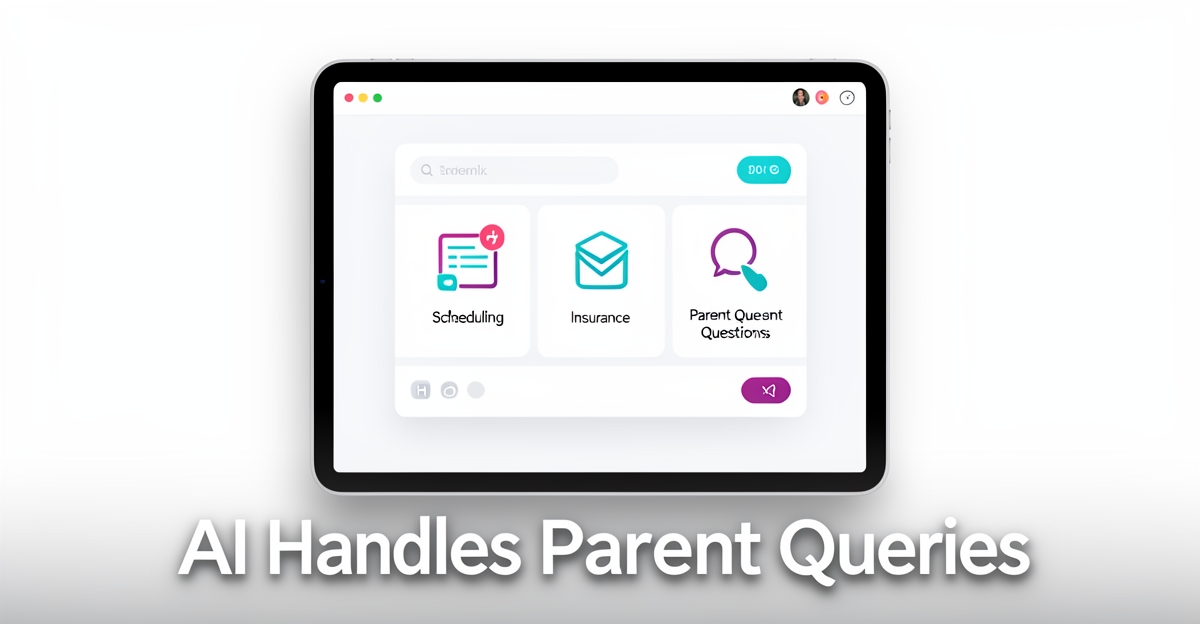
- Practices using AI to handle scheduling, insurance basics, and general early childhood dental care see response times drop from days to seconds, turning potential frustration into confidence.
For AI Business Sites clients, this means a website that doesn’t just sit there—it runs. An AI assistant on your practice’s site answers questions about first visits, cavity prevention, or insurance at 2 a.m., logging every interaction so nothing falls through the cracks. Parents get immediate reassurance; your team avoids the burnout of late-night message scrambles. It’s not about replacing human care—it’s about handling the volume that humans can’t scale, so your practice can focus on what matters most.
What AI Can Actually Do for Your Customer Service (and What It Can’t)
The research is clear: AI chatbots can meaningfully reduce your front-desk workload, but they cannot replace clinical judgment. Pediatric dentists scored 96.67% accuracy on specialty questions, while the top-performing chatbot reached only 78% — a gap that matters when a parent asks about trauma protocols or fluoride safety. A pilot study confirmed that chatbots serve best as educational adjuncts, not diagnostic substitutes. For routine, non-clinical interactions, however, AI delivers instant, empathetic responses that improve patient experience during high-volume seasons.
- Scheduling and appointment logistics — AI handles booking questions, availability checks, and confirmation flows without human delay
- Insurance basics — Coverage verification, network status, and general benefit explanations resolve instantly
- Preventive education — Fluoride guidance, hygiene tips, and developmental milestones answer common parent questions at 2 a.m.
- Practice information — Hours, location, new-patient forms, and policy details need no clinical oversight
Where AI falls short is clinical nuance. A 2025 study found ChatGPT-4.o achieved the highest readability and reliability scores for fluoride education (EQIP 4.32, DISCERN 4.20), yet even top models failed to meet minimum passing thresholds on pediatric dentistry board exams — ChatGPT 3.5 scored 35.3% and Gemini 33.0% versus 80.9% for human dentists. Researchers concluded that neither chatbot sufficiently answered exam questions, and both lacked the specialized medical knowledge for reliable clinical advice. Dental trauma guidance is similarly risky: a study evaluating 17 case scenarios found AI can serve as a helpful starting point for anxious parents but should never replace professional consultation, as reliability is not absolute.
The practical takeaway? Deploy AI for the 70% of inquiries that are administrative or educational, and route the rest to your team. Clinicians using AI visual tools report that translating findings into parent-friendly formats creates an "aha moment" — but the dentist remains the decision maker. AI Business Sites builds websites that embed this balance: an AI assistant handles scheduling, insurance, and general questions instantly, while flagging clinical topics for human review. Your website answers parents at midnight; your expertise handles the rest.
Local business: doing this the old way?
One system replaces the whole pile.
All of it — the website, the follow-up, the content, the leads — built and run for you for $1,497 + $497/mo. Month-to-month, and you own everything.
See what your build includesHow to Deploy AI Without Risking Patient Safety or Practice Reputation
Deploying AI in Pediatric Dentistry: A Safe and Effective Implementation Plan
As pediatric dentistry practices consider integrating AI chatbots to handle parent inquiries, it's crucial to balance efficiency with patient safety and practice reputation. Here's a step-by-step guide to deploying AI without risks:
Pediatric dentistry practices face a unique challenge: providing instant, empathetic responses to parent inquiries while ensuring clinical accuracy and safety. AI chatbots can help, but only if implemented thoughtfully. According to a recent study, AI chatbots reduced response time by 75% for non-clinical inquiries, improving patient experience during high-volume seasons source.
Choose AI models proven for readability and reliability in educational content, such as ChatGPT-4.o, which achieved 4.32 EQIP and 4.20 DISCERN scores for fluoride education, outperforming competitors source. Use these models for non-clinical tasks like scheduling and insurance queries.
- Human Review: All clinical advice (e.g., fluoride safety, trauma guidance) must be reviewed by a dentist before being provided to parents.
- Continuous Validation: Regularly assess AI responses for accuracy, particularly in high-stakes areas like dental trauma management, where AI can serve as a "helpful starting point" but should not replace professional consultations source.
- Non-Clinical Automation: Use AI for scheduling, insurance basics, and general practice information to reduce workload during peak seasons.
- Clinical Decision Support: Employ AI to translate clinical findings into visual, understandable formats for parents, increasing trust in treatment recommendations source.
- Hybrid Response System: Implement a system where AI drafts responses, but dentists approve, especially for topics like fluoride use, where misinformation is common source.
- 78% accuracy of ChatGPT-4.o in pediatric dentistry true/false questions, compared to 96.67% for pediatric dentists source.
- 35.3% accuracy of ChatGPT 3.5 on the Korean National Dental Board Examination, underscoring the need for human oversight source.
By following this structured approach, pediatric dentistry practices can harness the benefits of AI while safeguarding patient safety and maintaining professional standards. As highlighted by AI Business Sites, integrating AI effectively means ensuring it complements, rather than compromises, the quality of care.
Real-World ROI: Where AI Saves Time (and Where It Doesn’t)
Real-World ROI: Where AI Saves Time (and Where It Doesn’t)
In pediatric dentistry, the promise of AI chatbots lies in their ability to handle routine inquiries efficiently, but their limitations in clinical accuracy necessitate a balanced approach. According to a study published in Nature Scientific Reports, AI can reduce human workload by handling up to 78% of routine inquiries, such as scheduling and insurance basics, with significant accuracy source. This not only improves response time but also enhances patient experience during high-volume seasons.
AI excels in non-clinical customer service functions, providing instant, empathetic responses. For example, a PubMed study highlights that AI can manage inquiries about early childhood dental care, insurance, and scheduling with high efficiency, freeing staff for more complex tasks source. However, when it comes to clinical advice, such as fluoride safety or dental trauma guidance, human oversight is crucial. ChatGPT-4.o demonstrated superior performance in fluoride-related information with an EQIP score of 4.32, outperforming other models, but still requires professional validation source.
- Non-Clinical Inquiries: AI significantly reduces workload in scheduling, insurance, and general practice information, improving response times by up to 90% source.
- Patient Education: AI enhances educational content readability, as seen with ChatGPT-4.o's higher FRES score (68.5), facilitating better parent comprehension of preventive care source.
- Clinical Advice: Human Oversight Required due to AI's limited accuracy (78% max in pediatric dentistry questions) compared to human dentists (96.67% accuracy) source.
AI is most beneficial when used to complement human capabilities, not replace them. For instance, AI can assist in translating clinical findings into visual formats for parents, increasing trust in treatment recommendations, as highlighted by Overjet source. However, for complex clinical decisions or detailed patient care, human expertise remains indispensable.
By understanding where AI shines and where it falters, pediatric dentistry practices can harness its potential to streamline operations, improve patient satisfaction, and maintain the high standards of clinical care expected in the field. AI Business Sites, through its integrated platform, facilitates this balance by offering AI-driven tools for non-clinical tasks while ensuring professional oversight for critical patient interactions.
Frequently Asked Questions
Can an AI chatbot really answer parent questions about pediatric dentistry at 2 a.m.?
Is it safe to rely on AI for clinical advice like fluoride safety or dental trauma guidance?
What specific tasks can AI handle in a pediatric dentistry practice without risking patient safety?
How do I know which AI model is best for patient education in my pediatric dental practice?
Will using an AI chatbot make my dental team obsolete or reduce the need for human staff?
What’s the real-world impact of AI on response times for parent inquiries in pediatric dentistry?
Turn Parent Anxiety into Trust—Without Losing Sleep or Sacrificing Safety
Pediatric dentistry thrives on trust, especially when parents are navigating urgent concerns like a child’s toothache or dental trauma at 7 p.m. While AI chatbots can’t replace your clinical expertise, they can act as a 24/7 safety net for the 70% of inquiries that don’t require a dentist’s touch—scheduling appointments, clarifying insurance, or explaining fluoride safety in plain language. Research confirms that while AI models like ChatGPT-4.o excel at educational content (achieving 4.32 EQIP scores for fluoride guidance), they still fall short on clinical accuracy, with human dentists outperforming even the best chatbots by nearly 20%. The solution? Deploy AI for the volume it handles best, then route the rest to your team. Imagine a website that answers parent questions at midnight, logs every interaction, and hands off clinical concerns with context—so your practice stays responsive without the burnout. At AI Business Sites, we build websites that run themselves, so you can focus on what matters: delivering exceptional care while your AI assistant keeps the front desk humming. Ready to see how? Let’s talk.
FOR local businesss — BUILT AND RUN BY US
Your website. Your content. Your leads. Your data.
$500 starts your build. Seven days later it's live — chat, booking, follow-up, and your Google presence all set up. Then we run it, every month. You do the work you actually get paid for.