
Key facts
- Labor shortage is the #1 constraint across all restoration shops, not funding or space according to Hagerty's 2024 industry report.
- Online channels accounted for 26.8% of classic car restoration market revenue in 2025 and are projected to reach 36.4% by 2034 per DataIntelo market research.
- Collectors under 45 represent 28.7% of active restoration project starts globally as of 2025 per DataIntelo market research.
- Average restoration project spend in North America reached ~$22,400 in 2025, up from ~$17,300 in 2021 per DataIntelo market research.
- "Bad from new" parts — condensers, tires, and other components failing right out of the box — have become common across the industry per Hagerty's shop owner interviews.
- Specialty subcontractors like radiator shops and clock repair specialists are disappearing as owners age out with no successors per Hagerty's 2024 industry report.
- The HAGI Top Index shows over 38% cumulative appreciation from 2020 to 2025, driving an investment mindset among collectors per DataIntelo market research.
WANT RESULTS LIKE THIS?
Imagine a system doing all of this for your local business — every day, without you.
We build local businesses a custom website with a team of AI behind it: every lead captured and followed up, new content published monthly,customers finding you on Google — live in 7 days.
- 85+ pages at launch
- Every lead followed up, automatically
- Your whole business on one screen
Why Restoration Shops Lose Trust Before the First Conversation
Most restoration shops don't lose trust because they do bad work — they lose it before the first conversation even starts. The operational realities that define daily life in a restoration shop are exactly the things that make clients suspicious: unpredictable schedules, parts that arrive defective, and specialists who retire without successors.
Hagerty's 2024 industry report confirms that labor shortage is the #1 constraint across all shops — not funding, not space, not demand. Finding people with the aptitude to learn these skills takes months, and teaching them takes years. Meanwhile, Eric Peterson of Leydon Restorations warns that "bad from new" parts have become common — condensers, tires, and other components that fail right out of the box. He puts it bluntly: "Charge us more the first time if you have to, but give us a part that works!"
- Specialty subcontractors — radiator shops, clock repair, brake relining — are disappearing as owners age out with no successors
- "Job creep" turns routine inspections into major repairs when hidden issues surface
- Environmental regulations force shops to use harder-to-work-with paint and solvent substitutes
- Space constraints leave successful shops physically overwhelmed with customer cars
Clients don't see any of this. They see TV shows where a 30-minute episode delivers a finished restoration. They expect modern service intervals — 10,000 miles between visits — not the reality of a car that needs attention every few hundred miles. The gap between a 30-minute TV timeline and months of parts delays, subcontractor coordination, and hidden rust discovery is where trust evaporates.
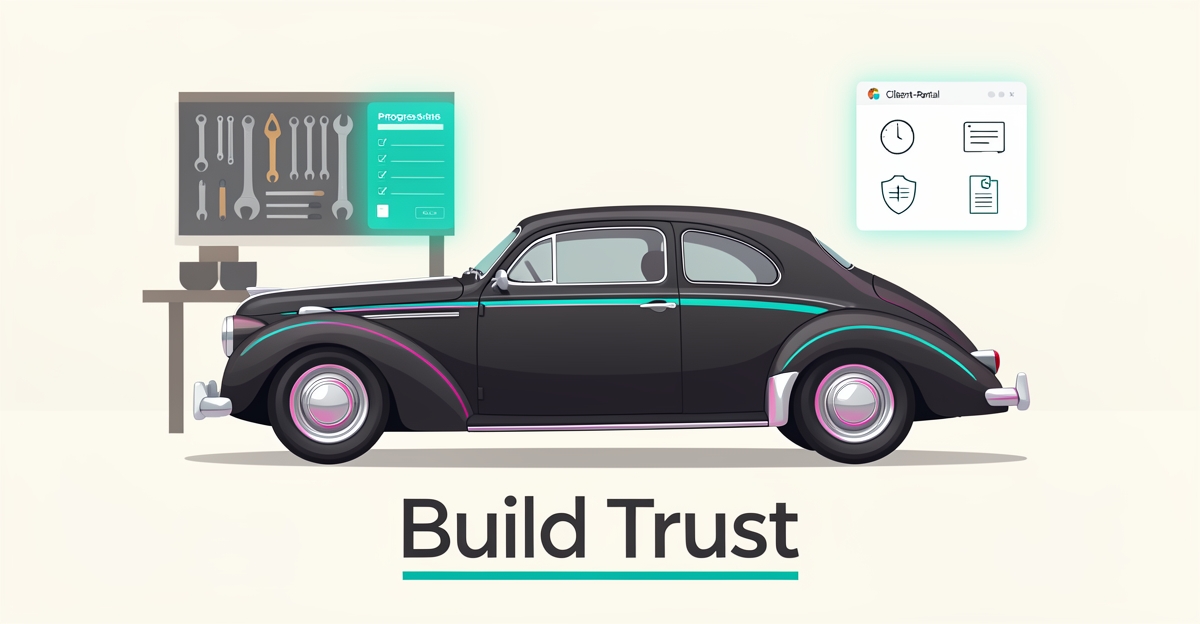
At AI Business Sites, we've seen how a website that explains these realities upfront — with a transparent process hub, realistic phase timelines, and a client portal showing real-time project status — turns skepticism into patience. When clients understand the constraints before they sign, they become partners instead of critics.
What the Market Data Reveals About Buyer Expectations
The classic car restoration market is undergoing a significant digital transformation, directly shaping what buyers now expect from restoration businesses online. Online channels accounted for 26.8% of total market revenue in 2025 and are projected to reach 36.4% by 2034, reflecting a 9.2% compound annual growth rate for online sales. This shift is being driven by a new generation of collectors: 28.7% of restoration project starts in 2025 came from enthusiasts under 45, many of whom first discover the hobby through YouTube channels exceeding 200 million monthly views or TV shows averaging 2.3 million viewers per episode.
As restoration projects increasingly represent substantial financial commitments — with average spend reaching ~$22,400 in North America in 2025 (up from ~$17,300 in 2021) and the HAGI Top Index showing over 38% cumulative appreciation from 2020 to 2025 — owners are adopting an investment mindset. They demand documented quality and transparency over quick fixes, seeking assurance that their significant outlay will be met with meticulous, verifiable work. For a restoration business, this means the website must move beyond basic information to become a trust-building hub that addresses operational realities like job creep and parts sourcing challenges while showcasing the expertise that justifies premium pricing and extended timelines. A platform that supports clear communication, real-time project visibility, and verified credentials becomes essential in meeting these evolving buyer expectations. AI Business Sites enables this through integrated client portals and automated updates that keep owners informed throughout the restoration journey.
Trust Architecture: Process Transparency That Addresses Job Creep
Trust Architecture: Process Transparency That Addresses Job Creep
Building trust with potential clients is crucial for a classic car restoration website. One effective way to achieve this is by creating a "Process Hub" that transforms operational constraints into trust signals. By addressing the common issue of "job creep" — where routine services reveal unexpected, major work — transparency can be leveraged to build confidence.
According to Hagerty's insights, "job creep" is a universal challenge in restoration shops, making scheduling and client communication extremely difficult. For instance, Philip Reinhardt of Mechanical Arts noted that routine services often uncover hidden issues, such as completely worn-out front ends in cars without state inspections. A Process Hub can mitigate this by providing:
- Realistic Phase Timelines: Including buffers for parts sourcing and subcontractor coordination. For example, a typical restoration project might be divided into 12-week phases, with built-in 2-week buffers for unforeseen delays.
- "What to Expect" FAQ: Directly addressing job creep scenarios, such as the discovery of worn-out parts during routine service, and how your process handles these surprises. This could include a step-by-step explanation of how unexpected issues are identified, communicated, and resolved.
- Client Portal: Offering real-time project visibility, approved changes, and upcoming milestones, mirroring the trust-building transparency seen in platforms like Bring a Trailer, which succeeds by telling stories of automotive heritage rather than just listing cars.
Transforming the Communication Gap
A client portal is instrumental in transforming the communication gap into ongoing visibility. By giving clients direct access to their project's status, you replicate the success of transparent marketplaces. For example, a portal might show:
- Project Timeline Updates: Live adjustments reflecting any "job creep" adjustments, with explanations.
- Approved Changes and Costs: Clear documentation of any scope changes, ensuring clients are always informed.
- Milestone Achievements: Visual indicators of progress, reinforcing trust through tangible outcomes.
Statistics Highlighting the Need for Transparency
- 28.7% of active restoration project starts are from collectors under 45, emphasizing the need for a digital, transparent experience (DataIntelo).
- Online channels are projected to reach 36.4% of the market revenue by 2034, underscoring the importance of a trustworthy online presence (DataIntelo).
- Job creep and parts quality issues are among the top challenges, directly impacting trust and requiring transparent communication strategies (Hagerty).
AI Business Sites Solution
AI Business Sites' custom website solution, with its integrated client portal and content engine, is designed to address these challenges. The platform:
- Automates Content Generation: Ensuring a consistent flow of project updates and educational content that reinforces transparency and expertise.
- Provides Real-Time Visibility: Through the client portal, aligning with the trust-building strategies of successful marketplaces.
- Streamlines Communication: Reducing the gap between expectations and realities through clear, data-driven process explanations.
By embracing transparency and leveraging technology to facilitate open communication, classic car restoration websites can effectively build trust with their digitally savvy clientele, setting a new standard in the industry.
Example Implementation
A restoration shop might outline their process as follows on the website:
- Initial Assessment (Weeks 1-2): Detailed evaluation of the vehicle, including a list of potential risks for "job creep."
- Custom Quote and Project Plan: Presented through the client portal, with clear milestones and buffers for parts sourcing.
- Regular Updates via Client Portal: Weekly status checks, with visual progress tracking and direct messaging for any changes.
- Final Inspection and Delivery: Documented with before/after media, available in the client's portal for future reference.
This structured approach, combined with the transparency of a client portal, directly addresses the challenges of "job creep" and builds trust through predictable, communicated processes.
Local business: doing this the old way?
One system replaces the whole pile.
All of it — the website, the follow-up, the content, the leads — built and run for you for $1,497 + $497/mo. Month-to-month, and you own everything.
See what your build includesExpertise Signals That Justify Premium Pricing and Wait Times
When a client writes a six-figure check for a restoration that won't see daylight for 18 months, they're not just buying labor — they're buying confidence that their investment won't become a cautionary tale. The shops earning that trust don't just claim expertise; they make it visible, verifiable, and impossible to fake.
The talent pipeline starts with credentials that carry weight in the collector community. Multiple shop owners cite McPherson College's Automotive Restoration program as their primary source for technicians who understand both traditional craftsmanship and modern documentation standards. Pair that with concours judging credentials, marque club leadership roles, and manufacturer-specific certifications, and you have a team page that answers the "why you?" question before it's asked.
Case studies are where expertise becomes evidence. Mirroring Bring a Trailer's editorial storytelling approach, each project should document the problem, the parts-sourcing detective work, the fabrication solutions, and the result — with before/after photography that meets concours documentation standards. A 1930s Bentley restoration isn't just "completed"; it's a narrative about sourcing correct brass-era fasteners, 3D-scanning an unobtainable water pump housing, and coordinating with the only remaining specialist who understands the original oiling system.
- Concours awards and class wins with judging sheets available on request
- Marque club affiliations and leadership positions (PCA, MGA, CCCA, etc.)
- Manufacturer certifications (Ferrari Classiche, Porsche Classic, Aston Martin Heritage)
- Team credentials from recognized programs like McPherson College
- Published technical articles or speaking engagements at marque events
The parts quality crisis makes transparency a competitive advantage. Eric Peterson of Leydon Restorations puts it bluntly: “Charge us more the first time if you have to, but give us a part that works!” A dedicated Parts Philosophy page shows your sourcing standards, verification protocols, and in-house capabilities like 3D scanning and printing — an adaptation strategy Hagerty-profile shops are already deploying. Video documentation of incoming parts inspection aligns with DataIntelo's finding that video descriptions increase customer confidence in high-value transactions.
At AI Business Sites, we build websites that make this level of documentation manageable — not a marketing burden. The same platform that publishes your case studies also handles the client portal where owners track progress, approve decisions, and see the expertise they're paying for in real time.
From One-Time Restoration to Lifetime Relationship
Restoration shops have long relied on maintenance and repair work — tune-ups, A/C service, belts and hoses — to smooth the cash-flow valleys between major projects. That diversification strategy, documented across the industry, reflects a deeper reality: the relationship doesn't end when the car leaves the shop. According to market research, collectors under 45 now represent 28.7% of active restoration project starts, and they expect the same digital convenience they get from every other service provider. They don't want a paper invoice in a glovebox; they want a portal that shows service history, stores documentation, and schedules the next appointment with a tap.
- Project tracking that evolves into maintenance scheduling
- Complete service history and document storage
- Review integrations showcasing both restoration and maintenance experiences
- Expert verification — concours judging credentials, niche specializations like "Pre-1970 Porsche Specialist"
This mirrors what marketplace analysis found: niche focus drives trust and conversion in high-value automotive transactions. A client portal becomes the connective tissue between a one-time restoration and a lifetime relationship — exactly the long-term approach leading shops emphasize through ongoing maintenance services. When the website functions as a relationship platform rather than a project brochure, it aligns with how modern collectors actually behave: they research on YouTube (200M+ monthly restoration views), they buy parts online (26.8% of market revenue and growing), and they choose shops that make the ongoing conversation effortless.
Frequently Asked Questions
Why do restoration shops struggle with unpredictable timelines and 'job creep'?
How can a website help set realistic expectations about restoration timelines?
What expertise signals justify premium pricing and 18-month wait times for restoration work?
How does the parts quality crisis affect restoration projects, and what should a shop communicate about it?
Why do younger collectors expect a digital client portal for their restoration project?
How can a restoration website build trust like Bring a Trailer does for car sales?
Where Transparency Meets Trust in Classic Car Restoration
Building trust online for a classic car restoration shop isn’t about flashy promises—it’s about making the invisible work visible. From explaining job creep and parts sourcing realities to showcasing verified expertise through case studies and credentials, your website becomes the bridge between client anxiety and confident partnership. By integrating a client portal that offers real-time updates, transparent timelines, and documented quality, you turn operational challenges into trust signals that justify premium pricing and extended wait times. The digitally native collector under 45 already expects this level of transparency—they research on YouTube, buy parts online, and choose shops that communicate like true partners. Now is the time to align your online presence with the expectations of today’s investor-minded enthusiast. Take the first step toward a website that doesn’t just showcase your work, but actively builds the trust that sustains it—explore how AI Business Sites helps restoration shops turn skepticism into loyalty through intelligent, self-running websites designed for your craft.
FOR local businesss — BUILT AND RUN BY US
Your website. Your content. Your leads. Your data.
$500 starts your build. Seven days later it's live — chat, booking, follow-up, and your Google presence all set up. Then we run it, every month. You do the work you actually get paid for.