
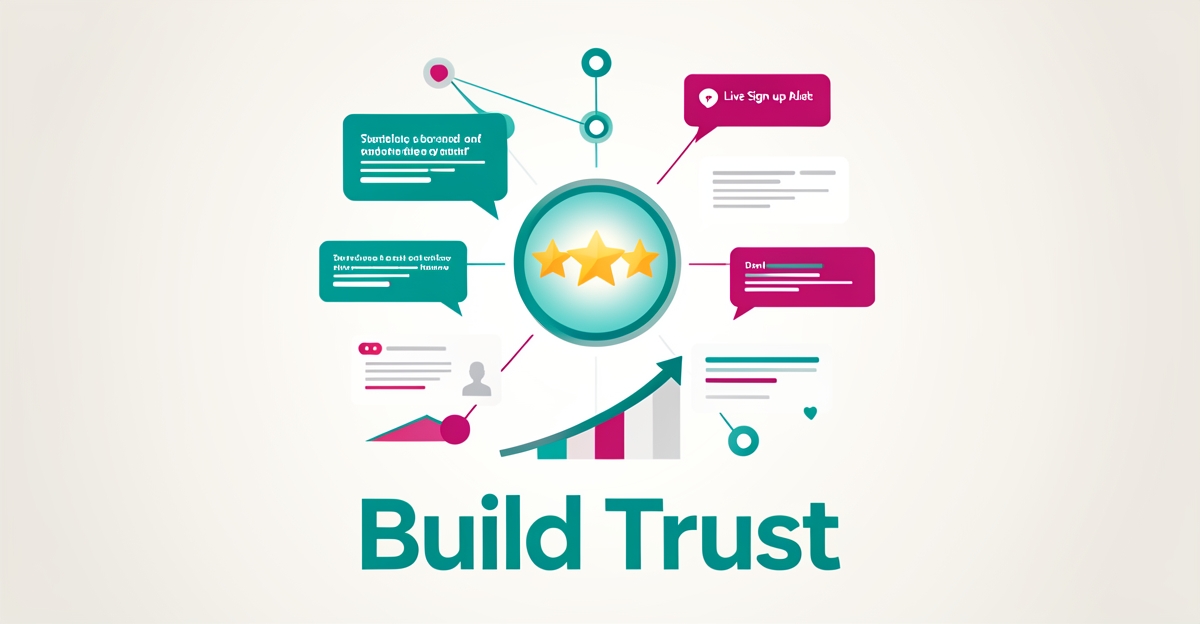
Key facts
- ["89% of consumers trust social proof when making decisions, according to Nielsen.", "Products with 5 reviews are 270% more likely to be purchased than those with none, per PowerReviews.", "47% of shoppers cite user reviews as the most influential content, outperforming brand and influencer content.", "Social proof tools can increase conversions by up to 98% by displaying real-time customer activity, as seen in Provesrc's analysis.", "UGC interactions result in a 100.6% conversion lift, highlighted by PowerReviews.", "92% of consumers trust earned media, based on Edelman research.", "GoPro's top 3 customer-filmed YouTube videos have 429+ million combined views, demonstrating UGC's reach."]
WANT RESULTS LIKE THIS?
Imagine a system doing all of this for your local business — every day, without you.
We build local businesses a custom website with a team of AI behind it: every lead captured and followed up, new content published monthly,customers finding you on Google — live in 7 days.
- 85+ pages at launch
- Every lead followed up, automatically
- Your whole business on one screen
The Trust Gap in Leagues: Why Retention Suffers
Many leagues struggle with retention not because of poor gameplay or facilities, but because new players hesitate to commit without seeing proof that others trust and enjoy the experience. This trust gap is especially pronounced in community sports, where signing up involves not just a fee, but a social investment—showing up week after week, building rapport with teammates, and relying on organizers to deliver consistently. When that reliability feels uncertain, even enthusiastic prospects may walk away before lacing up their cleats.
Research confirms that trust is a prerequisite for commitment, particularly when actions involve ongoing participation or financial input. According to behavioral science research, trust is one of the key factors in converting customers online because providing a credit card number—or in this case, committing to a season—represents a meaningful hurdle for people to overcome. Without visible evidence that others have had positive experiences, that hurdle feels higher. Leagues that fail to showcase authentic player feedback leave newcomers to wonder: Will I fit in? Will games actually happen? Is this well-run?
The core issue isn’t just a lack of praise—it’s a lack of verifiable, community-driven evidence that the league delivers on its promises. When leagues rely only on self-reported claims like “95% satisfaction” or “best in the city,” skepticism grows. As noted in the same research, the effectiveness of social proof depends on how much the customer trusts the business's claims, especially when those claims are hard to verify. Third-party validation—such as named testimonials, video stories from real players, or visible signs of active participation—carries far more weight than internal messaging.
This is where automated social proof systems become essential. Leagues that integrate real-time activity notifications—like “12 players registered this week” or “3 new teams formed in Maplewood”—reduce hesitation by showing others are actively engaging. Similarly, displaying multimedia success stories with names, photos, and specific details (e.g., “Maria, 3rd season, Co-Ed Softball”) builds credibility far more effectively than generic praise. These elements don’t just attract sign-ups; they reinforce ongoing participation by reminding players they’re part of a trusted, active community—a insight supported by findings that when someone creates content about your brand, they're joining your community. For leagues, every testimonial, every shared moment, becomes a thread in the retention fabric.
The Power of Social Proof: Research-Backed Solution
Social proof isn't just helpful for building trust in your league—it's essential. Research shows that 89% of consumers trust social proof when making decisions, making it one of the most reliable ways to overcome skepticism and encourage sign-ups. For leagues, this means that authentic feedback from current players carries far more weight than any promotional message you could send.
The impact is measurable and significant. Products or services with just five reviews are 270% more likely to be chosen over those with zero reviews, demonstrating how even a small amount of verified feedback can dramatically reduce hesitation at the point of decision. Additionally, 47% of shoppers say user reviews are the most influential content when researching options—far surpassing brand-generated content (11%) or influencer posts (10%). This "authenticity advantage" is especially powerful in community-driven environments like sports leagues, where seeing real players share their experiences fosters a sense of belonging and commitment.
To leverage this effectively, focus on three key elements: authenticity, visibility, and timing. Use multimedia testimonials that include names, photos, and specific league experiences to build credibility. Display them prominently on registration and checkout pages where sign-up friction is highest. Finally, automate collection at meaningful milestones—like after a player’s first game or season completion—so feedback feels genuine and timely. By aligning social proof with your league’s natural rhythm, you turn satisfied participants into your most persuasive advocates.
Local business: doing this the old way?
One system replaces the whole pile.
All of it — the website, the follow-up, the content, the leads — built and run for you for $1,497 + $497/mo. Month-to-month, and you own everything.
See what your build includesImplementing Effective Social Proof Strategies for Leagues
Leagues thrive when players feel connected to a community they can trust. Building that trust starts with showing new sign-ups that others like them have not only joined but stayed, succeeded, and spoken up about their experience. The most effective way to do this is by making authentic player voices visible at every stage of the journey — from first click to season renewal — using tools that work behind the scenes so you don’t have to chase feedback manually.
Start by automating testimonial capture at moments when players are most likely to share positive feedback, such as after their first game, at season’s end, or following a championship win. Research shows that products with just five reviews are 270% more likely to be purchased than those with zero reviews, and 47% of shoppers say user reviews are the most influential content when researching online. The AI Business Sites platform supports automated Google review requests and reputation management, letting you turn these high-sentiment moments into a steady stream of verified player stories without adding to your workload.
Next, bring those stories to life where decisions are made. Place multimedia testimonials — featuring real players, names, photos, and short video clips — directly on registration and checkout pages. Enhancing testimonials with authenticity cues like names and photos builds credibility, and video content, in particular, helps new visitors visualize themselves as part of your league. Displaying this social proof at high-intent touchpoints reduces hesitation and answers the unspoken question: “Will I belong here?”
Finally, reinforce trust in real time with live activity notifications. Showing updates like “12 players registered this week” or “3 new teams formed in Downtown” leverages the bandwagon effect — people are more likely to join when they see others doing it. These signals validate choices and reduce drop-off, especially when paired with clear timing rules and A/B testing to find what resonates most with your audience. Together, these strategies turn passive satisfaction into active advocacy, creating a self-reinforcing cycle where happy players attract the next ones — and the system keeps running while you focus on the game.
Frequently Asked Questions
Why do new players hesitate to join my league even when the games look great?
How many reviews or testimonials do I really need to make a difference?
Are player testimonials actually more effective than my league's own marketing messages?
What kind of testimonials build the most trust — text, photos, or video?
When's the best time to ask players for feedback so it feels natural and not forced?
Do real-time notifications like '12 players registered this week' actually help convert sign-ups?
Key Takeaways
{ "title": "Your League's Best Recruiters Are Already on the Field", "content": "Trust isn't built in mission statements — it's built in the moments players share. The research is clear: 89% of consumers trust social proof, and products with just five reviews are 270% more likely to be chosen th
FOR local businesss — BUILT AND RUN BY US
Your website. Your content. Your leads. Your data.
$500 starts your build. Seven days later it's live — chat, booking, follow-up, and your Google presence all set up. Then we run it, every month. You do the work you actually get paid for.