
Key facts
- Sporting goods stores waste 15+ hours weekly on manual catalog updates that AI can slash by 40% per research.
- AI-driven inventory systems cut stockouts by 85% during peak seasons by predicting demand shifts per research.
- Retailers using AI auto-update catalogs from weather forecasts see 15% higher sales and 10–20% lower fulfillment costs per research.
- AI generates SEO-optimized product descriptions at scale, creating 850+ million catalog data points for Walmart in 2024 per research.
- AI-powered catalog automation reduces go-to-market time from weeks to hours, capturing early-season demand competitors miss per research.
- AI inventory systems improve forecast accuracy by 20–30% by analyzing real-time weather, events, and demand patterns per research.
- Automated visual content generation creates seasonal product videos in 3–7 seconds without photoshoots per research.
WANT RESULTS LIKE THIS?
Imagine a system doing all of this for your local business — every day, without you.
We build local businesses a custom website with a team of AI behind it: every lead captured and followed up, new content published monthly,customers finding you on Google — live in 7 days.
- 85+ pages at launch
- Every lead followed up, automatically
- Your whole business on one screen
The Seasonal Inventory Conundrum: Challenges for Sporting Goods Stores
The Seasonal Inventory Conundrum: Challenges for Sporting Goods Stores
As the seasons change, sporting goods stores face a daunting challenge: manually updating their product catalogs to reflect the latest seasonal demands. This labor-intensive process can lead to missed sales opportunities, stockouts, and wasted resources. For instance, failing to promptly update catalogs for winter sports equipment can result in lost sales when demand spikes unexpectedly due to a sudden cold snap.
The Human Cost of Manual Updates
Manually adjusting inventory for seasonal changes consumes valuable time and resources. Sporting goods retailers often spend 15+ hours per week on spreadsheet maintenance, channel formatting, and compliance fixes, taking away from more strategic activities source. Moreover, the inefficiency of manual processes can lead to stockouts and overstocking, with AI-driven inventory management showing the potential to reduce stockouts by 85% or more source.
The Business Impact
- Missed Opportunities: Delayed catalog updates mean missing out on early-season demand. Automated systems can reduce go-to-market time from weeks to hours, capturing critical early sales source.
- Operational Inefficiency: Manual inventory management and catalog updates divert resources from growth-focused activities. AI inventory systems can improve forecast accuracy by 20–30% and reduce fulfillment costs by 10–20% source.
- Competitive Disadvantage: Retailers without agile inventory management fall behind competitors in responsiveness to seasonal changes.
The Need for Automation
Given these challenges, automating seasonal product catalog updates with AI emerges as a strategic necessity for sporting goods stores. By integrating AI, retailers can:
- Auto-update catalogs based on real-time weather patterns and local event calendars.
- Generate SEO-optimized content for seasonal products at scale using Generative AI (LLMs) source.
- Reduce manual labor by up to 40% through automated inventory management and catalog synchronization source.
Embracing the Solution
For sporting goods retailers, the path forward involves leveraging AI to transform seasonal inventory management from a manual, reactive process into a proactive, automated one. By doing so, they can ensure their product catalogs remain fresh, relevant, and responsive to customer demands throughout the year, ultimately driving more efficient operations and increased sales. AI Business Sites, with its custom websites designed to run themselves, offers a tailored solution for integrating these automated processes seamlessly into a retailer’s online presence.
AI-Powered Solution: Dynamic Catalog Updates Driven by Real-Time Data
Seasonal inventory shifts don’t have to mean last-minute scrambles or missed sales. For sporting goods stores, AI-powered systems now enable dynamic catalog updates that respond to real-time signals like weather forecasts, local event calendars, and demand patterns—automatically surfacing the right gear at the right time.
By integrating AI inventory management with external data sources, retailers can anticipate seasonal demand with 20–30% improved forecast accuracy and reduce stockouts by 85% or more. These systems analyze real-time data, historical sales, and external signals such as local sports seasons and promotions to simulate demand shifts and optimize stock levels before seasonal transitions begin. This proactive approach replaces reactive inventory management with autonomous decision-making, ensuring products like snowboards or swimsuits appear in the catalog as conditions change.
AI-driven platforms provide a unified inventory view across ERP, WMS, POS, and transit systems, enabling real-time Available-to-Promise (ATP) capabilities and autonomous stock rebalancing. Agentic AI workflows go beyond decision support to execute routine inventory decisions—such as dynamic reorder triggers, markdown initiation, and multi-channel allocation—within predefined parameters. This reduces manual workload and accelerates seasonal catalog updates from weeks to hours, capturing early-season demand that manual processes often miss.
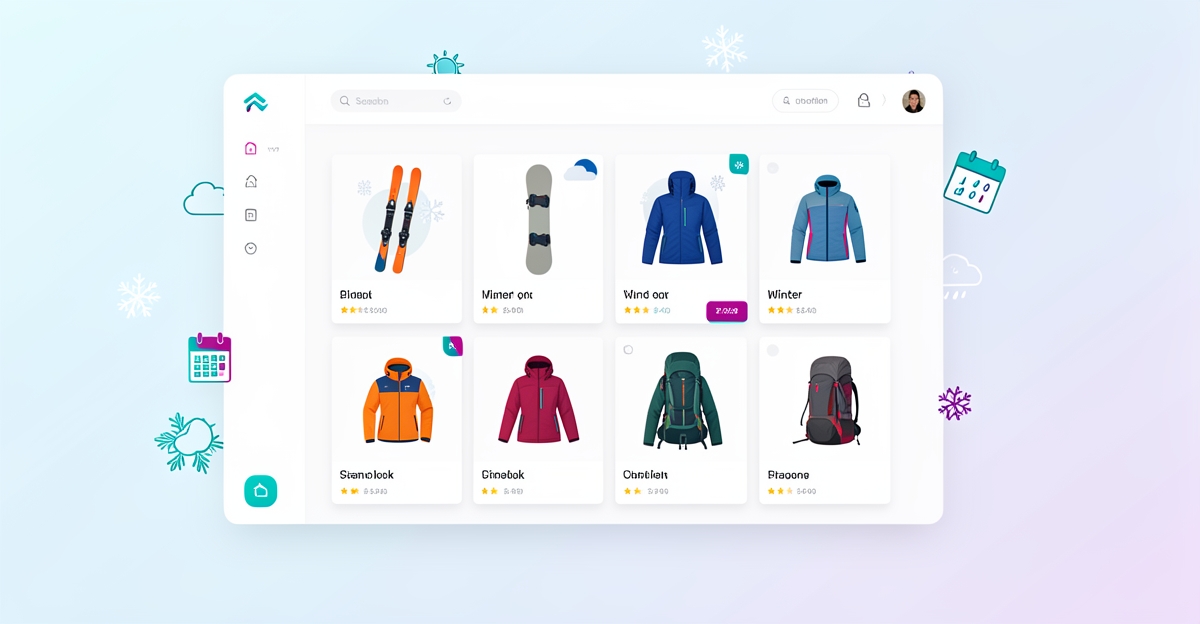
For sporting goods retailers, connecting weather APIs (like NOAA) and local event calendars to an AI inventory system allows the catalog to auto-adjust featured products based on real-time conditions. When a heatwave is forecast, the system can auto-feature swimsuits and hydration packs; when snow is predicted, it promotes snowboards and ski gear. This transforms the website from a static brochure into a dynamic, responsive catalog that updates automatically—aligning with the vision of a website that runs itself.
AI Business Sites supports this automation through its built-in AI content engine, which researches, writes, and publishes new content monthly—grounded in actual services and service areas—built for local SEO. By leveraging LLMs like GPT-4 and Claude, retailers can generate SEO-optimized product titles, descriptions, and bullets at scale for seasonal gear, reducing manual effort from 15+ hours per week to minutes. These models achieve human-level performance for product descriptions and have been used to create or improve over 850+ million catalog data points in enterprise settings.
Automated catalog systems also enable rapid visual content generation, producing product images and 3–7 second videos for seasonal variations without costly photoshoots. These visuals can be embedded directly into product pages and social media via the website’s AI assistant, reducing content creation time and cost while maintaining brand consistency. With agentic workflows, the AI can draft stock rebalancing, reorder triggers, and markdown initiation based on seasonal forecasts, then route changes for human review before publishing—ensuring accuracy and control.
By combining AI inventory management with real-time weather, event, and demand data, sporting goods stores can maintain a fresh, relevant product catalog year-round—turning seasonal transitions into a competitive advantage rather than a operational burden. This approach not only captures early-season demand but also minimizes excess stock and lost sales, creating a more responsive, efficient retail operation.
Local business: doing this the old way?
One system replaces the whole pile.
All of it — the website, the follow-up, the content, the leads — built and run for you for $1,497 + $497/mo. Month-to-month, and you own everything.
See what your build includesPractical Implementation: Step-by-Step Guide to Automating Your Catalog
Seasonal inventory turns can make or break a sporting goods store’s revenue—yet most retailers still rely on spreadsheets and gut instinct to manage transitions, costing them early-season sales and customer trust. The good news? AI can automate the entire process, from detecting local events to updating your catalog in real time. Stores that use AI-driven inventory systems see 20–30% more accurate demand forecasts and 85% fewer stockouts during peak seasons, turning what was once a 15-hour weekly chore into a set-and-forget operation.
Here’s how to put this into practice on your site:
Step 1: Feed external data into your AI inventory engine Start by connecting your AI platform to weather APIs and local event calendars. When a heatwave rolls in, AI can auto-feature swimsuits and hydration packs; when snow forecasts drop, it highlights snowboards and ski gear. This isn’t theoretical—retailers using AI-powered systems saw 15% higher sales and 10–20% lower fulfillment costs by aligning stock with real-time demand signals.
Step 2: Automate catalog content generation Use your site’s built-in AI to generate SEO-optimized product titles and descriptions for seasonal gear. One retailer scaled to 850 million catalog data points in a single year by automating this process, proving text generation is production-ready today. For visual assets, AI can create 3–7 second videos and product images for seasonal variations in under a minute—saving hours of design work.
Step 3: Tie it to your CRM and content engine Sync your AI inventory system with your website’s backend so product availability, pricing, and descriptions update automatically. AI Business Sites clients use this integration to reduce manual catalog maintenance from 15+ hours per week to minutes, letting the site run itself while capturing early-season demand before competitors.
Step 4: Set up agentic workflows for autonomy Configure your AI to autonomously rebalance stock, trigger reorders, and initiate markdowns based on seasonal forecasts. With 40% operational efficiency gains, you’ll spend less time firefighting and more time growing your business. Just set approval thresholds in your CRM so the AI drafts changes and you review before publishing.
What this looks like in action:
- Weather-triggered homepage banners swap from swimsuits to snowboards automatically.
- Product descriptions and FAQs update for seasonal use cases—like "Best snowboard bindings for groomers" in winter.
- Low-stock alerts fire directly into your project board, with AI-drafted supplier emails ready to send.
- New seasonal collections go live across your site and sales channels in hours, not weeks.
Frequently Asked Questions
How much time can AI actually save me on seasonal catalog updates for my sporting goods store?
Will AI-generated product descriptions hurt my SEO or sound robotic?
Can AI really predict seasonal demand for things like snowboards or swimsuits based on weather?
What happens if the AI makes a wrong call on reordering or markdowns — am I locked out?
Do I need to replace my current ERP, POS, or warehouse system to use this?
Is AI image generation ready for seasonal product photos, or will it look off-brand?
Turn Seasonal Transitions from a Chore into a Competitive Advantage
For sporting goods retailers, seasonal inventory updates don’t have to mean last-minute scrambles or missed sales. As this article shows, AI-powered systems can automatically adjust your catalog based on real-time weather, local events, and demand patterns, ensuring the right products are featured at the right time. The result? Faster go-to-market transitions, fewer stockouts, and more early-season revenue—all while freeing up your team to focus on growth. Leading platforms already deliver these capabilities, with retailers seeing 20–30% better forecast accuracy and 85% fewer stockouts during peak seasons. The key is integrating these systems with your existing website and CRM so updates flow seamlessly across every channel. If you’re still relying on spreadsheets and gut instinct, now’s the time to automate before your competitors do. Start by connecting your AI inventory platform to weather APIs and event calendars, then let your website’s built-in AI content engine handle the rest. The technology exists today—your next step is putting it to work.
FOR local businesss — BUILT AND RUN BY US
Your website. Your content. Your leads. Your data.
$500 starts your build. Seven days later it's live — chat, booking, follow-up, and your Google presence all set up. Then we run it, every month. You do the work you actually get paid for.